
EMQ » January–April 2024 » Volume 60 Issue 1

Summary: Does God’s faithfulness end when our usefulness runs out? While most Christians would deny this, the way we tell the story of God’s mission reveals otherwise. This places a significant question mark over God’s faithfulness, and it threatens our spiritual formation and our evangelistic integrity.
By Collin Cornell
Most Christians would answer a hearty and immediate, NO. It is spiritually and missiologically fundamental to affirm the exact opposite: the One who calls us is faithful (1 Thessalonians 5:24). God does not treat us as disposable. Scripture instead celebrates God’s enduring faithfulness to those whom the world casts away: the old and gray-haired (Isaiah 46:4; cf. Psalm 71:12–16); the lowly (1 Corinthians 1:26–31); those who break faith with God (2 Timothy 2:13). “Though father and mother forsake me, the LORD will receive me” (Psalm 27:10, BSB).
The truth that God is faithful even when usefulness runs out is precious to Christian mission workers. Retired missionaries must lean on it when their lives of service conclude. Families and friends of people with disabilities cherish them quite apart from societal standards of productivity. Practitioners of creation care respect the inherent value of lands regardless of their profitability.[i] As Christians, we invite outsiders to experience the steadfast love of God in Christ because they can rely upon it for their whole lives, without fear of being cast out or discarded.
And yet for as fundamental as this truth is to our Christian faith and our mission practice, the way we commonly tell God’s mission story is out of alignment. We have let a strong element of disposability shape our understanding of the biblical narrative. Even unintentionally, we have placed a significant question mark over God’s faithfulness, and this threatens our spiritual formation and our evangelistic integrity.
Two moments in our usual telling of the biblical mission story that put usefulness in bold theological relief. The “standard canonical narrative” instrumentalizes the election of Israel and the incarnation of the Son of God, and in closing it proposes a different, non-instrumental approach.[ii] A better telling of God’s mission story understands both these events not as means to an end, but rather as God’s goal(s) from eternity. God’s mission in Scripture is not mainly a salvage operation but an (interrupted) plan for fellowship to draw close to his creatures.
The Standard Canonical Narrative
Old Testament scholar and missiologist, Christopher J. H. Wright’s most recent book, The Great Story and the Great Commission, exemplifies the standard telling of God’s mission story in Scripture. It presents the Bible as “one whole coherent narrative.”[iii] As Wright admits, the biblical story twists and turns and contains many smaller subplots.[iv] Nonetheless, Wright contends that the whole Bible can be concocted into a single drama in seven acts.[v]
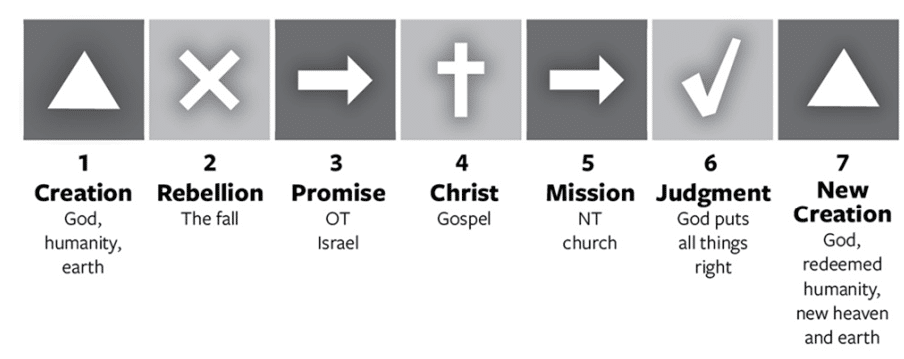
Figure 14.1 – The Seven Acts of the Biblical Drama from Christopher J.H. Wright’s, The Great Story and the Great Commission (© Baker Academic, 2023). Used with permission.
According to Wright’s explanation, act 1 at the left hand of the diagram represents Creation; it constitutes the “good beginning” to the biblical story in Genesis 1–2. The triangular symbol indicating this act visualizes a three-way relationship between God, the earth, and humanity. Wright emphasizes the controlling interpretive importance of act 1, writing: “It is important to take this first act of the Bible very seriously, as the foundation of all the rest.”[vi]
Notably, act 7 at the right hand of the diagram repeats the same image. Wright explains this visual reiteration: “If we don’t have a strong grasp of the creational beginning of the story and all that it means for human life, societies, and cultures, we will not have a good understanding of the goal of the rest of the story or of its wonderful ending in the new creation.”[vii] Stated differently: act 1 is not just the starting condition or set-up of God’s story. Its role is much more substantive: it provides the benchmark toward which God seeks to restore creation – to accomplish a “factory reset,” so to speak.
The standard narrative thus resembles a U-shape; the end is a return to the beginning. The Dutch mission worker Edjan Westerman describes it this way: “Scripture, interpreted from this traditional canonical perspective, hinges on the first chapters of Genesis, and because of this on the restoration of God’s original intentions.”[viii]
The Disposability of Israel
The second act in the sevenfold drama of Scripture is, according to Wright’s diagram, Rebellion, or the Fall. This event occurs in Genesis 3, though its effects spiral out in Genesis 4–11. Human disobedience disrupts each part in the original triangular relationship between God, creation, and humankind. Genesis 11 is the lowest point in the story, “what seems like a dead end.” [ix]
But then God reveals a counter-initiative. In Genesis 12, God promises descendants and a homeland to the man, Abraham. God also announces the divine purpose to bless all nations in (or through) him. This is act 3, which Wright captions Promise. Fittingly, he designates it with an arrow pointing rightward. Even though God’s promise faces toward the future, act 1 (Creation) continues to guide and govern the plot, including this episode. As Wright writes: “what we need to see is how this Abrahamic promise that drives act 3, and indeed the rest of the biblical drama, is connected to act 1.”[x] God’s promises to Abraham concerning his descendants and his homeland are only a miniature and microcosm of God’s original creational intention for all humans and the whole earth.
Wright thereby instrumentalizes the election of Israel. The nation that descended from Abraham and the land that they inherited are turned into waypoints in God’s larger purpose that reaches beyond them. Wright spells this out explicitly and repeatedly: “Out of all nations on earth, God created and called one, Israel, to be the means of bringing blessing to the rest.”[xi] Or again: “Israel is only there because God has plans for the whole earth and all nations.”[xii] If this means-to-an-end framing were not clear enough, Wright repurposes the famous verse from John’s gospel: “God so loved the world that he chose Abraham and created Israel.”[xiii]
Wright takes God’s promise to bless all nations through Abraham as a basic charter for mission. The promise in Genesis 12:3 is “a fundamental declaration of God’s intention, the agenda for the mission of God for the rest of human history.”[xiv] Indeed: “the mission of God is … simply God keeping his promise to Abraham.”[xv] God’s mission is, on this standard telling, also therefore basically instrumental and reparative: God summons Abraham and summons all subsequent agents of blessing in order to return creation to its original good condition. That is the mission of God: repair (“to rid his whole creation of evil”[xvi]). Mission work, too, is a means to an end, accelerating the sliding motion on the U-shape of God’s story.
But instrumentalizing Israel has the effect of making Israel disposable. This can be seen in several dimensions. First, it makes Israel hermeneutically “indecisive.”[xvii] As the theologian Kendall Soulen observes, the standard canonical narrative places certain episodes of the Bible in the interpretive foreground. Specific chapters emerge as focal points: in the Old Testament, these are preeminently Genesis 1–2 and Genesis 12. The vast remainder of Old Testament material “recedes into the background of the standard canonical narrative.”[xviii] The result is, as Soulen says, a commonplace “leap” in Christian rehearsals of God’s story: from Genesis 1–3 with its arc of Creation and Fall straight to the New Testament “interpreted as God’s deliverance of humankind from the fall through Jesus Christ.”[xix]
Christopher Wright notices this same leap. He identifies a “biblical deficiency of some evangelical traditions” such that they “‘jump’ … from Genesis 3 (the fall, act 2) straight to Jesus and the cross (the climax of act 4), as if nothing in act 3 (the largest part of the Bible!) is of any relevance to understanding or explaining ‘the gospel.’”[xx] Yet Wright’s own framework makes this jump inevitable. Wright may personally love and value the “narratives, laws, songs, and prophecies [of the Old Testament],” but the effect of loading all of them into act 3, the promise of God to bless all nations, makes it structurally impossible for them to contribute more robustly. The reader already knows the essential contours of God’s identity and God’s purpose; the exodus, the tabernacle, the monarchy, the exile, all these other Old Testament passages can only offer lessons auxiliary to Genesis 1–3 and Genesis 12.
The second implication of instrumentalizing Israel’s election expands on the first: if most of the Old Testament is hermeneutically indecisive, even interpretively disposable, then Israel itself is also disposable. On Wright’s telling, “the promise of the Old Testament comes to fulfillment when Jesus of Nazareth is born … acts 1–3 point toward what God accomplished in act 4.”[xxi]
But as Edwin van Driel notes, “if Israel were only elected for the sake of a larger goal, the grounds for this relationship disappear as soon as the goal is reached.”[xxii] Once Israel’s job is done, their standing before God becomes obsolete, even if Abraham’s descendants persist as the Jewish people down through history. This obsolescence of God’s covenant relationship with Israel is exactly what Christian theology has historically taught. Called “supersessionism,” this teaching has supported Christian persecution of Jews.[xxiii]
Making Israel disposable in these ways has further, negative missiological consequences.[xxiv] It undermines our Christian profession of God’s faithfulness. How can we say to retired missionaries that God treasures them even when their health fails, their capacities diminish, and their usefulness recedes – given this way of telling Israel’s election? How can we support the disability community if our story of Israel is so conditioned by their usefulness to God’s mission? How can we relate non-extractively to the earth if God relates in this way to Israel? More than that: how can we invite outsiders to trust this God – a God who calls Israel God’s firstborn son (Exodus 4:22) but then treats that son as a means to an end?[xxv]
Thankfully such a God is not at all the one whom Scripture attests! God set divine love on Israel not “because they were more numerous than other peoples, for they were the fewest of all peoples. But it was because the Lord loved them and kept the oath he swore to their ancestors” (Deuteronomy 7:7–8, adapt.). This is a beautiful tautology – the Lord loved them because he loved them. The Old Testament also frequently depicts God’s relationship with Israel through other non-instrumental metaphors such as marriage, betrothal, and friendship.[xxvi] Far from being disposable, the New Testament affirms that God’s covenant with Israel is “irrevocable” (Romans 11:29).
The Disposability of the Incarnation
The standard canonical narrative supposedly centers on Jesus Christ. This can be seen in Christopher Wright’s diagram, where Christ, act 4 of the biblical drama, sits visually in the middle. Despite this presentation, however, Christ’s incarnation, life and ministry, death, resurrection, and ascension all structurally answer to God’s prior goal of restoring creation to its original condition. As with the calling of Israel, the enfleshment of the eternal Son is, on the standard telling, instrumental and reparative. The Son comes to “to rid his whole creation of evil.”[xxvii] Indeed one might go so far as to say that the incarnation is an “emergency measure”[xxviii] occasioned by the human rebellion in act 3 and oriented toward act 7, the new creation. The biblical story retains its basic U-shape. Far from orbiting around Jesus Christ, the standard narrative places him in an ellipse around creation. Christ wins the decisive victory over sin and evil; he accomplishes, at least anticipatorily, the “factory reset” of creation back to its good, primordial state.
Just as in the case of Israel, so also with Jesus Christ: the effect of casting him as a contributor (even the pivotal contributor) to a story whose essential coordinates come from outside him is to render Christ hermeneutically “indecisive.”[xxix] Act 1, Creation, governs and norms Jesus’s ministry.
He may be the “Word of God,” as John’s gospel confesses (John 1), but in fact, his is a word in support of God’s prior word, expressed more fully in creation at the beginning. He may declare himself “Alpha and the Omega, the First and the Last, the Beginning and the End” (Revelation 22:13), but actually, his career stands between a different beginning and end, namely creation and new creation. The evangelical theologian Oliver O’Donovan understands even the resurrection of Jesus from the dead as “the confirmation of the [old] world-order God has made.”[xxx] Christ corrects and confirms creation.
The standard narrative thus makes the incarnation interpretively secondary. One hesitates to say disposable, but the effect is similar to that of the Old Testament: the reader already knows the essential contours of God’s identity and God’s purpose on the basis of Genesis 1–2. The content of Christ’s incarnation is auxiliary.
As odd and perhaps impious as it sounds, this hermeneutical disposability opens the way for another and more radical disposability. Orthodox Christians by definition affirm the divinity of Christ. But if the incarnation of the Son is truly an “emergency measure” occasioned by human rebellion, then, having achieved its goal of restoring creation, it becomes unnecessary – even obsolete. The Dutch theologian Arnold A. van Ruler supplies a provocative example of this reasoning. According to one summary of van Ruler:
God did not create the world for the sake of the incarnation, but the other way round: Christ’s salvation has been accomplished in order that the creation may exist before God. Van Ruler considers the incarnation to be God’s temporary measure to rescue his creation from sin, evil and corruption. In his eschatological kingdom, the incarnation will be abolished.[xxxi]
In other words, “the eternal Son of God took on human nature in the incarnation as a reaction to human sin [and] this human nature will be laid aside in the eschaton when sin, death and guilt have been destroyed.”[xxxii] This is, as van Ruler admits, a “revolutionary innovation in Christian belief,”[xxxiii] and it certainly goes beyond what Wright or other biblical theologians of mission claim.[xxxiv] But it is consistent with their instrumentalizing of the incarnation within the story of God’s mission. The instrumental logic it follows is the same.
Such instrumentalizing bears immense missiological consequences. It curtails God’s faithfulness, making it retractable. If the Son of God drew near to us in his incarnation only to complete a certain term-limited job, and then once that task is complete, he rescinds that nearness – does this not undercut all our Christian conviction about God’s desire to establish fellowship with us – his creatures? Did Christ come only to save us, such that, once we are saved and restored, the basis of our relationship with him becomes obsolete?
A Better Telling of God’s Story
A better telling of the story of God’s mission renounces both these forms of disposability thinking. Instead of an instrumental view of Christ, it takes departure from exactly the possibility that van Ruler opposed: it asserts that God did create the world for the sake of the incarnation. As Colossians 1:16 says, “All things were created through him and for him” (emphasis mine; Greek: eis auton). Far from being an ad hoc emergency measure, God’s mission from eternity was to draw close to creatures in the person of the Son. Sin and evil interrupted and complicated this venture! and the coming of the Son has the effect of “rid[ding] creation of evil.”[xxxv] But the raison d’être of incarnation is not repair but communion.
If this be so, act 1, Creation, is not (in Wright’s words) “the foundation of all the rest.”[xxxvi] Creation is good – but it is not yet complete in Genesis 1–2. Rather, creation does not reach its fullness until later in the biblical story. It is, in Kendall Soulen’s phrase, a “creation-for-consummation”: God intended from eternity to grow and develop the world from its initial good condition, to prepare it to be a home for God’s own presence (i.e., its consummation).[xxxvii] Visually, we might reconfigure Wright’s diagram so that Christ is in the furthest left-hand corner, since he is the beginning, the Archē (Colossians 1:18). This results not in a U-shaped story but rather a diagonal: the end surpasses the beginning.
Instead of being an auxiliary word in service to a yet more original or primary word (namely, Creation), this better telling of God’s mission story can more fully confess that Christ is truly and fully the Word of God, the “exact representation of [God’s] being” (Hebrews 1:3). Christ is the benchmark: the measure of God’s will is not Genesis 1–2, but rather, the incarnate Son. Creation refracts and anticipates him, not the other way around. So, too, Christ is the definitive image of God, and humans are made after his likeness (Colossians 1:15). As such, he is unsurpassable within God’s economy. There can be no completion of a term-limited job. Abolition of his incarnation is impossible.
A better telling might also reconsider the election of Israel. Israel is not “there because God has plans for the whole earth and all nations.”[xxxviii] Rather, as the medieval Jewish commentator Rashi said it, “God created the heavens and the earth for the sake of Israel.”[xxxix] Instead of being a means to an end beyond it, Israel embodies God’s plan from everlasting. God’s glory indwelt the Tabernacle at the center of the Pentateuch; Israel is thus embedded within God’s “creation-for-consummation,” integral to God’s mission of making creation a home for God’s own presence. On such a recalibrated telling, no danger of obsolescence hangs over Israel’s status.
Much remains to be said about this better telling of God’s mission story. Where Israel might fit on a revised version of Wright’s diagram is difficult to discern: some Christian theologians who are attentive to the irrevocability of God’s covenant would keep Israel in the third and promissory position after Christ, Creation, and Rebellion.[xl] Others would place Israel in second place, following Christ but before the Fall.[xli]
Regardless, a better telling means that mission, too, loses its instrumental and reparative profile. Mission is not time-limited, an endeavor that will end when God renews the earth. It is, rather, an ongoing invitation to draw near to God because God has already drawn decisively near to us in Christ. Finally, this better telling allows us to reclaim God’s faithfulness beyond instrumentality. We can say a hearty, “NO: God does NOT use us and cast us away.” God desires fellowship with us whether we are old and gray-haired, faithless or faithful, productive or fallow.

Collin Cornell (collincornell@fuller.edu), PhD, is assistant professor of Bible and mission at Fuller Theological Seminary. He teaches in Old Testament and missiological hermeneutics at Fuller Seminary’s Texas campus. His research includes the history of religions and biblical theology, including biblical theology of mission.
[i] See, for example, Norman Wirzba, This Sacred Life: Humanity’s Place in a Wounded World (Cambridge: Cambridge University Press, 2021).
[ii] The language of “standard canonical narrative” comes from R. Kendall Soulen, The God of Israel and Christian Theology (Minneapolis: Fortress Press, 1996). Other biblical theologies of mission that follow the same plotline as Wright include Arthur Glasser (Announcing the Kingdom), Michael W.Goheen (A Light to the Nations), and Brad Kelle (Telling the Old Testament Story) – among many others.
[iii] Christopher J.H. Wright, The Great Story and the Great Commission, Acadia Studies in Bible and Theology (Grand Rapids: Baker Academic, 2023), 13.
[iv] Wright, Great Story, 14. Wright also concedes that the Bible contains material that is not narrative at all, such as wisdom literature, psalms, or the New Testament letters.
[v] Wright, Great Story, 15–16.
[vi] Wright, Great Story, 18.
[vii] Wright, Great Story, 18.
[viii] Edjan Westerman, Learning Messiah, Israel and the Nations: Learning to Read God’s Way Anew (Eugene, Oregon: Wipf & Stock, 2018), §13.7. Westerman was a Dutch pastor and former staff worker for the International Fellowship of Evangelical Students.
[ix] Wright, Great Story, 21.
[x] Wright, Great Story, 23.
[xi] Wright, Great Story, 23.
[xii] Wright, Great Story, 24.
[xiii] Wright, Great Story, 25.
[xiv] Wright, Great Story, 22.
[xv] Wright, Great Story, 25.
[xvi] Wright, Great Story, xiii.
[xvii] Soulen, God of Israel, 31.
[xviii] Soulen, God of Israel, 32.
[xix] Soulen, God of Israel, 32.
[xx] Wright, Great Story, 55–56n10.
[xxi] Wright, Great Story, 27.
[xxii] Edwin Chr. van Driel, “Incarnation and Israel: A Supralapsarian Account of Israel’s Chosenness,” Modern Theology 39 (2023): 7.
[xxiii] R. Kendall Soulen, “Supersessionism,” in A Dictionary of Jewish-Christian Relations, ed. Edward Kessler and Neil Wenborn (Cambridge: Cambridge University Press, 2005), 413–414.
[xxiv] A critique I owe to R. Kendall Soulen, “Why Did God Choose the Jews?” in Irrevocable: The Name of God and the Unity of the Christian Bible (Minneapolis: Fortress Press, 2022), 82.
[xxv] Wright brings up his own sons in a very confusing example on Great Story, 24.
[xxvi] See van Driel, “Incarnation and Israel,” 7.
[xxvii] Wright, Great Story, xiii.
[xxviii] Westerman, Learning Messiah, §13.7.
[xxix] Soulen, God of Israel, 31.
[xxx] Oliver O’Donovan, Resurrection and Moral Order: An Outline for Evangelical Ethics (Leicester: InterVarsity, 1986), 14.
[xxxi] My italics. Quotation taken from Adriaan van der Dussen, “The Creator Blasphemed? A Critical Analysis of Van Ruler’s Rejection of Augustine’s Use of the Distinction uti and frui,” NTT Journal for Theology and the Study of Religion 73 (2019): 273. Edjan Westerman first alerted me to the significance of van Ruler (Learning Messiah, §13.7).
[xxxii] Garth Hodnett, “A.A. van Ruler’s idea of the ‘messianic intermezzo’ and its implications for understanding the Old Testament,” unpublished study, p. 1, https://www.academia.edu/38227199/A_A_van_Rulers_idea_of_the_messianic_intermezzo_and_its_implications_for_understanding_the_Old_Testament.
[xxxiii] Quoted in van der Dussen, “The Creator Blasphemed?” 273n43.
[xxxiv] See note 2 above.
[xxxv] Wright, Great Story, xiii.
[xxxvi] Wright, Great Story, 18.
[xxxvii] On this theme, see now Miroslav Volf and Ryan McAnnally-Linz, The Home of God: A Brief Story of Everything, Theology for the Life of the World (Grand Rapids: Brazos, 2022).
[xxxviii] Wright, Great Story, 24.
[xxxix] Quoted in Paul M. van Buren, A Theology of the Jewish-Christian Reality, Part II: A Christian Theology of the People Israel (San Francisco: Harper&Row, 1987), 54.
[xl] R. Kendall Soulen, “Israel and the Nations in the Time of Preparation,” in Covenant and the People of God: Essays in Honor of Mark S. Kinzer, ed. Jonathan Kaplan, Jennifer M. Rosner, David J. Rudolph (Eugene: Pickwick, 2023), forthcoming.
[xli] van Driel, “Incarnation and Israel”; Westerman, “Presence and Involvement: The Pre-incarnate Messiah in the History of Israel,” Kesher 41 (2022), https://www.kesherjournal.com/article/presence-and-involvement-the-pre-incarnate-messiah-in-the-history-of-israel/.
EMQ, Volume 60, Issue 1. Copyright © 2024 by Missio Nexus. All rights reserved. Not to be reproduced or copied in any form without written permission from Missio Nexus. Email: EMQ@MissioNexus.org.




