EMQ » October–December 2022 » Volume 58 Issue 4
Cross-cultural Work
Teams working in cross-cultural contexts face formidable challenges. The balanced framework provides focus areas to help leaders and teams thrive, achieve mission, sustain their efforts and see vision realized.
By Tim Crouch with Mark and Cinda Wood
Working as teams in cross-cultural contexts is a difficult and complex task. Team leaders must strive to balance relationships, competencies, and structures to help members thrive and lead their teams to achieve mission, sustain efforts, and see vision realized. What do leaders and teams need to give themselves to realize fruitful leadership and ministry in these complex times? To answer this question, I am proposing a multi-dimensional, interconnected model known as the balanced framework.
I have served as a local leader, a regional leader, and now as leader of our mission. Over time, as I looked around at our teams throughout the world, my first thought was that everyone leads in a different way. However, as I continued to study the situation, I observed that there were three central focus areas of team leadership consisting of effectiveness, connectedness, and wellness.
These focus areas grow out of an understanding of our identity and the interconnectivity of relationships that I describe as a balanced framework. Leaders and teams are often strongest in one or two areas that become their primary focus. For example, a leader may be very effective in ministry which becomes the defining strength of their team. While this model of leadership is not wrong, it is incomplete. Leaders and teams need to maintain awareness simultaneously in several areas, not just one.
The balanced framework helps to bring awareness and, in turn, establish an organizational culture through which leaders, teams, and team members can develop in each vital area to be fruitful in their ministries.
Figure 12.1 depicts the balanced framework with the areas of effectiveness, wellness, and connectedness.
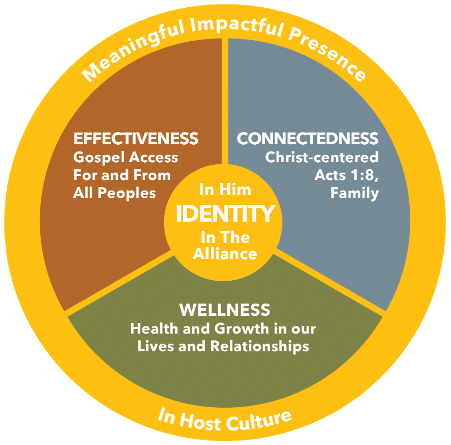
Each of the components of the balanced framework flow from and are tied together through the foundational elements of identity. All of these areas are equally important, though this does not mean a leader or team always spends equal time on each area. A leader or team member may focus more on connectedness on home assignment and less on effectiveness during the same period, for example. Leaders and teams need to balance between a focus on tasks (looking externally) and a focus on the team (looking internally). Both aspects of task and team are needed, like wings on an aircraft, but over-emphasis on one or the other can cause instability and impede purpose.
Foundational Elements of Identity
The foundational elements of the balanced framework focus on three parts of identity for a cross-cultural worker: our identity in the Lord, as an organization; and in our host culture. Our primary identity grows from who we are in the Lord as shown in the center of the diagram. Also central, in the way that it influences the other aspects, is our organizational identity. At the outer rim of the diagram is our identity in host cultures, or meaningful, impactful presence. It may be helpful to imagine the diagram viewed from the top as a cone with the identity elements at the pinnacle supporting and influencing all other spheres.
Our Identity in the Lord
Our identity in the Lord is the core of who we are and everything that we are flows from him. This identity is trinitarian in nature. As followers of Jesus Christ, we are people loved by the Father, saved by the work of Jesus, and empowered by the Holy Spirit. Ministry and our identity begin with who the Lord is and the invitation to abide in him (John 15:4). Abiding in the Lord drives and is the source of ministry. When identity shifts from the Lord at the core of ministry, instead of being service to him, ministry becomes idolatry (1 John 5:21).
Identity in the Lord is essential in calling, preparing to go serve, and ongoing well-being during service. Understanding who we are in the Lord can be distorted through pain and wounding experienced in life. Without healing, life’s wounds, pain, and distorted identity can significantly impact our work and those with whom we work. Conversely, an identity rooted in the Lord, knowing him and being known by him, enables us to endure and walk through the darkest valleys. As we grow in understanding who we are in the Lord, we also grow in self-awareness.
Our Organizational Identity
The second core component of identity, subservient to identity in the Lord, is identity as an organization. Each of our organizations has a unique purpose through which it seeks to serve the kingdom. Leaders and teams serve as primary means to carry out organizational mission and vision, whether a sodality or modality. A balanced framework gives structure to help guide leaders and teams in their purpose but also offers flexibility to be adaptable in specific and various contexts. How do your organization’s mission, vision, and core values shape what you do and how you do it?
Our Identity in Our Host Culture – A Meaningful Impactful Presence
I describe identity in our host culture as a meaningful, impactful presence (MIP), the third part of identity. Each word of this phrase carries a specific meaning in the host culture. A meaningful, impactful presence also draws on who we are in the Lord and as an organization.
Meaningful
Meaningful means the team’s presence must have value in the eyes of the host culture as well as to the local church, if it is established, and to supporting, sending groups. Navigating what is valuable in the eyes of each of these parties can be difficult and requires research and reflection. What the team does should add value to the community as perceived in that community. A team must lean in and listen to the voices of those they seek to serve as well as to their senders.
Impactful
The team’s presence should lead to the transformation of people and communities. People served by the team are impacted by the gospel in word and deed. Being impactful can take time and may be difficult to see, but this also highlights the needs for intentional assessment.
Presence
The team’s presence needs to be established, legal, and sustained in a strategic location. Each ministry location varies but, as much as possible, ministry requires an incarnational presence over a period of time. This means that there must be research to identify, understand, and prepare for the local context prior to a team’s entry and to sustain their presence. Ministry needs to also focus on strategic ministry locations, depending on desired outcomes.
Integration of a Meaningful, Impactful Presence
Teams may face real challenges between having a legal presence and doing ministry in a location. Meaningful, impactful presence (MIP) seeks to avoid the tension of a bifurcated existence between gaining access in a legal existence and doing ministry. This tension can create a significant level of stress in a team and can lead to a shortened team life due to burnout or other factors. The desire is to integrate the three parts of a MIP in ways that happen simultaneously, rather than compartmentalizing each. The goal is to bring alignment in doing what we say and saying what we do.
Many key skills and abilities are necessary to work in another culture. Language and cultural acumen are just two of these skills. Key questions relating to a host culture are, “Am I knowable?” and “Am I understanding and being understood?”
Growing from and rooted in our identity are the three areas of the balanced framework: effectiveness, connectedness, and wellness. These areas are not listed in any particular order, but each should be seen in balance to the others.
Effectiveness
I define effectiveness as the measured relationship of ministry strategies to desired outcomes. There are two parts in this definition: our goals and our work. Our goals are the desired outcomes we want to see come about. Our work describes the ministry strategies we use to accomplish our desired outcomes. Effectiveness occurs through a cyclical action-reflection process that is led by the Holy Spirit. This process is broken down into five steps:
- reflect
- plan
- work
- evaluate
- repeat
Step 1 – Reflect
It is important that we take time away to listen to the Holy Spirit. This is necessary not just for leaders but for the whole team. Just as Jesus took time to be alone from his work, we also need to step away to hear the still, small voice of the Spirit. This may take the form of retreats that lead to a team meeting and sharing what the Spirit is saying. Hearing from the Holy Spirit encourages us to listen to all the parties around us, individually and corporately, including teammates, national partners, and other stakeholders. It is important during this phase that we articulate what we are hearing and write it down. This is a great opportunity for creative expression, as well.
Step 2 – Plan
Planning takes what we are hearing from the Holy Spirit and applies it to our context, establishing goals and strategies as effective means to achieve desired outcomes. The adage is applied here, “Plan your work and work your plan.”
Planning requires a personal and broad knowledge of the team and the context in which a team works, and a deep toolbox of effective strategies. Key strategic questions can be of great assistance in good planning. For instance, what are the individual gifts, skills, and abilities of your teammates? How are their language skills and cultural acumen? What are their complementary strengths to achieve a common goal? What strategies best fit the context? There are many effective methods of doing strategic planning but one of the most strategic things you can do is to plan. Develop a sound, agreed-upon strategy for the team.
Step 3 – Work
It is essential that teams be able to execute and bring plans into reality. In the process of working, a team may find that its plans need to be adjusted to accomplish the goal. During this period, coaching is an invaluable help. Coaching may come from multiple directions, from a team leader or a teammate, peer to peer, or by an outside coach to assist in meeting team goals. Plans need to be implemented.
Step 4 – Evaluate
Evaluation is a process by which we measure how effective our planning and work are and take appropriate steps to adjust as needed. Thorough evaluation should take various forms and cover different spans of time. Evaluation can be informal and formal. A team meeting with individual check-ins and project updates is one type of informal evaluation. Annual personal growth plans, peer assessments, project assessments, and strategic reviews conducted by members outside of the team are more formal established types of evaluation. All of these formats are helpful to gain self-awareness and to move toward mastery in skills and abilities. Evaluations will also help to reveal what resourcing would be beneficial to teams and team members.
Step 5 – Repeat
The reflection-action cycle of effective planning is a spiral that moves forward. Each step informs the next as the team moves forward to accomplish desired outcomes. Teams are also at the mercy of visas, furloughs, and even pandemics, among multiple other factors impacting outcomes. In this current climate, the action-reflection cycle may be shortened.
Effectiveness is the relationship between desired outcomes and strategies used to accomplish outcomes. The work of international workers is not ours alone but depends on connectedness and partnership with supporters and those in our host culture.
Connectedness
Connectedness describes the networking investments necessary for sent ones and kingdom collaborators to engage in ministry. Although there is a vast network and web of relations in ministry, the balanced framework focuses on two aspects, connectedness to sending churches and others at home and connectedness in the host culture where we serve.
Connectedness to Sending Churches and Groups
Our ministry cross-culturally extends and empowers sending churches, donors, and stakeholders. In return we have an accountability to these groups, inviting them to partner with us in what God is doing. This is a mutually beneficial relationship that can be expressed in many ways.
Two areas to pay attention to in our connectedness to sending churches and groups are self-awareness and other-awareness. Both orientations, self and other awareness, are best evaluated through reflective questions. Self-awareness regarding our connectedness to sending churches and groups asks, “How well am I known in the groups I am sharing with?” How open are you as a worker to sharing about your life as well as ministry? Do you share not just the high points but also the low points of your time on the field? Do you and the church/group view yourselves as interdependent?
The second area, other-awareness asks, “How aware am I of what is happening in this church and how can I support them?” Are you praying for the church, its leaders, and members on a regular basis? Are you building a relationship or just viewing them as a source of funding? Special encounters through strategic prayer, short-term trips to the field, and speaking events enable sent ones to deepen these relationships. Other-awareness also is the opportunity to improve by asking questions such as, “How can I better share with you what we are experiencing?” and “How can I better pray and support you in what God is doing in your ministry?”
Connectedness in Our Host Culture
Connectedness in our host culture focuses on the people that we seek to serve and other organizations serving in the same context. Self and other awareness are also important in these areas. “How well do I know the language and culture?” is an other-awareness question. An example of self-awareness would be, “How approachable am I and open to being known by those I seek to serve?”
Ministry and mission requires synergistic partnerships so the accomplishment of God’s mission is not entrusted to a single group or organization but to all of us who serve with different gifts and callings. How connected and aware are you of other groups serving in your context? To what extent are you seeking to partner for kingdom synergy?
Ministry follows the lines of relationship. A focus on connectedness recognizes the essential need to invest in healthy growing relationships with our senders and those to whom we are sent.
Wellness
Wellness refers to spiritual growth, personal health, and solid resources for well-being that empower leaders and team members to grow capacity and competencies for work. Wellness is holistic, embracing the entire person. If one part of a person is not healthy, it impacts all of the person (1 Corinthians 12:26).
Spiritual Growth
Ministry flows out of the fullness of abiding in the Lord. However, if we are not careful, these springs can run dry and the struggles of working cross-culturally become magnified. A seasoned worker shared that when the spring runs dry the weaknesses of our flesh are like tinder ready to catch any spark of the enemy.
Spiritual growth is directly connected back to our identity in the Lord. Others can help us remember and refresh ourselves. Regular retreats, times of prayer, and worship help us find our rhythms of abiding in him.
Personal Health and Well Being
The global pandemic has brought renewed focus on the need for holistic well-being. Working from one side of the world with the other by electronic connection makes it difficult to know when work stops. A healthy lifestyle and developing margin are good practices, but what happens when they are not in balance?
Resources for Well-Being
A sign of well-being is that workers can take care of themselves. However, there are times when intervention is needed. Developing an active and recognized member care resource is essential. Member care seeks to assist in the following three approaches.
- Preventative and Restorative: The best way to be healthy is to stay healthy. Member care seeks to enable well-being through preventative measures such as the Cerny-Smith Stress test to better understand what level of stress workers are facing. A regular cycle of vacation, unplugging, reconnecting, and retreats help workers to continue ministry in healthy ways.
- Organic and Organized Member: care seeks to encourage practices and pursuits that workers develop organically on their own and provide some measure of organized opportunities as well. These may range from books, to webinars, to coaching opportunities.
- Access and Choice: Autonomy of worker needs to be a central consideration enabling wellness. Educating through awareness and clearly communicating options allows access to various levels of intervention but also provides for autonomy through a range of choices and accessible safe people. One size does not fit all.
Wellness is the desired state of health and growth of teammates, families, and leaders that allows service for the gospel to flow out of realities of the gospel. Wellness is holistic, addressing the whole person and community.
Conclusion
The balanced framework is a concept to keep vital areas in focus for flourishing in cross-cultural ministry. It flows from identity that draws us to the areas of effectiveness, connectedness, and wellness. The framework also seeks to bring into balance a focus on team and a focus on task, holding both of these in unison. While this is a concept that is very much wet cement for us, it is something that I believe is important for mission leaders serving globally. It is my hope that sharing this will start a conversation which provides constructive feedback.

Tim Crouch (crouchc@cmalliance.org), DMin, serves as the vice president for Alliance Missions for the Christian and Missionary Alliance. He and his wife, Shelly, previously served as Alliance international workers in Russia and in regional leadership. Tim’s heart is to see Alliance Missions help make gospel access available for the peoples who lack it. He and Shelly reside in Columbus, Ohio. They have four grown children.

Mark Wood (mark@mongoliawoods.com), PhD, and Cinda Wood (cinda@mongoliawoods.com), MA, have served in Mongolia with the Christian and Missionary Alliance since 2008. They currently serve in leadership at Kingdom Leadership Training Center in Darkhan, Mongolia seeking to equip women and men throughout Mongolia to serve the kingdom. Cinda and Mark both graduated in 2020 from Biola University, Cook School of Intercultural Studies with a PhD and master’s, respectively. They have two children – Annika and Toby.
EMQ, Volume 58, Issue 2. Copyright © 2022 by Missio Nexus. All rights reserved. Not to be reproduced or copied in any form without written permission from Missio Nexus. Email: EMQ@MissioNexus.org.