EMQ » October–December 2022 » Volume 58 Issue 4
Transforming Disability
To what degree has society’s frame of reference on disability shaped the Church, ministries, and perceptions of who is or isn’t qualified for mission? How do we move people with disabilities from recipients to participants in God’s Mission?
By John Trotter
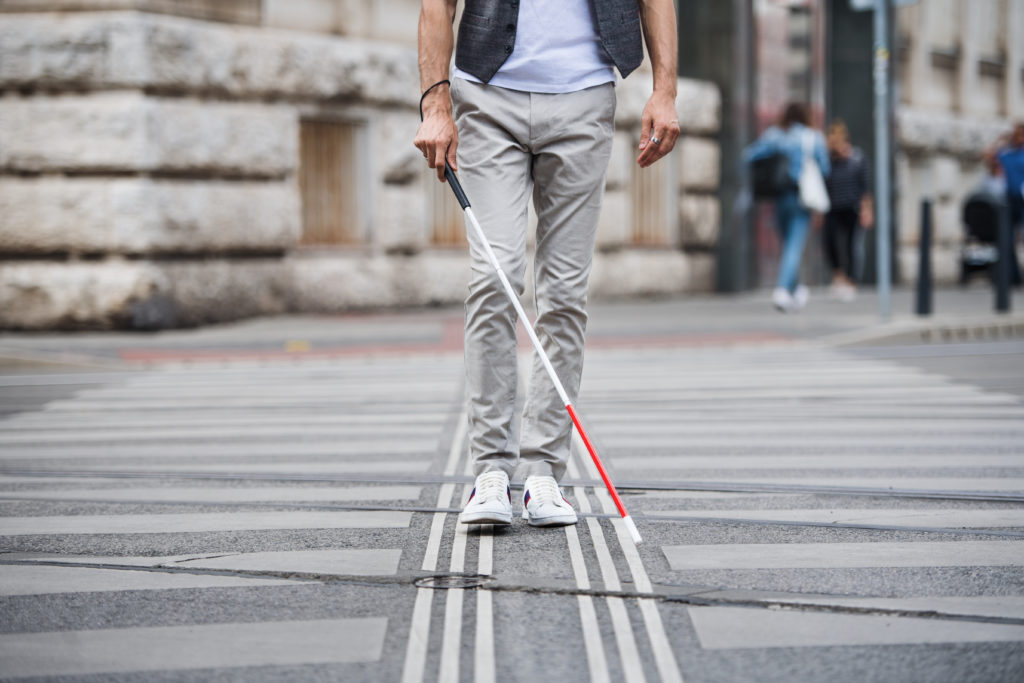
Several years ago, I began to progressively lose my eyesight. It led to blindness. My missionary service in Nepal became overshadowed by the broader society’s perception of what the blind should or should not do. People regularly attempted to carry me as I walked down the road, questioned me about whether God cursed me in a former life or if I had bad karma, or advised me on medical treatment. When I received a call that my mom had died of a sudden heart attack, the weight felt insurmountable.
A few weeks after the funeral, I entered the parking lot of our family’s church in the US using my white cane per usual. A zealous man and his wife (who I later learned were first time visitors) called out to me from about fifteen feet away, “Sir excuse me, can I pray for you?”
Of course, if you were me, you would know that this is a common occurrence. The cane is not just a symbol of blindness or independence, but for many Christians it is a symbol that my body is not fully abled. Satan has robbed me of the full life God intended. This was almost stated verbatim by the man in the parking lot when he prayed for me despite my reluctance to engage.
I looked at him after he finished and said, “I need to say something, and I hope it helps you in the future. I love Jesus. He made me how he wanted to make me, and I love who I am. I am a blind missionary from South Asia who has a robust theology of disability. God’s power is made perfect in weakness. We live in a broken world, and I am weary. Many people are weary of Christians feeling a deep need for our healing because we carry a white cane representing our disability. You need to be careful, my friend, and understand that this is the life we lead.”
He responded by quoting John 10:10 that the thief has come to steal, kill, and destroy but God has come to bring life. His entire frame of reference for persons with disabilities (or PWDs) equated disability with Satanic bondage.
The man in the parking lot is not representative of all Christ followers’ perceptions on disability, but his sentiments do represent a lens that many have in understanding the issue. To be fair, much progress has been made by the broader society concerning disability, inclusion, and accessibility. We are much farther along than we once were, but to what degree has society’s frame of reference on disability shaped the Church, ministries, and perceptions of who is or isn’t qualified for mission?
Theologian Dr. Amos Yong has argued that it is in fact not disability itself that proposes the largest barrier for PWDs, but the social repercussions that occur from ablest and normalization bias.[1] The Church would like to think that they have made a marked imprint on society but perhaps the reverse is truer. Heal the blind. Cure the sick. Watch the immobile take up their mats and walk. Such stories fill the pages of the Gospels and such narratives have become foundational to our Christian faith.
In missions, PWDs are typically put in two categories.
- Category 1: people that need healing
- Category 2: people with whom we need to walk in their suffering
At best those with disabilities have been viewed as recipients of mission, not participants. At worst, those with disabilities can be made out to believe they need to be fixed before they can be accepted by society or other believers.
Frames of Reference on Disability
A certain representation of believers sees the Bible, and thus missions activity among PWDs, as having a timeless principle that all with disabilities should be healed or cured. Others have looked to the Acts 2 discourse as being a place where all people and all senses, exemplified by all languages, are transformed by the power of the Spirit. They make much less of human weakness and focus more on God’s power despite disability.[2]
Still others have pointed out that Scripture seems to speak negatively of those with physical disabilities, using physical disability as a negative attribute to overcome even to the extent of barring off PWDs from the presence of God (Leviticus 21:16–21, John 12:40, 2 Corinthians 4:4). With such a broad spectrum of theological interpretation, disability, and missions, at their best, have a confused relationship.
Nancy Eiesland, speaking on behalf of those with physical disabilities, illuminates the tension: “As long as disability is addressed in terms of the themes of sin-disability conflation, virtuous suffering, or charitable action, it will be seen primarily as a fate to be avoided, a tragedy to be explained, or a cause to be championed rather than an ordinary life to be lived.”[3]
To exacerbate the issue, missionaries are supposed to be tough pioneers, ducking in and out of homes in rugged terrain, ready to trek through a jungle on a dime – the stereotypes could continue. Somewhere in the midst of all this is a person with a disability who has been called by God and who desires to take the gospel to the world. They may or may not be healed in this life. They may not even be sure what to do with the healing narratives of the gospel. Still, the Lord has called. Where do they go from here?
There are several frames of reference when it comes to dealing with disability on the mission field. If we are going to do mission with persons with disabilities it is important to understand the starting point of the discussion because we cannot assume that anyone is on the same page. We are not. Over the last 30 years a branch of theology – disability theology – has emerged that has examined some of the models of disability to help us understand how faith interacts with disability.
Disability Models
- Medical: The medical model of disability seeks a bodily cure, fixing the body, or medicine to normalize PWDs. Sociologically, a medical model of disability places the able-bodied healer in control, and reciprocity is non-existent; the PWD is a burden to be lifted.[4] The ultimate goal and best way forward under this model is normalization.
- Social: The social model values PWDs accepting their disability as part of their identity and progressing on in society. It seeks to include PWDs in societal and religious life rather than focusing on cures, healing, and medical betterment.
- Cultural: The cultural model of disability looks at how a particular culture in a specific time interprets disability. Dr. Louise Gosbell explains: “The cultural model promotes disability not as a static, unchanging global phenomenon, but rather, disability is experienced, represented, and interpreted differently across various cultures and historical periods.”[5]
Expecting divine healing as the primary goal in working with PWDs roots itself in a medical model. Coming alongside the disabled in compassionate ministry assumes a more social model. Understanding how a particular culture views PWDs in light of the biblical frame of reference would favor a more cultural model.
Traditionally, most have assumed that Christ and biblical times did indeed follow the healing/medical cure line of thinking. Theologian Roji George, however, makes a direct correlation between bodily healing and social inclusion of PWDs in Christ’s ministry. George argues that in Christ’s healing the bodies of those on the margins, he restored those with disabilities to a newfound place in society. Due to how interconnected kinship was in first century Palestine, Christ’s healing those with disabilities resulted in restoration of entire societies.
The notion is that disability was focused not so much upon individual disadvantage but on societal participation. In Christ inviting the crippled, lame, and the blind to the banquet table in Luke 14, he seems to be subverting the traditional view of the disabled in placing them as honored guests in his kingdom.[6] Christ’s radical welcome of PWDs and the frame presented by George on the communal aspect of healing conflates the social and medical models through which many have explained disability.
To go further, through the life of Jesus and his ministry, social and cultural models are all smashed together, erecting a new frame of reference on disability. Christ spoke very specifically to the culture of the day not merely to cure people who were disabled and ostracized from society, but he interacted with the culture in such a relevant way that it led to societal transformation.
Each culture and time period brings a frame of reference to how they understand disability, and they often insert that into the biblical narrative. Almost always, in our contemporary time we run to the extreme of medical or social models to try to wade through the gauntlet. Christ, however, smashed these models all together and was not so concerned about transforming one life but transforming entire communities.
Kingdom Imagination
So what does all this mean? It means that we need a kingdom imagination when it comes to seeing PWDs released in missions. At some level if we seek to engage and empower PWDs to do mission we have to start looking at the communal aspect instead of solely the individual. This inevitably requires interdependence of the whole body of Christ working together. Joni Eareckson Tada summarizes the issue well and gives a clarion call to the Church:
“Herein lies the problem with the mission movement. We are inclined to assess our performance to the standards of the secular world. This success-oriented approach can cause us to squeeze our potential missionaries into rigid molds in which they have to be intelligent, strong, agile, to have high energy: the type A personality. This can mean that the mission movement selects only missionaries who have certain personality types, or alternatively it can tend to squeeze people who are different shapes into the same mold. When applying the world’s standard of success we therefore discount people who are different, who can’t be squashed into an ableist mold. Almost by definition people with disability will not fit into an ableist mold, nor should they…. I appeal to leaders in agencies and denominations to consider… selecting and training qualified people with disabilities for mission work.”[7]
We can’t unknow what we know. We know that Christ transformed frames on disability. We know he flipped societies upside down. We know that the Lord has given the Great Commission to the whole body. Our frames of reference must expand to include a kingdom vision. In doing so, we bump up against society’s definition of ability. Marginalization is complex and the thousands of years of injustice that got us to this point are a tall order to confront.
Social Issues
Jesus flipped the kingdom of this world upside down when he came to earth. While onlookers largely dismissed those with disabilities, he came and mystified existing models of disability, reorienting the way society thought about persons with disabilities (PWDs). We are clearly not living in first century Palestine, and the reference point for Americans dealing with disability is 2,000 years removed from the biblical text. To think about doing missions with PWDs, we have to understand what has transpired.
Though talks of access, equal opportunity, and social justice are common discussion in American society today, this is a recent phenomenon. In modern times, it seems that society, not the Church, has led the way in the inclusion of PWDs. There is no doubt that all spheres, religious or secular, have had difficulty welcoming PWDs to the table. However, few have begun the conversation of empowering them into the mission of God.
In the big picture, little time has passed since marginalization was the lot for all who were born with a disability. During the 1920s and 1930s, PWDs were a mocking source of entertainment, being considered for elimination from society and, at best, hidden away. However, by 1970, legislature was making accommodations in education and work life for them; by 1971, all disabled Americans had a right to free public education.[8] The shift was rapid, and though progress has been made, employability for PWDs has not kept pace with legislative reform.
The mantra of the Disability Rights Movement in the United States has been “nothing about us without us,” stating that PWDs would no longer stand idly while others made decisions for them.[9] PWDs grew weary of losing repeatedly when they were left out of the conversation. The reaction was rugged individualism and independence. The independent living movement started in the late ’60s and early ’70s in the United States which created a paradigm shift in how Americans viewed PWDs and how PWDs viewed themselves. Dependence was cast down and independence replaced it.
This radical ethos of independence has so dominated discussion around disability that little space has been left for interdependence. Cultures all around the world still have a strong practice of collectivism and interdependence, but much of the foundation of the Disability Rights Movement was built upon rugged American individualism.
While PWDs became more educated, employable, and self-sufficient, little space was given to mutuality. This ethos of independence travelled well in the United States with its high importance on individuality but hasn’t worked well in some of the world’s warmer cultures that emphasize collectivism. Independence is not culturally nor biblically the goal in releasing PWDs into mission.
From Independence to the Mission of God
If mission agencies originating in the West carry this same mantra “nothing about us without us,” what will come of the body of Christ metaphor in 1 Corinthians 12? Where is the interdependence of the Trinity God in such a paradigm? Will mission agencies simply mirror the kingdom of this world in their ethos or is there a different way?
The challenge is before us. Mission agencies can get everything right with all their inclusive practices, empower PWDs, even have a robust biblical basis for all they do. However, the halt comes when missionaries with disabilities land in a new culture with very different reference points on disability. How will they be received? Will they be able to cope with the differing perspectives on disability that may not be favorable to them? Can mission organizations do anything to prepare PWDs and walk them through the cultural adaptation on disability that is inevitable? The complexity grows.
The Whole Gospel from the Whole Church to the Whole World
Years of marginalization will not disappear overnight. Frames of reference on disability vary as time and culture varies. There needs to be something rooted in God that brings clarity to all the complexity.
The first chapter of the biblical text records the plurality of the godhead and reveals his intentions for his people. “Then God said, ‘Let us make mankind in our image, in our likeness so that they may rule over the fish of the sea and the birds of the sky, over the livestock and all the wild animals and over all the creatures that move along the ground.’ So God created mankind in his own image. In the image of God he created them; male and female he created them,” (Genesis 1:26–28). God is love and that love cannot be experienced without relational community.[10] Within one chapter of the biblical record, the Disability Rights Movement ethos of independence and rugged American individualism is questioned.
The interdependent nature of God himself cannot be overstated. God is God only in relationship; He cannot exist outside of that. People, regardless of their ability, reflect God to the world. This, in a nutshell, is what missions is designed to do – to see heaven and earth collide, shining forth the beauty of our trinity God to everyone.
Biblical Foundations of Interdependence
Perhaps no text in Scripture more clearly spells out the place of weakness in the body of Christ than Paul’s letter to the Corinthians in chapter 12. Considering the elitism and division taking place, his words on the body as a unit are profound.
Rick Langer delineates five keys from this text if unpresentable parts is read from a disability perspective:
- PWDs are indispensable to the body of Christ (v. 21–22)
- PWDs are honored, not just tolerated (v. 23–24)
- PWDs are accommodated (v. 23)
- PWDs are placed in the body by God (v. 24)
- PWDs are to contribute to unity, not division (v. 25)[11]
Langer places PWDs in a special role in the body of Christ and doesn’t merely allow for their participation or inclusion. They are an integral part to the mission of God.
Jeff McNair further articulates what it is to understand the indispensable parts of the body of Christ. “It is arguable that only the development of relationships will lead to shared power. Entering relationship implies relinquishing one’s own power and allowing others to have power. It is through relationship that people who are indispensable express their indispensable nature.”[12]
The trinity God is the perfect example of interdependence. The Church, God’s people called out to display Christ to the world, are to be interdependent in their expression of God’s message and mission.
The facts are before us. How will we respond? How will the mission of God no longer relegate PWDs only to receive compassion and ministry in missions? Will we join dozens of others in local churches and mission agencies who have decided that in our day, in this generation, we will be known for our interdependence of the whole body? The frames of reference and models of disability were smashed together by Christ to institute a new kingdom way. We have waded through hundreds of years of marginalization to get to this point. The whole gospel, from the whole body to the whole world. This is our time!

John Trotter (johntrotter1@fuller.edu) is lead teacher at Global Frontier Missions in Atlanta and a doctoral student at Fuller Theological Seminary writing on disability missiology. He has served in the areas of church planting, community development, and education for 20 years in South and Southeast Asia and amongst the Asian and African diaspora in the US.
[1] Amos Yong, The Bible, Disability, and the Church: A New Vision of the People of God (Grand Rapids, MI: Eerdmans Press, 2011).
[2] Amos Yong, “Many Tongues, Many Senses: Pentecost, the Body Politic, and the Redemption of Disability,” Pneuma 31, no. 2 (2009).
[3] Nancy L. Eiesland, The Disabled God: Toward A Liberatory Theology of Disability (Nashville, TN: Abbington Press, 1994), 73.
[4] Thomas Reynolds, Vulnerable Communion: A Theology of Community and Hospitality (Grand Rapids, MI: Baker Books, 2008), 25.
[5] Louise Gosbell, The Poor, the Crippled, the Blind and the Lame: Physical and Sensory Disabilities in the Gospels of the New Testament (Sydney, Australia: MacQueary University, 2015), 125.
[6] Roji T. George, “Disabled Jesus: Reading Jesus, His Mission, and the Community from a Disabled Perspective,” Bangalore Theological Forum 2019, 355.
[7] Joni Eareckson, foreword to Disability in Missions (Peabody, MA: Hendrickson Publishers, 2018), Kindle Location 146–47.
[8] Paul Jaeger and Cynthia Bowman, Understanding Disability (Westport, CT: Praeger Publishers, 2005), 39.
[9] Joseph P. Shapiro, No Pity: People with Disabilities Forging a New Civil Rights Movement (New York: Three Rivers Press, 1994).
[10] Enoch Wan and John P. Penman, “The Trinity: A Model for Partnership in Christian Missions,” Global Missiology 3, no. 7 (April 2010), http://ojs.globalmissiology.org/index.php/english/article/view/138/397.
[11] Rick Langer, “The Body, the Gifts, and Disabilities: A Look at 1 Corinthians 12,” EFCA Today Summer 2011, accessed June 1, 2021, https://www.efcatoday.org/story/body-gifts-and-disabilities.
[12] Jeff McNair, “The Power of Those Who Seem Weaker: People with Disabilities in the Church” Journal of the Christian Institute on Disability 3, no. 1 (2014): 93–108, https://journal.joniandfriends.org/index.php/jcid/article/view/77.
EMQ, Volume 58, Issue 2. Copyright © 2022 by Missio Nexus. All rights reserved. Not to be reproduced or copied in any form without written permission from Missio Nexus. Email: EMQ@MissioNexus.org.