
EMQ » July–September 2021 » Volume 57 Issue 3
By Kimberly Drage
Since the 1960s the mission world has intentionally sought to understand and actively support the well-being of missionaries. This interest has led to the development of research, conferences and essentially, an entire profession which we know as member care.[1] In surveying the research on member care and missionary well-being, it is worth noting that well-being for missionaries is often framed in terms of external stresses from cross-cultural living or the internal psychological needs of individual missionaries. Yet, when you venture outside the world of missions, there is a strong body of evidence within both psychology and management research pointing to the role organizations themselves play in contributing to the well-being of their members.[2] This research study sought to take a deeper look at the influence mission organizations have on the well-being of those serving within them.
Methodology
The question guiding this project was, “What is the role of organizations in missionary well-being?” To answer this question, I conducted in-depth, semi-structured interviews with eight missionaries actively serving in Africa, Asia, or Europe. Each missionary was affiliated with a different organization.
Qualitative methodologies provided a capacity for engaging the varied and complex ways missionaries made sense of their interactions with their organizations and how those engagements influenced them. This is helpful for developing a richer understanding of the qualities revealed in the data as opposed to measuring them.[3] Qualitative methods also provided the capacity to consider interrelated and dynamic contributions to particular phenomena.[4] In this way, discovery could take place at the level of organizational systems and interrelated processes rather than being limited to isolated phenomena. In addition, the inductive logic of qualitative methodologies allowed for the discovery of new concepts that had not previously been acknowledged.[5]
Operating on the assumption that any individual could encounter positive and negative experiences within their organization, I gave each participant the opportunity to answer questions related to a time when they liked their work and a time when they did not like their work. They also provided a self-report of their energy level during the reported time period.
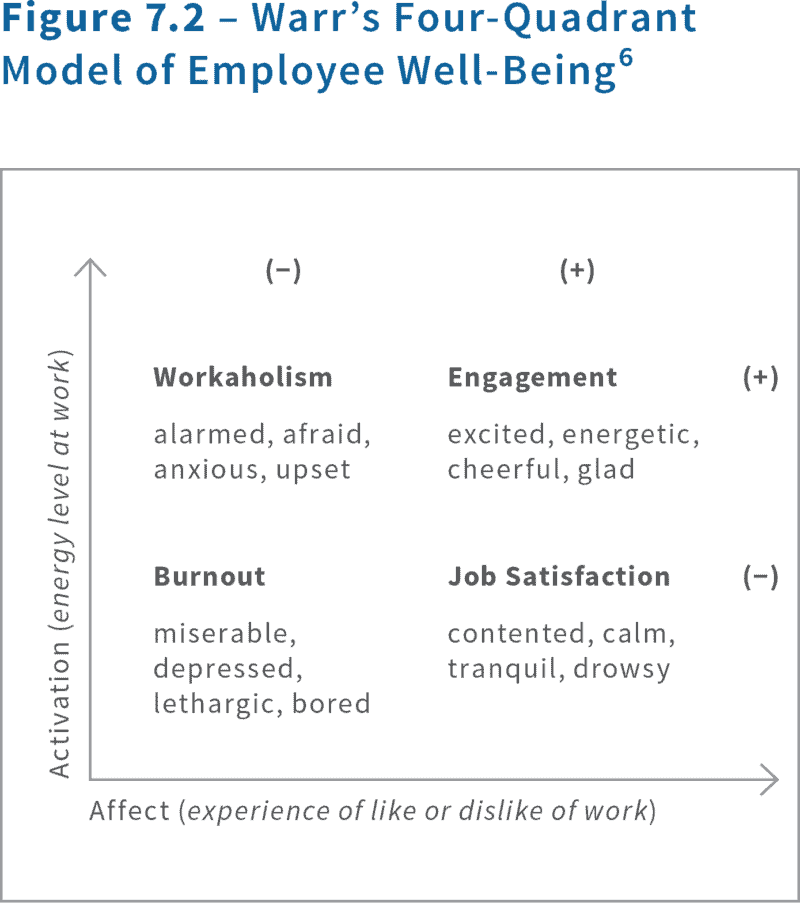
All interviews were recorded, transcribed, and designated with a well-being category based on Warr’s model of employee well-being using self-reported affect (like or dislike) and activation (energy) levels. These four categories: Workaholism, Burnout, Engagement and Job Satisfaction were used to help understand participant experiences during the reported time period (see figure 7.2)[6].
Beyond this initial well-being designation, I systematically coded the interviews using the Gioia method, which uses the language of participants to create coding structures.[7] Finally, I analyzed the coded data aiming specifically to explore themes and patterns related to the role organizations played in the well-being of those interviewed.
Results
When interviewing was complete, there were sixteen reported time periods. Using Warr’s model, I associated eight with engagement, seven with burnout and one with workaholism. There were no reported instances of job satisfaction. Early on in my analysis, it became clear that organizational influences had the capacity to be both positive and negative regardless of the well-being category designated to that the time period. I described these organizational roles in participants’ stories as: well-being enhancing, well-being neutral and well-being diminishing.
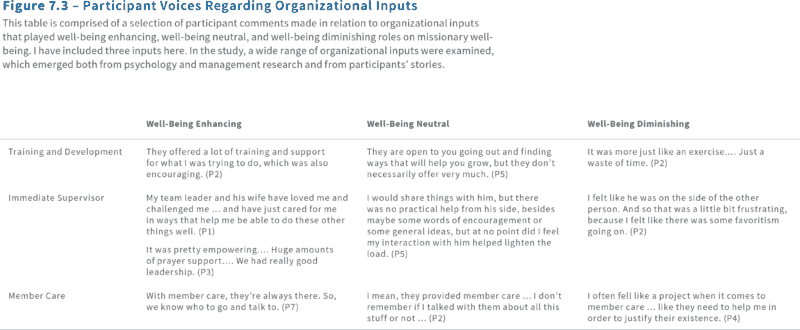
Designation of well-being enhancing and well-being diminishing roles was based on my interpretation of participants’ framing of organizational engagements as either increasing or decreasing what they liked (affect) or their energy (activation) during the reported time period. Well-being neutral engagements were those that were mentioned but did not clearly influence what they liked or their energy or were expressed with ambivalence from participants. Within this framework, I examined characteristics of organizational inputs that emerged from the data and how they were perceived as influencing well-being (see figure 7.3).
Mission Organizations Played a Key Role in Missionary Well-Being
The first question I sought to answer from the data was whether or not organizations did influence well-being. My analysis resulted in a clear “yes.” In eleven out of sixteen reported time periods, respondents indicated that their organizations played a direct role in what made that time likable or unlikable.
At the same time, experience of the organization was often divided between field representatives and the broader organization (team level vs. home office). For example, there were instances where the local team played a well-being enhancing role for the missionary while the broader organization played a well-being diminishing role and vice versa.
Due to the central role of member care in promoting well-being, it is important to note that even member care could be well-being diminishing depending on how it was offered and perceived by missionaries. Other prominent organizational influences on well-being included engagement from immediate supervisors and the amount of freedom (work autonomy) organizations gave to missionaries in designing and carrying out their work.
Engagement with Immediate Supervisors and Well-Being
The data clearly showed that the role of immediate supervisor is significant for missionary well-being. For one participant, engagement of the entire organization was expressed almost exclusively through his relationship with his immediate supervisor, highlighting how influential this relationship can be in the mission context.
In terms of well-being, every participant reported positive experiences with an immediate supervisor during the reported time period when they liked their work. Six out of eight reported time periods characterized by dislike of work were directly influenced by the organization. In every one of these situations, the immediate supervisor played a key role either through their absence, through poor leadership, or, in one case, through the support they offered in that difficult season.
Leadership absence resulting from organizational transition or regular home assignments played a significant role for four participants in the time period when they disliked their work. For two of these participants, the source of dislike of their work was the result of feeling unsupported while they were placed in leadership roles. As one respondent who had been assigned to a temporary leadership role commented when describing the organization, he said:
The word absent comes to mind. They kind of put me in this spot because they needed a body, but they weren’t very helpful in equipping me or helping me do the job very well.
When I asked how this absence was for him, he responded:
Yeah (laughter) it was terrible. Uh, it was really discouraging. I mean it led to feelings of burnout. It led to a period of depression as well … just feeling alone and pretty helpless.
This suggests that lack of support for field-level leaders not only has well-being implications for the people being led, but also for under-supported leaders themselves.
Work Autonomy and Well-Being
Work autonomy or the freedom for missionaries to shape their work was also a significant factor in the well-being of missionaries in this study. For seven out of eight participants, autonomy in determining their work contributed to the enjoyment of the time period associated with engagement. Freedom granted by organizations allowed participants to fulfill a sense of calling or vocation through their work. As one respondent commented after describing the collaborative process of designing her role:
I feel like it’s an entire integration of who I’ve been created to be and how I best thrive in serving others … I feel that I’m thriving best because I’m using the gifts and abilities that I’m really gifted at.
At the same time, as noted in the section on immediate supervisors, participant experiences also showed instances where too much autonomy was perceived as an absence of support and was diminishing for well-being.
This variation in experiences related to autonomy highlights the tension organizations face in providing both autonomy and support to missionaries.
Conclusion
In examining the characteristics of organizational roles that were perceived as well-being enhancing, the theme of connectedness emerged for me. Organizations that were able to connect with the needs of missionaries could provide, adjust, or reduce engagements so they were not impeding work autonomy. In this way, they were able to play a role that felt supportive to missionary aims and thus, enhanced well-being.
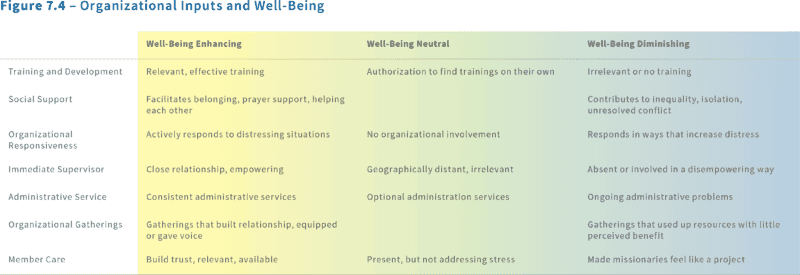
Correspondingly, when looking at well-being diminishing roles, the theme of disconnection emerged. Rather than being seen as supportive by participants, these organizational engagements came across as irrelevant or costly (taking resources away from the work); were experienced as detrimental to missionaries themselves; or were simply absent and, in this way, decreased well-being. Well-being neutral roles were engagements that were mentioned, but missionaries did not clearly link them to their energy levels or enjoyment of work. These inputs were characterized by low organizational involvement (see figure 7.4)
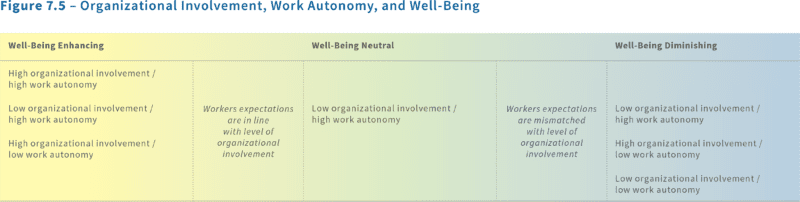
Considering the role of expectations may be one way to understand more fully well-being neutral inputs where participants expressed ambivalence. When the level of organizational support (high or low) is aligned with worker expectations, we can anticipate a perceived well-being enhancing role. Similarly, we can anticipate that mismatches of expectations and level of support will be perceived as well-being diminishing. For example, an organization that provides no training and development might be perceived as supporting work autonomy and thus enhancing well-being in a context where the worker has expectations of low-involvement. However, a worker with an expectation of high-involvement might perceive no organized training and development as a lack of support (see figure 7.5).
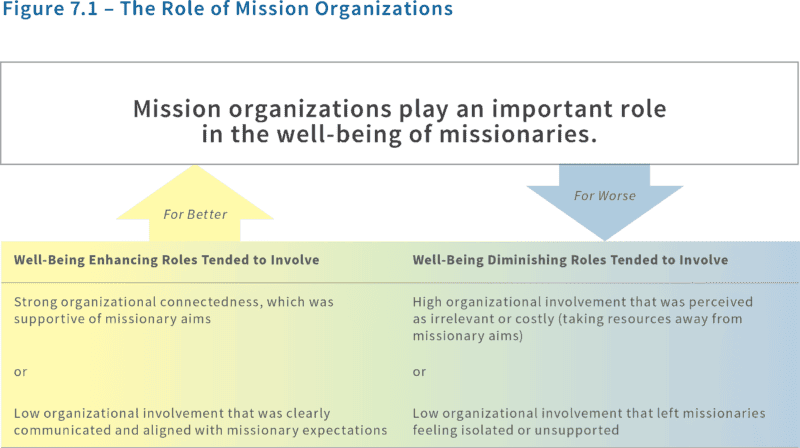
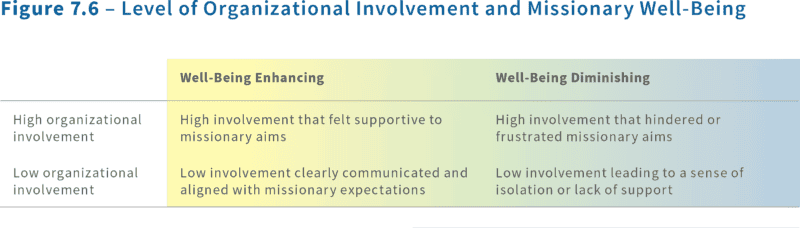
In summary, mission organizations do have the capacity to influence missionaries by carrying out well-being enhancing, well-being neutral, and well-being diminishing roles. For participants in this study, well-being enhancing roles tended to involve high organizational involvement coupled with strong organizational connectedness, which was perceived as supportive of missionary aims or low organizational involvement that was clearly communicated and aligned with missionary expectations. Well-being diminishing roles tended to involve high organization involvement that was perceived as irrelevant or costly (taking resources away from missionary aims) or low organizational involvement that left missionaries feeling isolated or unsupported (see figure 7.6).
Recommendations
The findings of this study suggest that organizations themselves do have the capacity to play key roles in the well-being of their members. Since improving well-being has implications for both individuals and the work at hand, there is much to be gained from investments of time and intention in increasing the well-being enhancing engagements of organizations. With this in mind, I offer the following recommendations for organizations:
Choose a High- or Low-Involvement Approach
Based on the findings of this research, the first step for organizations in increasing their capacity to positively influence well-being is to choose the level of involvement the organization is committed to and has the capacity for.
Is your organization aiming for a high-involvement or low-involvement approach to engaging members?
Organizations taking a low-involvement approach should be intentional about communication, establishing clear expectations about the support that will and will not be provided, and how members can access support when they need it. In addition, it is important that these organizations focus on recruiting new members for whom low organizational involvement is a good fit. In other words, they are onboarding people who are capable of handling high levels of work autonomy. In addition, it will be important for these organizations to consider the implications of any organizational decisions or policies in terms of maintaining low-involvement and creating space for high missionary autonomy.
If an organization chooses a high involvement approach to management, they should invest in the development of a people management strategy that nurtures connectedness with their members in ways that are fitting for their organizational capacities, context, and culture. Initially, this approach will require investment of resources aimed at assessing current management practices and their perceived influence on members in order to identify strengths and weaknesses in terms of connectedness, paying attention to how different points of organizational involvement may be experienced differently. From there, organizations can develop an appropriate long-term strategy for maintaining connectedness with their members. This will likely include investments in creating avenues for employee voice, leadership development, and training at all levels related to the high involvement culture they are seeking to create. Organizations may also want to look for examples of organizations that are maintaining connectedness well to learn from them.
Support the Critical Role of Immediate Supervisors
I recommend that mission organizations support the key role immediate supervisors play for the well-being of their members. This starts with on-going intentional investment in effective leadership that is in line with the organization’s management strategy.
Leaders need training and resourcing so they can carry out the role effectively, which has well-being implications both for themselves and for those they are supporting.
Mission organizations should also take care to manage planned leaves of absence (home assignment / organizational transition) to ensure that qualified leaders are in place to cover any leadership gaps. Extra support should be given to any temporary leaders who are inexperienced in leadership who have been assigned to these roles.
Finally, mission organizations should invest in on-going leadership training, recognizing emerging leaders and preparing them for potential future roles. This would not only create a pool of qualified leaders when positions become available, but also create a trained pool of employees to cover both planned and unplanned leadership gaps.
Kimberly Drage is an Organizational Consultant and Coach with SentWell, an organization committed to holistic care for cross-cultural workers. Through her experience serving on the field for eleven years and her research in Human Resource Management, Kimberly has developed a passion for care for cross-cultural ministers from a systemic-organizational perspective.
EMQ, Volume 57, Issue 3. Copyright © 2021 by Missio Nexus. All rights reserved. Not to be reproduced or copied in any form without written permission from Missio Nexus. Email: EMQ@MissioNexus.org.
[1] Kelly O’Donnell, “The Missional Heart of Member Care,” International Bulletin of Missionary Research 39, no. 2 (April 2015): 91–96.
[2] Cynthia D. Fisher. “Happiness at Work,” International Journal of Management Reviews 12, no. 4 (2010): 384–412, https://doi.org/10.1111/j.1468-2370.2009.00270.x. Matthew J. Grawitch, Melanie Gottschalk, and David C. Munz, “The Path to a Healthy Workplace: A Critical Review Linking Healthy Workplace Practices, Employee Well-Being, and Organizational Improvements,” Consulting Psychology Journal: Practice and Research 58, no. 3 (2006): 129–47, https://doi.org/10.1037/1065-9293.58.3.129. Christopher P. Parker et al., “Relationships Between Psychological Climate Perceptions and Work Outcomes: A Meta-Analytic Review,” Journal of Organizational Behavior 24, no. 4 (2003): 389–416. J.N. Kurtessis et al., “Perceived Organizational Support: A Meta-Analytic Evaluation of Organizational Support Theory,” Journal of Management 43, no. 6 (2017): 1854–84, https://doi.org/10.1177/0149206315575554. Linda Rhoades and Robert Eisenberger, “Perceived Organizational Support: A Review of the Literature,” Journal of Applied Psychology 87, no. 4 (2002): 698–714, https://doi.org/10.1037/0021-9010.87.4.698.
[3] Norman K. Denzin and Yvonna S. Lincoln, eds., Handbook of Qualitative Research, 2nd ed. (London: Sage Publications, 2000).
[4] Michael Quinn Patton, How to Use Qualitative Methods in Evaluation (Los Angeles, CA: Sage Publications, 1987).
[5] Dennis A. Gioia, Kevin G. Corley, and Aimee L. Hamilton, “Seeking Qualitative Rigor in Inductive Research: Notes on the Gioia Methodology,” Organizational Research Methods 16, no. 1 (July 24, 2012): 15–31, https://doi.org/10.1177/1094428112452151.
[6] Peter Warr, Work, Happiness, and Unhappiness (New York: Routledge, 2007). Anne Mäkikangas et al., “The Longitudinal Development of Employee Well-Being: A Systematic Review,” Work & Stress 30, no. 1 (January 2, 2016): 46–70, https://doi.org/10.1080/02678373.2015.1126870.
[7] Gioia, Corley, and Hamilton, “Seeking Qualitative Rigor,” 15.




