EMQ » July–September 2021 » Volume 57 Issue 3
By Simone Mulieri Twibell
At its most fundamental level, missiology simply refers to the study of mission. This basic understanding, however, invites further reflection. What and whose mission ought to be studied? What methods, academic disciplines, and tools must be employed in such a study? Inevitably, other questions beckon to be included in the discussion. Is there an essential core that pertains only to missiology that is not shared by other disciplines? What are missiology’s primary concerns? What are the goals and purpose of missiology? This article seeks to address these pertinent issues by offering a few insights from both a biblical and academic reflection.
Mission and Missions
Johannes Verkuyl’s understanding of the all-encompassing role of missiology reveals the enormity of its task and the often dichotomized nature of its work. In Verkuyl’s words,
Missiology is the study of the salvation activities of the Father, Son, and Holy Spirit throughout the world geared toward bringing the Kingdom of God into existence. Seen in this perspective missiology is the study of the worldwide church’s divine mandate to be ready to serve this God who is aiming his saving acts toward this world.[1]
Scherer also proposes a definition of missiology by considering its comprehensive task:
Missiology’s primary task is the study of the mission of the Triune God, and within that of the mission of Jesus, the apostles, the church(es), and the mission-sending bodies. This means that missiology is the study of God’s mission everywhere in all six continents, from everywhere to everywhere…[2]
Both Verkuyl’s and Scherer’s assumptions show that the task of missiology encompasses two clear dimensions of study: the activity of God and the activity of the church. Both dimensions clearly overlap yet are not well defined. Thus, as a starting point, it will be helpful to provide a distinction between the activity of God, which I simply refer to as mission, and the activity of the church, identified as missions. In this light, mission refers to the redemptive purposes and efforts of a sending God who originates and begins all missionary efforts to rescue a people and who, at the same time, promises to culminate his saving initiatives in the world through the establishment of his kingdom in the eschaton. Missions, on the other hand, lies within this bracket of God’s movement (see figure 1.1) and refers to the specific ways in which the Church reflects the life of God in the world and participates in his overarching mission.
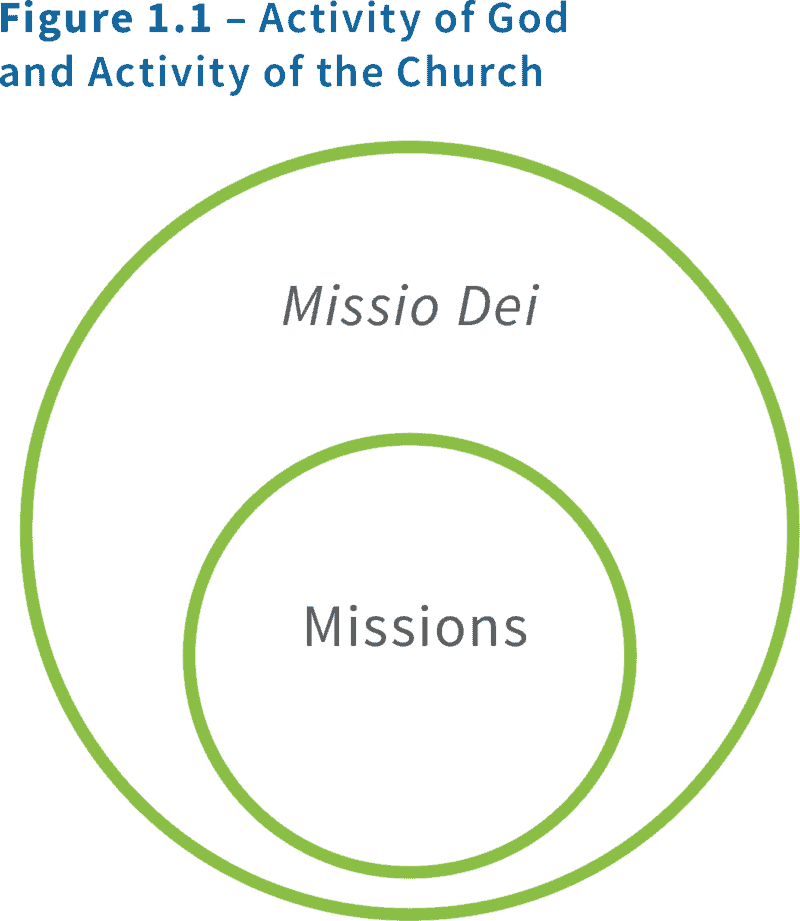
Clearly, missions should not be understood apart from the missio dei. After all,missions lies at the heart of the mission of God because God is both the source and finisher of all missionary activity. Thus, missions must not neglect the purpose or reason for its activity. By placing missions within the missio dei, the movement of the church becomes Theo-centric and participatory in the overall activity of God, which is concerned with redeeming and transforming a people. This interdependence of mission and missions becomes the necessary frame of reference under which missiology must seek to operate.
The biblical conviction that God is active in the world and remains active in human history through the lives of those whom he calls and sends is at the heart of missions. This is the God who called Abraham and sent him to an unknown land, establishing a covenant with him and promising to birth a nation through him. God’s saving works are always universal in dimension but particular in function. The Lausanne Covenant expresses the vision of God’s activity as a circular phenomenon in which God clearly initiates and culminates all missionary activity for his purposes and glory: “(God) has been calling out from the world a people for himself and sending his people back into the world to be his servants … for the extension of his kingdom, the building up of Christ’s body, and the glory of his name.”[3]
If the missio dei is concerned with rescuing and restoring a fallen creation in order to bring glory to God’s name and God calls his church to bear witness to the in-breaking of his kingdom, how do those who have witnessed the new reality of God’s transforming grace partner with God in this adventure? No small number of approaches, methods, and answers has been tailored to fit the needs of this daunting task throughout the history of missions.
When it comes to the manner in which the Church is to engage in this journey, missiologists have often disagreed. Whereas some have placed the emphasis on proclaiming the gospel as a necessary vehicle by which to share God’s redemptive purposes, others have affirmed that it is the world’s sociological needs that must dictate the agenda. These views have often arisen from a truncated understanding of missions. It is in the context of God’s activity within this world that we must understand our task.
Missions, in the words of John Stott, “is not a word for everything the church does.… [but] describes rather everything the church is sent into the world to do.”[4] In other words, just as Christ sends his Church into the world as his Father has sent him, so the church is called to permeate the sullied and tainted fabric of society with the gospel, the good news of salvation. Although this salvation begins with the promise of redemption and restoration, it is not limited to the spiritual dimension. It also shows concern for the physical aspects of life, focusing on bringing justice and reconciliation to the broken systems and relationships within the cosmos. As such, the Church is called to “share his concern for the liberation of men and women from every kind of oppression”[5] as Jesus so vividly demonstrated throughout his earthly ministry.
The mission of God is ultimately his, and we are simply invited to share in and participate in his mission. As Paul Hiebert says, “The history of humankind is first and foremost the story of God’s mission to redeem sinners who seek salvation, the story of Jesus who came as a missionary, and the story of God’s Spirit who works in the hearts of those who hear.”[6] This “unchanged story of what God has done to save the world supremely in the historical events of the life, death, resurrection, and reign of Jesus Christ”[7] is what we call the gospel, a message which must be shared unswervingly with a “fresh telling”[8] amidst every nation, ethnicity, culture, and tongue.
For this reason, two fundamental aspects that cannot be separated lie at the heart of the missionary enterprise: bearing witness to the gospel through proclamation and becoming agents of reconciliation and healing through compassionate ministry. As John Stott again reminds us, loving our neighbor does not refer only to a “bodiless soul that we should love only his soul, nor a soulless body that we should care for its welfare alone.” [9] The gospel, the good news of Jesus Christ’s redemptive activity, reveals the two-fold nature of his all-encompassing mission: the intentional call to personal repentance and a compassionate concern for the tangible needs, both physical and social, of the people.
Needless to say, endless debates have been fomented by partisan and parochial views of the gospel that exalt one of these aspects at the expense of the other. In recent decades, however, Christians have turned to a more robust and comprehensive understanding of missions by accepting the social as well as the evangelistic responsibility of the gospel. Because God sent his Son on a mission to redeem the world, heal broken relationships that sin had tainted, and inaugurate his kingdom, the Church must respond in unison by consistently serving as agents of transformation and healing in a broken, dark, and desperate world, partnering with the Triune God in this mission of rescue and ransom.
Missiology in the Academic World
Missiology, as an academic field, portrays how the Church has furthered the kingdom of God on earth throughout its history and how the Church should continue to participate in missions related activities today. For this reason, adequate reflection necessitates both careful study of the Scriptures and a responsible cultural exegesis. Andrew Wall’s understanding of missiology as “the systematic study of all aspects of mission”[10] underscores an important aspect of missiology as a field of study: it must be faithful to consider “all aspects” of its activity.
According to Skreslet, missiology ought to be understood as an “intersection point among the many disciplines that take an interest in mission-related phenomena.”[11] In this intersection, one must confront two particular questions. First, which fields of study require the closest correlation with missiology? Second, which particular points belong only to missiology that may not be shared as primary concerns by other academic disciplines? As a network of disciplines that interact with each other, missiology must critically reflect upon the nature of its work.
Particularly due to the multidisciplinary nature of this field, Scherer recognizes that “missiology must find a way to be holistic, integrative, inclusive, and complementary to human learning without becoming exhaustive.”[12] In this important undertaking, which fields of knowledge must missiology specifically include? Among the many disciplines from which it draws, biblical studies, Church history, systematic theology, and ethics must be employed in the systematic study of missions. These disciplines will provide a terra firma by which a proper theological understanding may be critically formulated. On the other hand, in order to obtain an informed perspective of the world, the social sciences, with particular emphasis on the fields of cultural anthropology, sociology, psychology, and world religions must be duly emphasized. Doing so will be conducive to a refined appreciation of the importance of adequate cultural analysis in order to remain relevant in a globalized, pluralistic, and culturally-sensitive world.
Because mission truly is now from everywhere to everywhere, and human realities along with their worldviews vary from context to context, the academic disciplines utilized in the study of missiology may also differ depending on the particular setting in which the particular study is executed. For example, whereas philosophy might be a discipline more widely used and, generally speaking, considered pertinent in the West, political science may be a sub-field of the social sciences primarily utilized in the Majority world, where issues of social justice and political activism are more prevalent. But if it is true that missiology draws heavily from so many other disciplines, are there also concerns or particular core elements pertinent primarily to missiology?
As a case for the distinctiveness of missiology as an academic field, Skreslet supplies two central practices that seem to distinguish missiological study from any other type of scholarly activity: the “processes of religious change” and the “reality of faith.”[13] Although I agree with his assessment, I would add a third dimension that has been at the forefront of the missionary enterprise from its inception: “the establishment of healthy and vibrant churches.” These central features have become the bull’s eye which missiologists have sought to target in this “intersection point” where various disciplines meet to dialogue. Needless to say, the shared concern of missiologists in recent years have revolved around cultural factors that have shaped religious affiliation, the ongoing interaction with people from other faiths in the attempt to engage the world dialogically, and the various church-planting efforts around the world in the effort to remain faithful to the Great Commission.
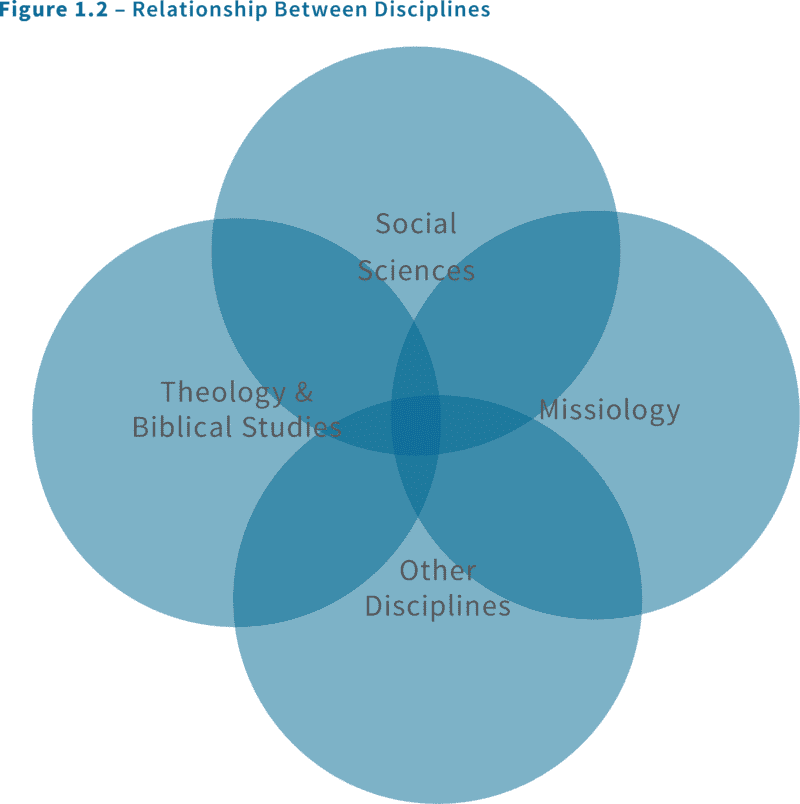
These efforts, however, must not be isolated from the continual need to apply data, methods, and theory derived from all other secondary fields of study. Jenkins, in his seminal work The Next Christendom, points out that most Christians today come from the ranks of the poor, a fact that will continue to be extended into the future.[14] Thus, it becomes of utmost importance that a proper awareness of Christianity’s geographical and numerical expansion be informed not only by the influential and traditional social sciences it has often drawn upon, but also by other disciplines such as economics, education, health sciences, and linguistics. This fact naturally leads to the conclusion that missiology is both a practical and theoretical field, drawing heavily on other subjects and disciplines that may provide insight for better understanding the dynamics and the context in which it seeks to function. Figure 1.2 shows the integrative aspect of missiology as a field of knowledge. Thus, the relationship between missiology, theology, social sciences, and other disciplines.
Upon careful consideration of the interdisciplinary nature of missiology as a field of study, one question seems to remain. Should the primary loyalty of missiology be with the study of mission or with the mission itself? Although a real temptation exists to focus all its energies and strength into developing its role within the academic world, the primary and most fundamental concern of missiology must not be neglected. Calling the Church to participate in the mission of God in the local church through partnerships, networks, and global movements ought to burn within those who study missions and self-identify as missiologists.
Towards a Working Definition
As a dynamic and integral field of study, missiology’s primary purpose centers upon unifying the various elements that have shaped its existence: an unswerving commitment to an appropriate understanding of the Scriptures, the continual engagement with the world in an effort to be relevant with its message, and the relentless duty to reach out to new places with the goal of making disciples of the nations. As a field that studies the expansion and growth of the mission of the Church, missiology’s goal is to interact with other disciplines in order to enlarge its scope of understanding. As a result, the purpose of missiology remains one of integration, seeking to enlighten the understanding of the Scriptures by developing new skills in ministry through careful cultural analysis and its various contextual needs around the world.
With this in mind, I suggest the following working definition of missiology:
Missiology is the systematic study of the activity of the Church, guided by the activity of the Triune God, facilitating the understanding of the world which continually seeks to engage, reach, and transform with the good news of Jesus Christ through a multidisciplinary and integrative approach.
Simone Mulieri Twibell, PhD (Trinity International University), currently serves as Assistant Professor of Intercultural Studies at Olivet Nazarene University. Prior to this assignment she served as senior pastor at churches in Kentucky and Illinois and volunteered as a short-term missionary in Central America.
EMQ, Volume 57, Issue 3. Copyright © 2021 by Missio Nexus. All rights reserved. Not to be reproduced or copied in any form without written permission from Missio Nexus. Email: EMQ@MissioNexus.org.
[1] James A. Scherer, “Missiology as a Discipline and What It Includes,” Missiology: An International Review 15, No. 4 (1987): 512.
[2] Scherer, “Missiology as a Discipline,” 520.
[3] The Lausanne Covenant, paragraph 1.
[4] John Stott, Christian Mission in the Modern World (Downers Grove: IVP Books, 1975), 48.
[5] The Lausanne Covenant, paragraph 5.
[6] Paul Hiebert, Anthropological Insights for Missionaries (Grand Rapids: Baker Books, 1985), 17.
[7] Cape Town Commitment, 170.
[8] Cape Town Commitment, 170.
[9] John Stott, Christian Mission, 47.
[10] Stanley H. Skreslet, Comprehending Mission: The Questions, Methods, Themes, Problems, and Prospects of Missiology (New York: Orbis Books, 2012), 12.
[11] Skreslet, Comprehending Mission, 12.
[12] Sherer, “Missiology as a Discipline,” 514.
[13] Sherer, “Missiology as a Discipline,” 13.
[14] Philip Jenkins, The Next Christendom (Oxford: Oxford University Press, 2011), 2.