EMQ » April–June 2021 » Volume 57 Issue 2
By Frank Preston
This article will discuss the reconfiguring of two anchors of the missions effort that have been entwined since Luke’s recording of the Acts of the Apostles: media and disciple making movements.[1]
What is Media to Movements?
Media to Movements is a strategy that uses specific media content tailored for select audiences in order to identify seekers from unreached people groups and then invite those seekers into a seeker-to-conversion process. The operative word is to identify, not to persuade, with the ultimate goal of seeing seekers become reproducing disciples.
Scholars note that there are two general approaches to using media in outreach. One approach is called push media, in which media products are used to persuade the media consumer to adopt an idea put forth by the media provider. The second approach is called pull media, in which media products are used to identify people who have a proclivity toward the message that is provided by media provider.[2] Hence, by definition, Media to Movements takes a pull strategy – communicating to people who are already open for religious change. The strategy is comprehensive with church planting movements as the long-term outcome. The strategy is grounded in a model reflected in Luke 10:2 of praying that God will identify people from within the unreached group – persons of peace – who will carry the gospel to others within the unreached group.
Media in Church Planting
I have often enjoyed asking small groups to provide ideas of how media was used in the initial stages of the expansion of the gospel in the early church. Most often I hear things like “the writing of the books of the New Testament.” This is not surprising because we have a literate bias – we have an affinity to words on paper. It is generally agreed that James, the earliest New Testament book, was written in AD 50, followed by Paul’s Epistles beginning in AD 52. But the Acts 2 Pentecost occurred around AD 30, some twenty years before the book of James. So, more precisely, the first use of media in the early church was the public forum with Peter in Acts 2:14, then later Stephen in Acts 6:9, and as illustrated in Act 17:2 when Paul was speaking in synagogues and in 17:16 when he joined meetings of gentiles in various places.
Scholars note that Paul’s missionary efforts followed the main Roman roads to start the first churches and then spread to other nearby regions. Acts 19 is an example of this, starting with Ephesus and then radiating out from there. Public speaking was the most noted media in outreach until the advent of the printing press in the mid 1400s. Viggo Sogaard and James Engel[3] document the expansion of broadcast media of radio and television in the twentieth century as a new mode of communication. But as Sogaard notes, the broadcast media approaches were proclamational “one way communication” oriented.[4]
The rise of new media ushered in a revised approach to media consumption. Marshall McLuhan, Dale Eickelman, and Elihu Katz[5] were among many scholars who identified a shift that occurred in communications from strictly persuasion media approaches to what is commonly called a use and gratifications model of media consumption. Generally this use and gratifications model subsumes the idea that people use media for their purposes, and not the other way around. By nature, new media is a two-way communication process that involves interaction and dialogue. But people only have a limited amount of cognitive resources to allocate to new ideas, so most people only consume media that fits their needs. If media producers’ ideas don’t immediately fit a consumer need, the message is tuned out.
The upside to this phenomenon is that if a person is consuming a media message that is unlike their normal media habits, it means they are interested in something different than they normally consume. This may seem simple, but it is a profound observation and adds complexity to developing media strategy. Instead of simply making proclamational content, media producers need to find out a seeker’s needs, then identify those who are consuming the message, and then service the seeker with a process that meets the seeker’s need. The strategy is seeker centric, not media producer centric.
For this reason, a media response system is as important as the message itself. This can be seen in Acts 17:2 in Paul’s ministry. Paul was called by God to proclaim the gospel to the Gentiles, yet in this passage it notes that it “was his custom” to go to synagogues. The genius to this approach can be seen in 17:4 where a large number of “God-fearing” Greeks and prominent women followed Paul for additional discussions and discipleship. Paul, speaking through their public forum, identified which kind of Greeks were more open to the gospel message, and he spoke to their need. He could have chosen to speak at bath houses where far more Greeks would be assembled, but Greeks who were “open for conversion” were in the synagogue. The principle of targeting smaller yet specific audiences who are interested in the message and can be part of a response follow up system (aka follow Paul outside the synagogue) would be more effective than broadcasting to the masses.[6]
Media to Movements in the Current Era
As noted earlier, media in the broadcast era migrated toward proclamational approaches that were one-way communication. With the advent of new media / social media, cracks in persuasion theories became pronounced. Google and Facebook are grounded in use and gratifications theories defined as: people using media to meet their needs. This new era of media forces Christian media providers to retool media to the fit the current era of communications. Yet in many ways we already have historical Christian examples in Acts 17 where using media to identify seekers and then assisting them in their spiritual journey serve as adequate theoretical guides. These are not new concepts for Christian media. Use and gratifications models guided early developers of Media to Movements strategies.
In 2010, armed with the new insights, a North Africa Team with Gospel Ambition (pseud) and a Pioneers/Beyond/Mitra Asia collaboration in South East Asia launched Media to Movements approaches in their respective areas. Both teams tried separate strategies, shared information, and began building best practices. Other individuals and organizations such as Frontiers, Arab World Media, Visual Story, Mobile Ministry Forum, and a host of other like-minded coworkers joined in the development of the concepts, some doing training, others experimenting.
In 2020, a survey was sent to over six hundred field workers who had taken one or more of the Media to Movements trainings.[7] Sixty-two percent who took training did so because they desired to see more fruitfulness in their work. The research noted that of those who implemented a Media to Movements approach after their training, “86% of the trainees reported mid-range-or-greater impact on their ministry practice, with 24% reporting very significant changes to our ministry practice.” In North Africa they experienced more national conversions and disciples who make disciples than had been seen in the history of the work there. In the South East Asia experience, initially the team was identifying less than twenty potential persons of peace (PPOPS) per month. Currently the team reports in excess of 115 PPOPS per month. Of the PPOPS on average thirty-eight percent measure long-term growth as disciples, up from seventeen percent in the early days.
Lesson Learned in Media to Movements
Though the Global Survey Report is more comprehensive, this section will offer a few notable observations.
In the article by Dwight McGuire, it was observed that two and a half percent of any population is open for religious change at any time.[8] Though this was based on statistical theory and research on movements by scholars like Everett Rogers,[9] consistent evaluation of data supplied by Media to Movements practitioners to Kavanah Media empirically supports McGuire’s assertation. This observation supports the notion that there are no closed fields, but there are unreached peoples because of the lack of workers.
A principle put forth by Wesley and others drawing from Luke 10:2 is not so much that the laborers are few, but that “from the harvest will come the harvesters” if field workers empower local lay leaders. A characteristic of Disciple Making Movements (DMM) strategy is identifying potential persons of peace and then empowering them to grow as leaders in church planting within their context. This was a clear observation from the study on scripture engagement in Disciple Making Movements.[10]
A second observation is that push media (persuasion media) strategies are no longer effective. Significant numbers of secular scholars have empirically demonstrated this through qualitative and quantitative research. Pull media, media that identifies potential consumers, has a stronger theoretical and practical foundation. One only has to look as far as Amazon, Google, and Facebook to see pull media in action. Media to Movements strategies use pull media principles.
A third and less discussed observation is what in social marketing researchers call low identity conversion as compared to high identity conversion. In its simplest terms, low identity relates to social and cognitive costs as being low in the conversion process. In locations where Christianity is an accepted norm, generally a person can convert to become a real Christian without suffering significant loss. In a sense, becoming a new Christian adds to their identity structure. They are still a member of their society and social group, work their same job, and remain in the same social status.
In high identity conversion, the costs to one’s identity structure is significant. Waardenburg describes Islam as a “signification system” where conversion to another religion would be paramount to social treason.[11] In a high identity conversion process, seekers need to follow “stages, steps and processes” in the conversion process.[12] Reading a gospel presentation on-line and then praying to receive Jesus on-line is a strategy developed generally for western populations but does not transfer to seekers in other religion majority areas. Different strategies and response mechanisms need to be deployed. This is a core principle taught in the Media to Movements training programs, particularly around persona development.
Persona development is involved in the funnel model used by the Media to Movements practitioners. There are several iterations of the funnel model, but all are some adaptation of Wiktorowicz’s model of recruitment of Jihadis, a high identity conversion activity for a Muslim converting to high-risk religious practice among moderate Muslims.[13]
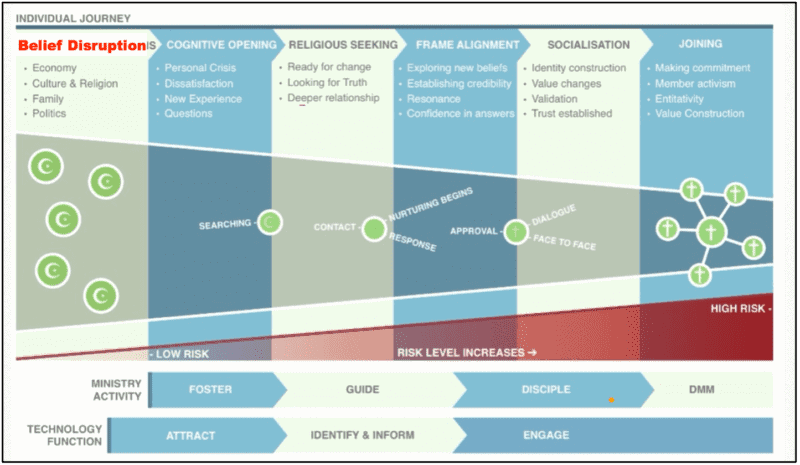
In the model developed by Gospel Ambition and Arab World Media/Pioneers, following Wiktorowicz’s categories, a high identity convert passes through six stages: belief disruption, cognitive opening, religious seeking, frame alignment, socialization, and finally joining.[14]
In the belief disruption stage the seeker has an experience that disrupts their previously held beliefs. This disruption could have come from a myriad of possibilities, but essentially something causes doubt in their belief structure. Normally these occur outside of any activity of an activist and not so much from the influence of a religious worker or religious organization.
This fits most closely to John 6:44 where God uses some means to prompt a seeker to initiate a journey that leads the person to the gospel. This journey could be slow or immediate, but the second stage of cognitive opening will then be activated and allows a person to consider that there may be life options other than their previous belief system. At these stages the media producer both fosters faith and attracts seekers who are in their seeking process. It is important to encourage the seeker to move to the next stage of spiritual seeking by making sure that there is content to connect cognitive openness to spiritual conversations. Someone being open is important, but the solution needs to be guided toward spiritual content. When speaking with the Sarmatian woman in John 4, Jesus directs the cognitive opening of a thirsty soul to a spiritual seeker stage: for “such people the Father seeks.”
Wiktorowicz notes that seekers at this stage are fairly passive, and in the funnel model below the media producer has products that are likewise passive – not calling for a commitment. But the ministry activity is to foster movement toward the next stage. The seeker needs more trust and information before they can make a religious change commitment, and the media counselor can guide that conversation. The media technology function is to identify and provide enough information that will keep the seeker engaged. The media follow up team must foster trust as the seeker is on his journey. Converting may be too early at this stage.
Belief change in high identity conversion will take time for many seekers. In my research on Jihadi conversion, about half of those in a high identify conversion process took an average of three months of back-and-forth conversation before conversion to Jihadism took place. Those from Muslim backgrounds who were in the Christian conversion process had a similar experience of three to six months. The less a person has knowledge of Christian culture or is entwined in Waardenburg’s description of a signification system discussed earlier, the more time this transition stage will take.
In the spiritual seeking stage, seekers will need time and guidance to see a connection between their previously held religion and their emerging belief in a new religion. It is necessary to have some level of contextualization of the message without compromising the essence of the message. Frame Alignment or message alignment occurs from contextualizing messaging because it helps the message to be deemed credible related to the issue that prompted the seeker’s journey. This is often the case because the previous beliefs help make sense of the new belief system. In the John 4 conversation with the Samaritan woman, Jesus constantly referred to woman’s need and related it to her previous belief structure. Paul did the same at Mars Hill in Acts 17 where he aligned the gospel with their pursuit of the “Unknown God.”
The last two stages of socialization and joining allow the seeker to go deeper in firming up the foundations of an emerging belief system. As stated earlier in Matthew 13, seed sown in context of other growing seed is essential at this stage. Again, this can be seen in the book of Acts where, of the twenty-one conversion stories, nineteen are group conversions. Seeds need other growing seeds to create a healthy environment. Getting involved with something like a Discovery Bible Studies with friends and relatives, people from their own social network, serves as socialization and then, as it becomes a church, facilitates joining.
In the funnel (figure 7.1) note the processes in ministry activity and technology function. In the ministry activity, engagement will vary from stage to stage. As discussed earlier, fostering in the early stages allows the seeker to be passive.
In the technology function, media ads attract persona-based information seekers. Later, technology is aligned passively by only providing information and then increase to active engagement by asking for identifiers, such as name, contact, etc. But in the early stages technology processes just attracts seeker with an option to connect the seeker with someone who is willing to answer questions that the seeker has. It is not recommended that a button stating “pray to receive Jesus” be on the first landing page. In South East Asia, they never ask a person to make a faith decision in the media domain. They have found that in the later stages of socialization and joining a person who makes a faith decision with an on-the-ground worker will have a high sticking rate of thirty-eight percent (a person stays with the Christian faith). Data analysis has shown that a decision made online and in the media domain have a sticking rate less than three percent with some data sets reporting less than one percent. This is consistent with the teaching of Matthew 13 parable of the sower.
Related to high identity conversion are those in the conversion process who generally involve their social network. In high identity situations, group conversion would be normal, whereas in low identity conversion, individualistic conversions would be normal. Media to Movements seeks to engage reference groups of seekers so that they can become believers, and house churches are started by people who know and trust each other. McGuire makes this point in the two and a half percent article.[15]
Conclusion
This article discussed the essence of a Media to Movements approach focusing on identifying seekers and then maturating them toward becoming disciples who make disciples. The biblical foundations and communications theory provide an impetus to deploy such a strategy. Those who have included this approach into their ministry have seen significant fruit. We feel the difference is identifying responsive two and a half percent people as compared to those who are unresponsive. But beyond conversion, setting a standard to see disciples who make disciples alters metrics and leads to an end-to-end church planting strategy.
Frank Preston (pseudonym) and his wife Linda have served with Pioneers for over twenty-five years where Frank was tasked with developing media strategies for outreach to closed people groups. He has been part of the MediatoMovements coalition since its inception. Frank earned his PhD from the School of Journalism and Mass Communication at the University of Wisconsin-Madison. His research interest is in the confluence of media and cell group formation in church planting.
NOTES
[1] This article is an abridged version of a chapter by the same author published in Motus Dei: The Movement of God and the Discipleship of Nations edited by Warrick Farah (William Carey Publishing, 2021).
[2] Kerry Fiona Chipp and Devarpan Chakravorty, “Producer Push to Consumer Pull: Who Curates New Media Content? Developing Strategies for New Media Environments” Journal of Product & Brand Management 24, no. 4 (2016), https://doi.org/10.1108/JPBM-06-2015-0918.
[3] James F. Engel, Contemporary Christian Communications, Its Theory and Practice (T. Nelson, 1979). Viggo Søgaard, Media in Church and Mission: Communicating the Gospel (Pasadena, CA: William Carey Library, 1993).
[4] Viggo. Søgaard, “Go and Communicate Good News,” Paradigm shifts in Christian witness, eds. Charles E. Van Engen, Darrel Whiteman, J. Dudley Woodberry (Maryknoll, NY: Orbis Books, 2008), 57–65.
[5] Philip Palmgreen, Lawrence A. Wenner, and Karl Erik Rosengren, eds. “Uses and Gratifications Research: The Past Ten Years,” Media Gratifications Research: Current Perspectives (Sage Publications: Beverly Hills, CA, 1985).
[6] Frank Preston, “Using Media to Accelerate Church Planting,” Seedbed 31, no. 1 (2017): 5–12.
[7] Frank Preston, “Global Survey Report,” Media to Movements (2020), https://uploads-ssl.webflow.com/5e68e1c47c78829623151672/5ef55b7167fae9e0d64693c0_Global-Survey-Report_full.pdf.
[8] Dwight McGuire, “2 1/2 Percent: Church Planting Movements from the Periphery to the Center” Evangelical Missions Quarterly 46, no. 1 (2010): 24–31.
[9] Everett M. Rogers, Diffusion of Innovations, 4th ed. (New York: Free Press, 1995).
[10] Frank Preston, “A Study on Scripture Engagement in Disciple Making Movements,” Evangelical Missions Quarterly 56, no. 2 (2020): 37–40.
[11] Jacques Waardenburg, “Islam Studied as a Symbol and Signification System” in Humaniora Islamica II (1974) 267–285.
[12] Alan R. Andreasen, Marketing Social Change: Changing Behavior to Promote Health, Social Development, and the Environment (San Francisco, CA: Jossey-Bass, 1995).
[13] Alejandro J. Beutel, Radicalization and Homegrown Terrorism in Western Muslim Communities: Lessons Learned for America (Minaret of Freedom Institute, 2007).
[14] See https://www.Media to Movements.org/articles/the-funnel.
[15] Dwight McGuire, “2 1/2 Percent,” 24–31.
EMQ, Volume 57, Issue 2. Copyright © 2021 by Missio Nexus. All rights reserved. Not to be reproduced or copied in any form without written permission from Missio Nexus. Email: EMQ@MissioNexus.org.