EMQ » January–March 2021 » Volume 57 Issue 1
By Michael T. Cooper
Syncretism has been an issue in Christianity since its birth and will likely continue to be an issue, especially in places where there might be an overemphasis on evangelism without discipleship and an under-emphasis on theological education. Such places, as critics note, are emerging around the world in rapidly multiplying indigenous movements known as church planting movements or CPM. In one area where CPM advocates have identified a ripe field of harvest, syncretism is a constant struggle. In 2019 as I continued research for Ephesiology: The Study of the Ephesian Movement, I interviewed several CPM practitioners. Here is one of those interviews that illustrates the struggle with syncretism.[1] The interviewee’s name has been changed.
Michael: Rajneesh, are you encountering any false teaching in the churches you work with?
Rajneesh: Yes, some but not many.
Michael: That is good to hear. What kind of false teaching do you hear?
Rajneesh: False teaching like baptism is required for the salvation, speaking in tongue is the sign of infilling of the Holy Spirit, Universalism and so on.
Michael: What about syncretism?
Rajneesh: Yes, we do hear a lot about syncretism nowadays here in India.
Michael: Do you see syncretism in new churches?
Rajneesh: Yes, in some areas and that’s mainly because of culture.
Michael: Can you explain what you mean?
Rajneesh: In India, culture plays a huge role in every faith. For an instance, we can’t ask a new believer to throw out all the idols from his home as this will leave a bad impression on him/her. So, at first, he/she attends a house church with having syncretic mindset.
Michael: And then what is the process for a new believer to throw out idols?
Rajneesh: It depends on how people do the follow up. We usually ask them to attend one of our house churches, and then as he learns the Word of God, he/she understands that the idols are nothing.
Michael: So, then what is the first step for one to become a new believer?
Rajneesh: Repent and accept Jesus.
Michael: Repent from what exactly?
Rajneesh: From sin.
Michael: Can you elaborate?
Rajneesh: Past sin means from everything he has done in the past that are sin.
Michael: What are examples of this sin?
Rajneesh: Disobedience, hatred, unforgiveness etc.
Michael: Thank you Rajneesh. This is very helpful.
Rajneesh: Your welcome! You seem to be so interested in knowing about we Indians.
Michael: Very much so.
After a brief personal exchange, we picked up our conversation about the similarities between India and Asia Minor.
Michael: There were at least fifty distinct ethnic groups in Asia Minor with many distinct religious practices. It is very interesting that Paul is primarily concerned with allegiance to God which meant the immediate change from worshipping idols to worshipping the one true God. Repentance from sins came as a result of worshipping God as new believers understood what it meant to be a disciple.
Rajneesh: Wow, so many. Yes, very true. But Indian current situation did not allow this to happen. Because of so many reasons we don’t directly say people [to] throw out your idols.
Michael: Very interesting. So, do you think that people are still worshipping their idols while also worshipping God?
Rajneesh: No, they don’t worship but they just don’t throw them out. In India at every Hindu house idols will be but that doesn’t mean everyone worships. Also, many times from one family just one person comes to faith so all of sudden he/she cannot change everything or go out from the house because other family members are worshipping idols.
I wonder how prevalent a conversation like this might be in the Church Planting Movement (CPM) world? Stories like these indicate a focus on gospel presentations and professions of faith while apparently minimizing discipleship. The risk of syncretism in such cases, I suggest, might correlate to the gap between those who indicate decisions for Christ and those who demonstrate they are disciples. The danger of an increased number of syncretized believers where Jesus is simply added to traditional religious practices might merit a reconsideration of, or adjustment to, CPM strategies and methods.
The Tale of Two Orgs
As my research for Ephesiology progressed, the question of CPM and syncretism continued to bother me. Could it be that CPM advocates might unwittingly be propagating a gospel that simply adds Jesus to a pantheon of beliefs? I decided to do a simple quantitative analysis of two organizations to see if I might observe similarities that would help safeguard against syncretism or raise awareness of its likelihood.[2]
“Organization A” (Org A) is the mission arm of an evangelical denomination in the United States. During the time period of the data (2012–2017), they were engaged in reaching more than 800 ethnic groups around the world with over 3,000 expat missionaries. “Organization B” (Org B) is a parachurch mission agency in the United States focusing on UPGs in more than 50 countries with over 200 expatriate missionaries and several thousand national partners. Their data ranges from the period between 2014–2018. Both organizations employed similar strategies for church planting and similar methods of evangelism as are common among CPM organizations (Four Fields Training, Training for Trainers, Discovery Bible Studies, Seven Commands of Christ, etc.).
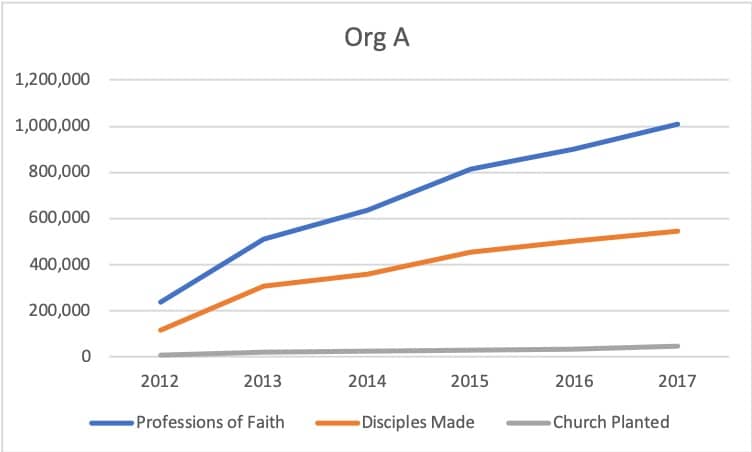
There is absolutely no doubt that both of these organizations experienced phenomenal growth. According to the data, Org A experienced a “disciples made” annual growth rate of 62.8% and a “churches planted” annual growth rate of 108.6% for a period of six years.
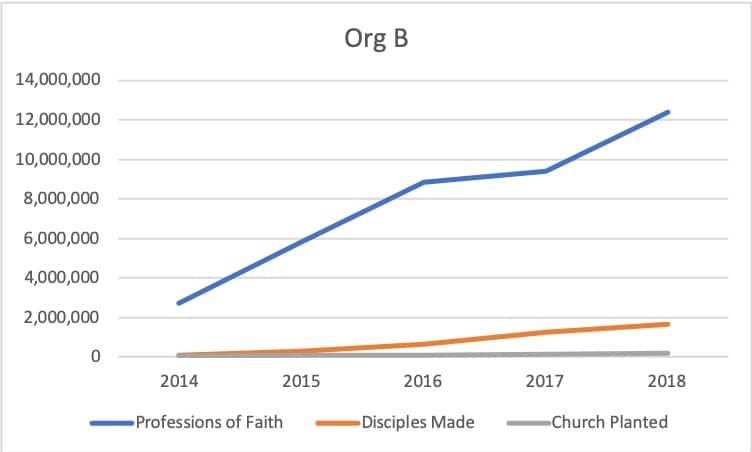
Org B experienced a “disciples made” annual growth rate of 316.92% and a “churches planted” annual growth rate of 87.02% for a period of five years. God was at work in spectacular ways in both organizations during the periods of their respective data.
CPM advocates would applaud the success of these organizations and point to them as validation for not listening to critics. After all, you cannot argue with the data. At some level, they are justified in their response. However, at another level, there are at least two critical issues that these graphs raise. First, neither graph is demonstrating exponential growth. During the outbreak of COVID-19, we have all become painfully familiar with what exponential growth looks like. Exponential growth will have the tell-tale sign of a J-shaped curve as illustrated in the graph of the coronavirus pandemic.
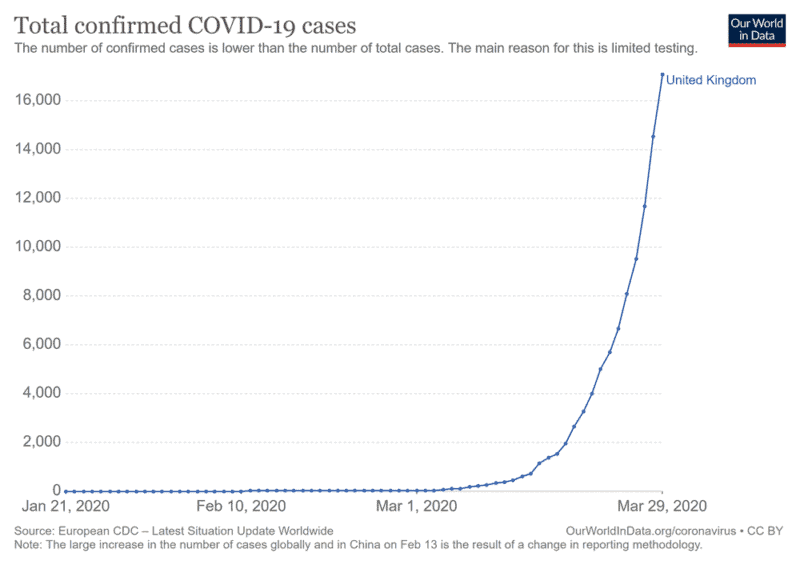
We are not seeing this type of growth curve in these two CPM organizations. Perhaps there are CPM organizations that are seeing this J-shaped curve, but can we consider Org A and Org B movements?
Consider the early church’s growth curve. While definitely slower growth, we do see the upturn into a J-shape that we would expect from a movement. It is important to note the two periods in the early church when the curve appears to flatten. First, in the 160s, the Antonine plague claimed nearly 25 million people in the Roman Empire. Second, in the 260s, at the height of the Cyprian plague, nearly 5,000 people were dying every day. In spite of a flattening of the curve, the church continued to grow.
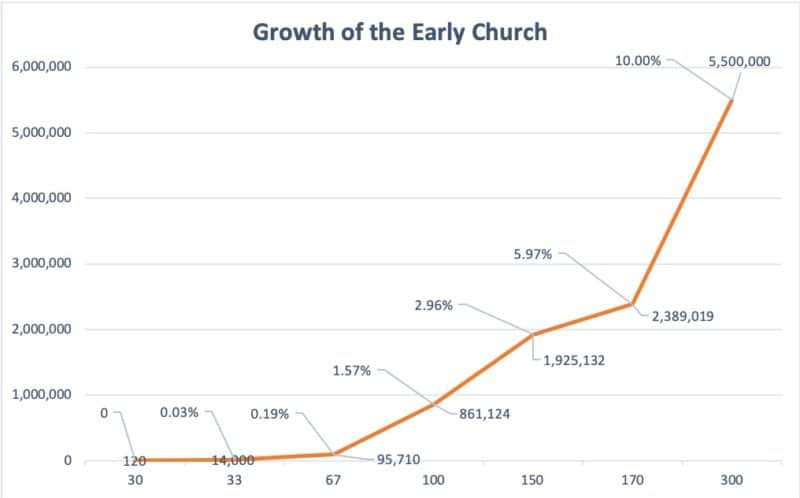
The second issue that the Org A and Org B graphs raise, and perhaps more importantly, are the gaps between “professions of faith” and “disciples made” and the flatness of the curve relative to “churches planted.” These might stimulate important conversations that trigger greater scrutiny about what is actually happening on their respective fields of engagement. Data like these do not necessarily explain why there are gaps, but they do help us formulate a number of potential research questions. Here are seven matters that come to mind as I consider these graphs. You might have more:
Gap between Professions of Faith and Disciples Made
1. Could indicate a disconnect between the gospel message and the culture.
2. Could indicate a lack of people to follow up professions.
3. Could indicate a recklessness in the way in which evangelism is done.
4. Could indicate a greater likelihood for syncretism.
Gap between Disciples Made and Churches Planted
1. Wider the gap between disciples made and churches planted might indicate a lack of clear definitions for disciple and church.
2. Wider gap might indicate that the form of the church is not indigenous therefore the disciple is uncomfortable attending.
3. Closer the gap indicates disciples are being followed up and incorporated into churches.
Ephesiology and the Defining a Healthy Movement
As I thought about instances like Org A and Org B and the writing of Ephesiology: The Study of the Ephesian Movement, I wondered if we might learn important principles that would help CPMs be healthy. Here are five principles that I discovered about the movement in Ephesus.
Principle 1
A movement can be defined as a passionate group of people whose convictions necessitate an identity which propagates a message that turns into action resulting in social or religious change. In the New Testament, that movement resulted from mature disciples whose leaders empowered them to action resulting in planted churches. These empowered Christ-followers turned the world upside down as they multiplied and spread a message that connected Jesus’s story to the stories of the peoples they engaged.
Principle 2
In the New Testament, a Christ-follower is more than someone who grows in their knowledge of God. A Christ-follower fellowships with other believers, worships in a community, and prays like those assembled in a house in Acts 4. Then, empowered by the Holy Spirit, a Christ-follower boldly declares the word of God and more and more people become followers of Jesus. This understanding of a Christ-follower is highlighted throughout the New Testament and is a primary reason for the growth of the early movement in Ephesus.
Principle 3
New Testament leaders understood that there was only one head of the church, Christ Jesus (Ephesians 1:22). Such an understanding leveled the leadership of the movement to such a point that Christ-followers clearly understood their responsibility of making more disciples as they were empowered to use their gifts for God’s glory. These leaders understood that they worked together with others as equals in God’s mission as God had called them all to be co-laborers (1 Corinthians 3). When Paul wrote about these leaders, their responsibility was clear – they were to equip the saints for works of ministry (Ephesians 4:11–12).
Principle 4
Spiritual multiplication is a principle of exponential growth to four generations. In 2 Timothy 2:2, Paul represents a first-generation disciple (G1) who continues to make more disciples, one of whom was Timothy (G2). In Ephesus, there were at least eight additional named disciples (G2) of Paul’s who presumably applied the same spiritual multiplication asked of Timothy. These G2 disciples were then expected to make more disciples (G3) who would, in turn, make even more disciples (G4). It should not escape us that the emphasis in the Ephesian movement was on making disciples not planting churches. In a very short period of time, I argue, the movement in Ephesus grew to more than 5,000 believers.[3]
Principle 5
During Jesus’s earthly ministry, He spoke about church only twice (Matthew 16:18, 18:17). In Matthew 16, we have Jesus’s promise that the church is His and He will build it. In Matthew 18, we learn that the church has the means to address conflict. Jesus certainly expresses ideas that have been incorporated into the ministry of the church such as baptism, communion, evangelism, discipleship, giving, and caring for the marginalized; however, these are generally responsibilities of disciples. Outside of Matthew, the only other place where Jesus addresses the church is in the final book. To the angels of the seven churches in Asia Minor, Jesus wrote individual letters commending some, admonishing most, and warning about the future if they do not listen to the Holy Spirit. In essence, this is Jesus’s assessment of the movement in Asia Minor. In Revelations 2 and 3, we can discern several distinctives of a healthy church, but I will leave these for you to discover.
Conclusion
I can still remember my amazement in 1988 in seeing a picture of Jesus on the wall of a Hindu temple in Karachi, Pakistan. As a young missionary, my first reaction was, “They believe in Jesus!” As I later came to learn, yes, they did believe in Jesus. However, he became one among many deities celebrated in the temple. These practitioners obviously heard about Jesus and expressed some level of faith in him. Yet the gap between such a profession of faith and what it means to change allegiances from their practices to allegiance to God was evident.
I am not saying that syncretism is inevitable when we see gaps between professions of faith and disciples made. In fact, I cannot say that without more research. However, I can confidently say that gaps between professions of faith and disciples made should raise the question of whether or not syncretism is occurring. Those gaps should also raise other questions about evangelistic effectiveness, abilities to properly connect Jesus’s story to those of the people, our theology of evangelism, as well as our soteriology. So, in the time between now and when more research can be conducted, please let me encourage you to become familiar with the most significant movement in the New Testament. If Ephesiology will help, I would be honored if you would read it.
By the way, I count Rajneesh as a friend, and I look forward to a time when we will continue our conversation as we are both committed to seeing faithful followers of Christ declare the glory of God to the nations.
Michael Cooper is missiologist in residence at East West Ministries International, focused on UPGs as well as the author of the recently released Ephesiology: The Study of the Ephesian Movement (William Carey Publishing). You can contact him at michael@ephesiology.com.
[1] Michael Cooper, Ephesiology: The Study of the Ephesian Movement (William Carey Publishing, 2020), 40.
[2] Data for both of these anonymous organizations were accessible on their respective websites.
[3] Cooper, Ephesiology, 142–144.
EMQ, Volume 57, Issue 1. Copyright © 2021 by Missio Nexus. All rights reserved. Not to be reproduced or copied in any form without written permission from Missio Nexus. Email: EMQ@MissioNexus.org.