EMQ » October–December 2020 » Volume 56 Issue 4
By David E. Datema and Leonard N. Bartlotti
Confusion reigns among leaders in the world of missions when it comes to assessing the evangelistic responsibility of the church. Every decade or so the wave of a new theory crashes ashore and theoreticians who teach and write books as well as practitioners who lead missions bob about furiously seeking to stem the tide or to ride the wave. The impressive conclaves and private skirmishes seem dominated either by enthusiastic and often uncritical promoters of the new wave or the veterans who scramble to synthesize older, devoutly held verities with the implications of the newly ascendant idea.[1]
In 1983, J. Robertson McQuilkin described the advent of the people group approach as “the current missiological tidal wave.” All efforts to stem the tide failed. Most chose to ride the wave. Fifty years later some argue that the wave seems to have spent itself; its remaining impetus rushing backward as if to feed the next surge. Others hold on to people group thinking, seeing nothing on the horizon coming to take its place. In what follows we will attempt to briefly tell the story of the development of the people group approach until 1982, when a consensus on terminology was established.[2]
Precursors to People Groups
In reality, the people group wave of the 1970–1980s was not “new.” Missionaries were well aware of humanity’s ethnic and linguistic diversity. They were not surprised by the complexity of peoples and ethnicities within single nation states. An uncritical reader of Ralph Winter’s “Three Eras”[3] treatment of modern mission history might conclude that it wasn’t until missionaries went “inland” from the “coastlands” that they suddenly realized this diversity. Yet even William Carey’s Enquiry (1792) showed appreciation for human difference and variety. Throughout the nineteenth century great strides were made in understanding human groupings. In 1910 Commission One of the World Missionary Conference in Edinburgh presented a survey of the non-Christian world that was over two hundred pages in length, used the phrase “unreached” regularly, and was impressively cognizant of ethnic and linguistic difference.[4]
In the twentieth century this research continued, expanding understanding of the diversity and complexity of human groupings. In Central America, W. Cameron Townsend noted the many tribal peoples often bypassed and in need of their own Scriptures. In India, J. Waskom Pickett wrote a signature book on mass movements which formed the basis for Donald McGavran’s later work on people movements and church growth principles. Most important among these for our purposes was the homogeneous unit principle, which emphasized the human tendency to prefer association with others of similar affinities. In Africa, David Barrett and Patrick Johnstone began research projects on peoples that eventually became global, Barrett representing a more academic investigation and Johnstone creating resources for prayer. All of these efforts represented attempts to identify human grouping at a level below that of nation-states.
Our point here is simply that the people group paradigm was not primarily a new revelation about the existence of diverse people groups. Rather, it was a unique and culminating phase of its development, “engendering a global awareness and concerted application of the people group concept that created new approaches to the task of world evangelization.”[5]
Stimuli That Sparked a Movement
The people group approach of the 1970s was triggered by two different but complementary stimuli. First, there was an awakening to the “shattering truth” that “at least four out of five non-Christians in the world today are beyond the reach of any Christian’s E-1 [local] evangelism.”[6] This stimulus came about through Ralph Winter’s provocative and groundbreaking lecture at Lausanne ’74, which exposed the inability of near-neighbor (E-1) evangelism to reach these people groups, and called attention to the need to make cross-cultural evangelism (E-2, E-3) “the highest priority.”
The second stimulus helped visualize this reality. The emergence of new computer technology enabled mission leaders to effectively display lists of the “hidden peoples” that made up that non-Christian world. It added specificity by naming and listing people groups instead of referring to them with vague general headings like “unevangelized” or “heathen world.” The intent was to overcome “people blindness,” the inability to see these smaller entities that made up the human population. Thus, an ethnic representation of the unevangelized world was wedded to a more detailed visualization of that world.
The convergence of these two forces shifted the picture of the world from nation-states to people groups, especially those labeled “unreached.” A previously monochrome world was now polychromatic: Variegated unreached peoples, languages, and groupings, previously “hidden” by (what Winter called) the “high grass” of existing national churches, were now projected before the eyes of missionaries and the global church.[7] This placed new emphasis and urgency on the “pioneering” phase of mission in pursuit of “missiological breakthrough” among each unreached people.
In one sense, the people group paradigm gained traction when it did because computer technology was advanced enough to organize and manipulate already existing data. The Ethnologue listing of the world’s languages was first computerized in 1971.[8] Across the mission world, computer technology now allowed for faster retrieval, arrangement and analysis of data than ever before.[9] It was a technological innovation that allowed for the construction and maintenance of people group lists, enhancing Winter’s cognitive insight with graphic display. While the insight itself was powerful, when coupled with the lists it proved to be irresistible. Now, individuals could not only hear about unreached peoples, but see them more clearly than ever before. In missions, seeing is believing.
The Primary Thought Leaders
Although many were involved in people group research, including David Barrett (World Christian Encyclopedia) and Patrick Johnstone (Operation World), the people group approach as a full-orbed concept and mission strategy was the product of three main spheres of influence, all emanating from southern California: Fuller Theological Seminary’s School of World Mission (SWM); the Missions Advanced Research and Communications Center (MARC) of World Vision; and the US Center for World Mission (USCWM). MARC was established in 1966 as a joint venture of World Vision International and Fuller.[10] Together they had a large influence during the 70s and 80s on unreached peoples research.
Each of these institutions was led by missiological luminaries. C. Peter Wagner, Professor at Fuller’s SWM, served as Chairman of the Strategy Working Group (SWG) of the Lausanne Committee for World Evangelization (LCWE).[11] Working closely with Wagner was Ed Dayton, Director of MARC. Dayton was a Fuller graduate and had studied under SWM professors. This collegiality and the close proximity (9 miles) between Fuller Seminary (Pasadena) and the then-headquarters of World Vision (Monrovia) facilitated synergy. According to Wagner and Dayton:
Since its founding in 1966, … MARC centered its philosophy of world evangelization around the people group. The analysis that was done jointly by Donald McGavran and Ed Dayton, at the School of World Mission at Fuller Seminary, indicated that the country-by-country approach to mission was no longer viable … McGavran and Dayton worked through an analysis of needed world evangelization, based on McGavran’s earlier insight gained from people movements … As the analysis continued, it was obvious that the basic unit of evangelization was not a country, nor the individual, but a vast variety of subgroups.[12] (Emphasis added)
Note the interconnecting concepts: world evangelization; people group vs. country approach; people movements; vast variety of subgroups. The driving concerns were both biblical and strategic: World evangelization could be strategically advanced by fostering Christ-ward people movements among all the identifiable subgroups of the world. (See Alan Johnson’s “Foundations of Frontier Missiology” in this EMQ issue).
In 1976 Ralph D. Winter reluctantly left his professorial role at Fuller’s SWM to found the USCWM (just 3 miles away in Pasadena) as a cooperative mission center “think tank,” research university, and platform to mobilize the church to reach the world’s “hidden” peoples. Originally proposed to be a part of Fuller, Winter’s ideas and approach were too radical and “out of the box” to fit in a normal educational structure. In faith, he launched an enterprise that became the leading promoter of the UPG concept and movement globally.
There were now three organizations in close proximity, each connected to Fuller’s SWM but with unique yet parallel and complimentary purposes. This created a rich environment for robust dialogue and debate among several missiological thought leaders.
Wagner and Dayton
In conjunction with SWM Professors at Fuller, MARC put together the first Unreached Peoples Directory for the 1974 Lausanne Congress. The Directory was an attractive booklet that introduced Congress-goers to the world of unreached peoples. For most, it was surely the first time they had ever seen a list of unreached peoples. It defined a people group as a homogeneous unit. Based on a questionnaire sent to 2,200 people, it presented a list of 413 unreached people groups, based on the criterion of “less than 20%” professing Christians. The list used the criterion of 20% professing Christians as a way to delineate “reached” status.[13] Three years after the Congress, the Strategy Working Group (SWG) was founded. Wagner worked closely together with Dayton and MARC and they jointly produced the Unreached Peoples book series from 1979 to 1984. These books continued the original work that had been presented in 1974, and each volume included an updated list of unreached peoples, the number of which increased each year.
The biggest change made during these years involved the criteria for “reachedness” – an issue that today remains central and contested. Without such a criterion there was no way of determining whether or not a people group was reached or unreached. First, “professing Christians” was changed to “practicing Christians” as the measuring criterion. (Some critics wryly suggested that in doing so all people groups were now unreached!) More important, there was also continuing debate about the appropriate percentage of Christians to represent the “reached” tipping point. It was finally agreed that an unreached people group be defined as “a group that is less than 20 percent practicing Christian.”[14]
Winter
Ralph Winter was the antagonist in this debate. He didn’t like the word “unreached” because of its general connotation as a reference to anyone who was not a Christian. He was also suspicious of quantitative criterion like a percentage. Winter put forth the alternative concept of “hidden peoples”:
Any linguistic, cultural or sociological group defined in terms of its primary affinity (not secondary or trivial affinities), which cannot be won by E-1 methods and drawn into an existing fellowship is a Hidden People.[15]
A few years later a simple, refined definition for hidden peoples emerged: “Those cultural and linguistic sub-groups, urban or rural, for whom there is as yet no indigenous community of believing Christians able to evangelize their own people.”[16] For Winter, it wasn’t about how many Christians or missionaries there were among a people. It was about the quality of the Christian community – the presence or absence of a viable, indigenous, evangelizing church movement – not its quantity.
The issue of affinity or sub-grouping was another particular concern of Winter, and it remains to this day the most confusing aspect of people group theory. How far can people groupings be divided into “segments”? What level of affinity (kinship, like-mindedness, attraction) was considered relevant to people group identity? Were “nurses in St. Louis” or “professional hockey players” (these were in the early lists!) distinct people groups? For Winter, this concept of segmentation was of ultimate importance because it was just here where people groups could be “hidden” from view, perhaps existing within a more obvious group. Winter developed four segments to portray these realities. He used the terms Megasphere, Macrosphere, Minisphere, and Microsphere in order to identify the sub-groupings that exist as layers or strata within a people group. Segmentation was needed “whenever we discover that a people group is internally too diverse for a single breakthrough to be sufficient.”[17]
The 1982 Chicago Consensus
By 1980, the year of the Lausanne Congress in Pattaya and the USCWM-backed meeting in Edinburgh, there were two definitions – one for “unreached peoples” and another for “hidden peoples.” There was a pressing need to agree on terminology, in part because these same entities were also trying to figure out how to match churches with agencies in order to “reach,” “adopt” or “love” unreached peoples. Note that mobilization concerns – how to present field realities and concepts to sending churches – began to take on increased significance.[18]
In the fall of 1981, Wade Coggins, on behalf of LCWE/North America and Ed Dayton called for a meeting to agree on terminology and discuss how such a matching program might work. First dubbed the “Unreached Peoples Discussion,”[19] it was eventually referred to as the “Reach-A-People Meeting,[20] and took place in Chicago, March 25–26, 1982. It consisted of nineteen mission leaders, most of whom were mission executives. The following definition emerged for people group:
A people group is a significantly large grouping of individuals who perceive themselves to have a common affinity for one another because of their shared language, religion, ethnicity, residence, occupation, class or caste, situation, etc., or combinations of these. For evangelistic purposes it is the largest group within which the gospel can spread as a church planting movement without encountering barriers of understanding or acceptance.[21]
The second sentence was added at Winter’s behest, in order to emphasize segmentation caused by social/cultural barriers. But the real issue had to do with the nomenclature (unreached or hidden) and definition of those without access to the gospel. An unreached people was also defined:
A people group among which there is no indigenous community of believing Christians with adequate numbers and resources to evangelize this people group without outside (cross-cultural) assistance.[22]
Thus, in the end, Winter agreed to use “unreached peoples,” while Dayton agreed to Winter’s definition that had no percentages. The focus was on the absence or presence of a viable church.
Remaining Difficulties
There have been no official changes to these definitions since. Yet significant problems remained. First, no percentage was given in the 1982 definitions, so there was no official agreement as to when a group became “reached,” resulting in different numbers of unreached people groups (UPGs). Second, the consensus did not answer one of the most pressing and practical questions: which level of segmentation (ethnicity, language, kinship, class, etc.) was the most appropriate one? Differences here also led to different numbers of UPGs. A good example of this uncertainty can be seen in the report of the pre-Congress (1989 Lausanne II Congress in Manila) Statistics Task Force chaired by David Barrett, which gives six categories for peoples: Countries, Macropeoples, Ethnolinguistic peoples, Minipeoples, Micropeoples and Sociopeoples.[23] As a result, different interpretations of exactly what constituted a “people group” led to different lists throughout the 1980s.
It was not until the mid-1990s and the advent of the AD2000 and Beyond Movement that a combined list was attempted that settled on ethnolinguistic as the primary category and changed the percentage to “less than or equal to 2% Evangelical — AND — less than or equal to 5% Christian Adherent,”[24] which remains in use for the Joshua Project list. Yet even today, people group lists reflect differences in assumptions about what constitutes a cohesive grouping within which the gospel can spread as a church planting movement without encountering barriers of understanding or acceptance. Consensus on these matters has proven elusive.
Winter continued to promote his “no people group left behind” approach by unveiling the concept of “unimax peoples,” which he considered to be the “mission relevant” group and which he also equated with the minisphere (the second to last of his segmentation levels). Winter was again trying to emphasize smaller groupings. It is clear from Winter’s later writings that he felt the 1982 definition was unwisely equated with ethno-linguistic peoples, which were in some cases too large and likely hiding smaller groups. Winter maintained these differences throughout his life, as is evident in the Perspectives Reader. In the eyes of most, however, people groups simply referred to ethno-linguistic entities.
Conclusion
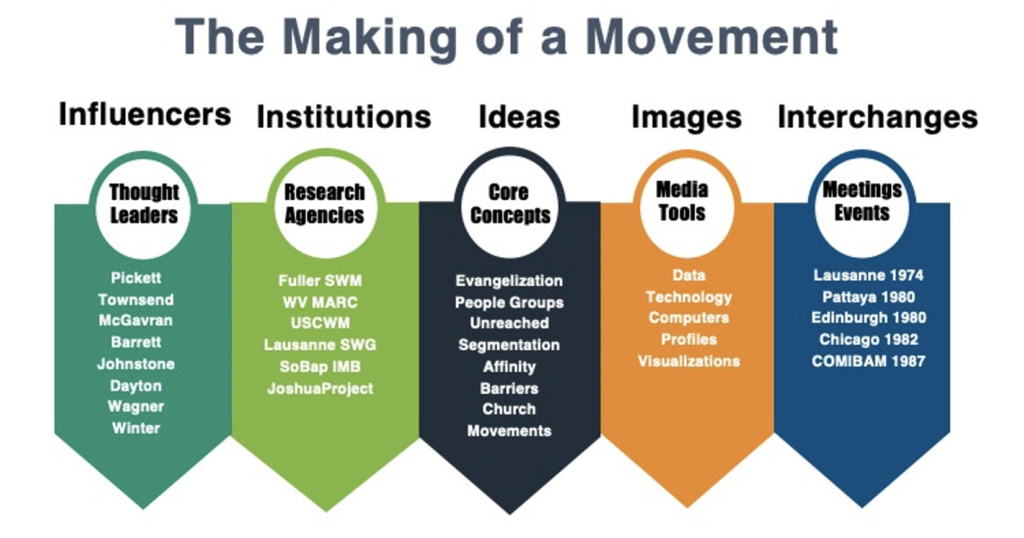
This historical overview puts into perspective both positive and negative aspects of this missiological tidal wave. First, a “perfect storm” was created by the coalescence of ideas relating people groups to world evangelization; the synergy of influencers (thought leaders) and institutions (research agencies); the simultaneous juxtaposition of computer technology, data, and media that provided new images of the unreached; amplified by the international interchange of ideas, people, data and organizations at consultations and events;[25] all of which together helped ignite and sustain a global movement. (See Figure 2.1 for a summary.)
Second, people group rhetoric was always far ahead of people group reality, meaning that even as the paradigm was boldly promoted on-stage, there was much back-stage confusion. The paradigm was always trying to catch up with its bold assertions and to cover conceptual holes, while keen observers, such as EMQ editors Jim Reapsome and Gary Corwin, supplied appropriate and significant push-back. Given the mass amounts of confusion that attended the movement, it is surprising that it ever succeeded at all.
Third, the fact that ongoing confusion continues today in terms of segmentation levels, debates about which percentage criterion is best, and the rise of hybrid identities as a foil to the discrete people group model, shows that human complexity remains beyond our grasp to fully comprehend. The people group paradigm humbles all advocates.
The concept of seeing the world as people groups is arguably the most significant thought innovation in twentieth century missiology. Still today, the people group remains the unit of analysis most people think of when contemplating world evangelization. As this issue of EMQ shows, things are changing. Whether the paradigm is simply adjusted or replaced altogether, it is likely that the same elements that brought it into existence will be significant in paving the way forward. New awareness of the social realities of the unevangelized world and new abilities to depict that world in ever-increasing clarity will change once more how we think about the Great Commission.
Dave Datema serves as Missiology Catalyst for Frontier Ventures in Pasadena, CA. He is also doing doctoral research on African-American missionaries Joseph and Mary Gomer.
Leonard N. Bartlotti, Ph.D. is an intercultural consultant, strategist, well-known speaker and educator with thirty-five year’s experience in cross-cultural ministry and pioneer work in Central Asia.
Notes
[1] J. Robertson McQuilkin, “Assessing the Evangelistic Responsibility of the Church,” (Unpublished Paper, Used with permission, Ralph D. Winter Research Center and Archive, Pasadena, CA, February 1982). This paper was edited and later published as “Looking at the Task Six Ways,” Evangelical Missions Quarterly, 19:1 (January 1, 1983).
[2] For an overview of the frontier mission movement, see Alan Johnson, “Part I: The Frontier Mission Movement’s Understanding of the Modern Mission Era,” International Journal of Frontier Missions 18:2 (Summer 2001): 81–88, https://www.google.com/search?q=Part+I%3A+The+Frontier+Mission+Movement%92s+Understanding+of+the+Modern+Mission+Era&btnG=Search&domains=www.ijfm.org&sitesearch=www.ijfm.org; Alan Johnson, “Part II: Major Concepts of the Frontier Mission Movement,” International Journal of Frontier Missions 18:2 (Summer 2001): 89–97, https://www.google.com/search?domains=www.ijfm.org&ei=XHWoXvKDHtO5-wS_tZnYBg&q=Part+II%3A+Major+Concepts+of+the+Frontier+Mission+Movement; Alan Johnson, “Part III: Critical Analysis of the Missiology of the Frontier Mission Movement,” International Journal of Frontier Missions 18:3 (Fall 2001): 121–127, https://www.google.com/search?domains=www.ijfm.org&ei=mXaoXtWxIJLf-gSAi6mwBw&q=Part+III%3A+Critical+Analysis+of+the+Missiology+of+the+Frontier+Mission+Movement&oq=Part+III%3A+Critical+Analysis+of+the+Missiology+of+the+Frontier+Mission+Movement&gs_lcp=CgZwc3ktYWIQAzoFCCEQoAFQsN8IWLDfCGCs6whoAnAAeACAAboBiAGUA5IBAzEuMpgBAKABAqABAaoBB2d3cy13aXo&sclient=psy-ab&ved=0ahUKEwiV4sDd4IvpAhWSr54KHYBFCnYQ4dUDCAs&uact=5; Alan Johnson, “Part IV: The Core Contributions of Frontier Mission Missiology,” International Journal of Frontier Missions 18:3 (Fall 2001): 129–131, https://www.google.com/search?domains=www.ijfm.org&ei=K3eoXsnMJIn7-gTU9ZKgBw&q=Part+IV%3A+The+Core+Contributions+of+Frontier+Mission+Missiology&oq=Part+IV%3A+The+Core+Contributions+of+Frontier+Mission+Missiology&gs_lcp=CgZwc3ktYWIQA1DS0glY0tIJYIjgCWgAcAB4AIABkAGIAZgDkgEDMy4xmAEAoAECoAEBqgEHZ3dzLXdpeg&sclient=psy-ab&ved=0ahUKEwiJjpSj4YvpAhWJvZ4KHdS6BHQQ4dUDCAs&uact=5. For more detail on people group definitions, see Dave Datema, “Defining ‘Unreached’: A Shorty History,” International Journal of Frontier Missiology 33:2 (Summer 2016): 45–71, https://www.google.com/search?domains=www.ijfm.org&ei=zHeoXoTSEY7u-gTrpJ3wCg&q=Defining+Unreached%3A+A+Short+History&oq=Defining+Unreached%3A+A+Short+History&gs_lcp=CgZwc3ktYWIQAzIFCCEQqwIyBQghEKsCOgQIABBHOgUIABCRAjoFCAAQgwE6AggAOgQIABBDOgcIABCDARBDOgkIABBDEEYQ-QE6BwgAEEYQ-QE6BAgAEAo6CAgAEBYQChAeOgYIABAWEB46CAghEBYQHRAeOgUIIRCgAToHCCEQChCgAVD3mxJY1ssSYKDSEmgAcAN4AIABogGIAbwckgEFMTUuMjCYAQCgAQGqAQdnd3Mtd2l6&sclient=psy-ab&ved=0ahUKEwiE6OPv4YvpAhUOt54KHWtSB64Q4dUDCAs&uact=5.
[3] Ralph D. Winter, “The Concept of a Third Era in Missions,” EMQ 17:2 (April, 1981); cf. “Three Men, Three Eras: The Flow of Missions,” Mission Frontiers 3:2 (Feb, 1981); more fully developed by Winter in a later version, “Four Men, Three Eras,” Mission Frontiers 19 (Nov 1997).
[4] John R. Mott et al, Report of Commission I: Carrying the Gospel to All the Non-Christian World, World Missionary Conference, (Edinburgh, London: Oliphant, Anderson and Ferrier and New York: Fleming H. Revell Co.), 1910.
[5] Len Bartlotti, personal communication, May 28, 2020.
[6] Ralph D. Winter, “The New Macedonia: A Revolutionary New Era in MissionBegins,” in Perspectives on the World Christian Movement: A Reader, eds. Ralph D. Winter and Steven C. Hawthorne (Pasadena, CA.: William Carey Library), 353.
[7] Ralph D. Winter, Penetrating the Last Frontiers, (Pasadena, CA: William Carey Library, 1978): “The main problem now is that the national church has grown up like high grass which our missionaries can’t see beyond.” (p. 3). This statement generated heated defensive responses from some denominational mission leaders, who felt their national churches and foreign mission programs (the vast majority of which were not pioneering) were being disparaged.
[8] “History of the Ethnologue”, Ethnologue: Languages of the World, accessed April 23, 2020, https://www.ethnologue.com/about/history-ethnologue.
[9] Samuel Wilson, “SHARE (Systems, Hardware and Research for Evangelization): The Development of a Cooperative Information Network for World Evangelization,” (Unpublished paper, Ralph D. Winter Research Center and Archive, Pasadena, CA, 1980).
[10] Samuel Wilson, “SHARE.”
[11] The LCWE was established in January 1975 to implement the ethos and vision of the International Congress on World Evangelization (ICOWE), July 16–25, 1974. It consisted of the international body, seven regional committees, an executive committee and four working groups: theology and education, intercession, communication, and strategy. The first meeting of the Strategy Working Group was in 1977.
[12] C. Peter Wagner and Edward Dayton, Unreached Peoples ’81: The Challenge of the Church’s Unfinished Business. (Elgin, IL., David C. Cook Publishing Company, 1981), 24.
[13] For a fuller discussion of the rationale and problems associated with “percentage” indicators of reachedness, see Dave Datema, “Defining ‘Unreached”: A Short History, IJFM 33:2, Summer 2016.
[14] C. Peter Wagner and Edward R. Dayton, Unreached Peoples ’79: The Challenge of the Church’s Unfinished Business (Elgin, IL.: David C. Cook Publishing Co, 1978), 24.
[15] Ralph D. Winter, Penetrating the Last Frontiers, (Pasadena, CA: William Carey Library, 1978), 42.
[16] Ralph D. Winter, “Frontier Mission Perspectives” in Seeds of Promise: World Consultation on Frontier Missions, Edinburgh ’80, ed. Allan Starling (Pasadena, CA: William Carey Library, 1981), 61.
[17] Winter, “Frontier Mission Perspectives”, 63. Winter concedes that “the reality of human diversity is, of course, immeasurably more complex than these four levels imply. One can easily imagine cases where there are far more than four levels.”
[18] The USCWM’s “Adopt-A-Hidden-People” proposal was drafted by Len Bartlotti, then Chairman of the Mobilization Division, published in Mission Frontiers, 2:11 (November 1980), and discussed at the Edinburgh 1980 World Consultation on Frontier Missions. Concurrently, SWG, MARC and Lausanne in Pattaya discussed their “reach” a people concept. The Center’s proposal involved a 3-step process: 1) “Validation”; 2) “Agency decision to initiate action”; 3) “Church adoption of the Hidden People.” The schema reflects Winter’s convictions about both data and mission agency initiative in pioneering, and envisioned marshalling all the resources of the U.S. Center behind mission-church initiatives. The AAP proposal (which evolved into the current Global Adopt a People Campaign [GAAPC] based in Manilla, Philippines) became part of a call for a comprehensive mission renewal movement: “The time has come for church and mission leaders to unite in promoting a cooperative mission renewal movement embracing the entire home base of the Protestant mission movement, and the rebuilding of pioneer mission perspective within it.” See Len Bartlotti, “A Call for a Mission Renewal Movement,” IJFM 1:1 (1984), 37–56, https://www.ijfm.org/PDFs_IJFM/01_1_PDFs/Bartlotti.pdf.
[19] “Letter from Wade T. Coggins to Participants,” January 13, 1982, Ralph D. Winter Research Center and Archive, Pasadena, CA, USA.
[20] “Letter from Ed Dayton and Wade Coggins to Participants,” February 26, 1982, Ralph D. Winter Research Center and Archive, Pasadena, CA, USA.
[21] Ralph D. Winter and Bruce A. Koch, “Finishing the Task: The Unreached Peoples Challenge”, in Perspectives on the World Christian Movement, 4th Ed., Ralph D. Winter & Steven C. Hawthorne, eds. (Pasadena, CA: William Carey Library, 2009), 536.
[22] Ralph D. Winter, “Unreached Peoples: The Development of the Concept”, in Reaching the Unreached: The Old-New Challenge, ed. Harvie M. Conn (Phillipsburg, NJ: Presbyterian and Reformed Publishing Company, 1984), 36–37.
[23] Patrick Johnstone, “People Groups: How Many Unreached?” International Journal of Frontier Missions, 7:2 (April 1992).
[24] “Why Include Adherents when Defining Unreached?”, joshuaproject.net, accessed April 20, 2015, http://joshuaproject.net/resources/articles/why_include_adherents_when_defining_unreached. A Christian Adherent is simply anyone who self-identifies as a Christian of any kind.
[25] Ralph Winter consistently promoted the historical significance of international consultations. These events were venues for the strategic interchange of ideas, people and organizations focused on world evangelization and the “every people by the year 2000” goal. See e.g. Mission Frontiers, January 1988, where he calls COMIBAM ’87 (Congreso Misionero Iberoamericano-’87 in Brazil), a gathering of 3000 third-world leaders, “the meeting of the century.” He writes, “The great hew and cry here at COMIBAM ’87 is to transform mission fields into mission forces. And I do not believe the world will ever be the same again. COMIBAM is one unmistakable, indelible evidence of a movement that is gaining strength around the world….the definitive, final public announcement of the coming of age” of third world missions. In particular, COMIBAM gave “significant attention to the unique instrument of global evangelization—namely, the missionary and the mission society.” Accessed July 2, 2020 http://www.missionfrontiers.org/oldsite/1988/01/j883.htm.
EMQ, Volume 56, Issue 4. Copyright © 2020 by Missio Nexus. All rights reserved. Not to be reproduced or copied in any form without written permission from Missio Nexus. Email: EMQ@MissioNexus.org.