EMQ » April – July 2025 » Volume 61 Issue 2
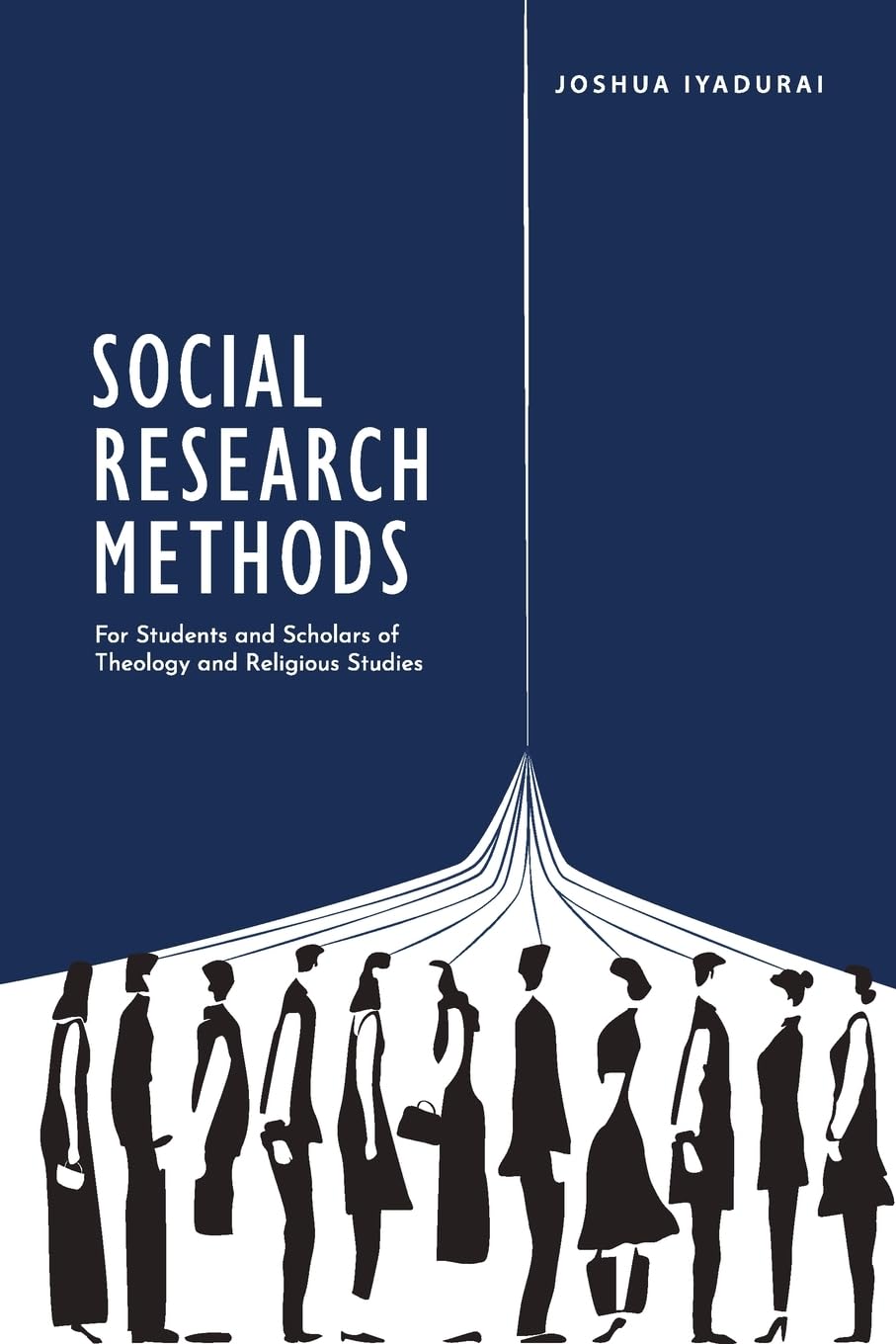
Social Research Methods: For Students and Scholars of Religious Studies
By Joshua Iyadurai
Marina Centre for Interdisciplinary Studies in Religion, 2023
300 pages
US$28.21
*As an Amazon Associate Missio Nexus earns from qualifying purchases.
Reviewed by Cameron D. Armstrong, Asia Graduate School of Theology, Philippines.
To remain relevant, theological studies must engage in social science research, argues Joshua Iyadurai in Social Research Methods. Often, however, students of theology and religious studies are ill-equipped for such a task. This book seeks to fill that gap.
Iyadurai organizes his book into nine chapters. Chapter 1 introduces how religious studies scholars might choose a topic befitting social science. Chapter 2 contends that to think like a researcher, examining the literature at a conceptual level is imperative. Chapter 3 introduces the different social research strategies (qualitative, quantitative, and mixed methods). This overview is followed by a deeper discussion of each strategy’s framework in chapters 4–6. Crafting a robust research proposal is the subject of chapter 7. Iyadurai then explains in chapter 8 the actual write-up process of dissertations, theses, and journal articles. The book concludes with chapter 9, which highlights guidelines for supervisors and students, especially concerning the research and writing phases.
Iyadurai’s work possesses several strengths, yet here I mention only two. First, the primary contention that theological research should not only advance knowledge but serve the life and mission of the Church is indeed pivotal. Engaging in research based on the lived experiences of real people contextualizes research beyond the historical and theoretical. Thus, even fields like theology, which are not strictly centered in the social sciences, should maintain a human focus. Second, Iyadurai’s examples of possible research directions nearly all stem from the Majority World, specifically South Asian contexts. Such discussions outside of mainstream Western conversations are welcome as they encourage non-Western religious scholars to produce sound work and reveal blind spots for Western researchers like me.
One weakness of the text includes Iyadurai’s slim discussion on research ethics. Only two short paragraphs, for example, develop the pitfall of plagiarism, which is a widespread reality in both Western and non-Western theological institutions. Also, little discussion is given to the need for an institutional review board certifying that the researcher has sifted through ethical issues relating to the study of human participants. Although Iyadurai is correct that Majority World institutions may or may not have such review boards or committees, further detailing how having a proposal vetted by a group of experienced scholars protects researchers would add considerable credibility.
Social Research Methods is a helpful resource for theological institutions, scholars, and students. The book frames the discussion of how and why social science methods can lead to rigorous studies benefiting the global church, followed by step-by-step dissertation/thesis-writing guidelines that make the process more manageable. As an introductory text on such a significant subject, Iyadurai’s work is an opportune gift.
For Further Reading
Practical Theology and Qualitative Research, 2nd edition, by John Swinton and Harriet Mowat (SCM, 2016).
Research Design: Qualitative, Quantitative, and Mixed Methods Approaches, 6th edition, by John W. Creswell and J. David Creswell (Sage, 2022).
EMQ, Volume 61, Issue 2. Copyright © 2025 by Missio Nexus. All rights reserved. Not to be reproduced or copied in any form without written permission from Missio Nexus. Email: EMQ@MissioNexus.org.