EMQ » April–July 2024 » Volume 60 Issue 2

Summary: Understanding acculturation strategies helps missionaries know what they personally experience and what members of a diaspora community experience. It also provides several insights relevant to diaspora church planting.
By David R. Dunaetz
Well-prepared missionaries know that they will need to adapt to their host culture when they arrive in their country of service. However, they may be less prepared to know how to work with immigrants whom they meet in their host country who are also adapting to a new culture.
When we arrived in France as church planting missionaries, we were seminary trained and ready to master and assimilate into French culture. Our goal was to put into practice Thomas and Elizabeth Brewster’s principle of missionary bonding where we would spend our first few weeks with the French and avoid the missionary community so that we would integrate and feel like we belonged with the French.[i]
It worked for a few hours or so, but we were not able to find many people in the Parisian suburbs who wanted to bond with Americans who did not speak French very well. By God’s grace, the missionary team with which we were to work was quite a bit more welcoming. They provided us with the basic information for day-to-day living and helped us get enrolled in language school.
Nevertheless, we were still determined to fully assimilate into French culture and leave our American culture behind. It was at times very painful. I remember a French professor asking me, in front of the whole class, something like “Pourquoi étudiez-vous le français? Vous le parlez si mal!” (“Why are you studying French? You speak it so poorly!”).
Although I eventually became fluent, I never came close to losing my accent, and I am sure that no one who ever spoke to me thought I was French. Even our desire to give up English (as our grandparents had given up Yiddish and Swedish when they immigrated to America) slowly faded as we realized that we would never communicate as well in French as we could in English.
During our early days in France, we also assumed that we would be working with well-educated French. I had been studying Pascal and Voltaire, Hugo and Proust, Sartre and Camus. However, during the first few months in the country, we developed the conviction that God was calling us to do evangelism and church planting among those most open to the gospel, whatever their background.
So, during our 17 years in France, the primary groups of people we worked with were Caribbean and African immigrants. We also worked with the French, and occasionally the Chinese, the Vietnamese, and the expatriate Anglo community, but to lesser degrees.
Although we never thought about it, we soon realized that we were not the only ones adjusting to French culture. These immigrants, most of whom grew up speaking French but who were diaspora members of various cultures, nonetheless, were also adapting and using various strategies to do so.
The changes that occur in people, including changes in beliefs, values, emotions, and behaviors, when they adapt to a new culture result from a process that cultural psychologists call acculturation.[ii] Wise missionaries will become familiar with the various acculturation strategies that both they and any immigrants with whom they work use.
Acculturation
Culture can be defined as the set of beliefs and values that are generally held in common by typical members of a group and that influence their behavior. When members of different cultures interact, the changes which occur are all part of the acculturation process. At the group level, when members of two different cultures interact, both cultures are influenced; new beliefs and values form, for good or for bad, based on the interactions, resulting in changes in typical and expected behavior.
Acculturation also describes what happens on the individual level. Each person, especially those moving into a new culture, must develop ways to adapt to the new culture. Acculturation should be distinguished from enculturation which is the process by which children learn the culture in which they are raised and from assimilation which refers to the process of losing the beliefs, values, and behaviors of one’s original culture and adopting the beliefs, values, and behaviors of a new culture.[iii]
John Berry’s Theory of Acculturation
John Berry of Queen’s University, Ontario, observed that not all immigrants respond to their new culture similarly.[iv] This would be true of both missionaries and members of a diaspora community who have immigrated to the host country for either economic reasons or as refugees. In Berry’s model of acculturation, two primary variables influence how people respond to the host culture.
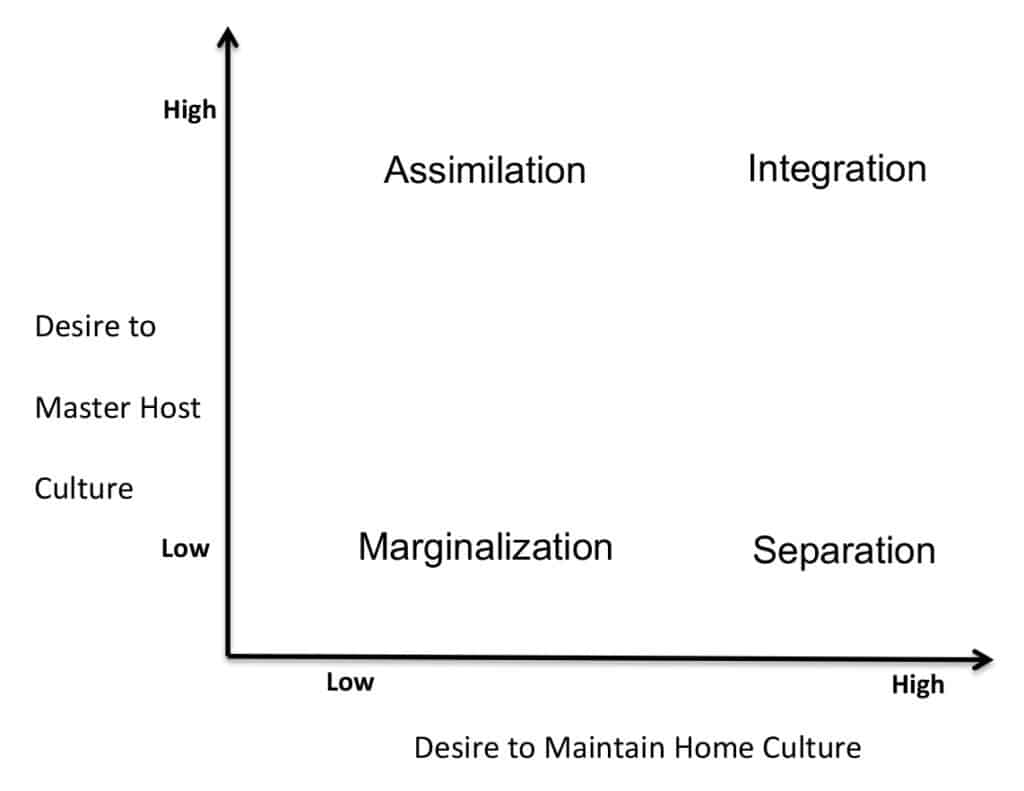
The first variable is the person’s desire to maintain their home culture (a desire which can be high or low) and the second variable is the person’s desire to master the new culture, primarily for the sake of developing relationships with members of the new culture (this desire may also be high or low). Although related to each other, these two variables are independent of each other and can occur in any combination (low-low, low-high, high-low, and high-high; see figure 11.1). These combinations result in different acculturation strategies.
The desire to maintain one’s home culture, that is to maintain the beliefs, values, and behaviors that one learned as a child, can result from several motivations. Some cultures place a high value on the language, values, and customs that are central to the culture. These are often cultures with strong literary traditions. Members of these cultures often value these traditions greatly and want to pass them on to their children, seeing them as equal or superior to the traditions of the host country.
The desire to maintain one’s home culture may also be motivated by familiarity. Whereas the food and humor of the home country may be much appreciated, these aspects of the host culture may seem strange and unattractive. The desire to maintain one’s home culture may also be motivated by competence. Whereas the missionary or immigrant might be quite fluent in their home language and culture, they may be painfully incompetent in their host language and culture. Similarly, the desire to maintain a network of close relationships, either in person or through social media, may motivate the desire to maintain one’s home culture.
Similarly, the desire to master the host culture can be motivated by several factors. The most important is the ability to develop relationships with members of the host culture. For the missionary, this will likely be necessary to have an effective ministry. For the economic immigrant or refugee, developing relationships with people in the host culture will likely make finding a job easier.
There may also be a belief that the host culture is superior to the home culture and that one’s children will be far more successful to the degree to which they master the host culture. Another factor is age, younger people can learn language and culture easier than older people and may be more motivated to do so as they seek to develop their own social network, which is likely to be much less developed and less stable than an older person’s. Like the desire to retain one’s home culture, the strength of the desire to master the host culture will vary by individual, whether missionary or immigrant. Some will have a strong desire to do so, others will have less of a desire to do so.
Strategies for Acculturation
The various combinations of these two dimensions result in four different approaches or strategies for acculturation (figure 11.1). These four strategies are used by both missionaries and immigrants. It should be kept in mind that this is just a model, an approximate description of what tends to happen. Each individual is unique and lives in unique circumstances. For each strategy described, there is an unlimited variety of ways the details will play out.
Assimilation
When the desire to maintain the home culture is low and the desire to master the host culture is high, a strategy of assimilation is used. The missionary or immigrant seeks to become a fully functional member of the host culture, leaving their home culture in the past. For the missionary, this strategy may take the form of speaking the local language while at home, obtaining the host country’s nationality, raising children primarily with the local language, and retiring in the host country. For the immigrant, assimilation may look very similar.
The degree to which assimilation is successful depends on many factors. People who have been educated in an educational system similar to that of the host country (e.g., Western) can assimilate more easily, as well as people who look similar to the dominant ethnicity of the host culture.
Personality also plays a role; people who are more extraverted, those who are more open-minded and open to new experiences, and those who are less anxious tend to better assimilate.[v] One’s musical ability is also a strong predictor of language learning, especially learning to speak with the accent of the local population.[vi] These factors are generally beyond an individual’s control, so assimilation may not be possible even when desired.
Separation
In the quadrant opposite of assimilation, the strategy of separation is found (see figure 11.1). This strategy is used when the desire to maintain one’s home culture is strong and the desire to integrate into the host culture is low. This results in the host culture having minimal influence on one’s life and the ability to maintain all of the beliefs, values, and behaviors that one had before entering the new culture.
Among missionaries, this approach is often seen in short-term missionaries who do not have the time or resources necessary to learn the host culture and language. It can also be seen in longer-term missionaries who do not make language and cultural acquisition a priority and who work primarily through translators or with people who speak English.[vii]
Among immigrants, separatism can be seen in the creation of ethnic enclaves where one can comfortably live among one’s own people, shop at stores similar to those in the country of one’s origin, watch satellite television from one’s home country, and have only minimal contact with people from the host culture, often only at their place of work.
Some immigrants may use this strategy for only a short time when first arriving in the host country. Others will use it as a long-term strategy. A major drawback of this strategy is that immigrants who use it may become culturally distant from their children, who are more likely to assimilate into the host culture.
Marginalization
The strategy of marginalization occurs when both the host and home culture are rejected. This typically occurs in social outcasts, criminals, and cult members, but relatively rarely with missionaries. Nevertheless, when we arrived in France to work with a team to start an evangelical church in a town that did not previously have one (eglise-protestante-champs.fr), there had recently been some American missionaries who had lived for a short time in the town. Their only notable action was the distribution of some anti-evolution tracts translated into French. This approach appeared to be a strategy of marginalization because it seemed neither typically French nor typically American.
Immigrants might use this approach to acculturation when they feel rejected by both their home culture and host culture. Marginalization typically results in social deviance and poverty, often leaving people in a worse condition than if they had remained in their home country. It is rarely chosen as a preferred strategy and is often the only option available because of an inability to adapt or poor life choices.
Integration
When one has a high desire to maintain one’s home culture and a high desire to master the host culture, a strategy of integration is used. In this approach to acculturation, the missionary or immigrant feels at ease in both cultures and can switch between the two depending on the situation. On a practical level, this strategy maximizes one’s ability to function well in a variety of contexts, but it is costly in that mastery of the new culture and the maintenance of existing relationships from the old culture may require extreme effort.
An additional benefit is that, among people who move into a new culture, the use of this strategy is more closely associated with mental health and well-being than the use of the other strategies.[viii] People who arrive in a country and seek integration suffer from less depression and anxiety than those who use separation, marginalization, or even assimilation as an acculturation strategy.
For missionaries, integration requires learning the national culture of their place of service. Eventually, we gave up the strategy of assimilation and chose integration. We sought to act French when working with the French (to the best of our ability), but we were free to act American when we were with Americans. Interestingly, acting French around Americans (being direct and frank in expressing critiques of phenomena) caused us more problems than acting American around the French. Switching between cultures is often difficult.
For missionaries who are working with a diaspora culture, this could mean learning a third culture as well. If the immigrants are using a strategy of separation, entering into their home culture and worldview is necessary for effective ministry. Even if they are using a strategy of assimilation or integration, it would be wise to have a deep understanding of their home culture to avoid cultural stumbling blocks that would be perfectly acceptable in the host culture that both the immigrant and missionary are living.
For immigrants, this means learning the host culture, but it also enables them to reap the benefits that come from maintaining a social network of people that they trust and understand. Like assimilation, the degree to which they master the host culture will be influenced by many variables over which they have little control.
However, in the long run, immigrants who use this strategy will be better off. They will better integrate into society and reap the economic benefits that come with it, they will be able to fully understand their children who grow up in the host culture, and they can continue to reap the psychological benefits that come from maintaining close relationships with people from their own culture.
Implications for Church Planting
Understanding acculturation strategies helps missionaries understand what they personally experience and what members of a diaspora community experience. It also provides several insights relevant to diaspora church planting.
Just as different individuals use different acculturation strategies, young churches may also use different strategies. Although few churches seek a strategy of marginalization, a strategy of separation might be appropriate for a church that focuses on immigrants who have recently arrived in the host country. Such a church may provide a warm and safe community where the gospel is freely communicated in the home culture of those present.
A strategy of assimilation might be appropriate when working with immigrants who want to fully integrate into the host culture through a personal strategy of either assimilation or integration. At church, things are done according to the local culture (in our church plants, using a French style of worship), but at home, the immigrant members may be free to live out their own culture. This approach to church planting has the advantage that the church is welcoming to all ethnicities and cultures, not just a specifically targeted one.
A strategy of integration would be appropriate for a bicultural church, where there is a desire to help people integrate into the host culture. Both languages and both sets of cultural traditions would be present in church activities. This would be most effective in a church that only targets members of one specific immigrant culture.
Awareness of these acculturation strategies will help missionaries make sense of their own experiences, understand what the immigrants with whom they work experience, and provide a tool for developing a church planting strategy. Such a strategy is necessary if we desire “that at the name of Jesus every knee should bow, … and every tongue confess that Jesus Christ is Lord” (Philippians 2:10–11).

David R. Dunaetz (ddunaetz@apu.edu) served 17 years as a church planter in the suburbs of Paris, France. He is now chair and professor of leadership, organizational psychology, and public administration at Azusa Pacific University, adjunct professor of French at Claremont Graduate University, and the book review editor of Evangelical Missions Quarterly.
[i] E.T. Brewster and E.S. Brewster, Bonding and the Missionary Task (Lingua Franca, 1982).
[ii] John W. Berry, “Immigration, Acculturation, and Adaptation,” Applied Psychology 46, no. 1 (1997): 5–34. David R. Dunaetz, “Three Models of Acculturation: Applications for Developing a Church Planting Strategy among Diaspora Populations,” in Diaspora Missiology, eds. Enoch Wan and Michael Pocock (William Carey Library, 2015), 129–145.
[iii] John W. Berry, Ype H. Poortinga, Marshall H. Segall, and Pierre R. Dasen, Cross-Cultural Psychology: Research and Applications (Cambridge University Press, 2002).
[iv] Berry, “Immigration, Acculturation, and Adaptation,” 5–34. John W. Berry, “A Psychology of Immigration,” Journal of Social Issues 57, no. 3 (2001): 615–631. Berry et al., Cross-Cultural Psychology.
[v] Andrew G. Ryder, Lynn E. Alden, and Delroy L. Paulhus, “Is Acculturation Unidimensional or Bidimensional? A Head-to-Head Comparison in the Prediction of Personality, Self-Identity, and Adjustment,” Journal of Personality and Social Psychology 79, no. 1 (2000): 49–65.
[vi] Laura R. Slevc and Akira Miyake, “Individual Differences in Second Language Proficiency: Does Musical Ability Matter?” Psychological Science 17, no. 8 (2006): 675–681.
[vii] For a critic of this approach see M. David Rhodes, No Shortcut to Success: A Manifesto for Modern Missions (Crossway, 2022).
[viii] Ryder et al., “Is Acculturation Unidimensional,” 49–65. Eric Shiraev and David Levy, Cross-Cultural Psychology, 4th ed. (Pearson Education, 2009).
EMQ, Volume 60, Issue 2. Copyright © 2024 by Missio Nexus. All rights reserved. Not to be reproduced or copied in any form without written permission from Missio Nexus. Email: EMQ@MissioNexus.org.