
EMQ » January–April 2024 » Volume 60 Issue 1
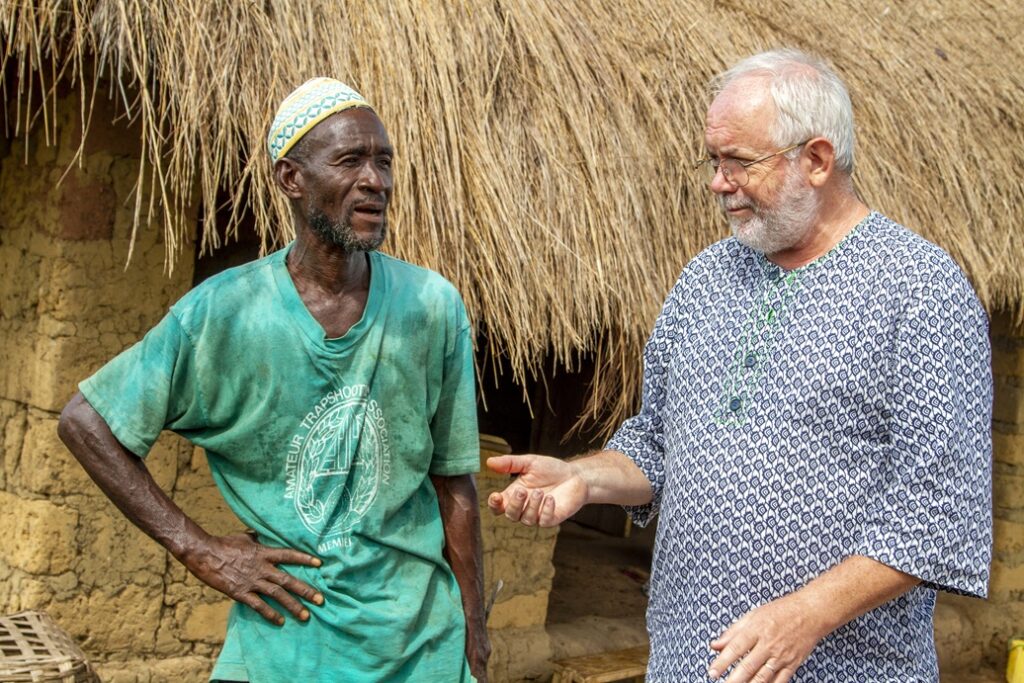
Summary: Patronage relationships are common in many cultures. Western missionaries in these environments are often viewed as patrons by default. This can be an uncomfortable role. However, when we understand how reciprocity works in these contexts, we can participate in ways that strengthen local relationships.
By Tamie Davis and Moyra Dale
In 2013, six months into my (Tamie’s) decade in Tanzania, I was asked to be the patroness of a village. I was only passing through and was taken aback by this request. My first instinct was to read this request as a postcolonial power imbalance in which missionaries are wealthy and local people dependent on them.
I wondered how I might avoid such an interaction in the future or transform it to be more equitable. However, both avoidance and transformation approaches assume patronage to be a vulnerability rather than an asset for witness to Jesus Christ.
What if there is another way to resolve this tension? Understanding reciprocity in patronage cultures, is the key. This can help us become what Anne Dyer calls a “positively helpful patron.”[i] In a healthy patronage model, a patron is not exempt from need.
Understanding Patronage
“Our fingers are not all the same,” says an Egyptian proverb, recognizing that people occupy different and uneven positions. In Swahili we say, “Akili ni mali,” that is, “knowledge is wealth,” because there are different things that we can offer to each other, not only money. Patronage relationships reflect these two dynamics.
Patronage relationships take place between two people of unequal status: a patron and a client. They both bring something to the relationship, enabling an exchange. The patron offers access to resources such as material goods, protection, influence, or employment that provide economic, political or spiritual benefit. The client responds with public gratitude, loyalty (even when it is costly, if the patron is out of favor), and sometimes service, gifts, and visits. Thus, patronage is mutually beneficial but not symmetrical: patron and client have different roles that they are expected to fulfil.
A patron who does not provide, who places unrealistic demands on the client or who uses their position to control the client has not fulfilled his or her obligations. A client who takes from the patron without returning a kindness or repaying the favor has likewise failed in his or her obligations.
A healthy model does not disempower the recipient but enables both giver and recipient to make significant contributions to the relationship. This is all held in check by social sanctions of honor and shame which are collectively ascribed on the basis of whether the patron or client lives up to their role. Thus, neither patron nor client is unaccountable.
There is flexibility in patronage roles. Brokers are intermediaries between patron and client. If there is great social distance, a client may be unable to approach a patron. They require someone closer to the patron to bridge that gap and open the pathway to the patron.
In this middle position, a broker’s role is flexible: he or she appears as patron to those lower in status but approaches the one higher in status as a client. A broker will therefore typically deal in both kinds of resources, granting access to money or provisions for their client, and offering loyalty or honor to their patron. They are brokers not only of resources but of trust.
Patronage and Missionaries
Often missionaries do not get a choice about whether or not they are viewed as patrons. It is simply assumed that they will be.[ii] Missionary attitudes to patronage differ. Some see patronage as an asset to their ministry. Others view it as a liability.
Jim Harries of the Alliance for Vulnerable Mission argues that missionaries “should not relate to local people as patrons using foreign money,” because the associated gift-giving “requires deep cultural knowledge and an identity that a foreigner from a different worldview typically does not have.”[iii] While the missionary may be thinking of themselves as generous, Harries identifies that engaging in patronage has a number of negative results.
First, Western missionaries acting as patrons but unaware of local dynamics can be unknowingly co-opted into local disputes without their knowledge or consent.[iv] Second, because clients are required to give patrons honor and loyalty, they may outwardly agree with a Western missionary even when they privately disagree. The Western missionary may have no way of being able to ascertain otherwise. Harries points out that this can even occur at the level of theologizing, with local theologizing being circumvented by the need for local people to agree with Western theology.[v]
Third, this can lead to setting up of ministries that are a poor fit for the local context but which seem appropriate to the Western missionary. This can result in a waste of resources and ineffective discipleship.[vi] With these very great obstacles and vulnerabilities, patronage is viewed as a liability to mission, one which needs countering by models such as vulnerable mission.
Vulnerable mission is “mission carried about by the Westerner in reaching the non-West using the language(s) and resources of the people being reached”[vii] It arose out of a recognition that, “the idea that one could bring positive change to a community using outside money” needed to be challenged because it has entrenched dependency.[viii]
A vulnerable mission model seeks to resolve the complications missionaries encounter in patronage contexts by sidestepping patronage altogether. In a vulnerable mission model, a Western missionary uses only local resources and lives at a local level. To make this sustainable, Harries advocates missionaries keeping two separate worlds: “In one place a VM can be imitating the behavior of the poor… and in another the behavior of westerners.”[ix]
These should not to be secret from one another but provide a way for Western missionaries to communicate Christ in their local contexts without the complication of dealing with patronage, and still blow off steam or keep a family in a Western context.[x] The vulnerable missionary’s acceptance or welcome by local people is not based on financial incentives, so that their offering of the gospel is untainted. Anne Dyer points out that this model has a strong Scriptural foundation, such as in Matthew 10, Mark 6:8–9 and in Luke 10, where the disciples take nothing with them in their missionary work.[xi]
However, James Tino and Derek Chinchen both found that not including patronage in their ministry model diminished rather than increased their effectiveness. In 1995, Chinchen argued that patronage is an “indigenous style of discipling” which is “practiced naturally by many national Christian leaders” and which foreign missionaries can also practice “if they understand the patron-client system found in most non-Western societies.”[xii]
James Tino built on this paradigm in 2008, offering the story of José. Tino saw his relationship with his protégé José wither when Tino refused to be the patron for José’s ongoing farming activities. Tino reflects that he did not realize the implications of José’s requests, lending credence to Harries’ concerns about missionaries needing deep cultural knowledge to navigate patronage relationships.
However, rather than sidestepping patronage as Harries advocates, Tino envisions a different solution, where, in exchange for assistance with his crops, José would certainly have applied himself diligently to his studies and preparation as a church leader … improved his station in life, [and] eventually, he could have become a patron himself, mentoring other young men in the community as Christian disciples.[xiii]
For Chinchen and Tino, patronage can be the means by which longer-term and deeper relationship is secured as the client becomes the patron’s spiritual child, much as the apostle Paul became the spiritual father of Timothy.[xiv] Patronage is a means of investing in a person; a patron’s refusal to participate in it implies investment elsewhere. Such a refusal can be seen as a form of relational withholding.
This raises questions about Harries’ model of having a known double life where the missionary operates “in their local contexts without the complication of dealing with patronage” while keeping separate (withholding) his wealth and even his family.[xv] We suggest that here sidestepping patronage is just as much a liability to mission as patronage itself. Indeed, Tino says, being “unwilling to work within a patron/client system benefits neither the missionary nor the persons to whom they are ministering.”[xvi]
With missionaries viewing both participation in patronage and sidestepping patronage as unsatisfactory for kingdom purposes, Rennae de Freitas suggests instead that a better way may be “embracing and redeeming patronage to better navigate the power imbalance in relationships.”[xvii]
While we applaud the notion of using patronage to navigate relationships, we are hesitant about concluding, as Freitas does, that this is necessary because, “the corrupt patronage systems in the Majority World fall short of offering flourishing, abundant life for the powerless.”[xviii] We suggest that there are elements of patronage itself which can be deployed in the missionary’s life.
Here we follow Tino who argues, “the missiological task is not to attempt to “change the system”; rather it is to identify and understand patron/client relationships and utilize them for the good of the kingdom.”[xix] We suggest that a fuller understanding of the dynamics of reciprocity is one way of utilizing patronage for the good of the kingdom.
Reciprocity
Patronage is an asymmetrical, reciprocal relationship. Both client and patron contribute and receive, albeit different things. In patronage cultures, as in many societies around the world, reciprocity is the fundamental principle that undergirds the movement of material and social resources within societies. In patronage societies, these relationship exchanges are marked by unequal reciprocity, but the inequality does not cancel out the reciprocity.
Reciprocity is a system of gift exchange that is never completely balanced. If both want the relationship to continue, then someone owes, and someone is owed. Exchanging gifts does not constitute a ‘paying off’ of indebtedness. Rather, accepting a gift implies the commitment to return a gift, in what is a further ‘investing into’ the relationship. The aim of the exchange is not independence, but rather interdependence, a mutuality in which gifts do not have to be equal, either in substance or in amount.
This is where patronage differs from charity. Unlike in charity where the recipient’s only role is to receive, in patronage, a client has an obligation to reciprocate in some way.[xx] Indeed, clients who do not reciprocate are transgressing. Chinchen describes the “Big Man Mountain” where clients fulfil various obligations in order to access the patron’s resources.[xxi]
These steps ensure that adequate time is given for patron and client to assess each other’s character, for relationship to be built, and to protect the patron from a constant stream of requests divorced from relationality.[xxii] In the example of when I (Tamie) was asked to be the patroness of the village, my instinct to view it as engendering dependence was correct. The request came with no prior relationship, and since I was only passing through, it had little capacity for reciprocity to be expressed. Reciprocity is a useful paradigm for assessing the genuineness of a relationship.
Reciprocity also implies that it is not only the client who is needy or who gains. The patron is in need of the client’s loyalty, knowledge, or honor. Providing for the client engenders an obligation for the client to reciprocate in some way to meet a need that the patron has. Thus, the patron can be thought of as needy, perhaps not in material security but in relational terms.
A model of patronage where the patron is strong and dominates the client is highly flawed because it puts relationships at risk. A patron who is not vulnerable in some way cannot enter into a reciprocal relationship, the fundamental principle of patronage. Understanding reciprocity highlights the vulnerable aspects of the patron. This is where a vulnerable missionary can exercise patronage, in understanding their own vulnerability even as a patron.
The problem is, as Chinchen says, “American missionaries tend to be self-sufficient. It’s hard for them to be needy. But not to receive from others makes them look superior.”[xxiii] The problematic dynamics of patronage which vulnerable mission has highlighted come from being an inviolable patron instead of a needy patron.
Needy Patrons
Key to harmonizing patronage and vulnerable mission is the recognition that patrons are needy. Western missionaries have many needs when they come to communities. We can often feel like clients in this sense. We need local people to be our patrons: to give assurance of protection to us, open the door into networks of local relationship, perhaps help us to obtain lodging or a visa.
However, it is not the case that whenever we are needy we are in the position of a client, because patrons can be needy as well. As we become more established in a community or if our lifestyle marks us out as those who could be potential patrons, it is essential to maintain that sense of neediness. Chinchen advises, “if you have no needs, invent them. Ask clients to give valuable information in the community, to help with language study and to advise on cultural issues.”[xxiv]
This does two things. First, it indicates to people that you are seeking an ongoing relationship. If you do not have needs, how can they reciprocate to your patronage? The relationship is too one-sided for it to have longevity.
Second, being able to reciprocate preserves the honor of your client; without an opportunity to reciprocate, the client is shamed and the relationship will wither. Reciprocity therefore enables the relationship can continue. Furthermore, as a missionary has needs that are able to be met by clients, relationships are able to deepen and the missionary is able to be further integrated into the community.
I (Tamie) experienced these principles firsthand while my family and I lived in Tanzania. In 2021, Dar Es Salaam experienced an acute water shortage. The street where I lived with my family had no running water for two months. Our only option for water collection was to find a working line somewhere else in the city to re-fill and then transport some 20L water containers.
The problem was that the working line changed every day without public notification or advertisement. Without local networks, it was impossible to obtain water. My family and I had a clear need. A client of our – our bajaji (tuktuk) driver – stepped in to meet this need and offered to get the water for us. He also refused to take any money from us, either reimbursement for the water or payment for his transportation services.
When we asked him about why, he explained that we have a relationship, ‘we help each other out’ (tunasaidiana). By refusing payment, he indebted us to him, thus putting him in a position of giving to us. The amount was negligible compared to our patronage of the driver and thus the exchange was unequal, but the act was significant because it allowed him to reciprocate by giving, thus preserving his honor.
I also found that our neediness led to greater integration in the community. When our home was broken into, our neighbor took it upon himself to investigate the situation. He was involved in local government, at a level which had been previously unknown to us as it is played out primarily at a relational level. He organized the neighborhood watch (of which I was previously unaware) to keep a special eye on our family’s place. This opened up new relationships in our community.
To thank him for this favor, I made him some special baked goods at Christmas. Again, the comment came that ‘we help each other out’ (tunasaidiana). It resulted in him checking in on our family more often, and coming to me more often when he had financial hardship and was in need of funds. Because of our family’s need, our relationship with him was deepened. We were further integrated into our local community, and better able to navigate the relationships and requests for patronage within it.
Conclusion: Generous, Withholding or Needy?
Some forms of patronage by missionaries may be terribly damaging, including when missionaries are naively generous, unaware of the power dynamic at play. However, assuming this means patronage cannot be utilized by missionaries is equally problematic. This can position the missionary as a withholder or divert them away from contextualized discipleship models. Understanding reciprocity within patronage relationships and operating as a needy patron goes a long way to resolving these tensions. This enables a missionary to recognize that it is inevitable that they will be viewed as a patron. However, by positioning themselves as a needy patron, they can deepen relationships and learn to operate within patronage cultures in a way that deepens rather than endangers discipleship
Tamie Davis (tamiesusan@gmail.com) is a CMS Australia gospel worker and lived in Tanzania 2013–2023. She holds a PhD from the Australian College of Theology about the prosperity theology of a group of Tanzanian women.

Moyra Dale (1958–2022) worked in education and ethnography in the Middle East for over two decades. She was the author of Islam and Women: Hagar’s Heritage and co-founder of the When Women Speak network. She held a Doctor of Theology from Melbourne School of Theology as well as a PhD in education from La Trobe University.
[i] Anne Dyer, “A Discussion of Vulnerability in Mission for the Twenty-first Century from a Biblical Perspective,” Transformation 34, no. 1 (2017): 38–49.
[ii] James Tino, “A lesson from Jose: understanding the patron/client relationship,” Evangelical Missions Quarterly 44 no. 3 (2008): 320–327; Robert Oh, “Patron-Client Dynamics Between Korean Missionaries and Cambodian Christians,” Asian Missions Advance 48 (2015): 12–19.
[iii] Jim Harries, Theory to Practice in Vulnerable Mission: An Academic Appraisal (Eugene: Wipf and Stock, 2012), 1; Jim Harries, “Sidestepping Patronage with Vulnerable Mission,” paper presented at the Patronage Symposium, Beirut (October 4, 2018), 2.
[iv] Harries, Theory to Practice, 98.
[v] Jim Harries, “Enabling the Majority World to Benefit from ‘Superior’ Western Theology,” Currents in Theology and Mission 44 no. 2 (2017) 16–19.
[vi] Harries, Theory to Practice, 97.
[vii] Harries, Theory to Practice, xix. David Williams suggested an alternative definition in 2019, building on Eleanora Hof’s critique that vulnerable mission does not seek the participation of “non-Westerners.” He suggests instead, “Vulnerable mission argues that mission should take place in the language of the hearers and should empower the local church to care for the poor within its community using its own gifts and resources,” in David Williams, “Toward a Worldwide Theology of Vulnerable Mission,” Missio Dei 10, no. 2 (2019), accessed 8 September 2023, https://missiodeijournal.com/issues/md-10-2/authors/md-10-2-williams.
[viii] Harries, Theory to Practice, 41, 42.
[ix] Harries, Theory to Practice, 102.
[x] Harries, Theory to Practice, 105.
[xi] Dyer, “A Discussion of Vulnerability,” 41.
[xii] Delbert Chinchen, “The Patron-Client System,” Evangelical Missions Quarterly 41 no. 4 (1995): 446–451.
[xiii] Tino, “A Lesson from Jose,” 324.
[xiv] Chinchen, “The Patron-Client System,” 451.
[xv] Harries, Theory to Practice, 105. A weakness of this suggestion is also that it assumes a male missionary and places his wife and children in the non-vulnerable, non-mission world, excluding them from mission except as auxiliaries.
[xvi] Tino, “A Lesson from Jose,” 323.
[xvii] Rennae de Freitas, “Power and Partnership: Implications of Redeemed Patronage in Missional Context,” Missiology 51, no. 3 (2023): 258–67.
[xviii] de Freitas, “Power and Partnership,” 265.
[xix] Tino, “A Lesson from Jose,” 323.
[xx] Jayson Georges, Ministering in Patronage Cultures: Biblical Models and Missional Implications (Downers Grove: IVP Academic, 2019), 323.
[xxi] Chinchen, “The Patron-Client System,” 448.
[xxii] It is different to the dynamic Ethiopian Mekdes Haddis describes where the appreciativeness of recipients obscures rather than clarifies the relationship. Mekdes Haddis, A Just Mission: Laying Down Power and Embracing Mutuality, (Downers Grove: Inter Varsity Press, 2022), 127.
[xxiii] Chinchen, “The Patron-Client System,” 450.
[xxiv] Chinchen, “The Patron-Client System,” 450.
EMQ, Volume 60, Issue 1. Copyright © 2024 by Missio Nexus. All rights reserved. Not to be reproduced or copied in any form without written permission from Missio Nexus. Email: EMQ@MissioNexus.org.




