EMQ » July–September 2023 » Volume 59 Issue 4
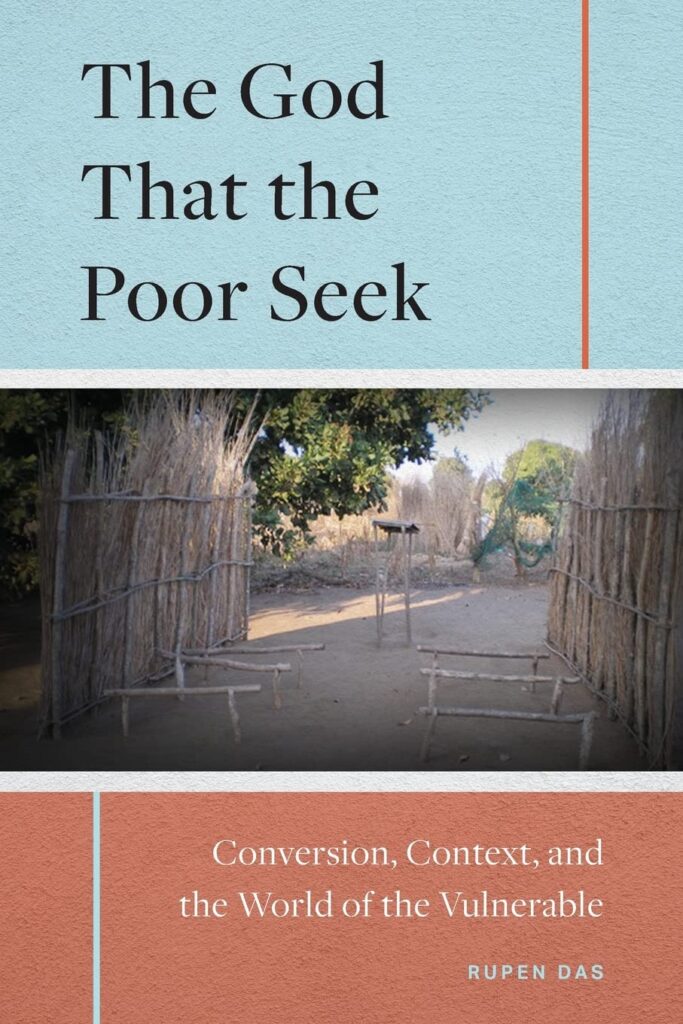
The God that the Poor Seek: Conversion, Context, and the World of the Vulnerable
By Rupen Das
Langham Global Library, 2022
248 pages
US$25.99
*As an Amazon Associate Missio Nexus earns from qualifying purchases.
Reviewed by L. Lynn Thigpen, PhD, adjunct professor, Liberty University, Lynchburg, Virginia, and emeritus IMB missionary to Southeast Asia.
After meeting a man who came to Christ through a dream, Rupin Das, executive director of the Canadian Bible Society, struggled because he found people “were encountering Christ in ways that were different from what traditional Christian and evangelical theology and recent missional practice constituted as conversion” (2). In eight chapters, The God that the Poor Seek explores this journey and “what the poor, the victims of human trafficking and abuse, and the refugees think about God”(xxviii). Researching “event-based poverty” among Syrian refugees in Lebanon, as well as chronic poverty among slum dwellers in Bangalore, India, Das discovered the majority converted because of the presence and power of Christ.
The research for the book focused on those who had truly changed their allegiance from one religion to following Christ (Bates). The study is honest and searching, thorough, and with extensive footnotes, albeit most of the material is a bit dated due to some historical explorations of poverty ministry, conversion, and contextualization. Ultimately and most importantly, Das is respectful of the personal narratives of his participants.
After his introduction and second chapter exploring conversion, Das addresses context and asks in the third chapter, “Is there a culture of poverty that requires contextualization?” (91) After a lengthy discussion of the topic, Das concludes, “Poverty has a unique physical, sociological, and psychological impact on the poor in any location … thus making the context and culture of the poor in that location different than that of the nonpoor surrounding them” (95).
Chapter four considers the difficulties in hearing the voices of the poor – the obstacles of illiteracy and orality, power distance, and misconceptions. Harking to liberation theology and empowerment, Das explores “the challenge of listening to the poor” (107) and the need for understanding and dialogue.
The meat of his book consists of two chapters sharing the conversion experiences of his participants, something reminiscent of the World Bank series Voices of the Poor. Following these “voices of the poor,” Das takes a phenomenological approach in chapter seven. Synthesizing the narratives of participants from two very different settings and religious backgrounds, he believes the stories predominantly focus on an imminent and accessible God. A thorough exploration of the data also unearths an undeniable theme of peace.
In the final chapter, “Immanuel: The God that the Poor Seek,” Das concludes, “The poor we interviewed despaired because the deities they worshiped had failed them” (194). In contrast, God “heard their prayers, cared about their needs, and was present with them” (201). To these converts, God was found to be “accessible, caring, and compassionate, a God who responded to their poverty and dire circumstances” (191).
Anyone working with the poor should explore this research. Whether charismatic or not, those working with the vulnerable will find in these pages direct advice from their audience, voices that deserve to be heard.
For Further Reading
Salvation by Allegiance Alone: Rethinking Faith, Works, and the Gospel of Jesus the King by C. J. Baker (Baker Academic, 2017).
Transformative Religious Experience: A Phenomenological Understanding of Religious Conversion by Joshua Iyadurai (Pickwick Publications, 2015).
Mission in the Spirit: Towards a Pentecostal/Charismatic Missiology by Julie C. Ma and Wonsuk Ma (Regnum Books International, 2010).
Crying Out for Change: Voices of the Poor by Deepa Narayan, Robert Chambers, and Meera K. Shah (World Bank Publications, 2000).
EMQ, Volume 59, Issue 4. Copyright © 2023 by Missio Nexus. All rights reserved. Not to be reproduced or copied in any form without written permission from Missio Nexus. Email: EMQ@MissioNexus.org.