EMQ » July–September 2023 » Volume 59 Issue 3
[mepr-show rules=”100329″]
Summary: Michael Stroope’s book, Transcending Mission, offers a semantic challenge on the use of the words mission, missionary and missional. He believes we distort history when we use these words to describe biblical people and activities. Using a cognitive linguistic lens, we can evaluate his claims against the way people develop complex schematic networks which help them assign meaning to words. This may lead us to consider that these words may have broader meanings when understood within their appropriately described context.
By Phil King
Was Paul a missionary? And more worryingly, what might today’s audiences infer if you call him one? Would they presume he was like missionaries they know: full-time religious professionals, sent by an organisation to convert the unreached?
These are key concerns for Michael Stroope’s Transcending Mission (2017),i centred on a question of semantics: what do the words mission, missionary and missional mean? He argues that since these words only appeared in the modern era, we distort history when they describe biblical people and activities.
For Stroope, the words we use influence how we perceive the past, and mission language “poisons” those perceptions. If language helps us look at history, he claims that mission is “murky” language,ii a “marred” lens,iii that “clouds” rather than “clarifies.”iv
Or, if language helps us “hear” the past, mission language “infuses” Scripture with “disturbing noise,”v “muffling” the gospel and its implications.vi He is even stronger with taste metaphors: mission language is “contaminated and therefore less than fit to drink,”vii it “pollutes our understanding” and “poisons our interpretation.”viii
Stroope follows a long tradition of linguistic relativity, which emphasises that words do affect how we see the world. As Sapir noted, “the worlds in which different societies live are distinct worlds, not merely the same world with different labels attached.”ix
So, if we give a contemporary English label (missionary) to Paul (a first-century, Greek-speaking Jew), we are not just playing with words. At best, we domesticate his world. At worst, we are twisting it to support our own agendas, claims Stroope: “Mission and missionary are more than simple terms, neutral concepts or bare facts… mission constructs reality in a particular way.”x However, Sapir’s assertions have been hotly debated: just how much influence does language have? Does it determine our thoughts, or merely channel our mind down certain pathways?
We need a lens to further evaluate Stroope’s claims about language and it’s meaning. Cognitive linguistics provides that. Through it, we can explore how we each acquire meanings for words like mission, and how we draw inferences from utterances, like the claim that Paul was a missionary.
Meaning is in Heads, Not Words
First, cognitive linguistics emphasises that meaning is not located in words; rather, it is inferred in individuals’ minds. So, words mean different things to different people. We are not all born with the same dictionary in our heads.
However, we often talk as if words do contain some kind of disembodied, proper meaning, irrespective of who uses them.xi This clearly influences Stroope, describing mission as a “dense term that… hides a host of currents in its depths,”xii or bemoaning the “inherent understandings existing already within the term.”xiii
Cognitive linguistics, by contrast, suggests we each construct our own schematic mental network associated with a word as we use it and connect it with our experience. Thus, word meanings differ from individual to individual, based on our different embodied experiences. This counters Stroope’s contention that word meaning “exists in the mind, long before what we mean by the word is touched or seen in the real world.”xiv
Central to the schematic network model is our ability to recognise prototypical examples of a concept. For example, we each build up a prototypical image of missionaries from our childhood exposure to them. In a Western church, this may be a person who shows up occasionally with exotic slides; for a child in rural Papua New Guinea, it may be the outsider with medicines and a car.
Our brains also spot things that are similar to the prototype, and abstract the common features, expanding our concepts to cover both the prototype and the new, similar kind of thing. For example, if I hear that my friend Tyler is a missionary and Paul is also a missionary, my mind seeks similarities, and my concept of missionary expands to include both.
Langackerxv and Taylorxvi illustrate with an American child learning the concept TREE. First, she hears her parents talk about trees in her surroundings, and builds up a prototype, TREE, of a deciduous tree, with a typical shape and leaves that fall in winter. Then she hears conifers also described as trees, and forms a more schematic image, TREE, to cover both her original prototype and this new shape, with evergreen leaves.
Then, palm trees are encountered and again the network grows, seeking a schema that can include palms, alongside conifers and oaks. The process carries on as she encounters trees in other domains, such as genealogical trees.
Importantly, a child growing up in Papua New Guinea surrounded by palms, or in Finland surrounded by evergreens, would end up with a different schematic network of TREE, structured around different prototypes. In this model, words are points of access into complex schematic networks in individual minds, rather than abstract, disembodied containers of meaning.
A similar process happens for mission. Stroope recognises this for his own concept of mission,xvii developing from his initial childhood prototype of going to people in faraway places to rescue them from eternal damnation to one that incorporated examples he encountered through life or literature, where missionaries also coerced and conquered. Figure 13.1 uses this approach to model Stroope’s mental concept of mission.xviii
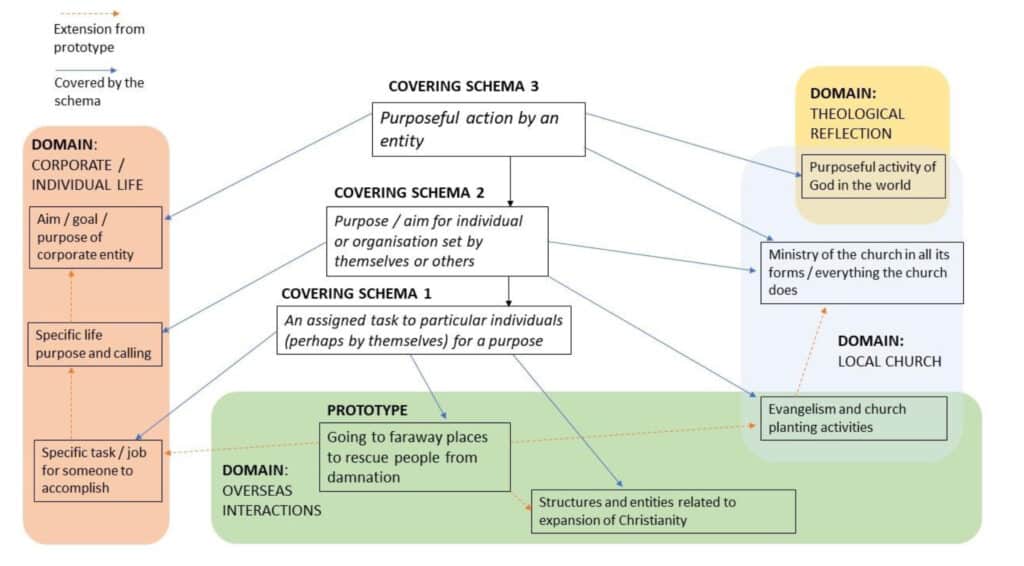
The highest level of abstraction is that of purposeful activity by an entity, covering the word’s uses in the other different domains: corporate life, theological reflection, the local church, and overseas interactions. This diagram illustrates how complex and interconnected our mental concepts are, based on prototypes and covering schemas, not simply a set of different senses from which we choose.
Whilst the diagram may have similarities for people with a shared culture, there would also be differences based on their experiential prototypes, and what they have heard or read. For example, the prototype for mission for a young person in my current church may well connect to local community engagement, not travelling overseas.
Stroope’s own concept of mission developed as he encountered its different uses. Similarly, our languaged experience of life is more important for building our concepts of mission than etymology, historical usage, or dictionary definitions.
This process of concept development within individual minds means that a quest for “precision” in meaning, and “coherent and clear” usage,xix will always fail. Whilst Stroope has justifiable concerns about the assumptions that the word mission “carries with it,”xx the problem lies not in the word itself but with the associated mental models in individual minds.
The Power of Cognitive Frames
Cognitive linguists are very interested in the experientially-based cognitive structures (or knowledge frames)xxi associated with words. Typically, when we hear a word, it evokes this whole frame.xxii
A frequently-discussed example is the restaurant script.xxiii When I say “I went to a restaurant,” your knowledge frame about restaurants is activated, and (if you share similar cultural experiences to me) you can understand if I mention “the waiter” or “the menu.” You also expect that the bill will be paid, and that I (probably) went there to eat. That is, just the word restaurant already evokes certain participants, interactions, a typical sequence of activities, and the purposes of those involved.xxiv
This is normal for any word: our life experiences create knowledge frames that we use to interpret new experiences. And, these frames are as different as the embodied experiences we have. A British restaurant owner’s knowledge frame would be very different from that of a Papua New Guinean child. Such frames have a powerful effect on the inferences we make when a word related to that frame is used.
So how does this apply to mission language? Each of us has lived experience of hearing or reading about mission. These experiences form knowledge frames that we use (subconsciously) to interpret other uses of the word, whether that is prototypical expectations about who is doing something, why they are doing it, or a typical script of activities and purposes. If someone shares Stroope’s schema (figure 13.1), the mission frame would at least evoke a specific goal, and perhaps the idea of “task, assignment or organised work”xxv to complete it.
Stroope is concerned because numerous biblical and historical figures (such as Jesus, Paul, Patrick, Columba, Gregory, and Francis) did not see themselves as involved in mission according to this frame. Often, they did not set out on a purposeful task, but lived a life of witness wherever they went. Stroope even questions the mission of God, as the Bible does not talk about God and his purposes this way. He claims that doing so runs the risk of us understanding God’s action in the world through our own schemas of mission.xxvi
This has consequences for us, too. Our knowledge frame of mission could mean we expect that we need to be sent on a task to purposefully transform the world if we are to follow these early Christians, rather than just living lives that witness to God and his transforming power.
The Importance of Context and Inference
Do these knowledge frames mean we must agree with Stroope that this language is “poisonous” and should not be used to describe the early church? When we describe Paul as a missionary, are our hearers constrained to interpret him through the lens of a modern full-time professional tasked with evangelism?
Certainly, the power of our cognitive schemas means there is real danger of jumping to unwarranted conclusions. To explore this further, we need to consider closely how people infer meaning from words in context.
First, we must recognise that language always underdetermines meaning;xxvii it is never precise, whatever words we use. When we try to communicate, we say less than we mean, expecting our hearers to fill in the rest based on our assumptions of shared knowledge.xxviii
For a word like missionary, the schematic network for my concept will almost certainly be different from yours. However, when I use the word missionary in a sentence like “Paul was a missionary,” I hope I have given you enough of a clue to work out what I was intending to communicate about Paul. Your ability to do this depends on the extent to which you can imagine the concept of missionary I intended.
One model of communication claims you infer what I intended to communicate based on what seems most relevant to you in the context.xxix Your mind chooses the interpretation that has the most significance for you whilst expending the least mental processing effort. So, if there are insufficient clues to prompt more mental effort, you will assume that I am intending the concept of missionary that is most salient for you.
As a result, you may end up inferring various “weak implicatures”xxx from your mental knowledge frames, such as the possibility that Paul was a full-time professional, living off support from the church. Stroope describes similar miscommunication, where “the speaker wants his hearers to consider God’s personal call to participate in redemptive activities wherever they live and whatever they do professionally…, but they hear that the speaker wants them to become professional evangelists and church planters in a foreign country.”xxxi
However, our minds do have a tremendous ability to create ad-hoc concepts.xxxii While frames constrain how we habitually think, we can also infer different meanings for words in different contexts, provided there are sufficient cues to put in extra processing effort.
For example, adding “kind of” to our utterance, “Paul was a kind of missionary,” would be an obvious cue to spend extra effort thinking about the points of similarity between my existing conceptualisations and Paul’s activities. The more cues built up through ongoing discourse about the difference between biblical and early church activities and mission during the modern era, the more likely it is that a hearer will be able to infer an appropriate concept of mission in each context.
Consider the word church as a parallel example. The knowledge frame for church for a contemporary Brit would prototypically include a building where people gather every week. So, when they read of the “angel of the church in Ephesus” (Revelation 2), they may infer (incorrectly) that the believers met in a dedicated building.
Yet, we do not remove the word church from our discussion of life in the first century. Rather we make sure we teach about the difference between the early church and our modern prototypes. Few would say that our understanding of those early gatherings in Ephesus are “polluted” and “poisoned” by the fact that the church has often been an agent of oppression in the intervening centuries.
Similarly, the biggest issue when talking about mission and missionaries in the Bible is the difference between individuals’ mental prototypes today and the reality of the biblical era. However, perhaps we can still use these words if we pay attention to how they are used and give cues to differences in context.
Stroope helpfully highlights the lack of explicit discussion of the difference between mission and missionary in the biblical and pre-modern period and more contemporary prototypes, and suggests this difference be emphasised much more in both technical and lay discourse. And he may be correct that there are some people and activities in biblical and pre-modern eras that are so far from our contemporary prototypes of mission and missionary that using these words to describe them is more misleading than helpful.
However, Stroope’s own conclusion is that we replace mission language with “better” language, that is “distinct in its language and manifestation, distinguishable from all other action and speech.”xxxiii His proposal is “Kingdom of God” language, and “witness” to it. Using this alongside mission language could broaden people’s perspectives on how God is interacting with his world.
However, kingdom of God language has the same limitations as mission language. Hearers will interpret it primarily through their own prototypical frames. For people familiar with the history of the United Kingdom, there is surely just as much chance of this language “polluting” their interpretation of God’s kingdom as there is for mission language?
Does it suggest a physical location ruled by a king? Colonial empire? Oppressive rule? History certainly challenges Stroope’s claim that “people and objects can only point to the kingdom and never build, control, create or manipulate it.”xxxiv Unfortunately, whatever words we choose, they will always underdetermine the meaning we intend, and there will be miscommunication and unwarranted inferences.
Conclusions
What can we learn from Stroope’s linguistic reflections on mission? Here are three suggestions:
1. Recognise the importance of words. They have the power to evoke complex knowledge frames, and encourage hearers to infer conclusions about participants, causes and purposes associated with a concept, based on their own experience. We cannot use mission to say what we mean, without thinking about the prototypical concepts in the minds of those we address, and the (potentially unwarranted) inferences they are likely to draw.
2. Be realistic about how words work. The complex structuring of mental concepts in our minds means no language is unambiguous or precise. Words provide entry points into these lexical networks, and there will always be a high likelihood of miscommunication as people work out what we are trying to say to them. Respecting this reality, the inevitable “murkiness” of any communication, is the first step to communicating more effectively.
3. Take context seriously. Context is the most significant factor in guiding people to their interpretation of the words we use, so using contextual cues can help clarify what we are intending to communicate. If we give sufficient cues, hearers may deduce that we are using a word in ways that differ from their prototypical frame and begin to explore what those differences are.
Thus, if we desire people to distinguish God’s activities through his people in the Bible and pre-modern era from contemporary prototypes of mission, we need to enrich their context, and provide resources to highlight the differences between, for example, “pilgrim witnesses” and “vocational missionaries.”
And Stroope’s book is an excellent tool for doing just that.

Phil King (phil.king@moorlands.ac.uk) worked with SIL International in Papua New Guinea for 15 years and has a PhD in Hebrew semantics. He currently teaches semantics and pragmatics at Moorlands College in the UK.
[1] Michael W. Stroope, Transcending Mission: The Eclipse of a Modern Tradition (Apollos, 2017).
[1] Stroope, Transcending, 27.
[1] Stroope, Transcending, 51.
[1] Stroope, Transcending, 72.
[1] Stroope, Transcending, 349.
[1] Stroope, Transcending, 353.
[1] Stroope, Transcending, 175.
[1] Stroope, Transcending, 226.
[1] Edward Sapir, “The Status of Linguistics as a Science,” Language 5, no. 4 (December 1929): 209.
[1] Stroope, Transcending, 150.
[1] Michael J. Reddy, “The Conduit Metaphor: A Case of Frame Conflict in our Language about Language” in Metaphor and Thought, ed. Andrew Ortony, 2nd ed.(Cambridge University Press, 1993), 164–201.
[1] Stroope, Transcending, 2.
[1] Stroope, Transcending, 67.
[1] Stroope, Transcending, 10.
[1] Ronald W. Langacker, Foundations of Cognitive Grammar: Volume 1, Theoretical Prerequisites (Stanford University Press, 1987), 373–386.
[1] John R. Taylor, Cognitive Grammar (Oxford University Press, 2002), 138–139.
[1] Stroope, Transcending, xiii–xiv.
[1] The model is based on descriptions in Stroope, Transcending, Prologue and Chapter 1.
[1] Stroope, Transcending, 169.
[1] Stroope, Transcending, 351.
[1] E.g., Charles Fillmore, “Frame Semantics” in Cognitive Linguistics: Basic Readings, ed. Dirk Geeraerts (Mouton de Gruyter (2006), 373–400; Roger C. Schank and Robert P. Abelson, Scripts, Plans, Goals and Understanding: an Inquiry into Human Knowledge Structures (Erlbaum, 1977); George Lakoff, Women, Fire and Dangerous Things: What Categories Reveal about the Mind, (University of Chicago Press, 1987).
[1] John R. Taylor, Linguistic Categorization, 3rd ed.(Oxford University Press, 2003), 91.
[1] Friedrich Ungerer and Hans-Jörg Schmid, An Introduction to Cognitive Linguistics, 2nd ed. (Pearson, 2006), 214–217.
[1] George Lakoff and Mark Johnson, Metaphors We Live By (University of Chicago Press, 2003), 81.
[1] Lakoff and Johnson, Metaphors, 82.
[1] Lakoff and Johnson, Metaphors, 16–18.
[1] Robyn Carston, Thoughts and Utterances: The Pragmatics of Explicit Communication. (Blackwell Publishing, 2002), 15–93.
[1] Raymond W. Gibbs, Jr., Intentions in the Experience of Meaning. (Cambridge University Press, 1999), 47.
[1] Dan Sperber and Deirdre Wilson, Relevance: Communication and Context, 2nd ed. (Blackwell, 1995); Billy Clark, Relevance Theory (Cambridge University Press, 2013).
[1] Clark, Relevance, 235–239.
[1] Stroope, Transcending, 12.
[1] Robyn Carston, Thoughts and Utterances: The Pragmatics of Explicit Communication (Blackwell Publishing, 2002), 320–375.
[1] Stroope, Transcending, 362.
[1] Stroope, Transcending, 361.
EMQ, Volume 59, Issue 3. Copyright © 2023 by Missio Nexus. All rights reserved. Not to be reproduced or copied in any form without written permission from Missio Nexus. Email: EMQ@MissioNexus.org.