EMQ » April–June 2023 » Volume 59 Issue 2
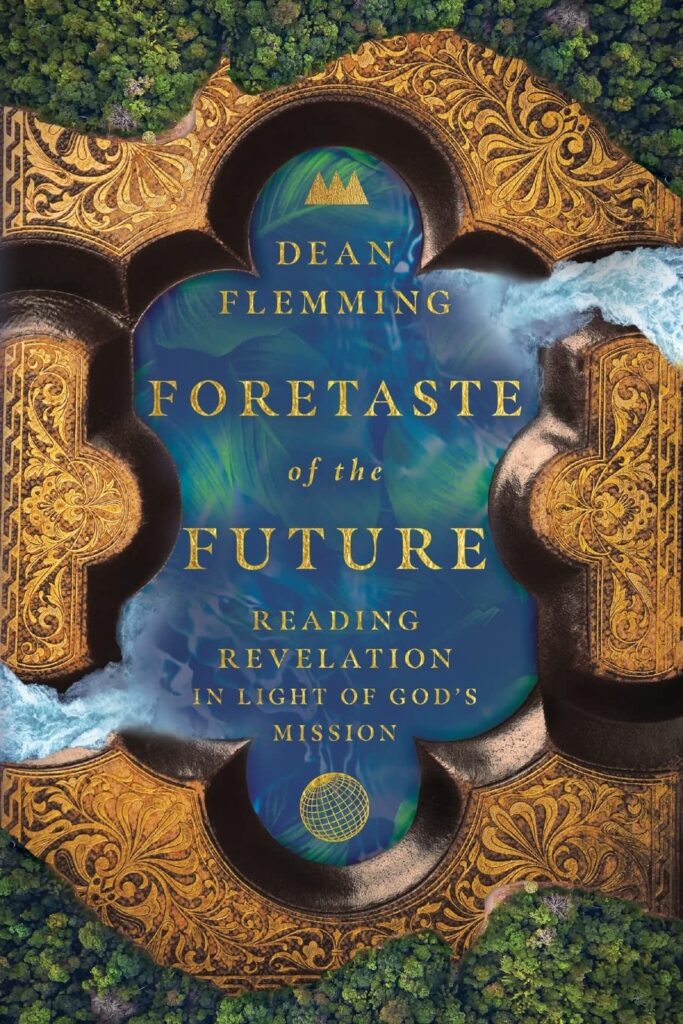
Foretaste of the Future: Reading Revelation in Light of God’s Mission*
By Dean E. Flemming
IVP Academic, 2022
245 pages
US$28.00
*As an Amazon Associate Missio Nexus earns from qualifying purchases.
Reviewed by David Greenlee, PhD, missiologist with Operation Mobilization, Tyrone, Georgia.
Dean Flemming’s Foretaste of the Future offers us a fresh, missional reading of Revelation, referred to by the publisher as the first missional reading of Revelation as a whole. Professor Emeritus of New Testament and Missions at MidAmerica Nazarene University, his insights are shaped by twenty years as an educator in Asia and Europe, the book flavored by quotations from Africa, Asia, and Europe.
Reading Revelation missionally means reading “from the back, in light of God’s ultimate purpose for all people and for creation.” (208) Although we read shaped by the future, we do so as followers, not forecasters. We should read as multinational communities of witness and worship, focused on God, shaped by the story of the slaughtered Lamb.
Guiding Flemming’s approach is the idea that “John’s primary goal in Revelation is not to predict the future but to shape faithful, missional communities – congregations of Jesus followers who worship the one true God and bear witness to what God is doing in the world.” (20) The apocalyptic imagery is not code but symbols that would be “obvious to people living in the Roman world of John’s day.” While codes tell us what something refers to, symbols go deeper, operating at multiple levels. As such, John’s language “functions more like poetry than prose” (18).
Central to Revelation are the two repeated themes of the throne of God and the Lamb. God’s throne and declarations of his sovereignty point to hope and the universal scope of God’s purposes. A missional reading of Revelation further “invites us to embrace the paradox of a crucified conqueror, a strong Lion who redeems as a slaughtered Lamb” (73). Lamb-like mission means that our lives and witness will be accompanied by woundedness and suffering, not just by power.
Flemming reminds us that Revelation is a letter written with a specific message for seven specific churches. Just as John wrote with a message for each church “we must allow Revelation to speak a context-specific word to churches within their life settings today” (81). While pointing to our future goal this message to the seven churches gives us, as well as those first recipients, a picture of “who we must become here and now … by the Spirit’s power, … a foretaste of the future in the midst of the dark places of our world” (97). As such, Revelation’s call is for public witness to Christ for the sake of the world, is a witness that is both verbal and embodied.
I warmly recommend Foretaste of the Future. While many of us see the missional implications of passages such as Revelation 5:9, Flemming opens up missional themes across every chapter including exploration of worship, judgment, politics, and creation. Beyond individual reading or as a guide for group study, theology and missions studies faculty will find it an important resource. Flemming writes with a smoothly flowing style. His emphases and content will also make the book attractive to audiences outside North America, however global distribution may be limited by availability and price.
For Further Reading
Unveiling Empire: Reading Revelation Then and Now, The Bible and Liberation Series, by Wes Howard-Brook and Anthony Gwyther (Orbis, 1999)
The Incomparable Christ, by John Stott (InterVarsity Press, 2004)
EMQ, Volume 59, Issue 2. Copyright © 2023 by Missio Nexus. All rights reserved. Not to be reproduced or copied in any form without written permission from Missio Nexus. Email: EMQ@MissioNexus.org.