EMQ » Oct – Dec 2024 » Volume 60 Issue 4
Including the Marginalized
Summary: At least 16% of the world’s population has a disability, and only 5–10% of them have heard the gospel. This makes people with disabilities the world’s largest unreached people group. Furthermore, people with disabilities who are followers of Jesus are rarely included in the work of spreading the gospel to others. This is not the way of God as demonstrated in Scripture. A more inclusive view of the missio Dei needs to inform our missiological strategies and methods.
By Kim Kargbo
I have worked in disability ministry overseas for over 20 years. I did not come into it through a sense of calling or a particular interest in disability. Like most people, my life had not been significantly impacted by disability, yet the Lord made clear that this was the path. It has been a journey of learning, loss, and sometimes suffering, paralleling in a small way, the journey of the people I serve.
Early in my ministry leadership, I realized that I did not have a very clear or extensive understanding of what God says about disability. So, I began highlighting every mention of disability in Scripture to see what I could learn. What I found blew me away. The number of references to disabilities and people with disabilities in the Scripture is staggering and deserves our attention.
How is it that the church writ-large over the centuries has made much of brief mentions of things like wine and drunkenness or women’s clothing with extraordinary amounts of teaching, and has largely ignored the plethora of commands and ministry mandates regarding disability? Our negligence is costly.
The World Health Organization estimates that at least 16% of the world’s population has a disability, with higher numbers in poorer countries.[i] That equates to over 1.3 billion people worldwide. And yet only 5–10% of those people have heard the gospel. This makes them the largest group of unreached people in the world.[ii] The reasons for this are many, but none offer a plausible excuse for followers of Jesus.
Not only are people with disabilities not reached with the gospel, those who are followers of Jesus are rarely included in the work of spreading the gospel to others. I was unable to find data on the number of people with disabilities in missions. The other disability ministries I checked with, including Joni & Friends (JAF), also reported that they had been unable to locate such data. JAF had even been in conversation with the Barna Group about the need for this data, but Barna never responded.[iii]
This is not the way of God as demonstrated in Scripture. Throughout history, God has consistently engaged people with disabilities in the missio Dei. Not only has God sought out those with disabilities for their own healing and restoration, proclaiming to them the good news that they are valued and forgiven, he has also invited them, along with all followers of Jesus, to share the good news of love and deliverance to others.
The Scripture is replete with references to people with disabilities being healed, restored, spiritually renewed, and sent out.[iv] In addition to many stories involving people with disabilities, God also frequently references the restoration of those with disabilities as signs of his divine work among God’s people and the nations.[v] This inclusive view of the missio Dei needs to inform our missiological strategies and methods.
Mephibosheth Receives a Place to Lead (1 Samuel 9:1–13)
After a long game of cat-and-mouse between Saul, the king whom God had rejected[vi] and David, the king whom God had appointed,[vii] David finally took the throne of Israel.[viii] To secure the throne, newly crowned kings in this time usually annihilated remaining male members of the predecessor’s family. However, David, in a Christ-like fulfillment of the covenant he made with Saul’s son, Jonathan,[ix] took Jonathan’s disabled son, Mephibosheth, as his own son.[x]
David does not relegate Mephibosheth to a place charity and benevolence, which would rob Mephibosheth of his dignity as an image-bearer. Instead, David bestowed Mephibosheth with honor and wealth, and provided him with a dignified means to sustain himself and his family by giving him leadership responsibility.
According to Dave Deuel, “David’s provision is a missing piece in the world of disability in the local church. Called and gifted people with disabilities are forbidden many leadership roles because their calling and giftedness are questioned or flatly denied.”[xi]
People with disabilities deserve to serve in positions of leadership in all aspects of church body life, including the fulfillment of the Great Commission. We can follow the example of David in not only welcoming them into the family as fellow members of Christ’s body but giving them a place to serve and lead.
However, to do that effectively, we need a significant adjustment in our attitudes and ideas about disability itself, the people that live with it, and the value and capability that they have for doing the work of God. Jesus was on a mission to redefine these ideas throughout his earthly ministry.
Man Born Blind Reveals Blindness of Spiritual Leaders (John 9)
Jesus dismantled the boxes that his people had created for who could be included in the missio Dei. He continuously (and usually patiently) realigned their misguided thinking, expanding the margins of the scope of his love and redemptive power.
In John 9, Jesus heals a man who was born blind. Jesus uses this miracle to reorient our perception of blindness from a physical impairment to something that prevents our spiritual sight and understanding regarding God’s inclusive glory. He flips the script on the Pharisees who refused to give the man who was born blind access to worship, calling out their own spiritual blindness.
This highlights the exclusionary practices of the religious institutions of the day. The man was an outcast, presumed to be cursed by God, but Jesus unequivocally includes him. However, even the man’s healing does not welcome him into the fellowship of the synagogue. Ironically, the man’s physical and spiritual restoration results in his excommunication from the institutionalized religious structures and community, and in further distancing him from his own family.[xii]
Jesus does not take kindly to people being barred from access to worship or from community in general. As he did in this passage, he looks for those on the margins, particularly those with disabilities, and draws them in, often to the dismay of those around him.
People with disabilities are still barred from access to worship through physical barriers in church buildings, through inaccessible worship practices, and through the attitudes of congregants. Jesus’s message has not changed.
We claim to be those who see, and thus we are without excuse.[xiii] Our eyes need to be unveiled to the people with disabilities who are conspicuously missing from our fellowship, our worship services, and our mission agencies. God uses unlikely people to accomplish his work in this world and proclaim his great power.
Four Lepers Proclaim God’s Deliverance (2 Kings 7:1–20)
After losing the war with Israel because of the Lord’s deliverance, the Syrians were wreaking havoc throughout the land and moving on to Samaria. The city of Samaria was besieged to the extent that people were eating their own children. The king sent a messenger to Elisha to ask for assistance. Elisha prophesied that by the next day food would be plentiful.
The twist in the story is who God chose to be the bearers of this good news. Four lepers, men with disabilities who had been driven from the city to survive outside the gates, discovered the abandoned Syrian camp filled with food and riches. As they began to stash the plunder, they became convicted of their own greediness and returned to bring the good news of God’s salvation to the entire city. The powerless and under siege king of Israel receives his deliverance from the powerful proclamation of four outcast lepers.
Throughout Scripture, God chooses “what is foolish in the world to shame the wise” and “what is weak in the world to shame the strong.”[xiv] While Elisha announces the defeat of the besieging Syrians, God accomplishes their rescue with no help from any human. Then, in the sovereignty of God, four desperate, disabled outcasts are chosen to “stumble upon” the miraculous deliverance, complete with enough food and wealth to supply the entire starving city of Samaria.
They could have kept the good news to themselves, but they opted to share the good news and the resources with everyone. The king doesn’t believe the lepers when they bring the good news, and his powerful general is killed by the stampede of people running for food.
People in positions of power do not tend to heed good news from those they deem lower than themselves, which is why it is consistently curious that God chooses and uses weak, uneducated outcasts to proclaim the good news to the world. While most people would probably not identify lepers or those with disabilities as appropriate bearers of good news, those are precisely the people that God chooses time and time again to be his messengers.
This begs the question of our modern missionary movement – why are we not incorporating those with disabilities into the Great Commission – not just as receivers of the good news, but as bearers of that news as well? Our own judgements of a qualified candidate for proclaiming the mission of God seem to often stand in opposition to the methods, and the people, that God himself chooses to use.
Making space for people with disabilities in the mission of God, and in our humanly constructed version of it, will require a definitive shift in our understanding. Jesus knew this, and thus made a powerful statement highlighting his priority and our resistance to it when asked to identify himself.
Jesus’ Declares His Identity (Luke 7:18–23)
Scholars, theologians, and pastors frequently highlight Jesus’ emphasis on healing “the sick” as a major component of his mission on earth. However, most of the healing stories in the Gospels reference disability, not illness. In Luke 7, John the Baptist is in prison struggling with doubts. He sends his followers to Jesus to ask Jesus to verify that he is really the Messiah.
Jesus’s response highlights his focus on people with disabilities during his earthly ministry, and he provides them as evidence of his Messiahship. It continues to upend the common understanding of the Messiah and reframe his purpose in the world through a new lens – that of restoring the disabled (blind, deaf, crippled, and lame), uplifting the oppressed, including the excluded, and proclaiming good news to the poor.
Every demographic Jesus mentioned in his response is a form of disability, including “the poor,” which encompasses nearly every person with a disability in that day and in our own, and the dead, the most extreme form of disability. Jesus hangs his very identity on those with disabilities who have encountered him. This is no coincidence.
As Jesus’s friend and cousin, John knew more about Jesus than almost everyone Israel, with the exception perhaps of Mary, Jesus’s mother. Yet when doubt fills John’s imprisoned soul, he seeks proof that Jesus is truly the Messiah. Jesus, in effect, tells the disciples to tell John, “If you want to know who I am, look at the disabled poor among us.”
Jesus drew attention to what was happening among this neglected and marginalized population, but modern missionary movements rarely notice them. And Jesus makes a veiled reference to this as well in his last cryptic statement to John’s disciples, “And blessed is the one who is not offended by me.”
Ministry from the Margins
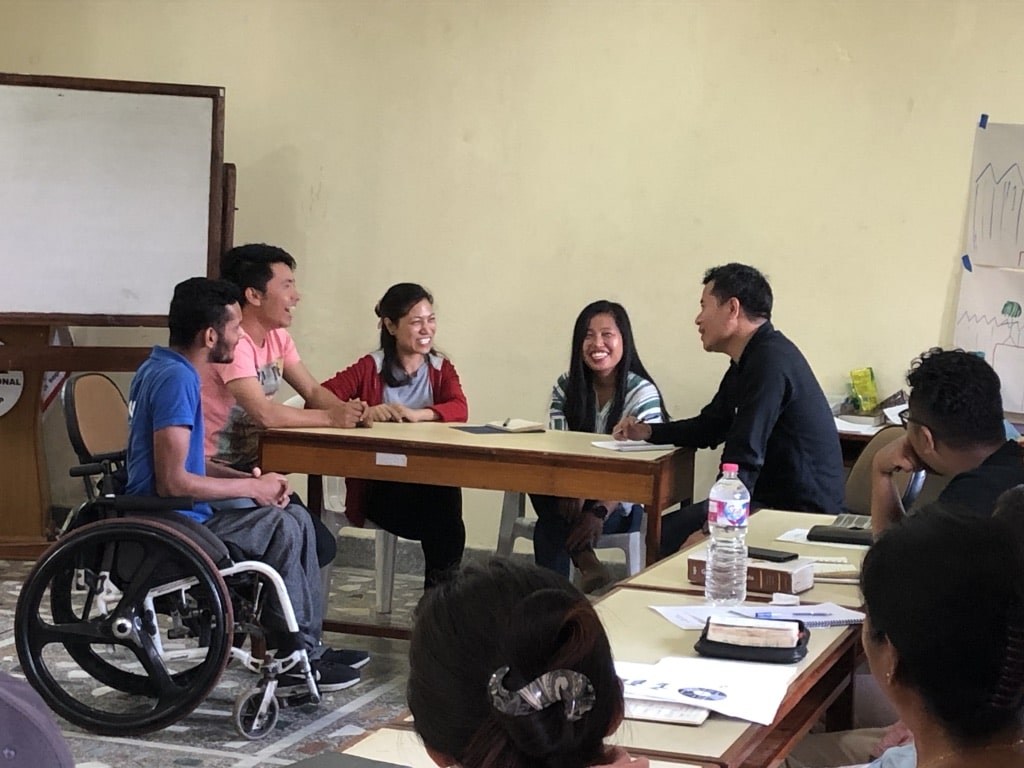
Our modern missionary movement has fallen prey to the measurements of success ingrained in us by our own societal values. We seek the conversion and discipleship of those who are powerful and influential, not those who are weak and disregarded. We believe that movements will go farther and produce better results when we involve the best and the brightest. The idea of focusing on the marginalized is offensive to our metric- and data-driven strategies. This was true in Jesus’ day as well.
This emphasis by Jesus on our need to see and hear what is happening among those with disabilities cannot be ignored. One-seventh of the world is not being reached with the good news of Jesus Christ and the abundant life that he brings because we are not noticing them, and we are not including them. But more than noticing and including, we are not focusing our attention on the discipleship of the least.
The dearth of references to disability among missiological circles rings loud and must be addressed if we are to fulfill the Great Commission. A focus on the weakest and the least influential in society seems counter-intuitive to the goal of “finishing the task.” Yet it is the strategy Jesus used when he invited us to participate in the Great Commission. Is it possible that we have experienced mission drift in our fulfilment of his commission to us? By definition, a commission is a mission with Christ. Are we actually with him in it?
As we have seen in the passages referenced above, God not only calls us to minister to those with disabilities, God calls those with disabilities to minister and lead as well. The goal is co-laboring together for the glory of God and the advancement of the kingdom. God’s power is best displayed in weakness,[xv] and people with disabilities are, by nature, ideal candidates for this. It is time that we evaluate our missiological strategies in light of Jesus’s example and begin to strategize a ministry from the margins that displays God’s glory brilliantly.

Kim Kargbo (kimkargbo@ahint.org)has been co-laboring with people with disabilities for the advancement of God’s kingdom for many years through her leadership of Accessible Hope International (accessiblehope.org). Her passion is seeing ministry leaders flourish as they reach the least and the lost in hard places. Kim has three grown children and engages the mission Dei globally from her home base in central Florida.
[i] World Health Organization, “Fact Sheet on Disability” (Geneva: World Health Organization, 2023), https://www.who.int/news-room/fact-sheets/detail/disability-and-health.
[ii] Lausanne Committee for World Evangelization, “Ministry Among People with Disabilities,” Lausanne Occasional Paper No. 35B (Pattaya, Thailand: Lausanne Committee for World Evangelization, 2004), https://lausanne.org/content/ministry-among-people-disabilities-lop-35b.
[iii] Dave Deuel, email message to author, June 2021.
[iv] John 9; Matthew 9:1–8; Luke 13:10–17; John 5:1–17; Exodus 4:10–12.
[v] Isaiah 35:1–11, Zephaniah 3:18–20, Jeremiah 31:1–9, Isaiah 42:5–9.
[vi] 1 Samuel 15:1–29.
[vii] 1 Samuel 16:12–13.
[viii] 2 Samuel 5:1–4.
[ix] 1 Samuel 24:20–21.
[x] 2 Samuel 9:11.
[xi] Dave Deuel, “A Workplace for Mephibosheth: A Biblical Case for Employing Those with Disabilities,” Lausanne Global Analysis 10, no. 2 (March 2021), https://lausanne.org/content/lga/2021-03/a-workplace-for-mephibosheth.
[xii] John 9:18–23.
[xiii] John 9:41.
[xiv] 1 Corinthians 1:27.
[xv] 2 Corinthians 12:9, John 9:3.
EMQ, Volume 60, Issue 4. Copyright © 2024 by Missio Nexus. All rights reserved. Not to be reproduced or copied in any form without written permission from Missio Nexus. Email: EMQ@MissioNexus.org.