
EMQ » January – April 2024 » Volume 60 Issue 1
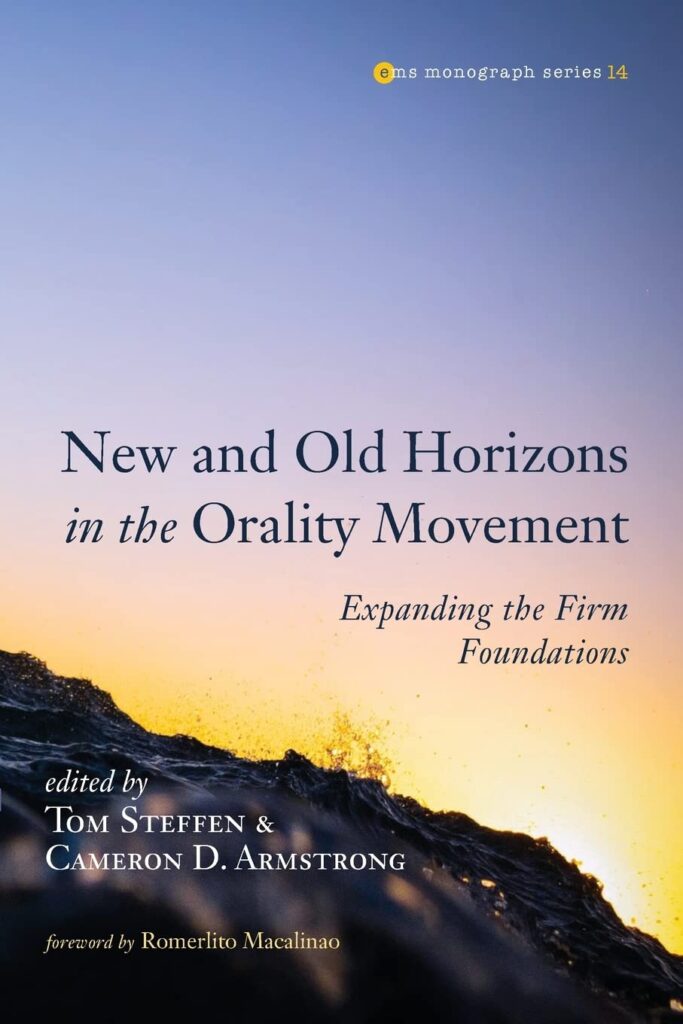
New and Old Horizons in the Orality Movement: Expanding the Firm Foundations
Edited by Tom Steffen and Cameron D. Armstrong
Pickwick, 2022
304 pages
US$38.93
*As an Amazon Associate Missio Nexus earns from qualifying purchases.
Reviewed by Jerome S. Cepeda, PhD student in Orality Studies, Asia Graduate School of Theology, Philippines.
What will it take to bring about impactful evangelism and discipleship? Tom Steffen and Cameron Armstrong and company discuss how orality as a methodology provides a robust approach to engaging people from oral cultures in evangelism and discipleship. To fully appreciate orality, readers are presented with its definition as an expression of one’s inner speech, describing orality as not just a preference for certain learning methods, but an identity.
Steffen and Armstrong’s New and Old Horizons in the Orality Movement is divided into three parts. Part 1 presents orality as a catalyst to re-evaluate the post-reformation model in advancing the gospel. As an example, orality-influenced models for evangelism such as Living Waters International illustrate the use of narratives in leadership development, network expansion, and community engagement.
Part 2 discusses how the power of narratives is universal and present in every place, society, and history. One example in this part of the discussion is Wiley Scot Keen’s exposition of the importance of identifying the metanarrative and how it can shape one’s worldview. The third major part of the book focuses on the role of oral hermeneutics in interpreting and communicating biblical meaning. To add perspective, Tricia and Stephen Stringer expand the use of orality by using it as a means to bring healing from brokenness or trauma. They shared that the use of biblical narratives, combined with personal narratives and healing activities, can bring spiritual and experiential wholeness.
One strength I found in the book is how comprehensively it defines terms. Collecting the lived experiences of the authors and how they articulate meaning adds a vivid description of what orality is all about. Another strength is the book’s presentation of processes or methods. The book provides both the concept and its meaning and the process of how it can be applied.
On the other hand, one potential area for further improvement involves Steffen and Armstrong’s discussion on the metrics used in identifying the effectiveness of orality as a method. Such a discussion could add greater comprehensiveness to the process. Second, the chapters do not elaborate on why it is helpful to consider transitioning low orality-reliant people to high orality reliance. Though New Horizons covers the importance of orality in reaching the highly oral people of the world, a discussion regarding how to transition less orality-reliant groups that are traditional and textual in their learning paradigm to a greater orality reliance might add a broader perspective.
Overall, New and Old Horizons in the Orality Movement provides a renewed perspective on how narratives are essential not just in communicating the gospel but also in sustaining its effect in areas such as personal transformation, leadership, and healing. I found the book engaging, especially the argument that orality helps move individuals from being informed to being transformed.
For Further Reading:
Beyond Literate Western Models: Contextualizing Theological Education in Oral Contexts by Samuel Chiang and Grant Lovejoy (International Orality Network, 2013).
Worldview-Based Storying: The Integration of Symbol, Story, and Ritual in the Orality Movement by Tom Steffen (Orality Resources International, 2018).
EMQ, Volume 60, Issue 1. Copyright © 2024 by Missio Nexus. All rights reserved. Not to be reproduced or copied in any form without written permission from Missio Nexus. Email: EMQ@MissioNexus.org.





One Response
Just wanted to let you know the amazon link goes to a different book than the one listed.