EMQ » July–September 2023 » Volume 59 Issue 4
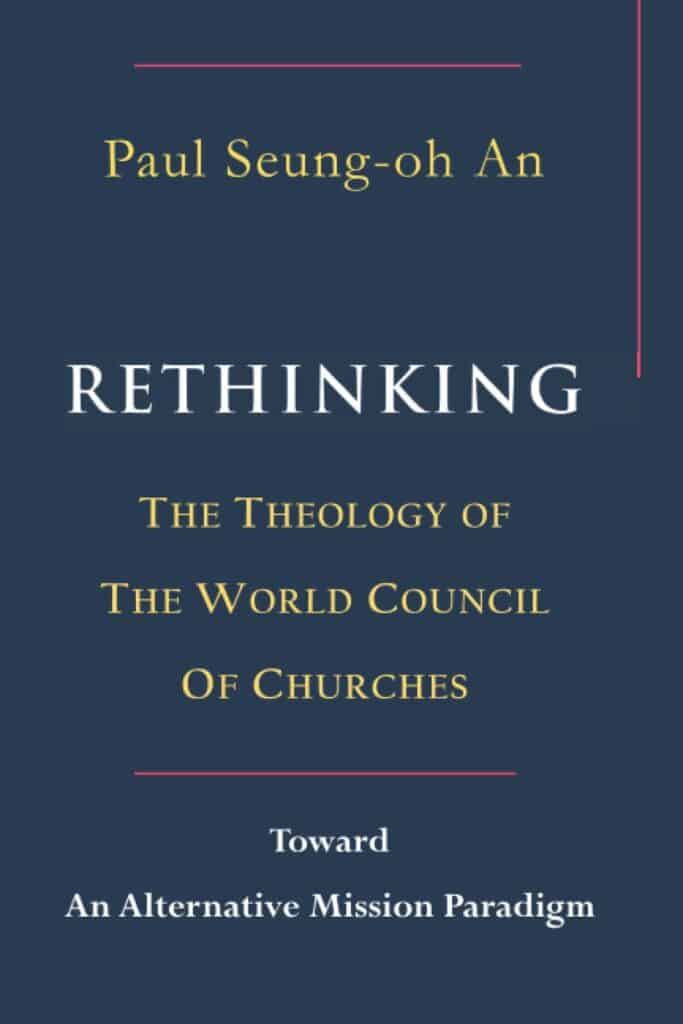
Rethinking the Theology of the World Council of Churches: Toward an Alternative Mission Paradigm
By Paul Seung-oh An
Global Institute of Mission, Korea, 2020
127 pages
US$10.00
*As an Amazon Associate Missio Nexus earns from qualifying purchases.
Reviewed by Jonathan P. Case, professor of theology, Houghton University.
Paul Seung-oh An, dean of the graduate school at Youngnam Theological University and Seminary, has written a book in which he seeks to evaluate how much the World Council of Churches (WCC) contributes to “the healthy establishment and expansion of Christianity” (vii). The answer, perhaps unsurprisingly, is not much.
In the first three chapters of the book, the author develops an extended comparison between the ecumenical mission paradigm of the WCC and a traditional evangelical paradigm. There are no surprises here. In the former ecumenical paradigm, the goals are reconciliation and unity among the world’s peoples, dialogue and co-existence among the world’s religions, and an understanding of salvation that addresses distinctly this-worldly concerns (such as poverty and ecological degradation). Jesus is the ethical model for humanity and the Liberator par excellence, and the target of mission is principally the poor, the alienated, and the larger scope of creation itself.
Consequently, the traditional perspective and concerns of the evangelical paradigm are downplayed or ignored outright: the salvation of souls in a world of open rebellion, the priority of the church over the world, a view of Jesus as the savior who leads us to heaven, and so on. Attempts to bring the two paradigms together have not fared well. An includes a chapter on the ecumenical missiology of the Presbyterian Church of Korea (Tonghap), which attempted a holistic integration of the two paradigms, a combination An judges to be “ideal in terms of theory but not so successful in real ministry” (77).
The stakes in this discussion are high when one considers the decline of churches in the West (especially liberal ecumenical churches) versus the continued growth of Islam. Even after the WCC adopted a more holistic approach to missions, An says the new paradigm is little more than another expression of ecumenical missiology, which has too many wide-ranging goals and thus includes the possibility of conflict as the Church tries to pursue “two contrary directions at the same time” (90). In the closing chapter, An briefly presents his “alternative mission paradigm.” However, it’s difficult to see how this is different from the evangelical paradigm, other than An’s paradigm stresses as its end goal the glorification and worship of God (99–100), which he says may save the church from traditional snares such as imperialism and greed.
I’m of two minds in thinking about this book. On the one hand, An does a passable job of describing the basic differences between the missiology of the WCC and traditional evangelical missiology. On this strength alone one might use this text in an introductory missiology course. On the other hand, An’s actual analysis may be too simplistic for some. The ecumenical theology he decries has its roots in two complex and interrelated areas: Western theological liberalism’s critique of the shortcomings of traditional evangelicalism and the phenomenon of secularization. I do not say the consequences for the church (which An has rightly seen) are insignificant, only that serious questions are not answered by moving theological emphases around like pieces on a chessboard, as if one could say, “If only we could move traditional evangelical concerns here, then we could sufficiently address the problems faced by the contemporary church.” Abstractions like this are rarely helpful.
For Further Reading
Secularization and Its Discontents by Rob Warner (Continuum, 2010).
The Genesis and Formation of the World Council of Churches by Willem Adolf Visser’t Hooft (World Council of Churches, 1982).
EMQ, Volume 59, Issue 4. Copyright © 2023 by Missio Nexus. All rights reserved. Not to be reproduced or copied in any form without written permission from Missio Nexus. Email: EMQ@MissioNexus.org.