EMQ » July–September 2023 » Volume 59 Issue 4
[mepr-show rules=”100329″] [/mepr-show]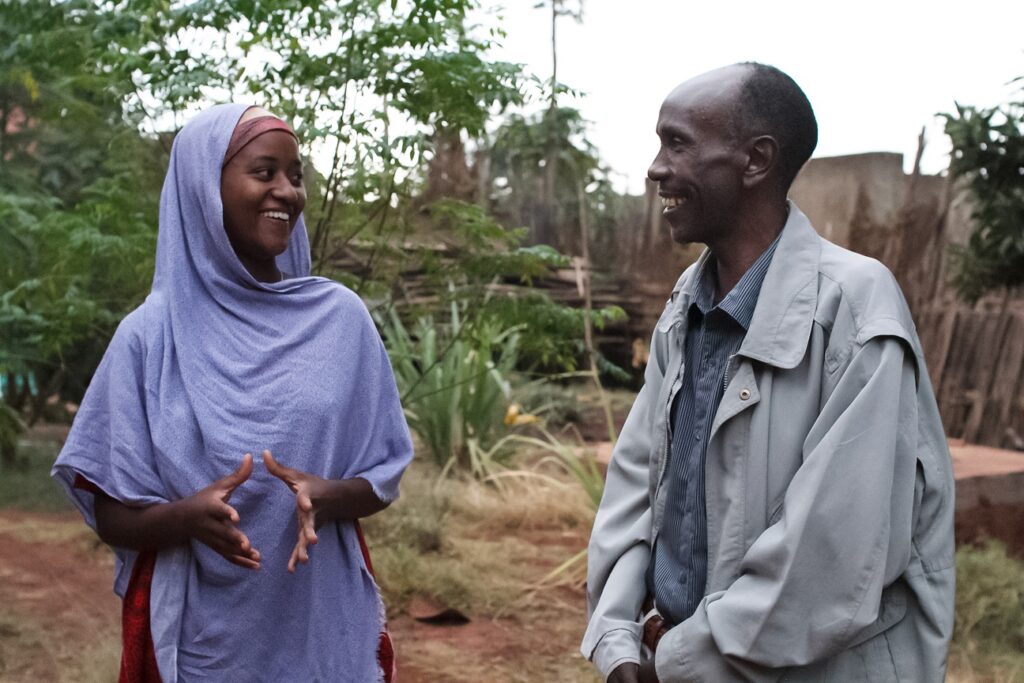
Summary: Over time, the church has repeatedly devolved into structures more geared to attracting and inspiring people than to transforming and mobilizing them. Unless we take deliberate steps to prevent it, many of the movements toward God among unreached people groups that we now celebrate could follow the same pattern. Redemptive communities can prevent or at least postpone this process.
By Ronald and Carolyn Klaus
In western Ethiopia, grinding poverty has colored the landscape for as long as anyone can remember. Eighteen years ago, a young man found Christ and began to lead his family and friends to faith. Under the mentoring of one of our colleagues, he formed his converts into small groups and focused on training the small group leaders – and later, coaches – for the multiplying small groups.
He taught them that Jesus is Lord over everything – over the demonic spirits in their witch-doctor-controlled villages, over their bodies, over their families, and over all aspects of the world. And he told them that they could discover God’s will for themselves by reading the Bible. Though most adults were illiterate, they worked together to understand what the Bible said.
Over several months, they eliminated alcoholism, domestic abuse, female circumcision, and the heretical prosperity gospel. Gradually they learned to clean their houses and improve their farms. Several hundred people are now in self-help savings groups and have started businesses.
All their children now wear shoes and are in school. Some have master’s degrees. Village leaders call on them to resolve village conflicts. Though at first neighbors called them a cult, now people flock to their 63 churches scattered over a 100-mile radius because they want “whatever you have.” We estimate these churches have well over 10,000 members.
Why have these groups of followers been so effective in addressing severe poverty? Why have most Protestant churches around them done almost nothing to address this life-threatening matter? And why, during Ethiopia’s most recent ethnic conflicts, have churches been silent while Christians killed Christians on the battlefield? The natural history of religious institutions explains much of this.
Over time, the church has repeatedly devolved into structures more geared to attracting and inspiring people than to transforming and mobilizing them. Unless we take deliberate steps to prevent it, many of the movements toward God among unreached people groups that we now celebrate could follow the same pattern. We plead with the missions community to think hard about the long-term future of the movements we start, rather than just rejoice over their beginnings.
Natural History of Church Evolution
How Churches Evolve—and Devolve
Research by the Beyond organization illustrates what we see. The diagram illustrates the four stages that movements and churches go through.[i]
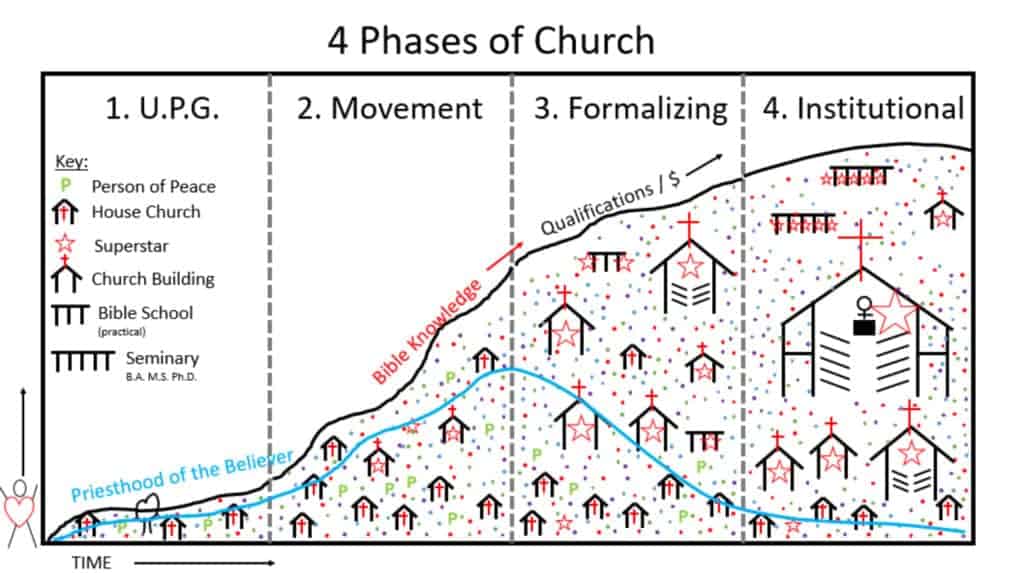
Caption: Figure 12.1 –Four phases of the church.
Stage 1: Unreached People Group
Few, if any, followers exist. Outsiders begin to establish relationships and lead people to Christ. They form small informal groups to disciple them.
Stage 2: Movements
New followers start to share their faith through their natural networks. Others join them. The new converts, rather than the outsiders, take responsibility for evangelism. They continue to meet in, multiply, and extend informal networks of small groups. These groups experience a great deal of community life, discipleship, and spiritual and numerical growth.
Stage 3: Formalization
Larger numbers of followers create pressure to form larger meetings. Congregational-level meetings begin and often (usually) replace the smaller informal ones. Leaders of these larger meetings feel the need for and therefore get formal training.
Professional, paid clergy emerge. Since their gifts outshine those of other members, they do an increasing amount of the ministry. The rest of the members begin to become more passive. The priesthood of the believers begins a clear decline.
Stage 4: Institutionalization
The movement may continue to grow for a while because it has accumulated resources and respectability. Still larger meeting places become widespread. Denominations form. Bible schools and seminaries begin. Pastors are salaried, which means that young people seek such positions and enter training with mixed motives and little evaluation of their spiritual gifts.
Professionals take over almost all ministries. The priesthood of the believers dies. Most people remain spectators. Under these conditions, the spiritual life of many people stagnates or declines. Eventually, the organized church begins to oppose attempts to renew it.
How Ethiopian Church History Illustrates This Pattern
Ethiopia has been a Christian nation longer than any other country save Armenia. Two young boys, captured as slaves, brought the good news to Ethiopia in AD 316. Today, the Ethiopian Orthodox Church (EOC), which developed from that beginning, is the second largest Orthodox Church in the world, after the Russian Orthodox Church.
However, biblical knowledge has waned, largely replaced by legends and rituals. Relatively few in the Orthodox Church today understand the basic truths of the gospel. Some who are priests on Sundays are witch doctors on Wednesdays. Worse, many in the Orthodox Church actively oppose the proclamation of the good news. Extremists in the EOC persecute Orthodox renewal leaders as much as some Muslims persecute Jesus followers in their communities.
Ethiopia has had a small Catholic Church since the fourteenth century. We in no way minimize the unparalleled work that Catholic Charities and the Sisters of Mercy still do in Ethiopia for sick and poor people. However, when a young Catholic that we know came into a profound relationship with the living Christ 20 years ago and began a wonderful renewal movement in that church, Catholic leaders found ways to put him in jail.
Protestant leaders cannot imagine that their evangelical churches could ever get to that point. Their twentieth-century missionaries who pioneered churches under great difficulties are indeed heroes, as are the brave believers who met behind closed blinds during Ethiopia’s Communist years.
However, today’s Protestant leaders bemoan the moral laxity, lack of commitment, and lack of community that have crept into their midst. Thousands are leaving evangelical churches for the glitter of prosperity-gospel churches and the excitement of prophet-led churches. Seminary students complain to us that their churches are only about power, status, and money. Most of the gifted leaders with whom we have worked have faced significant opposition from within their organizations.
Unfortunately, the decline illustrated by the first diagram, repeated throughout church history, and vivid in our own experience, happens no matter how forcefully its leaders exhort against it.
It happens because as churches grow, they tend to adopt wrong and unbiblical church structures, within which discipleship becomes nearly impossible. As soon as Constantine made Christianity legal and began building cathedrals, worshippers dropped their house churches and began flocking into these cathedrals to listen to the church fathers.
However, lectures alone cannot transform people. As with the development of many other skills, spiritual formation is a highly personalized and interactive process. That is why Jesus spent a lot of time with just twelve men. And that is why the loss of the intimate relationships with mentors that the early Christians had had in their house churches proved so tragic. People were not helped and held accountable to do what they were learning.
Of course, having the correct structure will not guarantee spiritual vitality. Personal Bible study, prayer, and holiness remain essential. However, without structures that facilitate relationships of biblical mentoring, accountability, and true community for everyone, churches cannot help most people become what God intends, no matter how well-intentioned their leaders are.
An Alternative Church Model: Redemptive Communities
What is a Redemptive Community?
To be redeemed is to become fully reconciled to God, oneself, others, and the environment. Redeemed persons are finding healing from past hurts and freedom from sinful habits. They are growing in the practices of Christian living, developing their gifts and skills, and becoming all that God created them to be.
This takes place best in communities in which people have significant relationships with one another. For these relationships to form, people must be in groups small enough for every person to know and be known and to share both their needs and their gifts. Love in this context is the real witness of the church: “By this shall all men know that you are my disciples if you love one another” (John 13:35).
These relationships are also the beginning of world impact. Redeemed people inevitably notice and care about the pain in those around them. They not only bring the good news of Jesus. They also reconcile relationships, improve living standards, secure justice for oppressed people, and make positive changes in their culture.
Together they do so far more effectively than as individuals alone, no matter how dedicated they are. When Jesus said, “You are the light of the world” (Matthew 5:14), he used the second person plural. The light comes from the “city set on a hill that cannot be hidden” (Matthew 5:14), not just the individuals who manage to climb up that hill.
Many churches today say they share these goals. However, instead of real community, they provide mostly superficial relationships and one-way talk. Most of those who listen to the talk get no help in figuring out how that talk applies to their lives, let alone accountability for doing anything. The secular world has long recognized that people do not acquire skills that way. Only practice and personal feedback from experienced coaches produce the habits that gain points on the field.
Churches that understood this would focus on raising up an army of trained disciple-makers, each of whom would mentor a few people into godliness and effectiveness in God’s kingdom. Instead, most of the church’s energy goes into flashy programs for passive onlookers. Programs inspire, inform, and entertain. But only relationships transform.
How Can Redemptive Communities Make These Principles Work Over Time?
Over 3,000 years ago, a man named Jethro described a method for facilitating such relationships. His son-in-law, Moses, had the formidable task of transforming 2 million former slaves into a civilized nation. Jethro realized that this was impossible without breaking the people down into small groups under a layered leadership structure. He recommended this structure:
Table 12.1 – Leadership Structure and Oversight
| Category of Leader | Number of People Directly Overseen | Total Number Overseen |
| Leader of 10 | 10 | 10 |
| Leader of 50 | 5 A’s | 55 |
| Leader of 100 | 2 B’s | 112 |
| Leader of 1000 | 10 C’s | 1130 |
We have implemented this structure of layered leadership, which we call a shepherding network, both in the US and in Ethiopia. At every level, leaders assume a pastoral role in the lives of the ten or fewer people in their group. At the same time, they receive pastoral care and ministry oversight in another group from a more experienced leader.
As a ministry expands, it constantly raises up new leaders at every level by apprenticing people with leadership potential to people with more experience. This works because everyone has access to help when they need it. It is interesting that the US Army employs a similar structure, with almost identical numbers, to win wars.
The Activities of Small Groups
Small groups must be truly interactive. Each person should be contributing regularly to all five basic activities of the group: personal sharing, inductive Bible study, prayer, mission, and accountability. Though every group meeting might not have all five of these activities, over time they all take place in a balanced way.
The Roles of Congregations
Where persecution does not prevent them, rightly structured congregation-sized groups can make valuable contributions to God’s kingdom. They can provide inspiring worship and exposure to more diverse spiritual gifts. They can also provide a broader social context for people. However, traditional services tend to spotlight large group activities, thereby undermining their small groups. It is better to reshape the larger gatherings so that in addition to facilitating worship and teaching, they also support and draw attention to what God is doing in the smaller groups. In this way, the two types of gatherings can complement one another.
Why Small Groups?
Small Groups are Biblical and Historical
Moses put Jethro’s advice into practice for at least 40 years (Deuteronomy 1:15–18). Rabbinical records show that rabbis trained their followers by inviting small groups to live with them. Both Jesus and Paul followed this model. After the day of Pentecost, the early disciples met in homes. Paul’s church plants were almost exclusively in homes.
The church continued this tradition until Constantine. Small groups fueled virtually all the church renewal movements throughout history.[ii] John Wesley’s class meetings were key to the revival that Methodism brought to England and later to America.[iii] The same thing has happened in the Korean Church,[iv] the base communities of Latin America,[v] and the underground church in China.[vi]
Historian Herbert Butterfield best captures the historical importance of the small group:
“The strongest organizational unit in the world’s history would appear to be that which we call a cell (small group) because it is a remorseless self-multiplier; is exceptionally difficult to destroy; can preserve its intensity of local life while vast organizations quickly wither when they are weakened at the center; can defy the power of governments; is the appropriate lever of prising open [forcing something to open] any status quo. Whether we take early Christianity or sixteenth-century Calvinism or modern communism, this seems the appointed way by which a mere handful of people may open up a new chapter in the history of civilization.”[vii]
Small Groups Are Supported by Science
The Power of Relationships
Modern psychological research abundantly confirms the shaping power of such small groups.
People who are more socially connected to family, friends, or their communities are happier, physically healthier, and live longer with fewer mental health problems than people who are less well connected …. We often overlook that it requires an investment of time to maintain good relationships …. They are as vital as better-established lifestyle factors such as eating well, exercising more, and stopping smoking.[viii]
Further research has begun to show why our relationships affect us so profoundly. Psychologists Mattingly, Lewandowski, and McIntyre have discovered “four distinct types of self-concept changes that can occur as our relationships become increasingly serious and interdependent.”[ix] Good relationships tend to expand people’s personalities and prune them of bad habits. Bad ones tend to contract personalities and cause people to pick up bad habits.
The Power of Habits
In his article, “Can Neuroscience Help Us Disciple Anyone?” John Ortberg explains that neuroscience shows us our struggle with sin in concrete ways. What we can see is that most of our behavior is not “a series of conscious choices. Most of our behavior is governed by habit.” Usually, behavior change requires getting new habits. However, “willpower and conscious decision have very little power over what we do …. Habits are in the neural pathways. And sin gets in our habits. So sin gets in our neurons ….”
As he further makes clear, “The people in our churches will not be transformed simply by having more exegetical or theological information poured into them – no matter how correct that information may be. The information has to be embodied, has to become habituated into attitudes, patterns of response, and reflexive action.”[x]
Small groups are the ideal setting for developing good habits. The members can help one another set goals, hold one another accountable, reinforce good behavior, and discourage bad behavior. They also learn how to get the help they need from God.
The Limits on Relational Capacity
Recent research has also helped us understand our limited capacities for relationships.[xi] Psychologist Robin Dunbar established that the average person can establish only about 150 “genuinely personal relationships,” as in the following table.[xii]
Table 12.2 – Average Number of Relationships
| Average Number of Relationships at Various Levels | Just This Group | This and Lower Groups |
| People whose names and basic facts we know. | 100 | 150 |
| Close friends and family members with whom we interact more often and trust a little more | 35 | 50 |
| Very close friends and family to whom we turn in times of trouble and for whom we would drop whatever we are doing to help them | 10 | 15 |
| Best friends, keepers of our darkest secrets, those we count on to be with us through thick and thin. | 5 | 5 |
These categories roughly correspond to Jethro’s suggestions for organizing the Hebrew people. He suggested 50 as the number a coach (leader of 5 leaders of 10) could effectively shepherd. The 100–150 number also parallels Jethro’s designation of someone to oversee 100 people (2 groups of 50). It is interesting that many churches plateau at 100–150, the number to whom one pastor can relate.
Neuroscientists say that our relational capacity derives from the size of the neocortex in our brains. Common sense tells us that everyone has limited time and energy available for relationships. Either way, discipling all believers requires the participation of many people – at least one for every ten persons. Only in this way can everyone receive care from someone who does not have too many people to care for. This principle is fundamental in creating redemptive communities.
Our Experience with Redemptive Communities in Ethiopia
In our twenty years’ experience in Ethiopia, we have seen redemptive communities form in Protestant, Catholic, Orthodox, and Muslim-background settings. They take more work to form than traditional churches. However, what we have seen God do with very limited human resources makes us believe that redemptive communities can prevent or at least postpone the process of institutionalization, keep evangelization and development moving forward, and mobilize and equip people to solve the problems of their societies far better than traditional church models.
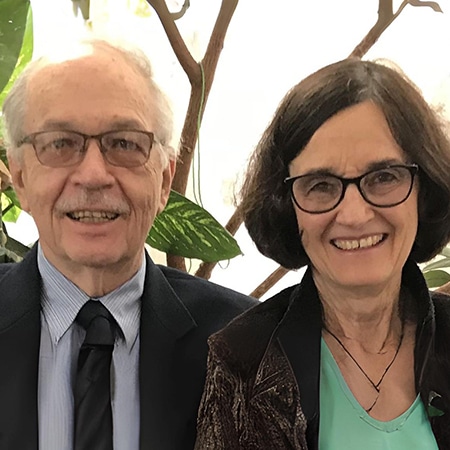
Ron Klaus, PhD, (ron@hopeinview.org) is a professor of engineering turned pastor. Carolyn Klaus, MD, (cklaus@hopeinview.org) is an internal medicine physician. Since 2004 they have acted as along-siders for movements toward Jesus among Protestants, Catholics, Orthodox, and Muslims in Ethiopia. Under their mentoring, these movements have formed thousands of small interactive discipleship groups, penetrated unreached people groups, promoted peace in war zones, cared for children in need, and improved the economic situation in many areas.
[i] Steve Smith, Neill Mims, and Mark Steves, “50 Years and Counting of Innovation in Mission,” Mission Frontiers 37, no. 6 (November 2015), http://www.missionfrontiers.org/issue/article/4-stages-of-a-movement.
[ii] Joel Comiskey, “Cell-Based Ministry as a Positive Factor for Church Growth in Latin America” (PhD diss., Fuller Theological Seminary), see chapter 2, “History of the Cell Movement,” https://joelcomiskeygroup.com/en/resources/phd_dissertation/en_ch2/.
[iii] D. Michael Henderson, A Model for Making Disciples: John Wesley’s Class Meeting (Anderson, IN: Warner Press, 1997). See also: Joe Iovino, “How’s Your Spiritual Life? The Class Meeting for Today,” United Methodist Church, https://www.umc.org/en/content/hows-your-spiritual-life-the-class-meeting-for-today.
[iv] Yoido Full Gospel Church, Wikipedia, https://en.wikipedia.org/wiki/Yoido_Full_Gospel_Church.
[v] Basic Ecclesial Community, Wikipedia, https://en.wikipedia.org/wiki/Base_community.
[vi] Bill Murphy, “China, Officially Atheist, Could Have More Christians than U.S. by 2030,” Houston Chronicle, February 22, 2018, accessed June 1, 2023, https://www.houstonchronicle.com/news/houston-texas/houston/article/China-officially-atheist-could-have-more-12633079.php.
[vii] William A. Beckham, The Two-Winged Church Will Fly (Houston: 1993), 119, quoted in Comiskey, “Cell-Based Ministry,” chapter 2.
[viii] Jenny Edwards and Isabella Goldie, “Relationships in the 21st Century: The Forgotten Foundation of Mental Health and Well-being,” Mental Health Foundation summary report (London: Mental Health Foundation, 2016), https://www.mentalhealth.org.uk/publications/relationships-21st-century-forgotten-foundation-mental-health-and-wellbeing.
[ix] B. A. Mattingly, G. W. Lewandowski, and K. P. McIntyre, “You Make Me a Better/Worse Person: A Two-Dimensional Model of Relationship Self-Change,” Personal Relationships 21 (2014): 176–190, accessed from Wiley Online Library, https://onlinelibrary.wiley.com/doi/abs/10.1111/pere.12025.
[x] John Ortberg, “Can Neuroscience Help Us Disciple Anyone?” Leadership Journal 35 (Summer 2014): 19.
[xi] Justin Barrett, “Does Your Pastor Need a Friend?” Christianity Today 61, no. 8 (October 2017): 61–63, accessed June 1, 2023, http://www.christianitytoday.com/ct/2017/october/does-your-pastor-need-friend.html.
[xii] “Dunbar’s Number,” Wikipedia, accessed June 1, 2023, https://en.wikipedia.org/wiki/Dunbar%27s_number.
EMQ, Volume 59, Issue 4. Copyright © 2023 by Missio Nexus. All rights reserved. Not to be reproduced or copied in any form without written permission from Missio Nexus. Email: EMQ@MissioNexus.org.