EMQ » July–September 2023 » Volume 59 Issue 3
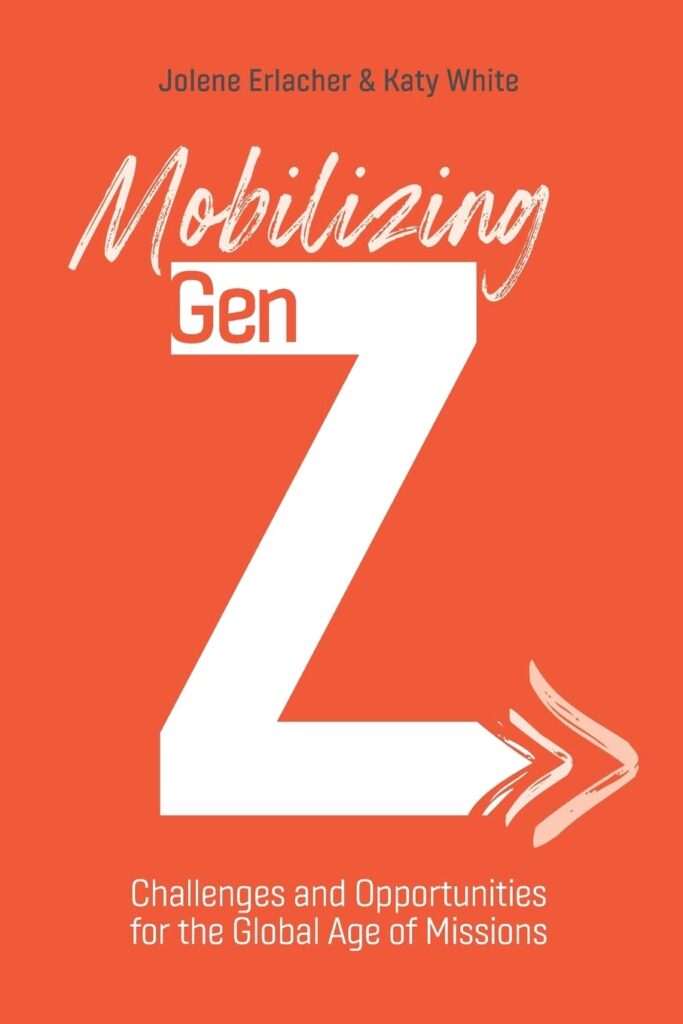
Mobilizing Gen Z: Challenges and Opportunities for the Global Age of Missions
By Jolene Erlacher and Katy White
William Carey Publishing, 2022
182 pages
US$14.99
*As an Amazon Associate Missio Nexus earns from qualifying purchases.
Reviewed by Edward L. Smither, professor of intercultural studies and history of global Christianity at Columbia International University.
In Mobilizing Gen Z, Erlacher and White aim to shed light on the identity of Gen Z (those born between 1996 and 2010), to understand their virtues and struggles, and to offer insights on mobilizing them for the ongoing work of global mission. The book is divided into four main sections. In part 1, the authors offer context on the present state of missions, including the cultures of Western sending countries and the current status of global Christianity. In part 2, they survey the identity, motivations, and faith of Gen Z. Given this background, in part 3, they suggest relevant approaches toward mobilizing Gen Z for mission. In the final part, they anticipate the future of mission and offer further insights for mobilization and sending.
Mobilizing Gen Z has some noteworthy strengths. First, the authors do a good job of describing Gen Z and particularly showing how they are distinct from millennials. For example, while younger millennials are digital natives, this description is true of all of Gen Z. They have never not been online. This has, of course, created problems such as a lack of social and communication skills, higher levels of anxiety, and greater exposure to pornography. Because of access to information, including online education, Gen Z has the potential to be the most educated generation to date. While millennials are more concerned about addressing problems in the world, Gen Z tends to be more individualistic and focused on happiness and stability. Though Gen Z has had less real-world work experience than previous generations, they tend to be more pragmatic and concerned about financial stability.
Second, Erlacher and White build on this description of Gen Z and provide some good insights into mobilizing the present generation for mission. Drawing from their professional strengths, they emphasize building long-term relationships with Gen Z and coaching them toward connecting with their calling. Part of this coaching involves asking good open-ended questions. In Appendix D, they provide a list of good questions to ask. They also emphasize the need to connect with them through relevant media, including texting and social media. That said, the authors emphasize challenging Gen Z to overcome biblical illiteracy and to become biblically rooted disciples.
In addition to these affirmations, I have two critiques. First, in part 1, the authors rely on some rather dated material to sketch out the picture of the present context of global mission. They were particularly reliant on the 2009 edition of Perspectives on the World Christian Mission. Second, while the composite profile of Gen Z in part 2 of the work was helpful, it did not go beyond what other authors such as Tim Elmore and Jean Twenge have already done.
Who will benefit from reading this book? I recommend it to mission organization mobilizers, church mission committees or advocacy teams, church and parachurch leaders working among Gen Z, as well as Christian university professors training students for global mission.
For Further Reading
The Future of Missions: 10 Questions About Global Ministry that the Church Must Answer with the Next Generation by Barna Group (Barna Group, 2020).
Generation Z Unfiltered: Facing Nine Hidden Challenges of the Most Anxious Population by Tim Elmore and Andrew McPeak (Growing Leaders, 2019).
iGen: Why Today’s Super-Connected Kids Are Growing Up Less Rebellious, More Tolerant, Less Happy – and Completely Unprepared for Adulthood – and What That Means for the Rest of Us by Jean M. Twenge (Atria, 2018).
EMQ, Volume 59, Issue 3. Copyright © 2023 by Missio Nexus. All rights reserved. Not to be reproduced or copied in any form without written permission from Missio Nexus. Email: EMQ@MissioNexus.org.