EMQ » July–September 2023 » Volume 59 Issue 3
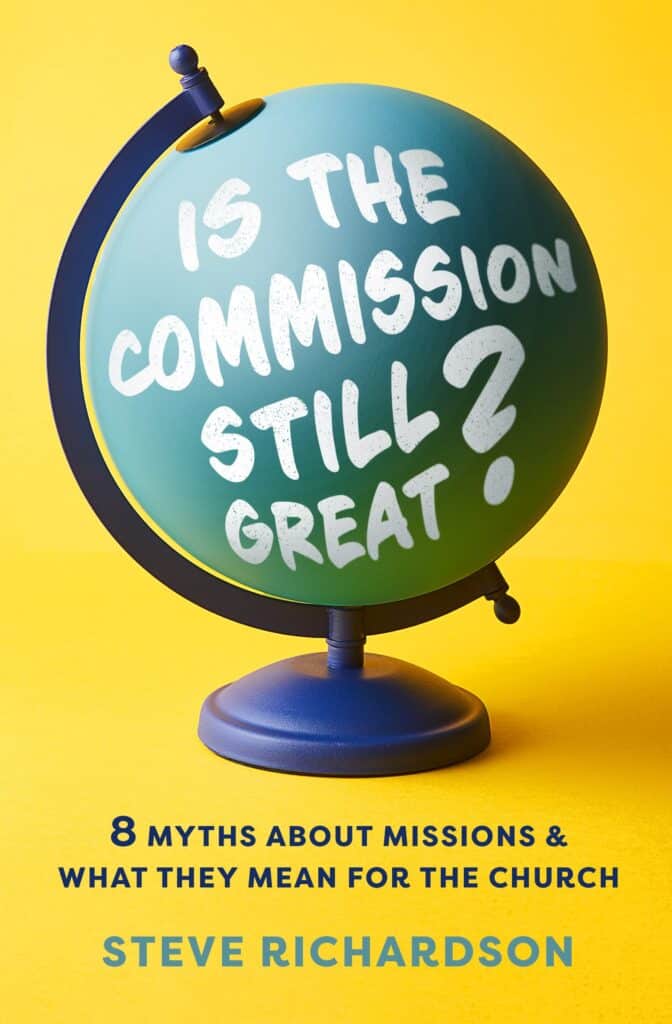
Is the Commission Still Great? 8 Myths about Missions and What They Mean for the Church
By Steve Richardson
Moody Publishers, 2022
208 pages
US$15.99
*As an Amazon Associate Missio Nexus earns from qualifying purchases.
Reviewed by Marcus Dean, Professor of intercultural studies and missions, Houghton University, and former missionary in Colombia and Puerto Rico for 14 years.
Is it time for the church in the West to hang up its missionary hat? Many would answer Yes. In this book, Steve Richardson answers with a resounding No. He develops this no as he answers yes to the question in the title “Is the Commission still Great?” Further, as the subtitle suggests, Richardson addresses eight myths or reasons people give for why Western missionaries are no longer needed or relevant.
The eight myths that Richardson addresses range from “Missions is Peripheral” (chapter 1) to “Missions is Failing” (chapter 8). These myths come from research done by asking fellow believers, “What do you think are some of the misperceptions or ‘myths’ that keep God’s people from realizing their full potential in Great Commission work?” (15). He also surveyed others involved in missions and church communities and received 120 responses to questions that probed the “prevalence of these perceptions in the North American church and their impact on our engagement with global missions” (15).
In each of the eight chapters, Richardson both explains a negative perception about missions and gives carefully thought-out support for not listening to that myth. His ultimate goal is to demonstrate that the West should continue to be involved in the work of the Great Commission. Each chapter ends with a few discussion questions that could be useful for individual reflection, a Sunday School class, or even a college class on missions.
One thing that I appreciate is that he not only debunks the myths but also argues that involvement in global missions is essential for the overall health of the church. For example, in chapter 4, he addresses the myth that “pursuing missions comes at a cost to other important ministries. A global focus reduces our local impact” (73). In his response, Richardson calls for the church to work from an abundance mentality rather than a scarcity mentality. This would mean global involvement will enhance our local ministry; it would be investing in, not diminishing, our resources.
The ninth and final chapter provides hope for moving beyond these myths. Richardson’s advice comes not just from personal reflection, but from listening to members of the global church. The way for the West to be meaningfully engaged in the Great Commission should be shaped by taking on the roles of “Encourager, Catalyst, Connector, Resourcer, and Pioneer” (177). While these roles are not limited to the West, the West is especially well-positioned to fulfill these roles.
Richardson provides a resource that not only answers the eight myths but also helps us to keep the call to missions alive in the West so that we stay involved in advancing the gospel around the world. Future research could be done with these myths among those who are not so strongly linked to missions. Are these the reasons that regular church members who are not keen on missions would also indicate as to why they are not involved?
For Further Reading
When Everything is Missions by Denny Spitters and Matthew Ellison (Pioneers, 2017).
Millennials and Mission of God: A Prophetic Dialogue by Andrew Bush and Carolyn Wason (Wipf & Stock, 2017).
EMQ, Volume 59, Issue 3. Copyright © 2023 by Missio Nexus. All rights reserved. Not to be reproduced or copied in any form without written permission from Missio Nexus. Email: EMQ@MissioNexus.org.