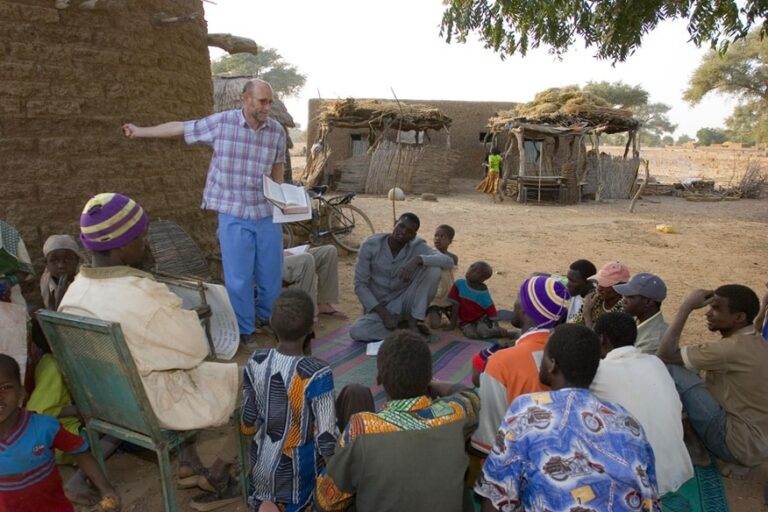
EMQ » April–June 2023 » Volume 59 Issue 2

Summary: Two-thirds of Christians in the US say they have not heard of the Great Commission. Even fewer could roughly estimate the number of unreached people groups in the world. And while 85% of pastors believe missions is a mandate for all, more than half of all Christians in the US believe it is a calling only for some. If the US Church is to bridge these glaring gaps, both leaders and churchgoers must unpack why it exists.
By David Chakranarayan
Matthew 28:18–20 is a passage in Scripture known as the Great Commission: “Therefore go and make disciples of all nations, baptizing them in the name of the Father and of the Son and of the Holy Spirit.” These final words from Jesus before he ascended to heaven show God’s heart for bringing his presence and redemption to all nations. Yet this biblical foundation is where we see the beginning of US Christians’ disconnect – and misunderstanding – around missions.
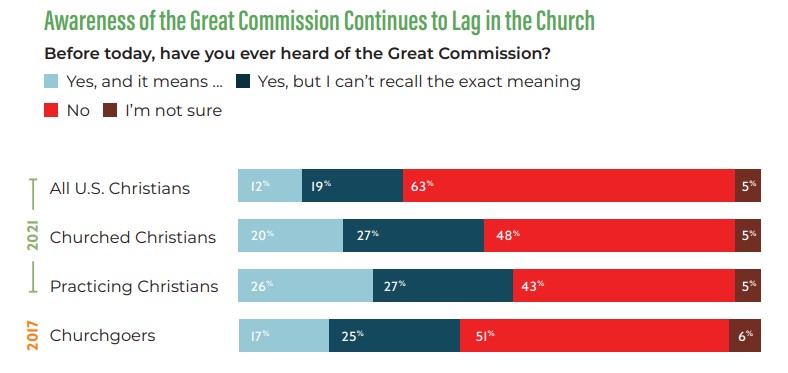
According to research released by Barna Group in partnership with Mission India through The Great Disconnect report, two in three US Christians (63% “no,” 5% “not sure”) say they have not heard of the Great Commission. When asked to identify the Great Commission from a list of five Bible verses, just one in three (31%) does so correctly, while more than half (51%) say they are unsure, and the remainder selects other verses. (See figure 11.1)
At the time The Great Disconnect was released this year, there were close to 8 billion people in the world, with 3 billion considered unreached. However, when asked to estimate the number of unreached people in the world, only 12%–13% of US Christians could do so correctly, with a majority indicating that they were unsure. Add to this that only 55% believe it is “very urgent” to reach unreached people with the gospel.
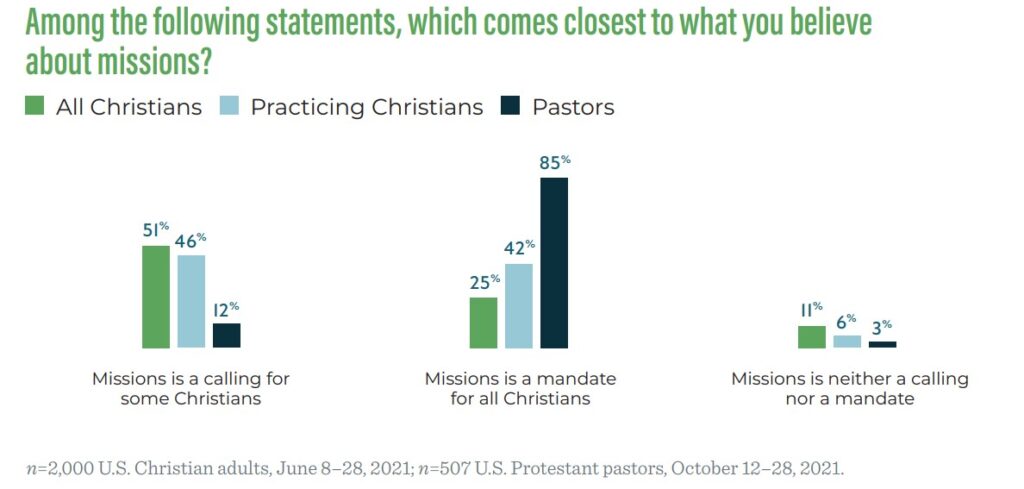
This disconnect between Christians and missions could be caused by the fact that more than half of US Christians believe that missions is a calling for some. In comparison, 85% of pastors believe it is a mandate for all. These statistics indicate that there is a slipping awareness of the missional calling of the Church at large – and a disconnect between the pulpit and the pew. (See figure 11.2)
If the US Church is to bridge this glaring gap, both leaders and churchgoers must unpack why it exists. In Barna Group-led focus groups, US pastors described a common frustration of feeling unable to translate missions work from pastoral vision into congregants’ action. No matter where pastors land with their perceptions of and approach toward missions, they feel their congregants are a few steps behind in embracing the Great Commission and recognizing their personal roles in missions.
Missions is an area where pastors experience a disconnect from their congregations – and congregants, in turn, seem disconnected from the world’s need and Jesus’ command for them to pursue the Great Commission personally.
Motivations: Start with Why
The US Church at large believes missions should meet both spiritual and physical needs, but individual Christians tend to gravitate toward one approach or the other: evangelism or aid.
In the eyes of US Christians, the top three greatest problems facing the world today are healthcare, providing food, and justice issues. With these three priorities in mind, pastors may be left wondering what to do for their church’s missions culture. Should a church’s motivation be around meeting spiritual needs, physical needs, or both? How can a church’s teachings, programs, and partnerships reflect this? Do any attitudes about missions need encouraging or correcting? (See figure 11.3)
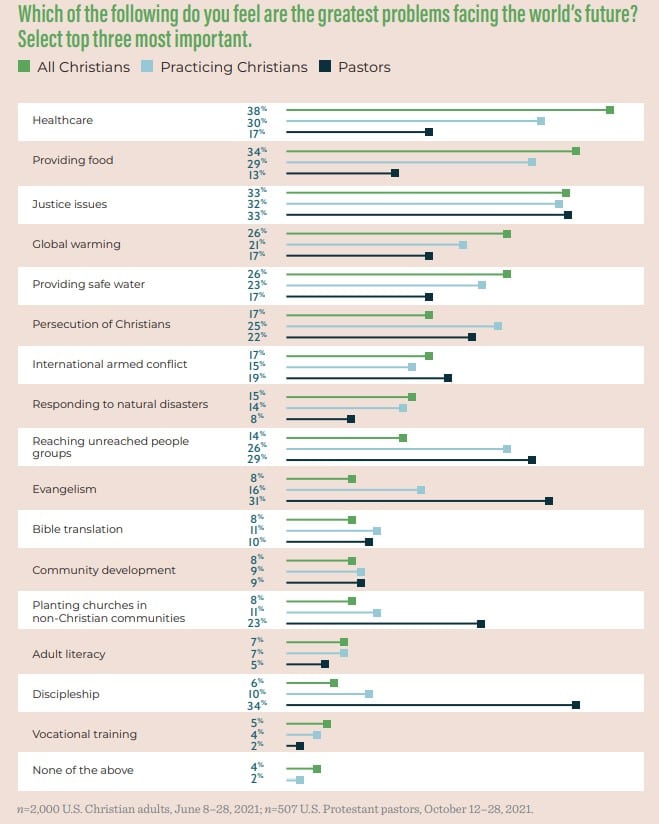
Whatever church leaders and Christians define as the purview of missions work, their perceptions of the problems in the world are plain. Pastors are spiritually focused, while the laity are first concerned with physical, visible needs. Though one in three pastors sees justice as a great problem the world faces, similar proportions assume spiritual issues like discipleship and evangelism are most important. Church planting also pops up as a perceived global need.
Answering the why and being attentive to motivations doesn’t mean everyone in a church will engage with its missions strategy. On the flip side, fostering participation without examining its purpose can also lead to ineffective engagement. Acknowledging congregants’ motives and diligently discipling them works toward building a global missions-minded (and Great Commission-literate) church.
As believers, taking time to assess missions motivations is biblical. Proverbs 16:2 reminds us, “All a person’s ways seem pure to them, but motives are weighed by the Lord.” God is concerned about what motivates his people and how their endeavors point back to him. This places a responsibility on pastors to put words around the why of their church’s missions strategies and make it plain to congregants through teaching, prayer, and action. Doing so reaps significant reward: More than half of US Christians say that supporting missions makes them feel proud to be a Christian.
Methods: Assess Models & Discover New Strategies
Over the last two years, the COVID-19 pandemic caused a global disruption in every industry, including global missions. With many Western missionaries having to leave their mission field and move home, churches were left asking about the future of missions. Who was going to carry on the work of missions around the world after so many missionaries had to return home? Should the work of missions be halted until the end of the pandemic, or was there another way to continue the work of the Great Commission?
Many were left asking even bigger questions, such as, “What is the right way to do missions?” “Is missions as we’ve always done it ethical? Smart? Harmful?” “How can we best support gospel-sharing and disciple-making without repeating past mistakes?” “Do our stated values and our missions strategies align?” “How will our work be remembered?”
The Great Disconnect dives into varying opinions around these questions. Barna’s research showed that Christians tend to think it’s best to send Christians to other countries as missionaries (known as the “sending model”), either to share the gospel directly (35%) or to meet physical needs (29%).
On this point, there is a disconnect between Christians and church leaders. The majority of pastors – three in four (75%) – see equipping and training Christians who are indigenous to an area as the clear path forward (the “indigenous model”), as opposed to the sending model (equipping).
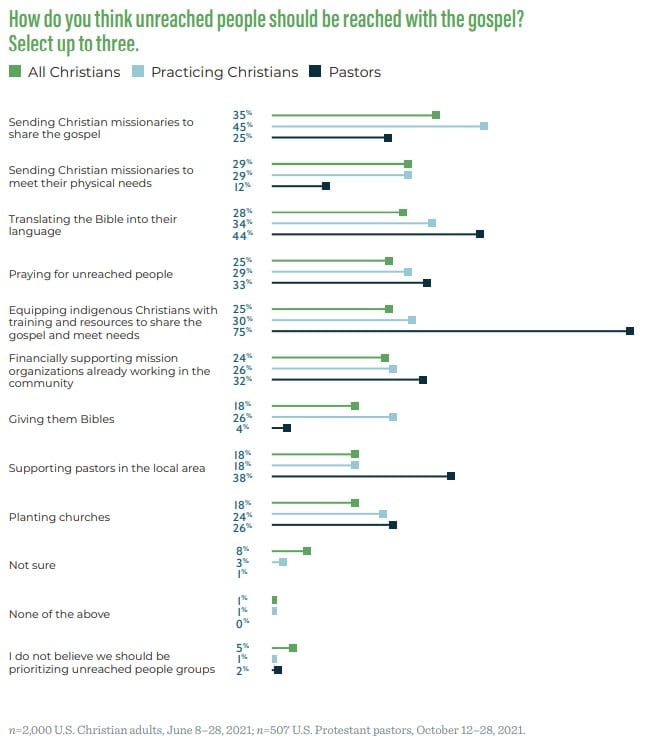
There is no doubt that most Christians are familiar with the sending model, so it is natural to default to that option when it comes to selecting a global missions strategy. However, the indigenous model, which focuses on supporting local pastors and missionaries, proves to be a strategy worth considering in order to share the gospel with the 3 billion unreached people of the world.
Consider this. The word indigenous often implies the picture of an individual in a majority world country living in a tribal setting. Yet in reality, an indigenous believer is simply someone who is local to the language, culture, and context of their geographical location. This means they are able to take the gospel and multiply it in a community more efficiently and quickly than a Western missionary, who needs a longer onramp to understand a foreign community.
In the same way, if a person from a rural tribe in a majority world country were to try to start a church in a middle-class US suburb, it is very likely the strategy would fail because the foreign missionaries are not familiar with the neighborhood’s language and culture.
This should prompt pastors to evaluate their missions strategy and discern whether a partnership with missions organizations working alongside indigenous believers is worth considering.
Money: Build Trust Through Stewardship & Transparency
The Great Disconnect report boils down to the finding that Christians really don’t know much about missions or the global need for the gospel.
As mentioned previously, of the roughly 8 billion people in the world, there are more than 3 billion that are considered unreached with the gospel. That’s not news to many pastors and church leaders because it’s their passion (and his calling on their lives) to reach the unreached! On a daily basis, Mission India sees the extreme need for the love of Jesus to be shared all over the globe. Others who work in missions or in church settings may have a similar day-to-day experience, thus being led to assume that the global need for the gospel is a given.
Yet as Barna’s research is showing, this isn’t the case for the average churchgoer. Beyond an unfamiliarity with the need to follow the Great Commission, US Christians are unsure where, specifically, to focus global missionary support.
The Great Disconnect shares, “Three in five Christians (60%) believe churches currently send the right amount of missionaries to other countries. Yet, when pressed to identify where global missionary support should be focused, one-third of Christians (32%) say they aren’t sure, while another 20% say support should stay in the United States.” (See figure 11.5)
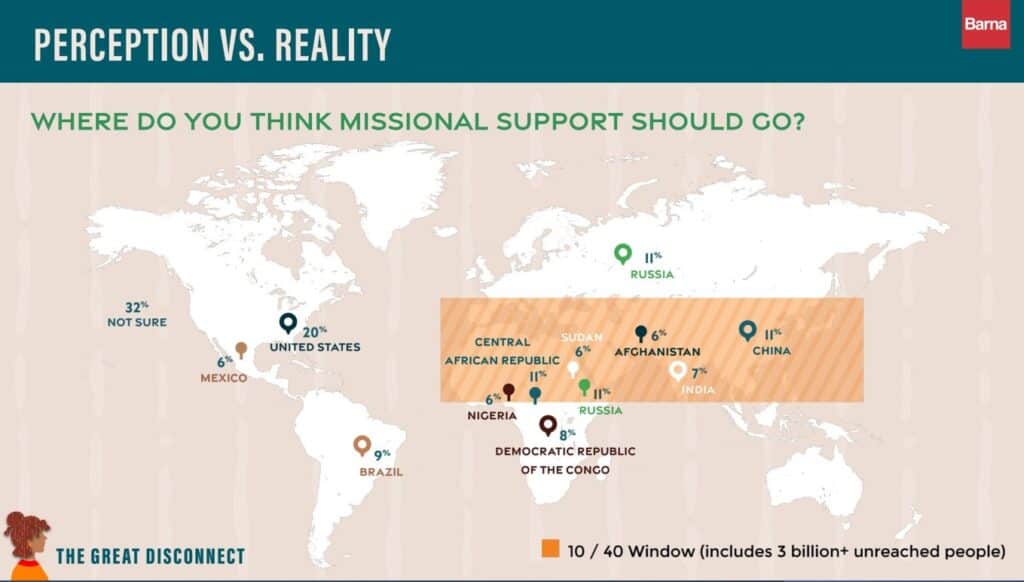
Take a moment and reflect on those stats. What does the 20% data point say about the mindsets of US Christians? What about that 32% who don’t know where support should go?
To break this down, Christians think the Church sends enough missionaries around the world (60%), yet don’t know how many people need to be reached with the good news.
Now that Barna has uncovered how disconnected US Christians are from the Great Commission and the world’s need for Christians to follow it, it’s on church leaders to make a change. This is one of the main reasons for The Great Disconnect report: to empower church leaders to help their congregants better understand global missions, in turn leading to the gospel spreading more effectively across the globe.
Let’s pray over this and ask God for his wisdom in our strategies, tactics, projects, and relationships to help the Church (and its leaders!) convey this massive need of the gospel in the world. There is so much opportunity ahead of us.

David Chakranarayan (david.chak@missionindia.org) serves as the director of church engagement for Mission India. He has served in the capacity of an associate pastor, church planter, lead pastor, global apologetics speaker, and an advocate for children living in poverty globally. He and Kristen have been married for 18 years, and they have five daughters named Ava, Maya, Jada, Kate, and Camdyn. He is passionate about reaching the nations with the gospel.
Readers can download the free report at: missionindia.org/the-great-disconnect/
EMQ, Volume 59, Issue 2. Copyright © 2023 by Missio Nexus. All rights reserved. Not to be reproduced or copied in any form without written permission from Missio Nexus. Email: EMQ@MissioNexus.org.