EMQ » July–September 2021 » Volume 57 Issue 3
By Deb McQuilkin
In the global era of COVID-19 and the Black Lives Matter movement, leaders serve with better outcomes when they possess and use cultural intelligence.[1] Collaboration, shared governance, leadership, teams, and ultimately organizational outcomes depend on working across cultures. “For many employers now, they are managing people from remarkably diverse backgrounds, and the difficulty for them is how to maximize the potential of their staff. It’s difficult to do if you don’t understand their culture.”[2]
Strategies and structures that are appropriate in one cultural setting may lead to failure in another. Edgar Schein at the Sloan School of Management says that “culture and leadership are two sides of the same coin.” Hence, cultural difference is a crucial situational factor in leadership effectiveness relative to cross-cultural contact.[3] Complex systems theory considers culture and history within and outside an organization. What worked in one organizational setting may not work in another setting due to these differences. Input into a system may have dramatically different results when placed within a different cultural context.
Cultural Sensitivities
Being insensitive to the impact of culture on people’s thoughts, attitudes, or behaviors impede a leader’s ability to become culturally intelligent and can cost an organization billions of dollars in lost opportunities.[4] David Livermore, executive director of the Global Learning Center, noted that the ability to read a situation and find the appropriate strategy “suited to the existing cues are particularly important during negotiations. 90% of executives from more than 60 countries said cross-cultural leadership was their top management challenge.”[5] Leaders must also be able to understand how people from different cultures view them and interpret their actions. Successful leadership behaviors may differ within various cultures.[6] Also, the findings stress the importance of leaders’ patience, openness, and flexibility. Cross-cultural leadership is based on respect for others and a willingness to learn and adapt fast.[7]
The term global leader however, is a misnomer as we all operate in a global environment. In today’s world, we face a shortage of human capital. This, rather than financial capital, is the bigger constraint.[8] Administrators operating in a global environment obviously need a broad perspective and the ability to relate to other people and cultures in an open, engaged way. Multicultural, multilingual, and multilevel management is the new world in which we find ourselves.
A culturally intelligent leader recognizes their own identities, how they are interrelated and has the flexibility to reprioritize them as needed.[9] Cultural differences lead to misunderstanding which increased conflict, low morale, and lack of productivity in work settings.[10] Cultural competence of leadership directly impacts the cultural competence of clinical staff employees.[11]
Cultural Variables
Variables across culture are myriad. Considerations when working cross-culturally include human bias, racism, values, religious beliefs, and social systems. Outside and within American geographic boundaries, cultural variances include deep rooted corruption, obstructive bureaucracy, corrupt judiciary, corrupt tax regimes, political influence, mafia, terror, and dislike of the West. Internationally educated professionals may bring these cultural variances into your organization. Some of these variables are components of culture and that culture’s values, others are external forces impacting that culture.
Cultural variables leaders consider when engaging others include:
- Authority: Is it hierarchical, egalitarian, shared or coercive?
- Work ethic: How long, how hard, and how does this culture value work/life balance?
- Ownership: Where does the ownership of knowledge and resources reside?
- Ethics: Are there absolutes? How is honesty, bribes, or fidelity measured?
- Gender: What is the role of women and, therefore, men in this organization and culture?[12]
A workforce is diverse in the degrees of adherence to majority cultural values. Cross-cultural leadership becomes quite complex and difficult to tease out the causal factors, especially when combined with other leadership considerations such as style, context or situation, complex systems theory, leader placement within the organization, and geo-cultural context.
Cross-cultural dimensions from Hofstede[13] and the Globe Study of CEO leadership behavior in twenty-four countries[14] inform and define cross cultural leadership. Generally, competencies for leadership are similar across professional organizations, ranging respectively from thirty-five to sixteen individual competencies. These are usually set within the five domains of: (1) communication and relationship building, (2) knowledge of the organizational or professional environment, (3) leadership skills, (4) professionalism, and (5) business skills.
Leaders across disciplines are historically remiss in appropriating useful cross-cultural communication in relationships based on trust. Administrators are key in aligning resources with organizational goals and the strategic plan by providing the operational leadership needed to eliminate barriers and to improve the use of best practices related to culturally and linguistically appropriate services.[15]
Increasing underrepresented minorities remains elusive. Leadership expectations create organizational standards for diversity and cultural competence. Cultural competence is directly correlated with minority presence.[16] The lack of minorities in leadership positions further hinders the progress of non-majority persons across the organizational spectrum.[17]
Cross-Cultural Leadership
Culture in this model is defined as the values, beliefs, and behavior of a collective people group. There is a wide variety of variation among any people within a defined culture, but a cultural group shares a common core of values, beliefs and behaviors. Gibson and Deng[18] validated two critical elements of cultural intelligence: (1) the motivation of leaders to culturally adapt their behavioral skills or actions and (2) their ability to determine when and where new behaviors are needed and execute these behaviors effectively. Effective cross-cultural communication between a leader and followers improves cultural understanding and cultural adaptation, becoming appropriate that communication is a considerable measurement of a leaders’ cultural intelligence.[19] Cultural intelligence is the ability to effectively cross different cultures, whether that involved different generations, geographies, heritages, faith, gender, organization, or sector.
Cultural competence is defined by the Office of Minority Health as
“… services that are respectful of and responsive to individual cultural health beliefs and practices, preferred languages, health literacy levels, and communication needs and employed by all members of an organization (regardless of size) at every point of contact”.[20]
Broaden that definition to include more than heath or healthcare, and a concise definition of cultural competence exists. No single list of competencies is adequate to predict or account for all the variance in leadership effectiveness. There are many types of situational variables that impact leader competencies and include complex system theory variables, interpersonal dynamics, 360-degree relationships, organizational culture, and country-culture variables (e.g., use of power, individualism, honor cultures, and respect for others).
Four Functions of Leadership
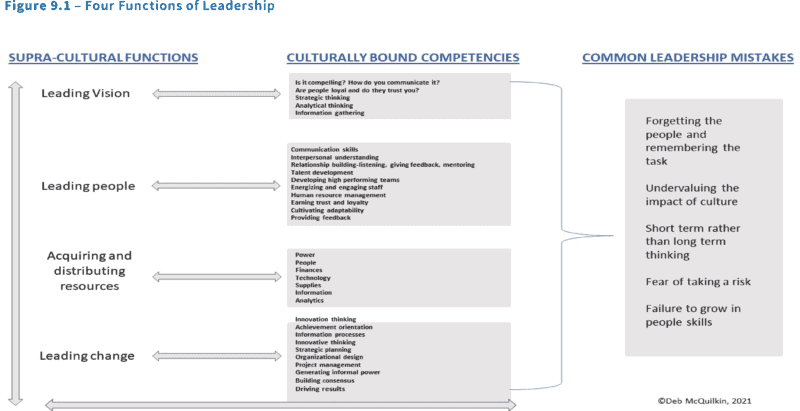
This article and subsequent model below (figure 9.1) identify four functions of leadership that exist regardless of culture and organization and are therefore supra-cultural or above culture.
The first function is leading vision. This function evaluates, “is the leader able to see the future clearly and anticipate large scale and local changes that affect the organization and environment?” Identified leadership competencies are culturally dependent in how they are used to fulfill functions of leadership. How one competency works in one culture might not work the same in another culture. Leading and casting vision requires strategic and analytical thinking, and adequate, appropriate information gathering to be done well. The way information is gathered, the way it is communicated, and the recipient’s trust in that information is crucial to creating the buy-in necessary to accomplish the vision and varies from one culture to another. The culturally intelligent leader also considers the trust and communication necessary not only across but between cultures. This is where majority cultures may mistake minority culture acquiescence for acceptance.
The second leadership function required, regardless of culture, is that of leading people. Awareness of other’s need for direct vs. indirect communication, how to handle honor and shame cultures, giving feedback, and listening are culturally determined. Building talent and teams, energizing staff, earning trust and loyalty vary across people group’s values, beliefs, and behaviors. Effective leaders are adaptable and sensitive to other’s needs in these areas.
Culture impacts the competencies necessary for the third global leadership function of acquiring and distributing resources. Whether power, people and talent, finances, technology or supplies, culturally intelligent leaders analyze and appropriately adapt to the norms of the people they lead. These leaders are effective at recruiting the right people able to work effectively across cultures to achieve organizational goals. They lever desired resources in culturally appropriate ways to build a better system that meets the needs of everyone.
This sensitivity and adaptation is necessary across the fourth function of leadership – managing change. Addressing healthcare and organizational innovation, utilizing informal power structures, establishing information processes, building consensus, and driving results depend on the values, beliefs, and behaviors of others. We manage change by building informal power. Cross-cultural leaders understand the roles of power and influence in organizations; they develop compelling arguments or points of view based on a knowledge of others’ priorities; develop and sustain useful networks up, down and sideways inside and outside the organization. These effective leaders become a go-to person for the organization and effectively impact the thoughts and opinions of others – both directly and indirectly.
Common Mistakes
What mistakes do leaders make in considering culture? Reflect on the following:
- Forgetting the huge impact personal and corporate culture makes in organizational outcomes
- Forgetting the people within the organization and focusing on the task
- Thinking short term rather than long term
- Maintaining a fear of taking a risk
- Failure to grow in people skills – the foundation of cultural intelligence
As we know those we lead and with whom we work and when their goals, needs, and motivations are not driven solely by our own cultural perspective, we can enjoy the synergistic outcomes found in working across cultures to improve relationships, better our organizations and advance the spiritual well-being of those we serve.
Deb McQuilkin is a retired Associate Professor from the University of South Carolina teaching Health Systems Leadership, and currently lives in Australia. She is the widow of Robertson McQuilkin, former president of Columbia International University.
EMQ, Volume 57, Issue 3. Copyright © 2021 by Missio Nexus. All rights reserved. Not to be reproduced or copied in any form without written permission from Missio Nexus. Email: EMQ@MissioNexus.org.
[1] P. Gibson and L. Deng, “A Qualitative Evaluation on the Role of Cultural Intelligence in Cross-Cultural Leadership Effectiveness,”International Journal of Leadership Studies 3, no. 2 (2008): 181–197; Department of Health and Human Services, Office of Minority Health (2020), CLAS Standards, https://thinkculturalhealth.hhs.gov/resources/presentations/8/the-national-clas-standards-health-literacy-and-communication; “Are You Cued into Cultural Intelligence?” Industry Week 258, no. 11 (2009): 24.
[2] L. Tao., “Cultural intelligence the New Indicator,” The Press A13 (2016).
[3] Gibson, “A Qualitative Evaluation on the Role of Cultural Intelligence,” 181–197.
[4] “Are You Cued into Cultural Intelligence?” 24.
[5] “Are You Cued into Cultural Intelligence?” 24.
[6] R. J. House, P.W. Dorfman, M. Javidan, P.J. Hanges, and M.F. Sully de Luque, “Strategic Leadership across cultures,” The GLOBE study of CEO leadership behavior and effectiveness in 24 countries (Los Angeles: Sage, 2014).
[7] J. Owen, “How to be a global leader,” Director 71, no. 2 (2017): 56–57.
[8] J. Hanna, “The Death of the Global Manager,” Harvard Business School Business Research for Business Leaders, Aug 8, 2011, https://hbswk.hbs.edu/item/the-death-of-the-global-manager.
[9] P.C. Earley, S. Ang, and J.S. Tan, CQ: Developing cultural intelligence at work (Stanford, CA: Stanford Business Books, 2006).
12 C. Levy-Leboyer, “Cultural intelligence: Individual interactions across cultures” (Book Review), Personnel Psychology 57, no. 3 (2004): 792–794.
[11] M. Dauvrin and V. Lorant, “Leadership and Cultural Competence of Healthcare Professionals: A Social Network Analysis” Nursing Research 64, no. 3 (2015): 200–210, https://doi.org/10.1097/NNR.0000000000000092.
[12] House, “Strategic Leadership across cultures.”
[13] G. Hofstede, Culture’s consequences: Comparing values, behaviors, institutions, and organizations across nations, 2nd ed. (Thousand Oaks, CA: Sage, 2001).
[14] House, “Strategic Leadership across cultures.”
[15] Y., Ogbolu, D. Scrandis, and G. Fitzpatrick, “Barriers and facilitators of care for diverse patients: Nurse leader perspectives and nurse manager implications,” Journal of Nursing Management 26, no. 1 (2018): 3–10, https://doi.org/10.1111/jonm.12498.
[16] O. Duhart, “Why more hospitals should prioritize cultural competency,” Harvard Business Review (May 26, 2017), https://hbr.org/2017/05/why-more-hospitals-should-prioritize-cultural-competency.
[17] Y. Wesley, “Leadership competencies to reduce health disparities,” Nursing Management, 46, no. 2 (2015): 51–53, https://doi.org/10.1097/01.NUMA.0000460049.40051.0f.
[18] Gibson, “A Qualitative Evaluation,” 181–197.
[19] Gibson, “A Qualitative Evaluation,” 181–197.
[20] Department of Health and Human Services, Office of Minority Health (2016), CLAS Standards, https://www.thinkculturalhealth.hhs.gov/Content/clas.asp.