EMQ » July–September 2021 » Volume 57 Issue 3
By Patricia Savage and Tena Stone
French-speaking Africa represents hard soil for sowers of the gospel. These countries include some of the most unreached areas of sub-Saharan Africa.[1] Places where God’s Word has never been preached. Remote villages with no Christian believers, and certainly no churches. Pockets of Islam and animism that have gone unchallenged for generations. Some people live in large modern cities, and others in places where there are no roads, no electricity, and no schools or hospitals. But there is one thing they share in common: they need to hear the good news.
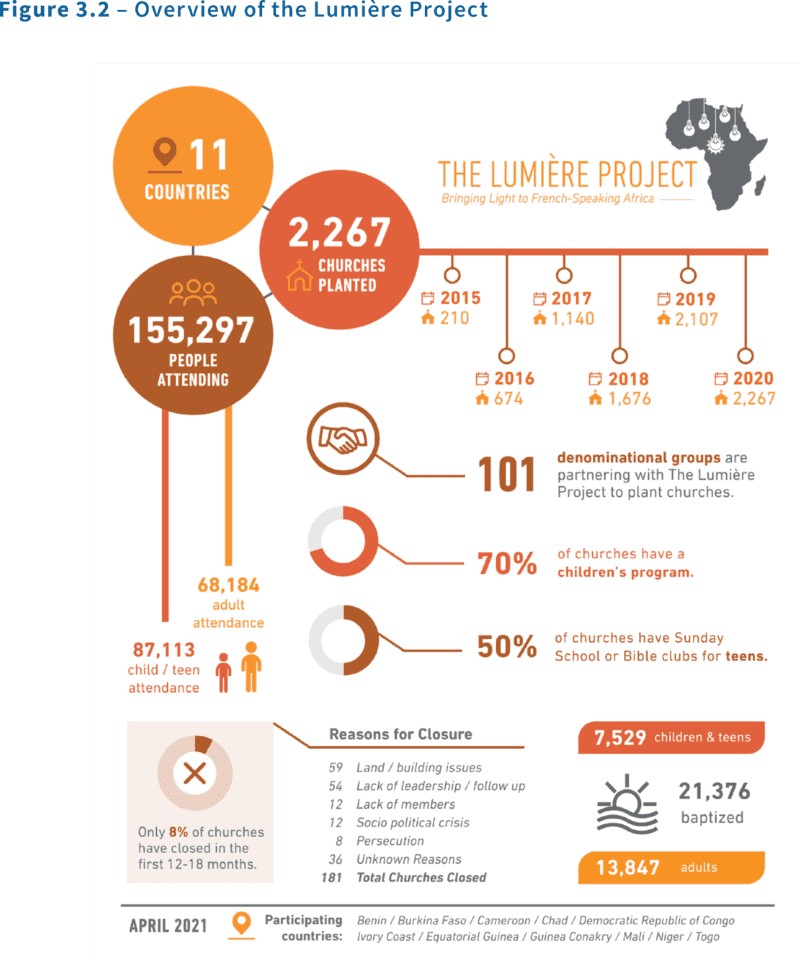
Pastors and evangelists from eleven African nations have risen up to commit themselves to spreading the light of Christ to every corner of their countries. The initiative is called the Lumière Project (lumière means light in French) and was launched by OneHope in 2015, with the goal to see 3,300 new churches planted across French-speaking Africa. To date, 2,267 churches have been planted and more than 155,000 people have attended a service at one of the Lumière churches.[2] From the beginning, research has been strategically embedded into this process, with churches being surveyed at the time they are planted, and then again twelve to eighteen months later. Qualitative research has also been conducted, with fifty-five church planters interviewed in four countries over the course of three years. Through the research, pastors have been able to share their challenges, triumphs, strategies, and the many miraculous ways God is moving in this part of the world.
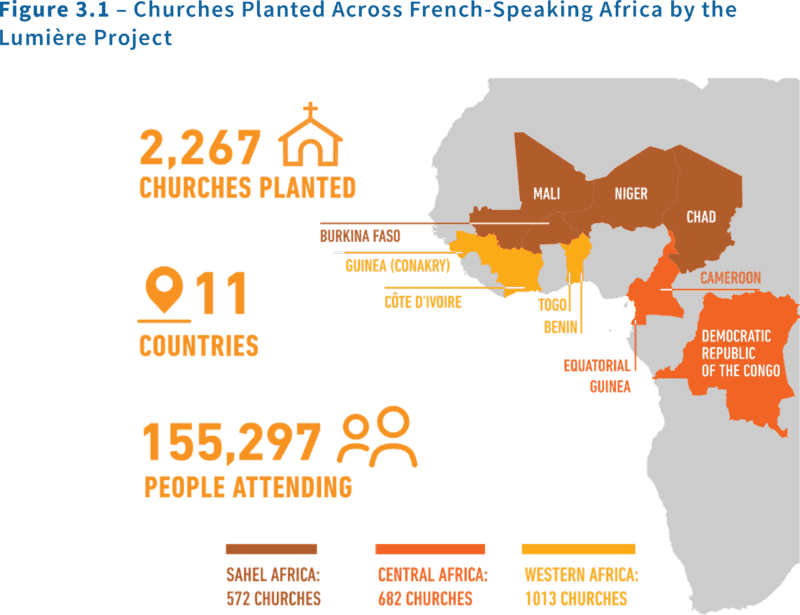
The Challenges of Church Planting in Hard-to-Reach Areas
The work of planting churches can be difficult, and these places are hard to reach with the gospel for a variety of reasons. One obvious challenge in some countries is a religious landscape that is hostile to Christianity. Countries like Niger (99% Muslim)[3] and Mali (94% Muslim) are strongholds of Islam that are not open and welcoming to evangelism efforts. Across all eleven participating nations, more than eight out of ten Lumière congregations are located in Muslim or animist communities. In these areas, religious opposition can quickly turn into open hostility and persecution. Some pastors regularly receive threats against their life or are the target of voodoo curses along with their families and church members. In some villages, congregations are harassed or physically chased away from meeting together.
Another challenge is language. Though French is the language that broadly unites these countries, it is certainly not the only one used or preferred. Ninety-two different languages are spoken among the Lumière congregations. Some pastors must first learn the local tongue before they can even begin to evangelize in the community where they feel called to plant. Once they get there, they often find that illiteracy is another challenge that prevents new believers from engaging with Scripture for themselves.
Distance is yet another practical barrier that makes pastoring a significant logistical challenge. Many Lumière planters travel great distances to shepherd their congregations. One in three pastors are responsible for both a mother church (an established congregation) and caring for at least one new church plant. The average distance between the two congregations is twenty miles. Sometimes those miles are extremely difficult, taking them into the bush across terrain where there is no real road for their motorbikes. Pastors can spend much of their time traveling back and forth to preach on Sundays and return during the week for Bible studies and discipleship groups. One pastor in Niger leads six different congregations and has had to get creative with how he divides his time. He travels to each church in rotation to preach on a different day of the week. On his day off, he sells chickens at the market to support his family and his ministry. People have nicknamed him the “Guinea Hen Salesman Pastor.”
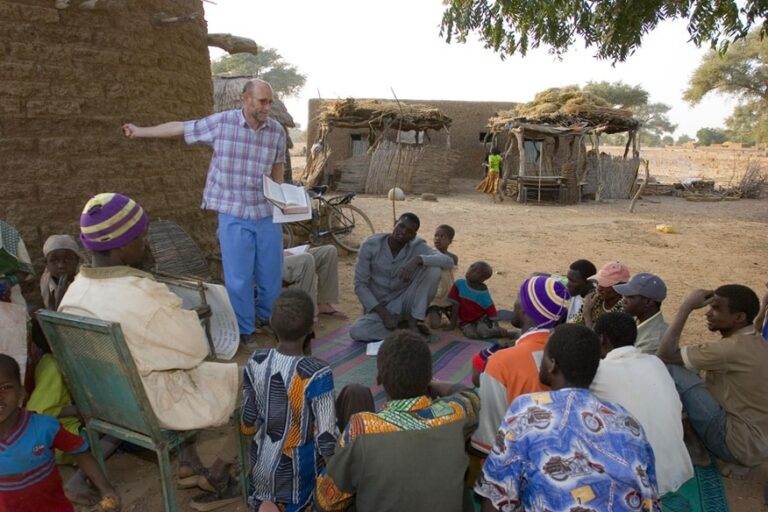
Finally, resourcing is a challenge that can keep new churches from thriving. “When we started the church, we met under the branches of a tree,” shares Pastor Enu[4] from the Democratic Republic of Congo (DRC). “Only a few people came because they were embarrassed.” His experience is far from unique. Many Lumière congregations gather outside under a tree or in someone’s yard or porch until they can raise funds for their own land and building. These informal locations are not only inconvenient – putting them at the mercy of the weather – but can also make outreach difficult. Some pastors report that in these situations the community does not take them seriously and may even view the church as a cult. Fortunately, nearly three in four Lumière churches are planted with the help of a mother church, who is often able to assist the new congregation with training, resourcing, and even financial help.
Creative Solutions Are Enabling the Gospel to Go Forward
Lumière church planters are not discouraged or dismayed in the face of challenges. Instead, they are overcoming barriers with creative solutions and strategies. “If you talk to them about God, you will be rejected,” says Pastor Kwasi describing his outreach in a Muslim area of Côte d’Ivoire. “But when you tell them that in the evening you will show a movie, even the village chief and Imam will come to watch.”
The movie is OneHope’s animated film, The GodMan, that depicts the life and death of Christ. The film forms the centerpiece of Pastor Kwasi’s church-planting strategy. Every month, he visits a different village with the film DVD, a projector, and a pop-up screen tied to the back of his motorbike. He shows the movie and preaches the gospel. Wherever people respond in faith, a church is established to disciple the new believers. The area of Côte d’Ivoire where Pastor Kwasi has dedicated himself to ministry is 99.9% Muslim and extremely remote. Yet he has been able to plant and pastor multiple churches in this hostile environment using this creative approach.
Across French-speaking Africa, Lumière pastors have embraced this church-planting model to take God’s Word to the cities, towns, and villages of their nations. The GodMan film opens doors to communities and hearts to the gospel. With seventy-eight translations, twenty-eight of them African languages, the film is both a valuable and accessible outreach tool. For people groups that do not yet have a translation, pastors have gotten creative. They show the film in segments, stopping to translate the dialogue and expand on the gospel message being shared. Using multimedia is an innovative approach in many remote areas where people have never seen a movie before. “In this whole village there is no electricity at all,” shares Pastor Kouadio from Côte d’Ivoire. “When we started evangelism it attracted people because there was light.”
Another thing that attracts people is sound. In low-literacy areas where people are unable to read the Bible for themselves, they can listen to Scripture if they have the right equipment. To help meet this need, OneHope has partnered with the ministry Faith Comes by Hearing to provide audio Bible kits. These devices, called Proclaimers, read Scripture aloud in the local language, helping new believers grow in their faith in between times when a pastor can come teach them. The Proclaimers address the Scripture access problem and are also an evangelistic tool themselves, attracting many to gather around and hear what the Bible has to say.
Children Are Most Often the First to Respond
Children are a critical mission field, and one that is too big to be overlooked. In French-speaking Africa, more than six in ten people are under the age of twenty-five.[5] Children and teens are the future of world missions, and the future leaders of our churches. There is no reason to wait to bring them the life-transforming message of the gospel and engage them in growing God’s kingdom. Lumière pastors recognize this opportunity, and their testimonies confirm that the harvest is plentiful.
“The children are always the first to accept Jesus,” says Pastor Enu of the DRC. In his experience using The GodMan film for outreach, he has sometimes seen hundreds of children respond to his invitation to accept Christ in a single night. These eager young people become the nucleus of the new church in that community. OneHope’s research shows that over half (56%) of those attending Lumière church plants are children and teens.
At a church plant in a rural area of the DRC, the pastor shared how difficult it was to grow the church at first. He started with a prayer group of eight people and spent all his time going door-to-door to preach the gospel, with very little response. But when a OneHope team came to support him bringing The GodMan film, growth was explosive. And it was the response of the children that made the difference. Young people brought their entire families with them to see the movie. “There were so many children one evening that it filled up the entire area and spilled over onto the road,” the pastor remembers, “all full with children who came to see this film about Jesus.” The church is thriving now and holds sunrise services every morning before the villagers leave to work in the fields.
One church planted through the Lumière Project is exclusively made up of young people. It is located on Niger’s northern border in a town where refugees fleeing north to Libya and Europe often abandon their children. A Lumière pastor has formed a church there for these refugees and street children, and there is not yet a single adult who attends the congregation.
Children Are a Church’s Future and Its Present
Lumière churches have a unique focus on discipling children and teens as critical members of new churches and put an early emphasis on children’s ministry. Discipleship programs for young people are one of the first priorities for a new church to establish. OneHope’s research shows that within six months of being planted, 70% of Lumiere churches have a children’s ministry and 50% have a ministry for teens. In some congregations without specific teen ministries, teens join the adult worship service or are involved in helping lead children’s ministry.
In addition to Sunday School, many churches offer a mid-week Bible club or discipleship program for young people. Some churches have ministry activities every day of the week. OneHope provides resources for these, such asGod’s Big Story and Stories of Hope – programs that build biblical knowledge and help kids share their faith with those around them.
For children and adults alike, illiteracy can make Scripture engagement a challenge. Qualitative research conducted among Lumière church planters across four countries revealed that illiteracy is a common and significant barrier. These pastors estimate that 90% of rural church members don’t own a Bible and wouldn’t be able to read it if they had one. This outlook improves in urban areas, where literacy rates are better, and pastors estimate more than half of church members own a Bible. However, the vast majority (69%) of Lumière churches are planted in rural areas where poverty and illiteracy are the reality.
OneHope’s God’s Big Story program responds to these challenges by taking an oral approach to children’s ministry resources. Pastors share a Bible story and give each child an illustrated card to help them remember what they learned. Each week, children return to receive the next card until they have heard the complete story of the gospel and can share it with others. In one church in the DRC, children show up to church three days a week, as early as five o’clock in the morning to worship and study the Bible in this way!
“Churches who have never tried anything with children have seen how the Lord can use and change the lives of children,” shares Pastor Kaima from the DRC. “They have started to copy our methods.”
Children Help Churches Grow
Far from being a hindrance in new churches, young people are a powerful and strategic nucleus for a new church plant. Children and teens help establish churches within their communities and prove that no one is too young for God to use. Pastor Enu’s team in the DRC mobilizes children and teens to do door to door evangelism. They go out two by two inviting people to visit the church. Every week, around five to ten new people show up on Sunday curious to know about Jesus.
With their child-focused strategy, Lumière churches have always seen greater numbers of young people attending than adults. But follow-up surveys show that children and teens remain faithful attenders and bring others with them. Two in three Lumière churches report stable or increased attendance of both young people and adults within twelve to eighteen months after being planted.
These children and teens are persistent and dedicated. At one church in a remote part of western Niger, children walked several miles from a nearby village in order to see The GodMan film. They continue to return to be discipled by the pastor, even though their Muslim families disapprove of their newfound faith. This is not an isolated example. Many pastors shared similar stories of how children and teens lead the way in being the first to respond to the gospel and remain the most enthusiastic of their new church members.
“One day I preached on John 3:16,” says Pastor Lumumba from Niger. “I saw an eight-year-old girl writing down everything.” After the sermon, the girl asked for an extra copy of the Book of Hope, OneHope’s Scripture resource for children that explains the gospel message. She took the book with her to school to share with her classmates. Her teacher was moved by her testimony and started to attend the small congregation where soon she too was saved and now brings her own children each week!
Stories like this are not unusual among Lumière churches. Children are uniquely open to hear and receive the message of Scripture, and their faith is a joyful and authentic witness to those around them. Older children bring younger siblings with them to church, and freely invite other children and adults alike. It is often the witness of a child’s life changed that encourages parents to visit the church for themselves.
Leadership is Critical to the Vision
The vision of the Lumière Project is too vast for any one person, organization, or church planting network to accomplish alone. In fact, 101 denominational groups are partnering in the work across the eleven participating countries. OneHope’s research has revealed the critical nature of collaboration and of multiplying the vision to plant healthy churches in unreached areas.
More leaders are needed to be called into this work and carry this initiative forward. Just one in twelve Lumière churches have closed their doors, and not for the reasons you might expect. Persecution, though a harsh and present reality in some places, is not the primary reason churches report closing. Neither is a lack of members. People are responding to the gospel in great numbers and faithfully attending church plants to be discipled in their newfound faith. It is primarily that they lack people to lead the work of church planting, pastoring, and shepherding the congregations. A lack of leadership or follow up is one of the most common reasons given for closure. Land or building issues are also frequently mentioned. This is a poignant reminder that the harvest is great, only the laborers and resources are few.
Looking across the harvest fields, young people are ripe to hear the gospel. Even the most unlikely of children are responding in faith. A pastor from Côte d’Ivoire shared about an altar call he gave that touched the hearts of teenage drug dealers of twelve and thirteen years old, and of children so poor they were surviving only by stealing. They came forward to receive Christ, touched by the scene in The GodMan film when Jesus forgives the thief on the cross.
Today, these children have been completely transformed and continue to attend the small church and be brave witnesses to their Muslim community. How would those children have come to believe if they did not hear? And how can they hear without someone preaching to them?
“We obey the Lord because it is his work,” says Pastor Enu. It is a sentiment we have heard across our interviews with pastors. The challenges are great, but they know our God is greater. In the midst of persecution, churches are standing strong. In the face of vast need, God is miraculously providing. In response to trusting faith, he is healing and answering prayers. Through the sacrifice and obedience of Lumière church planters, the gospel is being preached and the light of Christ is shining more brightly across French-speaking Africa. In every corner of these eleven countries, children and youth as well as their families are responding in faith and churches are being planted where there have never been churches before.
This article was a collaborative effort between Patricia Savage, Creative Editor, and Tena Stone, Vice President of Research at OneHope, along with Senior Researcher David Plate. Since 1987, OneHope has shared the life-changing message of the gospel with the next generation. Using research to design age and culturally relevant Scripture programs, OneHope has worked in every country and reached more than 1.7 billion children and youth with God’s Word. (research@onehope.net)
EMQ, Volume 57, Issue 3. Copyright © 2021 by Missio Nexus. All rights reserved. Not to be reproduced or copied in any form without written permission from Missio Nexus. Email: EMQ@MissioNexus.org.
[1] https://joshuaproject.net/continents/AFR
[2] The Lumière Project (2021), Internal OneHope report: unpublished.
[3] https://www.cia.gov/the-world-factbook/countries/niger/#people-and-society
[4] Note that names of pastors in this article have been changed for their safety.
[5] Worldometers.info; worldpopulationreview.com.