EMQ » April–June 2021 » Volume 57 Issue 2
By Steven Steinhaus
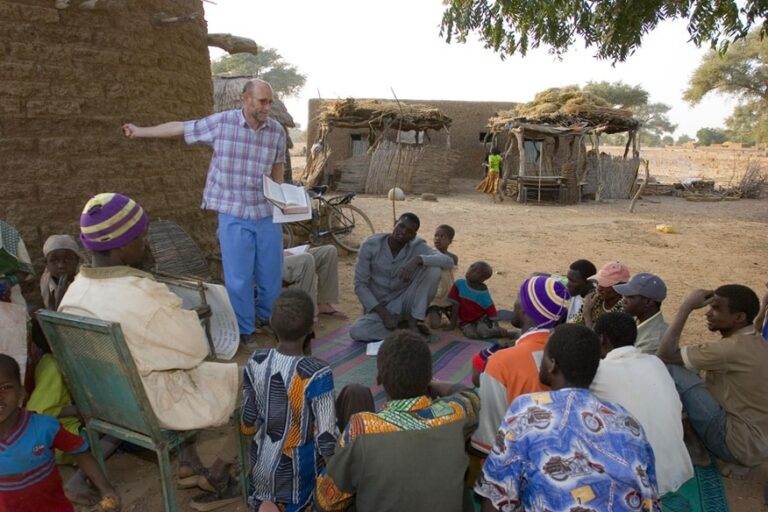
In recent years the term DMM (Disciple Making Movements) has become a fad. It means a lot of things to a lot of different people. On one hand, that’s OK. It’s a good term and a great goal! But the originators of the term emphasized not doing evangelism or teaching as most of us conceive of it, but instead allowing people to discover what the Bible actually says through Discovery Groups (using Discovery Bible Studies).[1]
But why emphasize discovery groups instead of proclamation, preaching, or traditional models of teaching? Why not just get to the point and tell people what they need to know? Below is my Top 10 list of reasons for Discovery Groups. Note that I’m not focusing on personal discovery, but on what happens through the Discovery Group process.[2]
The Word itself is more powerful than our best sermons and explanations.
Hebrews 4:12 states that the Word is powerful and “stronger than any double-edged sword.” I used to believe that was true if the teacher did a good job teaching it. If it was dressed up, explained and illustrated well, and preceded by some good music, then sure it could be powerful. I don’t think I viewed the Word itself as really powerful. But what if the Word itself really is the most powerful element? Then my job becomes finding how to best get people into the Word, not into a building or via a podcast. As David and Paul Watson write, “Scripture does not take second chair to any teacher. Scripture is the teacher”[3] (Emphasis mine).
The Word is meant to be applied with loving accountability, not just heard.
While we all recognize this, most of us have become accustomed to large auditoriums where preachers wax eloquent while we sit passively. We often view weekly Bible studies as optional extras, and accountability in such Bible studies usually only happens in college-age groups. But James says, “Do not merely listen to the word, and so deceive yourselves. Do what it says! … the man who looks intently into the perfect law that gives freedom, and continues to do this, nor forgetting what he has heard but doing it – he will be blessed in what he does.” (James 1:22, 25, NIV) These verses describe well why Discovery Groups work: (1) we look intently into the Word; (2) we continue to do so in groups; (3) we apply what we learn under loving accountability. We emphasize loving accountability because the basis of our obedience to God is love (John 14:15, 21, 23; 15:14; 1 John 5:3). While not lowering God’s standards, we exhibit grace and mercy to each other in group meetings because we are aware of our own failings (Romans 8:1; Jude 22–23).
Jesus often encouraged people to discover through Q&A and stories rather than one-way lectures.
While we do not dispute that Jesus gave some timeless sermons (praise God for that!), he seemed to favor impromptu, earthly stories (parables) with lots of Q&A. He also did not immediately divulge everything about his identity but carefully kept the Messianic secret until the end. How was he content to do things so slowly and patiently? By contrast, in modern homiletics we seek to create interest in an issue, give a full-orbed answer, and then ask listeners to be saved – all in thirty minutes! But have you ever noticed that Jesus asked hundreds of questions, yet seldom directly answered any?[4] Statements like, “Go and learn what this means ….” and “He who has ears, let him hear” invited his followers to ponder and discover. Perhaps part of the reason Jesus chose this modus operandi was that the process of spiritual life must be cultivated in step with the Spirit. Causing people to reflect, consider and pray, gives the Spirit more room to work.
Most people come to Christ after a long process in which they discover who he is.
This is how the first disciples came to Jesus – not instantaneously, or in a punctiliar fashion (see Gordon T. Smith, Transforming Conversion). Interestingly, even Bill Bright (founder of Cru and author of The Four Spiritual Laws) related that he came to Christ over a many-month process of Bible reading and attending a dynamic Sunday School class taught by Henrietta C. Mears.[5]
J.I. Packer writes this about conversion:
Conversion itself is a process. It can be spoken of as a single act of turning in the same way that consuming several dishes can be spoken of as a single act of dining, … revivalism encourages us to think of a simple, all-embracing, momentary crisis as its standard form. But conversion … is best understood if viewed as a complex process that for adults ordinarily involves the following: thinking and re-thinking; doubting and overcoming doubts; soul-searching and self-admonition; struggle against feelings of guilt and shame; and concern as to what realistic following of Christ might mean.[6]
Tim Keller concurs:
We … acknowledge that coming to this point of uniting to Christ by faith often works as a process, not only as an event. It can occur through a series of small decisions or thoughts that bring a person closer and closer to the point of saving faith. In a post-Christendom setting more often than not, this is the case. People simply do not have the necessary background knowledge to hear a gospel address and immediately understand who God is, what sin is, who Jesus is, and what repentance and faith are in a way that enables them to make an intelligent commitment.[7]
Why then are we so often impatient about giving people time to process? Let’s not discourage people in this process by being overly pushy or asking prematurely for a decision for Christ.
Discovery Groups are a group process and most people around the world come to Christ with their groups.
Though often overlooked, the fact is that the Book of Acts portrays group conversion as the norm, as does most of Christian history.[8] Today, especially in UPG situations, if we short-circuit this process by winning individuals separately, the new believer often faces some sort of persecution and loses the chance to win her family. Jerry Trousdale writes, “A community of believers can exile an individual who has become a Christian, but it can’t throw out a whole family without creating major social and economic problems for everyone.”[9] Thus in DMM, the disciple maker uses a discovery process to allow the group to discover together who God is and why they must believe in Christ. This greatly increases the likelihood of the whole family or group coming to Christ together. Years ago, David Hesselgrave warned: “Missionaries should not make initial gospel presentations to those who are ‘not qualified’ to respond, and they should not unduly obstruct the decision-making process by refusing to allow ample time for deliberation by individuals and responsible groups.”[10] Of course, groups have come to Christ throughout history in many ways, but Discovery Groups are a proven process, intentionally geared toward reaching people with their groups. What happens if you reach a Pakistani or Palestinian student apart from her family? What might happen if instead we asked to meet her parents and started a Discovery Group in her home?
Resistant and religious people are usually much more willing to listen if we come with a learner’s posture than if we come as teachers.
Committed Muslims, Buddhists and Hindus have little use for our ideas and theologies. They can often match our best stories with their own. But if we come asking them whether they’ve ever considered what the Bible says and invite them to discover it with us through a set of stories, it’s surprising how many are willing and interested. Muslims in particular profess belief in four Holy Books (the Torah, the Psalms, the Gospel and the Qur’an). So I ask Muslims if they’ve ever read the “other holy books” apart from the Qur’an. If they say the Qur’an is hard to understand, I tell them that’s because it came last. If they want to understand more, they should see what the earlier Books actually say. Whenever I invite someone to begin a Discovery Group, I always tell them there will be no teacher; a facilitator will just guide the process using simple questions. That idea in itself very often immediately removes resistance.
Discovery is just good pedagogy.
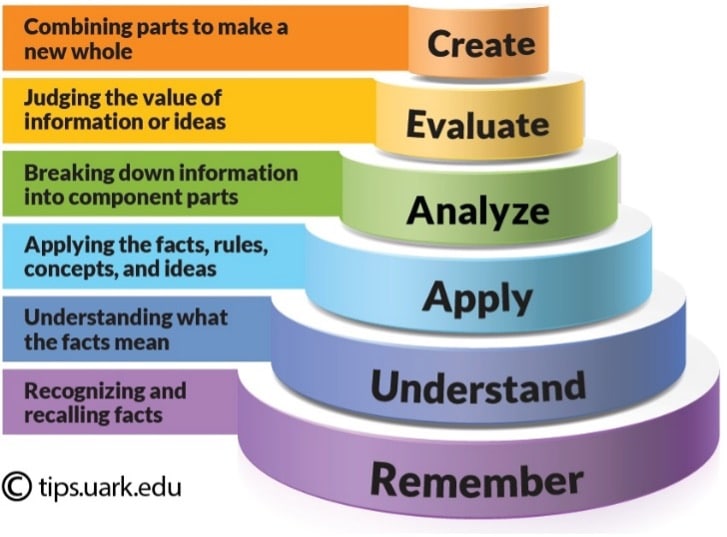
Modern educational theory reveals that the more people talk and interact over a subject, the more they learn. Add synthesis, application and accountability to the mix, and it’s dynamite. Professor Bloom of the University of Chicago famously parsed this years ago in his renowned “Taxonomy of Learning” (see figure 1.1). Many schools have taken notice and now use “flipped classrooms,” chat rooms, small groups, etc.[11] Why then do we try to get people to listen to lectures (sermons) when it comes to matters of faith? The Greek word to teach is didasko which literally means to cause people to learn. Since discovery is a proven way to learn, why not use it? As Romans 12:7 says, “If you’re a teacher, teach well!” (NLT).
Discovery Groups tend to result in less heresy.
I know this seems counterintuitive. Some may ask: “Doesn’t letting non-believers and new believers study the Bible without a trained leader inevitably lead to heresy?” No, actually the opposite is true. Heresies most often originate from highly-trained, charismatic and authoritarian preachers who can persuade their listeners to believe their heretical claims. In Discovery Groups, people learn week after week to: (1) look intently into the Bible and see what it really says; (2) to limit discussion that imports ideas and concepts into the text that are not clearly stated there; (3) to challenge others in the group who insert strange ideas by asking, “Where do you see that in the text?” This process nurtures incredible spiritual health – especially in contrast to one person expounding their ideas at length while others cannot even ask questions. Listening to powerful rhetoric can easily lead us to positions that are beyond the plain sense of the Bible. But in the Discovery process, people learn to “not go beyond what is written” (1 Corinthians 4:6).
Those who are critical of the discovery learning paradigm often don’t realize how much effort disciple makers put into selecting passages for their groups to study. No one-size-fits-all list of Bible passages exists for every culture and place. Instead, careful selection is made to fill gaps in the local worldview, remove barriers that hinder understanding, and address misunderstanding.[12] Also, the whole DMM process functions as a disciple-making chain. Each new group is tethered to leaders outside the group who seek to ensure the quality and viability of the group through mentoring (discipling) the key inside leader(s). This also ensures that new churches formed are tied to the global Body of Christ.
Discovery Groups multiply easily.
One of the most persistent problems in the expansion of the Church has to do with leadership development and pastoral training. Sadly, in much of the church in the global South, there are more believers and congregations than pastors to lead them. This is partly because we’ve created a leadership model that requires years of schooling and training, and which very rarely leads to multiplication. Contrast this to my friends in Pakistan who went from five fledgling churches to forty-three in just over three years. They did this not by a fiendish work ethic, but by putting the onus on heads of households to lead their own families in the discovery process. Over the same span of time, over one hundred groups were begun among Muslims in another Asian country. The key person in this mini-movement is a female vegetable seller who similarly found success by challenging seekers to gather their families and friends and start their own Discovery Groups. These are just two examples of what often happens when people understand how simple and reproducible Discovery Groups can be. And this stands in stark contrast to many successful churches in the West that have never planted another church.
Years ago Paul Watson wrote an article which appeared in Mission Frontiers journal entitled, “Groups that have the DNA of a Gospel Planting Movement” in which he sought to reveal the key components or “DNA” of Discovery Groups that leads to fractal-like multiplication. He writes, “Because our leaders came to Christ with their DNA established during the Discovery Bible Study, they easily transition to following this pattern as they are discipled as leaders. Furthermore, they naturally use this pattern to train people thereby transfer good DNA.”[13] Reaching the world for Christ will always mean more than simply helping people believe; it also ultimately rises and falls on developing new leaders. Discovery Groups are not only an easy way for people to come to Christ, they also provide the space for new leaders to be trained on the job.
We use all sort of methods and technologies not found in the Bible. So why not discovery?
Some people have argued that while preaching and teaching are clearly found in the Bible, discovery isn’t. Therefore, they say, we should only use what’s clearly biblical. We notice, however, that they don’t have a problem with using laptops, cell phones, automobiles, PowerPoint presentations, the internet, and microphones – none of which are in the Bible. Let me be clear: we don’t claim discovery is mandated by the Bible – any more than PowerPoint is. Instead, we consider it allowable from a biblical perspective, as one of the “all means” used to save some (1 Corinthians 9:22).
In conclusion … have fun!
In addition to the reasons already mentioned above, I can’t end without mentioning just how fun Discovery Groups are! We readily admit that not everyone who enters a Discovery Group comes to Christ. But most people who get into groups do enjoy it, and build good, lasting relationships. In the past when we tried debate, persuasion evangelism, or invitations to come to church, these usually had a deadening effect on our relationships. But most people we’ve done discovery with over the years remain our friends to this day, whether they came to Christ or not. Starting a group can be very simple. Just ask, “Would you and your family and friends be interested in looking directly at the Bible to see for yourself what it says?”
Steven Steinhaus (pseudonym), DMin (TEDS, 2017) serves with his family to reach and disciple Muslims through the biblical vehicle of church. Formerly in SE Asia for twenty-one years, the Steinhaus family now lives in Chicagoland where they have a glocal ministry serving with New Generations (www.newgenerations.org).
NOTES
[1] “DMM – Disciple Making Movement (a process toward a CPM): focuses on disciples engaging the lost to find persons of peace who will gather their family or circle of influence, to begin a Discovery Group. This is an inductive group Bible study process from Creation to Christ, learning directly from God through His Scripture. The journey toward Christ usually takes several months. During this process, seekers are encouraged to obey what they learn and share the Bible stories with others. When possible, they start new Discovery Groups with their family or friends. At the end of this initial study process, new believers are baptized. They then begin a several-month Discovery Bible Study (DBS) church-planting phase during which they are formed into a church. This process disciples the Discovery Group into a commitment to Christ, leading to new churches and new leaders who then reproduce the process.” Dave Coles and Stan Parks, Eds. 24:14 – A Testimony to All Peoples. (2019) 315.
[2] Several variations of a few basic questions are used in Discovery Groups around the world. The group facilitator normally just asks questions such as the following: (1) What are you thankful for today? (2) What are you struggling with today? (Each person present should respond.) Then a passage from the Bible is read, or an audio file of a Bible passage is played. After the Bible reading, each person is asked to retell the story or passage in his or her own words. The facilitator then asks: (3) What does this passage say about God? (4) What does this passage say about humanity? (5) What will you do to obey it? Each person is asked for a specific and measurable statement of how they will obey, beginning with “I will …” (6) Is there something we could do to obey as a group? (7) Who would you like to tell about it? In each meeting after the initial one, the group takes time to review the previous study and ask people what they did in application, and who they told.
[3] David L. Watson and Paul D. Watson, Contagious Disciple-Making: Leading Others on a Journey of Discovery (Nashville, TN: Thomas Nelson, 2014).
[4] A provocative but perhaps somewhat overstated book on this idea is Jesus is the Question: The 307 Questions Jesus Asked and the 3 He Answered, Martin B. Copenhaver, (Nashville: Abington Press, 2014).
[5] Michael Richardson, Amazing Faith: The Authorized Biography of Bill Bright (Random House, 2001).
[6] J.I. Packer, “The Means of Conversion,” Crux 25, no. 4 (1989) 14–22.
[7] Tim Keller, Center Church, (Zondervan, 2012) 281.
[8] Perusing the book of Acts reveals that out of about 30 conversion stories, only three were individual (Saul, Sergius Paulus, and the Ethiopian Eunuch). The rest were families or larger groups. I believe much of our confusion on this point comes from recent evangelical history where people coming from nominal Christian backgrounds made a personal decision to follow Christ—which eventually came to be seen as the norm.
[9] Jerry Trousdale, Miraculous Movements (Thomas Nelson, 2012) 41.
[10] David J. Hesselgrave, Communicating Christ Cross-Culturally (Zondervan, 1991) 617.
[11]Dr. Glaser, a Psychologist at the University of Pennsylvania, reports that the average adult remembers approximately 20% of what they hear, 70% of what they say, and close to 90% of what they say and do. (R. Glaser, “Education and Thinking: The Role of Knowledge, Technical Report No. PDS-6” (Pittsburgh, PA: University of Pittsburgh, Learning and Development Center, June 1983). In another interesting study, Scott Freeman, a neurobiologist, discovered that undergraduate students in classes with traditional stand-and-deliver lectures are 1.5 times more likely to fail than students in classes that use more stimulating active learning methods. (Aleszu Bajak, A study has found that lectures aren’t just boring, they’re also ineffective. American Association for the Advancement of Science, https://www.sciencemag.org/news/2014/05/lectures-arent-just-boring-theyre-ineffective-too-study-finds.
[12] Most groups start with Creation-to-Christ sequences. These are often followed by baptism and commitment stories, then groups delve into a Gospel or look at the topic of church, Christian character or other important topics. Chapter by chapter studies in the Book of Acts are also common early on in the life of the churches but eventually churches tend to go through books of the Bible just like churches do in legacy churches—albeit using the Discovery model.
[13] Paul Watson, “Small Groups that Have the DNA of a Disciple Making Movement.” Mission Frontiers. November-December 2012. https://www.missionfrontiers.org/issue/article/small-groups-that-have-the-dna-of-a-disciple-making-movement. Accessed on September 6, 2020.
EMQ, Volume 57, Issue 2. Copyright © 2021 by Missio Nexus. All rights reserved. Not to be reproduced or copied in any form without written permission from Missio Nexus. Email: EMQ@MissioNexus.org.