EMQ » April–June 2021 » Volume 57 Issue 2
By Yakup Korkmaz
Believers from a Muslim Background (henceforth, BMB) have absorbed over fourteen hundred years of multigenerational and communal indoctrination, which includes a strong polemic against the Bible and the biblical God. When the BMB comes to faith, they carry religious baggage regarding all areas of discipleship such as: identity, ethics, theology, biblical narratives, spiritual disciplines, and practical theology. Unless there is a clear biblical and practical model of discipleship that addresses the challenges of a BMB, many will struggle in their faith, identity as a Christian, and place in the church.
My Definition of Discipleship for Believers from a Muslim Background:
Discipleship is the application of the word and sacrament in the life of the BMB, within the setting and under the discipline of the local church, which results in the response of the means of gratitude and spiritual growth. Discipleship thus addresses both negatively exposing harmful aspects and positively replacing those aspects in every area of the BMBs’ experience such as: ideology, culture, theology, ethics, morals, identity, spiritual disciplines, etc.
In terms of how to disciple BMBs, the major findings from my doctoral research were the following: (1) Muslim culture and worldview negatively impact the theological, spiritual and practical lives of the BMB. (2) Islamic primary sources negatively impact the theological, spiritual, and practical lives of the BMB.
Precisely because Islamic presuppositions were found to negatively impact all areas of faith and practical life of BMBs, it was also found that (1) BMBs’ prior Islamic faith should be deconstructed and countered with biblical truth; therefore, the BMBs’ new faith must be fully reconstructed upon the Word of God. 2) Deconstruction of the BMBs’ prior faith should be dependent on the influence of Islam in the life of the BMB, and their prior knowledge of Islamic sources.[1]
What does this mean for the disciple-makers of movements of Muslims to Christ? They must do discipleship research. To critique or deconstruct the prior faith of the BMB, the discipler must critically read the Qur’an, study the Hadith and read the Sirat.[2] Disciplers must systematically study their subject from the primary sources of Islam during their preparation to preach, teach or write/make materials for BMBs.
Through discussion and observation, the discipler of BMBs must also learn to identify the beliefs and practices, along with the meanings and forms that still may hold a negative influence over BMBs (i.e. belief in evil eye, protective amulets, Muslim shamans, fortune telling etc.). Through observation, the discipler will also become more aware of the negative impact that Islamic sources, and the Muslim worldview has in the everyday experience of BMBs.
Most who minister to Muslims are not aware of the above mentioned and many other strongholds, and barriers to spiritual growth for BMBs. If we are to truly help our BMB brothers and sisters, we must know where they have come from, so we can help them leave it behind. Below is the model of discipleship that I have found both in my research and practice to be biblical and effective – a Presuppositional Approach to Discipleship – PAD. This is a two-step Model of Discipleship that includes deconstruction and reconstruction.
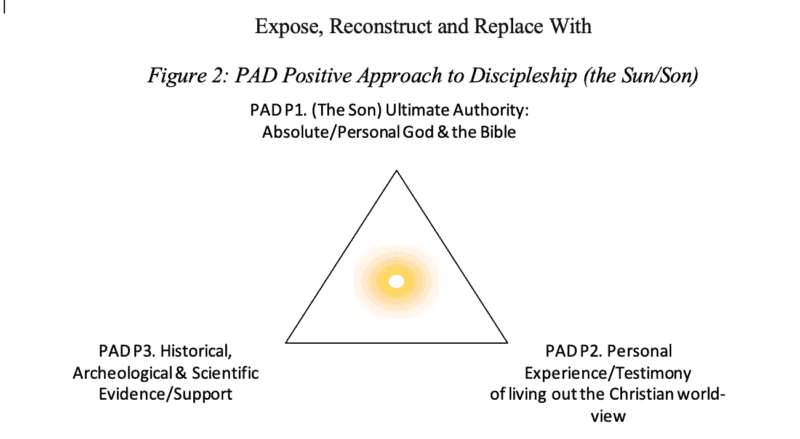
Step One: Positive Discipleship Approach (Reconstruction Phase)
The positive discipleship aspect of PAD (figure 3.1) has three features: (1) PAD primarily appeals to Christianity’s absolute authority – the biblical God and his revealed word. (2) PAD uses the Christian’s testimony and life experience to demonstrate that they are living with no contradiction to their authority. (3) PAD examines historical, archeological, and scientific evidences that attest to the truths found in the authority.
These three positive features of PAD are used to show the consistency, rationality, and superiority of the Christian worldview. This is to be done after the BMBs’ former foundation has been shown wanting (application of Reductio Ad Absurdum). Any agreement found in belief or practice from the Muslim worldview was already sourced in the Bible, and therefore borrowed, or a reflection of the Christian worldview. The positive side to PAD also provides the only acceptable replacement for the BMBs’ faulty system that can correct his or her faith and practice. In this model, the final stage is that BMBs will make a declaration of allegiance to Christ and his word, and commitment to each area of faith and practice.
Step Two: Negative Discipleship Approach (Deconstruction Phase)
The PAD negative approach (figure 3.2) challenges three aspects of Islamic sources and the Muslim worldview which negatively impact BMBs’ faith and practice: (1) PAD critically examines the Muslim’s ultimate authorities that shape Islam’s worldview and religion.[3] (2) PAD assesses the testimony that should be experienced out of strictly adhering to Islam’s ultimate authorities and exposes any contradiction that may lie within. And lastly, (3) PAD examines historical, archeological, and scientific issues inherent in Islam. These three areas are to be examined and critiqued for their inherent inconsistencies. During this deconstruction phase, the discipler is to apply Reductio Ad Absurdum (reducing the Muslim worldview to absurdity) to all three aspects of the discipleship model. The discipler will also refer to step one during this process (PAD) by comparing and contrasting the Islamic presuppositions which still may impact the BMBs’ faith and practice. After each area is deconstructed, and exposed, it should be replaced by biblical authority and practice (application of the positive aspect of PAD). BMBs’ former beliefs and practices should also be renounced.
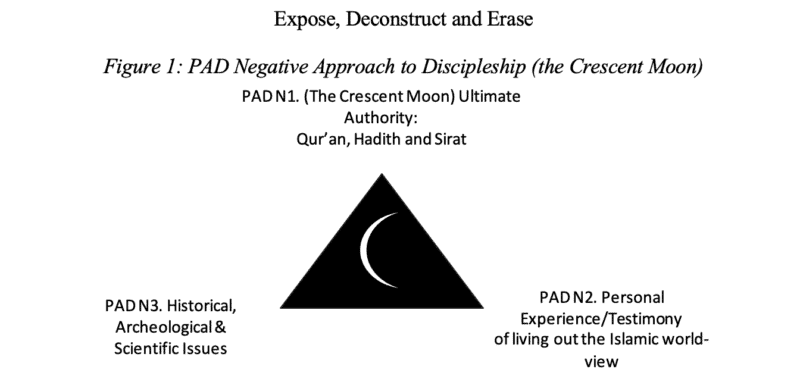
PAD N1–3, or the deconstruction process, and PAD P1–3, or the reconstruction process, necessitates teaching and preaching, with direct, strategic and systematic instruction. This, however, does not negate the need for discussion with the BMB concerning each issue, and the discipler to model obedience and application of each area.
Disciplers who will preach, teach, discuss, model, and write/make materials for BMBs, must consider the PAD model while preparing the materials. This includes data collection for their materials. Preparation of the cross-cultural worker will be time consuming, yet fruitful. For PAD Negative approach (N1–3), there are at least three areas of data collection that will need to be taken into account: (1) Theological, (2) Cultural Anthropological, and (3) Empirical. For PAD Positive approach (P1–3), there are also at least three areas of preparation that the discipler must recognize: (1) Theological, (2) Existential, and (3) Empirical.
Theological Research for PAD Negative Approach 1
During their preparation to preach, teach or write/make materials for BMBs, disciplers must systematically study the doctrinal area of their subject from the primary sources of Islam by critically reading and studying the Qur’an, the Hadith, and the Sirat. The discipler does not view the Qur’an as a book from God, or an authoritative book, which it certainly is neither. However, because the Qur’an, Hadith and Sirat were the foundational books for the BMBs, these need to be fully evaluated, and critiqued according to each subject. Precisely because it was found that the spiritual growth of BMBs is negatively impacted because of the Islamic primary sources, it is necessary to expose false teaching about God, every aspect of faith, and immoral practices that are promoted in these texts. The application for data collection for the discipler using PAD would be that he or she must also be aware of each category of discipleship that is a potential barrier to BMBs, and give due diligence to the research of each subject for the purpose of deconstruction.
Islamic sects have their own theological nuances and spiritual leaders from whom they derive their beliefs and practices. Depending on the BMBs’ prior Islamic affiliation, it may be prudent to research the type of teaching and materials the BMB was exposed to while he or she was in that sect. Examples of missionaries in the Muslim world who have done this type of nuanced research to aide their ministries are found in the book, Margins of Islam: Ministering in Diverse Muslim Contexts.[4] I point out in chapter six, “Biblical Approaches to the Nurcu Gülen Movement in Turkey,” that the Nurcu sect found around the world has a unique perspective concerning their spiritual leaders and teachings.[5]
The Nurcu have specific religious terms for each area of theology … Nurcu terms for these terms are very different – terms that would not be known or understood by an average Turkish Muslim.[6]
In this chapter I encourage missionaries to research by means of discussion and reading,
[t]hose who bear witness to followers of Fetullah Gülen must not only familiarize themselves with the Qur’an and Hadith but also with the writings and philosophy of Said Nursi. Understanding his thinking is an important gateway into understanding their worldview – thus how they will understand both the Quran and our witness of Christ.[7]Data collection for theological research for the discipler of the BMB is critical to the PAD N1 model for discipleship and must be individualized according to BMBs’ past religious allegiances.
Discipleship Research (Cultural Anthropological Area) for PAD Negative Approach 2
I have pointed out in my article, Research Evangelism Among Folk Muslims: (A Call to Missionaries to Christian Cultural Anthropology), that there must be a cultural anthropological area of research, known as Christian Ethnology. This model of anthropological research helps equip the missionary to understand the culture he or she is sent to, and to evaluate it through the lens of Scripture:
The Christian ethnologist must employ various methods of study, one being the ethnographic method, an immersion of the Christian into the lives of the people he or she is trying to understand and reach. Through this experience as a participant observer, the Christian is able to attain a level of understanding of the meanings of the various cultural practices. This time of study, observation, and ethnographic method can be referred to as research evangelism.[8]
The preparation time for the Christian Ethnographer as applied to discipleship I refer to as discipleship research. The discipler of BMBs through discussion and observation, will learn to identify the beliefs, practices, along with the meanings and forms that still may hold a negative influence over BMBs. Through observation, the discipler will also become more aware of the negative impact that Islamic sources, and the Muslim worldview has in the everyday experience of BMBs. Disciplers using the PAD P1–3 framework will evaluate these observations according Scriptures (P1) and teach and model how the Scriptures (P1) positively impact the experience of the Christian (P2).
Empirical Research for PAD Negative Approach 3
PAD N3 is helpful for the discipler to be aware of the historical, archeological, and scientific problems found in Islam. In this area of preparation for discipleship with BMBs, the worker could look at the following: (1) Problems with the historic expansion and negative impact of Islam around the world. (2) Historical, archeological, and geographical names and places mentioned in the Qur’an that do not exist or that are incorrect. (3) Scientific errors that are stated as fact, (or so-called miracles) in the Qur’an. (4) Problems of the canon of the Qur’an, and compilation of the Hadith, among many other empirical issues. According to the PAD N3 model, this area is useful, yet not the focus of deconstruction or for PAD P3 for reconstruction. The crucial area for the discipler is PAD N1/P1 – which PAD N2/P2 are derived from. There are three areas of Data Collection for Reconstructing BMBs’ Allegiances and Worldview upon the Word of God and the Trinitarian God.
Theological Research for PAD Positive Approach 1
The discipler must look closely at the doctrines and practice of the Christian faith through the lens of Scripture as he or she prepares to disciple the BMB. At this point the discipler examines systematic theology, biblical theology, narratives in the Bible, and uses the exposition of the Scripture or other methods to teach the truths of each subject. It is important that the discipler is first aware of the categories that need to be covered, and then prepares the reconstruction aspect of discipleship according to the Bible. For example, Western disciplers may not be aware of the biblical teachings concerning Animism. There happens to be clear Old and New Testament teachings concerning the evil eye, spell casting, protective amulets, and all areas of Folk Islam, and the biblical teachings are generally opposite of what is taught in the Muslim world. This and other categories of discipleship are necessary to cover with BMBs and will compel the discipler to search outside of the Western Bible school or seminary notes that they were exposed too.
Existential Research for PAD Positive Approach 2
This aspect of research has to do with the discipler’s personal testimony of living the Christian life according to the Bible. This is, however, not limited to the power of the gospel that not only changed the life, and lifestyle of the discipler, but also includes testimonies of saints around the world who obey and reflect God’s word in their lives. The discipler points to his or her own life, family, church, and friends’ thinking and experience as positive examples of living according to the Scriptures.
This is contrasted with the negative experiences that plague the Muslim world – when Muslims do in fact live according to their primary sources. The discipler will come up with examples or research the social implications of adhering to biblical principles for the following: marriage, relationships with, and roles of men and women, childrearing, forgiveness, retribution, reconciliation, lying, deception, cheating, business practices, adoption, unconditional love, dealing with demons, the impact of curses, spells or the evil eye, theft, fornication, abuse, gluttony, purpose and practice of fasting, praying, reading holy books, the purpose and function of the church vs. the mosque or ummah, and numerous other categories. Each category must be contrasted with the Islamic view (via the primary Islamic sources), and instances given of how living according to Islamic sources for the Muslim experience is either antithetical, and/or immoral according to the biblical view.
Empirical Research for PAD Positive Approach 3
Empirical research can be utilized to support the ultimate truths already found in the Bible. This aspect of the PAD model is not the emphasis for discipleship, nor is it the grounds which prove the veracity of the Christian system over and above the Muslim system. This aspect of the model is used to show that because the triune God of the Bible is the only true God, and the Bible is his unchanged and uncorrupted word, one would expect to see things in the natural world, history, and science support Christianity – because they were necessarily derived from him.
An example of using P3 with Muslims comes from Nabeel Qureshi’s, Seeking Allah, Finding Jesus: A Devout Muslim Encounters Christianity. Qureshi recounts how in his organic chemistry class he first understood the possibility of the Trinity in his study of molecules and resonance structures,
My eyes rested on the three separate structures of nitrate on the wall, my mind assembling the pieces. One molecule of nitrate is all three resonance structures all the time and never just one of them. The three are separate but all the same, and they are one. They are three in one. That’s when it clicked: if there are things in this world that can be three in one, even incomprehensibly so, then why cannot God?[9]
The discipler could also utilize manuscript evidences to support the reliability of the Bible, and look to the historical, geographical, and archeological evidences that support the Bible and the historic Christian faith. However, these are only third-tier; they are not the authoritative grounds to which the BMB anchors his or her faith. They do not verify, or validate the Bible, nor the Christian faith. It is worth noting that there is usually a dearth of material concerning Christianity in most Muslim languages, and that it would be very difficult to focus on the PAD P3 approach with BMBs because of this. Also, the PAD model is Reformed and presuppositional, so it is also important to reiterate that only the triune God and his word are the ultimate authority, and that he is the source and definition of all truth. These six areas of data collection are necessary for the preparation, and execution of the PAD model of discipleship. The instructional methods to deliver this information to BMBs concerning all six areas could be lecture, preaching, formal teaching, or discussion.
Conclusion
The findings of my research indicated that BMBs do not just discover the differences and conflicts of faith and practice on their own. BMBs also do not just organically know how to understand, obey, and practice the Christian faith. We must be research disciplers, intentional, and prepared to disciple BMBs with the unique challenges to spiritual growth they face.
Yakup Korkmaz (Pseudonym) has Ph.D. in Intercultural Studies from Columbia International University and has been a missionary in the Muslim world since 2002. Korkmaz is the academic dean of a mission school that prepares missionaries to serve in the Muslim world. His dissertation, from which this article was derived, was concerning Reformed Presuppositional Apologetics as a model of discipleship for believers from a Muslim background.
NOTES
[1] Research mentioned in this article is drawn from the author’s dissertation, “Reformed Presuppositional Apologetics: A Biblical, Theological, Historical, and Practical Model of Discipleship with Believers from a Muslim Background.” Ph.D. Diss., Columbia International University, February 2019.
[2] Earliest biographies of the life of Muhammad.
[3] This is in reference to the Qur’an, Hadith, and Sirat. This may also include the teachings of a BMB’s former sheikh or religious teacher of a tarikat (Muslim sect).
[4] Gene Daniels, and Warrick Farah eds., Margins of Islam: Ministering in Diverse Muslim Contexts, (Pasadena, CA: William Carey Library, 2018).
[5] Yakup Korkmaz, “Biblical Approaches to the Nurcu Gülen Movement in Turkey,” in Margins of Islam: Ministering in Diverse Muslim Contexts, 59.
[6] Korkmaz, “Biblical Approaches,” 66.
[7] Korkmaz, “Biblical Approaches,” 66.
[8] Yakup Korkmaz, “Research Evangelism among Folk Muslims: A Call to Missionaries to Christian Cultural Anthropology,” Evangelical Missions Quarterly 45, no. 4 (October 2009), 430–437.
[9] Nabeel Qureshi, Seeking Allah, Finding Jesus. A Devout Muslim Encounters Christianity, (Grand Rapids, MI: Zondervan, 2014), 195–196.
EMQ, Volume 57, Issue 2. Copyright © 2021 by Missio Nexus. All rights reserved. Not to be reproduced or copied in any form without written permission from Missio Nexus. Email: EMQ@MissioNexus.org.