EMQ » October–December 2020 » Volume 56 Issue 4
By Dan Scribner
Some of Jesus’ last words to his disciples were “go, therefore and make disciples of all the nations,” which raises at least two questions: “Who are the nations of the world?” and “Which ones have few, if any, disciples?” Since the 1970s various efforts have been made to answer these questions.
A Brief History of Global People Group Lists
Dr. Ralph Winter gave his landmark unreached peoples presentation at Lausanne ’74. No comprehensive global people group list existed at the time. In the late 1970s and early 1980s the Missions Advanced Research and Communications Center (MARC) division of World Vision headed by Ed Dayton began publishing annual Unreached Peoples Directories. These were partial lists of unreached ethnolinguistic people groups. Operation World, while focused primarily on political countries, also began including some people group information in the editions starting in the 1980s.
The foundation of global ethnolinguistic people groups lists is the excellent language research of the Summer Institute of Linguistics (SIL) over the last eighty years presented in the Ethnologue,[1] a catalog of the world’s languages.
Three comprehensive, global people group lists exist today. These lists have distinct definitions, sources, criteria, audiences and philosophies as outlined in Table 9.1 below.
The initial effort to produce a comprehensive global people group list was in 1982 with the first edition of the World Christian Encyclopedia (WCE), edited by Dr. David Barrett. This list continues to be updated and available through the Center for the Study of Global Christianity’s World Christian Database (WCD).
A second global people group list, the Integrated Strategic Planning Database (ISPD), later renamed the Church Planting Progress Indicators (CPPI) database, was started in 1991 by the International Mission Board SBC. The purpose was to track IMB church planting activity among people groups. While the ISPD/CPPI had its roots in WCD data, it has been extensively modified by IMB field staff over the last three decades.
A third global people group list, Joshua Project, was birthed in 1995 and owes much of its genesis to Patrick Johnstone. Joshua Project is also indebted to Omid research for South Asia, Asia Harvest research for China and the Buddhist world, IPN research for SE Asia and Indonesia, in addition to numerous other national people group researchers, mission agencies and onsite missionaries.
Table 9.1 – A comparison of the three global people group lists
| World Christian Database | CPPI (IMB) | Joshua Project | |
| People Definition | Globally ethno-linguistic only | Outside South Asia ethno-linguistic South Asia mixture of language and caste | Outside South Asia ethno-linguistic South Asia by caste, religion and language |
| Start Date | 1982 | 1991 | 1995 |
| Unreached Definition | Less than 50% evangelized | Less than 2% Evangelical | Less than 2% Evangelical and less than 5% Christian Adherent |
| Unreached Measures | Exposure | Response | Response |
| Sources | Census and academic reports[2] Denominational reports Ethnologue | IMB field staff Ethnologue | Census and academic reports[3] Regional and national researchers Networks, individuals, other data sets Ethnologue |
| Audience | Secular media, academia | IMB field staff and leadership | Global missions community |
| Philosophy | Adds groups when documented in published research | Adds groups once verified by field staff | Assumes worst case, adds all potential groups, removes if verified as not existing or became extinct |
Why Three Global Peoples Lists?
Different perspectives on the same situation are a healthy thing. Looking at a picture from several angles often yields greater appreciation. Using different definitions and criteria can help clarify a task and highlight areas needing further research. People group database compilers are confronted by questions such as: Is language always the primary definer of a people group? Should caste be considered when defining a people group? Should Christian Adherents be considered when setting the criteria for unreached? Should unreached be defined by exposure or response to the gospel? What are acceptable sources for input and edits? The three global people group lists answer these questions differently and thus provide different, but valuable perspectives.
Segmentation Within People Group Lists
Segmentation can be described as levels of detail or refinement. For example, the animal kingdom is segmented into a hierarchy of phylum, class, order, family, genus and species with each level more and more specific. In a similar way, people group lists have traditionally had various levels of segmentation. These segmentation levels create a hierarchy moving from very broad, general classification (level A) to increasing detail and specificity (level E).
Different methods of segmenting people group lists have been suggested. Three of the most common approaches to segmentation are the columns in Table 9.2.
Table 9.2 – Comparing People Segmentation Levels
| Segmentation Level | Dayton / Wilson (1984)[4] | Winter / Koch (Perspectives)[5] | Johnstone / Joshua Project[6] |
| A | Major Cultural Blocs – broad categories of people groups, defined by religious-cultural spheres, strategic significance is global overview. | Affinity Bloc – All people groups, who either live in a particular region or have similar cultural roots. Peoples are broadly grouped into blocs with affinities based on language, culture, religion, politics. In nearly every Bloc there are widely dissimilar and unrelated linguistic minorities, but often there is one particular culture that is dominant. | |
| B | People Cluster – Within each Affinity Bloc are a number of more closely related peoples which, for strategic purposes, may be clustered together. These relationships are often based on a common identity of language and name but sometimes on the basis of culture, religion, economy, or dominance of one group over another. | ||
| C | Primary – ethnolinguistic preference which defines a person’s identity and indicates one’s primary loyalty | Ethnolinguistic Peoples – often a cluster of unimax groups, defined by linguistic, ethnic and political boundaries, strategic significance is mobilization and strategy. | People Group – “A significantly large group of individuals who perceive themselves to have a common affinity for one another because of their shared language, religion, ethnicity, residence, class or caste, situation, etc., or combinations of these. For evangelization purposes, a people group is the largest group within which the gospel can spread as a church planting movement without encountering barriers of understanding or acceptance.” (the 1982 Consensus) |
| D | Secondary – a sociological grouping which is to some degree subject to personal choice and allows for considerable mobility. Regional and generational groups, caste and class divisions are representative | Unimax Peoples – networks of families with a shared identity, defined by social and cultural prejudices, discovered onsite, strategic significance is church planting. | Subgroups – a segment of a people group that may or may not need a unique church planting effort. In many cases, subgroups will require separate church planting efforts. In other cases, reaching the parent people group may reach the subgroups. In these cases, the gospel will likely flow between subgroups without encountering significant barriers of understanding or acceptance. Determined by onsite workers and research. |
| E | Tertiary – casual associations of people which are usually temporary and the result of circumstances rather than personal choice such as high-rise dwellers, drug addicts, occupational groupings and professionals. | Socio Peoples – an association of peers, defined by activities or interests, discovered onsite, strategic significance is small group evangelism. |
Levels A, B and C would be considered traditional people group categories and lend themselves to global lists. However, levels D and E are not tracked in existing lists. These two levels are not necessarily smaller types of segmentation but rather a reconfiguration with multiple, mixed or hybrid identities.
There is growing interest in greater detail, particularly among on-site workers seeking relevancy for local church planting. The interest in moving to segmentation levels D and E and greater detail does not preclude the importance of people group lists at segmentation levels A, B and C. Levels A, B and C serve as entry points for focusing on people groups. However, this desire for greater detail is pressing the limits of current people group lists.
Granularity and Complexity
Another term for segmentation might be granularity. Granularity is the level of detail and refinement of data. Increasing granularity can be pictured as moving from boulders to large stones to fist-size rocks to pebbles to sand. People group lists generally track groups at the country and language i.e. level C “fist-size rocks.” Greater granularity would mean tracking by province or district, subgroup and/or dialect, i.e. level D “pebbles.” For example, current lists have an entry “Pashtun of India” while a more granular list might have “Yusafzai Pashtun practicing Barelvi Sunni Islam speaking Urdu in Farrukhabad district of Uttar Pradesh, India” as a distinct entry. Further refinement by occupation, shared interests, skills, education, networks and/or social status would create lists at level E “sand.”
Graph 1. illustrates the relationship between people group list granularity and complexity. The graph is divided into the segmentation levels in Table 9.2.Very general uses are suggested for each section. The numbers in parenthesis are counts from the Joshua Project list as of May 2020. Groups to the left of the dotted line would be considered traditional people groups and groups to the right would be considered dynamic groupings. Table 9.3 compares traditional people groups and dynamic groupings.
Figure 9.1 – Granularity vs Complexity in People Group Lists
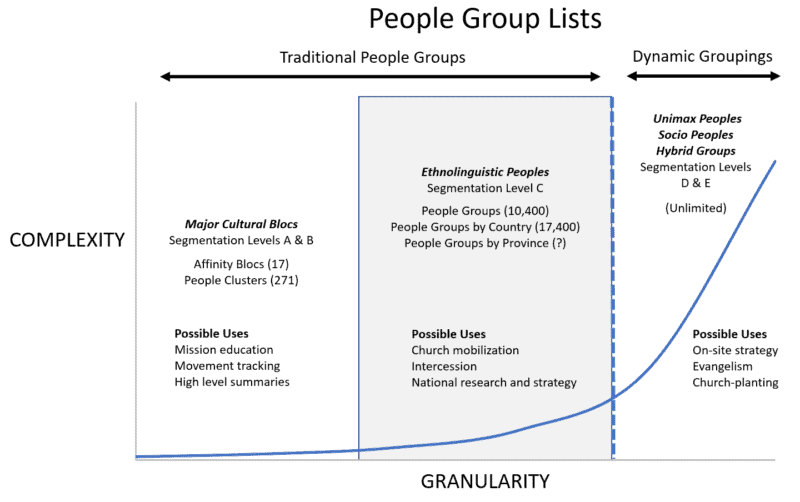
Consider the Fulani of Central Africa. Moving from left to right across Figure 9.1 the Fulani can be viewed as a single People Cluster[7] (level B “large stones”). This level does not distinguish specific Fulani people groups and combines 40 million individuals into one category. Typically, this is the level of granularity that the secular media and general missions education material use. To protect believers, movements to Jesus among the Fulani are reported at this broader segmentation level. However, a church adopting a people group for prayer and engagement needs greater detail and a smaller size group to focus on. The church would likely adopt a specific Fulani people group such as the Fulani, Pulaar in Senegal[8] (level C “fist-size rocks”). As workers began on-site ministry they might focus on the Toucouleur dialect speaking, millennial age, healthcare professional Pulaar Fulanis living in Matam, Senegal. This would be a hybrid grouping (level E “sand”). The “glue” that holds such a hybrid group together goes beyond ethnicity and language.
People Group List Challenges
As the Fulani example illustrates, a great deal is being asked of current people group databases. One size does not fit all. In fact, one size may end up confusing all! People group list challenges include a great variety of potential uses, a wide spectrum of audiences and significant security risks.
Variety of Uses
The uses mentioned in Figure 9.1 are very general and simply suggestions. The main point is people group lists are used in numerous ways ranging from challenging new believers to the big picture of the Great Commission to a local church mission committee selecting a specific people group for adoption to onsite workers identifying a strategic focus to maximize the spread of the gospel.
Spectrum of Audiences
Each end user has different interests and needs. Pastors giving an annual missions sermon may be looking for simple, high level summaries. An intercessor might want a descriptive people profile. Mission leaders want detailed data to make deployment decisions. Traditional people profiles and lists have probably proven more useful to mobilizers than to on-site workers. The breadth of potential audiences for people groups lists is problematic. Current lists attempt to serve all audiences but may not be optimized for any of them.
Security Risks
The more information included in a list i.e., the more “pebbles” and “sand” presented, the greater the security risks in sensitive areas. This often prohibits publishing lists. For example, reporting too detailed information on Christ-ward movements among the Fulani below the “large stone” level B could jeopardize growth and endanger lives.
Changing Barriers
From a church planting perspective, people groups boundaries are defined by barriers to the spread of the gospel. Whichever barriers are highest defines the extent of a people group. Changing barriers are causing an expansion from what might be called traditional people groups to what might be termed dynamic or hybrid groupings. Table 9.3 compares these perspectives.
Table 9.3 – Comparing Traditional and Dynamic Groupings
| Traditional People Groups | Dynamic Groupings |
| Barriers are based on fairly well defined linguistic, ethnic, political, religious or historical boundaries. | Barriers based on almost any kind of “glue” e.g. occupation, hobbies, interests, social networks, relationships, economic status, affinity groups etc. |
| Permanent, durable, fixed | Temporary, fluid, changing |
| Individuals are only in one group and stay in that group for a lifetime | Individuals can be and are most likely in several groups at the same time |
| Have served segmentation levels A, B and C reasonably well for the last forty plus years. | Not addressed by current people group lists |
| While imperfect, it is possible to catalog globally as demonstrated by WCD, IMB and Joshua Project people group lists. | Unrealistic and impossible to catalog globally. Lists may be feasible by on-site workers and researchers on a very local level. |
Traditional Boundaries Are Changing
The forces of language consolidation, urbanization, globalization and migration are blurring the boundaries of traditional ethnolinguistic people groups. Existing people group identities are being mixed and recombined, and new hybrid identities are being created. For example, language consolidation is reducing the language barrier that traditionally has defined many people groups. Speakers of smaller languages are rapidly learning one or more global languages, usually for education and job opportunities. These are often languages widely used on the internet. New mobile devices are allowing on-the-fly, real time translation. A rise in linguistic nationalism is also occurring which results in people groups being merged together through administrative governmental pressure. At the same time, some people groups are dividing over a desire to preserve language and its cultural contexts. Few boundaries are truly rigid; the edges have fluidity.
Urbanization and migration are reducing ethnicity barriers. Groupings of individuals in cities are being driven increasingly by occupation, shared interests, skills, education, networks, social status and activities rather than by ethnic background. Globalization is reducing the ethnic as well as religious barriers. An inter-connected world allows exposure to and opportunity to explore different worldviews, values and religions. Globalization allows connections and relationships with other likeminded individuals around the world, rather than only those in one’s immediate physical area. Efforts like SpaceX’s Starlink project to bring internet to rural communities are accelerating globalization.
New Groupings Are Emerging
These forces are changing the barriers to the spread of the gospel and impacting how the ethne of the world are defined from a church planting perspective. Growing reports of movements to Jesus crossing traditional people group boundaries demonstrates a shift in how the gospel flows. For example, it has been suggested that Gen-Z youth of Riyadh have more in common with the youth of Chicago than with their own parents. That might be an exaggeration, but it makes a useful point. Youth in many cases aren’t identifying as strongly with their traditional people group, based on ethnicity and language, as they are with others in their age group and social experience.
For onsite workers, other ways of grouping are becoming more useful and needed than groupings by ethnicity and language. The closer lists get to social and ethnic realities on the ground, the more needed and useful are other ways of grouping. For example, classifying Saudi Arabian Gen-Z youth in a database using traditional people group definitions could potentially obscure their preferred identity for church planting purposes and limit reaching them with the gospel. Identifying Saudi Gen-Z youth as a unique dynamic grouping might accelerate the flow of the gospel along relational and common interest pathways.
Complementary Perspectives
Traditional people group lists are still important and useful but need periodic “rethinking.” Lists help to outline the unfinished task of the Great Commission and provide church leaders and mobilizers with motivating benchmarks. At the same time, new perspectives and dynamics are bringing other groupings into focus. The “glue” that binds these new groupings together may not be language or ethnicity, but occupation, education, shared interests, social networks, generational issues and worldviews. These dynamic groupings will be increasingly strategic and effective pathways for the spread of the gospel. Both the traditional and dynamic perspectives of people groups are useful and should not be viewed as old vs. new, but rather as complementary.
Conclusions
- People group thinking is not going away. Traditional people group lists are still very applicable in parts of South Asia dominated by the formal and informal caste system, in tribal settings, and rural areas. This includes much of Africa and Asia, where the great majority of unreached people groups reside.
- At the same time, the forces of language consolidation, urbanization, globalization and migration are creating new social dynamics, and changing both the barriers and boundaries by which some groups are defined.
- These hybrid, transnational and other groupings must be considered for evangelistic purposes, disciple making and church planting movements.
- Global people group lists, as currently structured, do not support dynamic groupings, i.e. to the right of the dotted line in Figure 9.1.
- Thus, new ways of listing and tracking dynamic groupings on a local level are needed to advance the initiatives of on-site workers.
Dan Scribner has served as the Joshua Project Team Leader since its founding in 1995. Dan and his wife Mary have been Frontier Ventures (formerly U.S. Center for World Mission) staff since 1988. They live in Colorado Springs, CO and have four adult children and two grandchildren.
Notes
[1] 2020, 23rd Edition, https://www.ethnologue.com/.
[2] Includes sources such as national government census, UN, CIA database, other state/government generated data.
[3] Ibid.
[4]Dayton and Wilson, Unreached Peoples ‘84, cited by Dave Datema in “People Group Paradigm in 2020” webinar.
[5] Winter and Koch, Finishing the Task, 20–22, https://www.ijfm.org/PDFs_IJFM/19_4_PDFs/winter_koch_task.pdf.
[6] https://joshuaproject.net/help/definitions.
[7] See https://joshuaproject.net/clusters/173.
[8] https://joshuaproject.net/people_groups/15622/SG.
EMQ, Volume 56, Issue 4. Copyright © 2020 by Missio Nexus. All rights reserved. Not to be reproduced or copied in any form without written permission from Missio Nexus. Email: EMQ@MissioNexus.org.