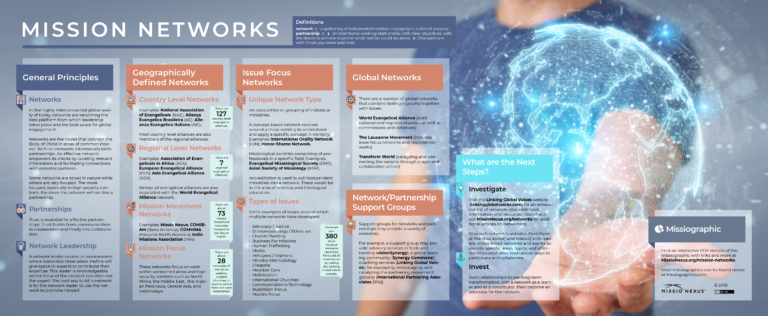
Networks are becoming one of the fastest growing platforms for leaders and practitioners to connect in the global missions community. These networks are leading to the discovery of best practices, new means of sharing information, and cooperative action for the sake of gospel proclamation to the ends of the earth.
Partnership is something we long for but often have a difficult time defining. North American churches and organizations are seeking to partner with the global community in ever increasing degrees, yet partnership is often a broad elusive term that can be defined very differently depending on the context.
Some time ago I read in the pages of a mission magazine that came to my desk an amazing statement. The writer was emphasizing his “conviction that the church, not the mission board, is the sending agency.” He added that according to the book of Acts, “the church at Antioch accepted responsibility for the Apostle Paul.” Then he went on to say that “in the 11th chapter of Acts Barnabas heard of Paul, sought him out, brought him to Antioch and helped him serve an internship in that church of not less than one year.”
As Charles Van Engen explains in his introduction, this book is about “doing mission theology”. He describes mission theology as “an activity that seeks to discern what God wants to do primarily through God’s people at a specific time, place and context in God’s world”.
Mark Anderson has answered a foundational question: ‘Can Christians fully grasp the Qur’anic worldview without becoming Muslims?’ Anderson has, by engaging the Qur’anic faith dialogically (grace) and by analyzing its doctrines thematically (truth).
Clemens Sedmak takes readers on a tour which spans the globe and plums the depths of the human spirit. Along the way, he introduces a diverse cast of novelists, philosophers, clerics, missionaries, and prisoners—from Chinua Achebe and Saint Augustine, Vaclav Havel and Isaiah the Solitary to Corrie Ten Boom and Cardinal Francis Xavier Van Thuen—and explores how they found the inner strength to endure in the “desert of displacement.” The result is a far-reaching, reflection on “sources of resilience derived from within.”
Intercultural ministry is “the defining theological line of the twenty-first century.” So begins this volume of fifteen essays that seeks to answer the question: “how do we build healthy communities that bring us together as next-door neighbors and global neighbors?”