EMQ » July–September 2022 » Volume 58 Issue 3
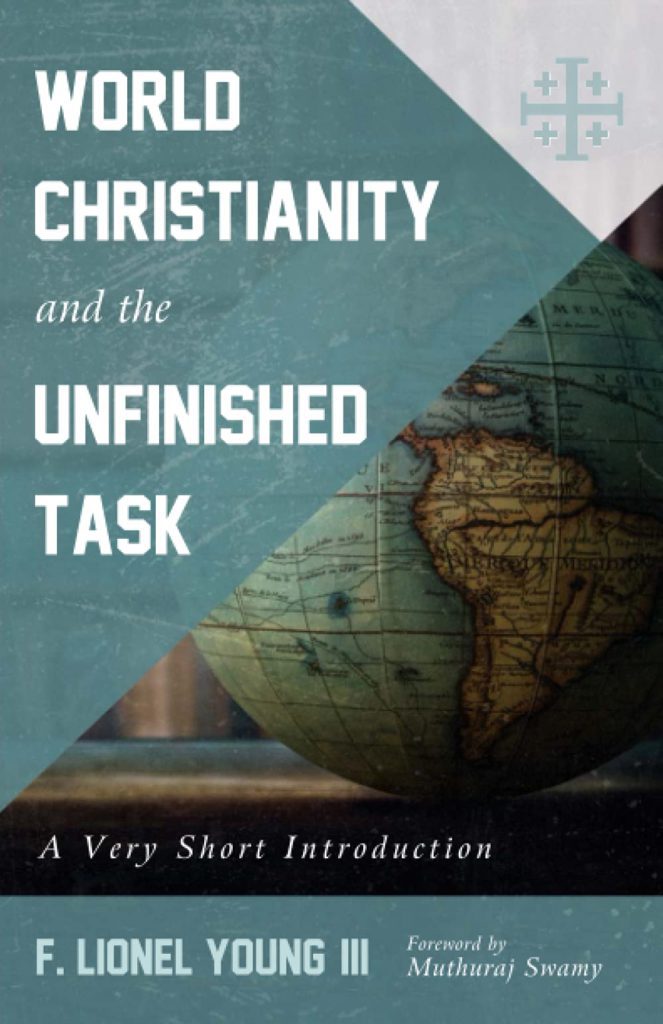
World Christianity and the Unfinished Task: A Very Short Introduction (find it on Amazon)*
By F. Lionel Young III
Cascade Books, 2021
172 pages
US$22.00
*As an Amazon Associate Missio Nexus earns from qualifying purchases.
Reviewed by Richard Cook, (PhD, University of Iowa), Associate Professor of Church History and Missions at Logos Evangelical Seminary in El Monte, California, who served as a missionary in Taiwan for over ten years.
In just seven chapters and under 150 pages, World Christianity and the Unfinished Task provides a broad overview of the current status of global Christianity. The slim volume features numerous heavyweight endorsements, including David Bebbington, Douglas Sweeney, Brian Stanley, and Gina Zurlo. F. Lionel Young III, the author, is a research associate at the Cambridge Centre of Christianity Worldwide and has extensive experience in theological education for underserved leaders in the developing world. He writes, “This book is intended to change the way readers think about the church and challenge the way Western Christians engage in contemporary missions” (back cover).
Packed with footnotes on almost every page, an extensive bibliography, and a useful index, the publication serves as a valuable and up-to-date resource for locating contemporary research on global Christianity. Many of the sources cited are readily available to most readers and are in English. Naturally, however, the data covers the entire world.
The author hopes to inspire a new worldview, which integrates the radical geographical transformation of Christianity over the last several decades, and to encourage the Western church to work as equal partners with non-Western Christians in Global missions. The first chapter sets the framework, laying out current statistics on the “Southern shift” of Christianity. Young, in chapter 2, summarizes the work of the dedicated researchers of global Christianity, including Andrew Walls, David Barrett, Lamin Sanneh, Brian Stanley, Mark Noll, David Bebbington, Dana Robert, Joel Carpenter, and Todd Johnson.
At the start of chapter 3, Young uses Barbara Kingsolver’s The Poisonwood Bible to launch a discussion of how “secular critics of missionaries get it mostly wrong.” He asks a good question: If the critics have been correct about nineteenth and twentieth-century Western missions, then why has there been such rapid indigenous church growth? Among the numerous points that critics have gotten wrong, Young highlights that Kingsolver’s caricatures of male-dominated missions have missed the true nature of the movement (66). Chapter 4, building on chapter 3, asserts that ultimately it was the “Surprising Work of God” that brought church growth, describing several revivals, such as the Korean Revival of 1906–07, the East African Revival, and the Brazilian Pentecost.
Chapters 5 and 6 encourage the church to consider the unfinished task, recognizing that it is not the “White Man’s Burden” alone. Chapter 7 concludes with a heartfelt plea for global partnerships in missions.
EMQ readers will be familiar with the statistics and the story, but this is a thoroughly researched and well-designed presentation. There are no diagrams, tables, charts, or graphs (which might be a disappointment for some), but instead, the information is presented narratively (which I prefer as a historian). As with many books with a global scope, there are occasional errors, such as some of the citations of Chinese names. As a “very short introduction,” the book succeeds.
For Further Reading
Christianity in the Twentieth Century: A World History by Brian Stanley (Princeton University Press, 2018)
World Christian Encyclopedia, 3rd ed. by Todd M. Johnson and Gina Zurlo (Edinburgh University Press, 2019)
EMQ, Volume 58, Issue 3. Copyright © 2022 by Missio Nexus. All rights reserved. Not to be reproduced or copied in any form without written permission from Missio Nexus. Email: EMQ@MissioNexus.org.