EMQ » July–September 2022 » Volume 58 Issue 3
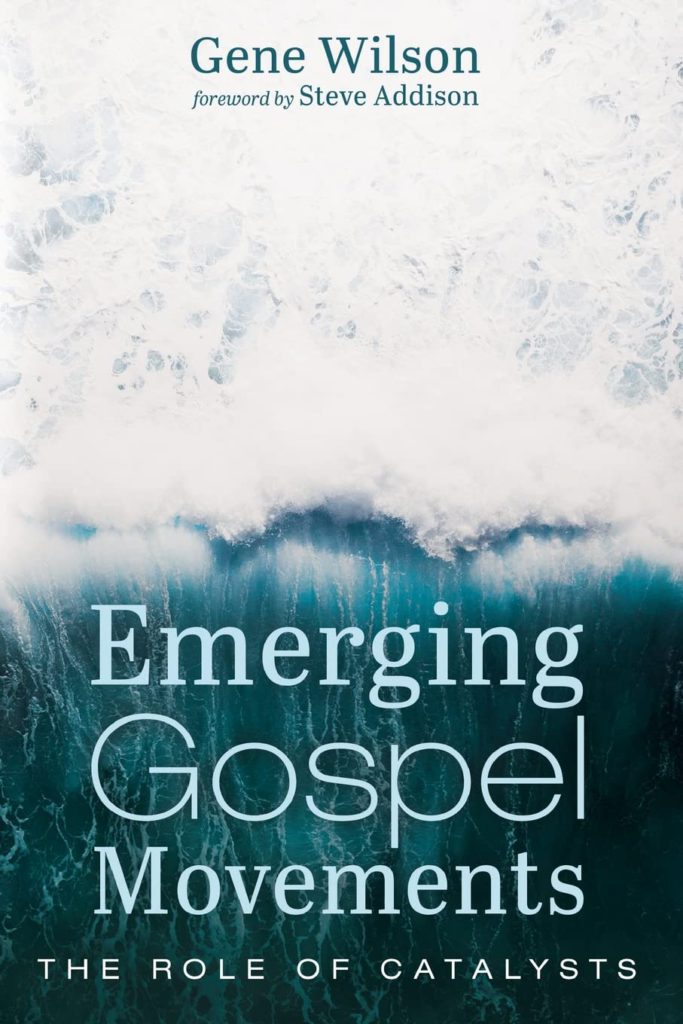
Emerging Gospel Movements: The Role of Catalysts (find it on Amazon)*
By Gene Wilson
Wipf & Stock, 2021
148 pages
US$22.00
*As an Amazon Associate Missio Nexus earns from qualifying purchases.
Reviewed by Richard Kronk, PhD, scholar-practitioner with Christar, Inc. and associate professor of intercultural studies at Toccoa Falls College, Toccoa Falls, Georgia.
Gene Wilson’s contribution to the growing literature on the topic of gospel movements concerns what Tom Steffen calls the “Fourth Era” of missions – the Facilitator Era. The Facilitator Era is marked by a shift in methodology that is best summarized by the idea of a catalyst. Catalysts, according to Wilson, engage in the missionary enterprise by employing their gifts and resources in ways that facilitate the ministry of others such that expanded kingdom impact through gospel movements is realized.
Wilson builds his case for the role of catalysts by first seeking to lay a foundation for gospel movements from the New Testament and relating these historical accounts to similar experiences today. Next Wilson sets out to define the necessity and role of gospel movement leaders as catalysts. Wilson argues that such movements are essential today in light of the remaining Great Commission task. In the last section of the book, Wilson walks his readers through the emergence, maturation, and pathways to growth of gospel movements worldwide. He lays out what he refers to as a “profile of a catalyst,” explores how to cultivate a “movement mindset” (113), and identifies appropriate support structures to facilitate such movements.
Despite Wilson’s efforts to root the notion of gospel movements in both biblical and historical realities, his efforts to establish their credibility at times stretches the limits of legitimacy. For instance, Wilson’s association of the social impact of the ministry of William Carey (India) and Mary Slessor (Nigeria) with the lasting transformation of gospel movements (44–45), implies that social change resulted from gospel movement methodology. But this conclusion cannot be substantiated without a serious re-reading of mission history.
Later, Wilson’s comment that Tychicus helped form a cluster of churches in Asia Minor (70) based on 2 Timothy 4:12 and 1 Corinthians 16:19, goes beyond a plain reading of the text. Lastly, in an effort to show that Gospel movements are present in virtually every sphere of the globe, Wilson describes what he calls an “Emerging North American Gospel Movement” (34–40). Despite details of the alleged movement, the description makes it clear that this example is still a hoped-for possibility and not a fait accompli. Furthermore, it is not clear whether church membership data used to validate the movement’s potential refers to new converts or to transfers from other area churches.
Throughout Emerging Gospel Movements, Wilson genuinely intends that his readers consider whether their contribution to the Great Commission could be as a catalyst in this new Facilitator Era. In the end, those who are already on board with gospel movement theology will be energized by the notion of serving the kingdom as a catalyst for gospel movements. Those who share a certain degree of skepticism of the theological legitimacy of this approach will find that Emerging Gospel Movements does not resolve that doubt.
For Further Reading
In favor of Gospel Movements:
Movements that Change the World: Five Keys to Spreading the Gospel by Steve Addison (InterVarsity Press, 2011)
In opposition to Gospel Movements:
“There are No Church Planting Movements in the Bible: Why Biblical Exegesis and Missiological Methods Cannot Be Separated” by Jackson Wuin Global Missiology 1, no. 12 (October 2014)
EMQ, Volume 58, Issue 3. Copyright © 2022 by Missio Nexus. All rights reserved. Not to be reproduced or copied in any form without written permission from Missio Nexus. Email: EMQ@MissioNexus.org.