EMQ » October–December 2022 » Volume 58 Issue 4
Event Impact
Missions conferences around the world have played an important part in mobilising young people into long-term missions service. But as we consider ways to mobilise today’s young people – Gen Z – we need to consider tools to measure events that will help improve their long-lasting effectiveness.
By Evi Rodemann
Event organizers, like me, host mission events all over the globe which call young generations into missions in their own contexts and cross-culturally elsewhere. But people often wonder how impactful these missions conferences are. Do attendees follow through on their commitments to missions? Is all the money spent on these events a good investment? How do we measure effectiveness and long-lasting impacts, if at all?
These questions need answers, especially as we consider ways to mobilise today’s young people in Gen Z. I interviewed sixteen global mission/church events to learn more. I inquired about how they determine success, if they had outcomes in writing and how they measured any of their possible outcomes and results, and if and how they tracked long-term outcomes.
Events are a significant part of my own missions story. I had a clear calling to serve in missions when I was 10 years old at a Christian conference at the Olympic stadium in Berlin. Through my teenage and young adult years I often attended missions conferences in Europe: first as a participant, later as a volunteer, and years later as an exhibitor and recruiter serving with an Indian mission. Many missionary friends experienced similar journeys. Rather than one-off experiences, events frequently played a part in helping future missionaries discern next steps in a mobilisation process.
Conferences – like CIMA (Latin America), Urbana (US), Mission Korea (South Korea), TEMA and Mission-Net (Europe) and more recent conferences like The Send, which occurs on various continents – coupled with individual time with God have played an important part in catalysing young people’s missions journeys worldwide. The Urbana website states that since their congresses began in 1946, God has used them to challenge nearly 300,000 young people “with their responsibility and privilege in global missions.”[1] Urbana has also been instrumental in launching mission events in other parts of the world.
But more than hearsay and collecting stories, I also wanted to dig deeper and see if these mission events intentionally planned for long-lasting results. If yes, what kind? And would the transformation be even more durable if it was embedded in a missions movement?
What is Impact?
Impact, according to the Oxford Dictionary, is “the powerful effect that something has on somebody/something.”[2] After exploring the different kinds of impacts made through events, I refined the definition for my purposes to, “a powerful effect that something, especially something new, has on a situation or person which will lead to actions.”[3]
What we want to see is mission events that do not simply provide those attending with great information on the global needs, but are an important contribution to our world being reached. And for this to happen, we need to pray and work towards impact which leads to action. Loving God always leads to an impact on us as individuals which again sets us into motion to be used by him to bring about another impact.
Figure 8.1 – From Inputs to Impact[4]

Impact requires clear intentions. In the case of missions conferences, we want to see young people go into missions. We share about that from the main stage, non-plenary platforms, and through informal learning. Then we offer ways young people can make a commitment and take a next step.
It could be the classic altar call to surrender their lives to Jesus, or a missions call to pray or share the good news with one person on their way back home from the event. One recent missions event in Brazil asked the participants to commit to adopt the orphans in their nation, to pray for missions, and join outreaches. Our calls to action lead to measurable outputs and outcomes. It is our work to then pray and turn this into long-term impact.
In my recent training to become an impact consultant with the nonprofit consulting firm Phineo (phineo.org/en/), I learned about the impact cycle. Perceiving impact this way rather than as a linear process, helps deepen understanding.
Figure 8.2 – The Impact Cycle[5]
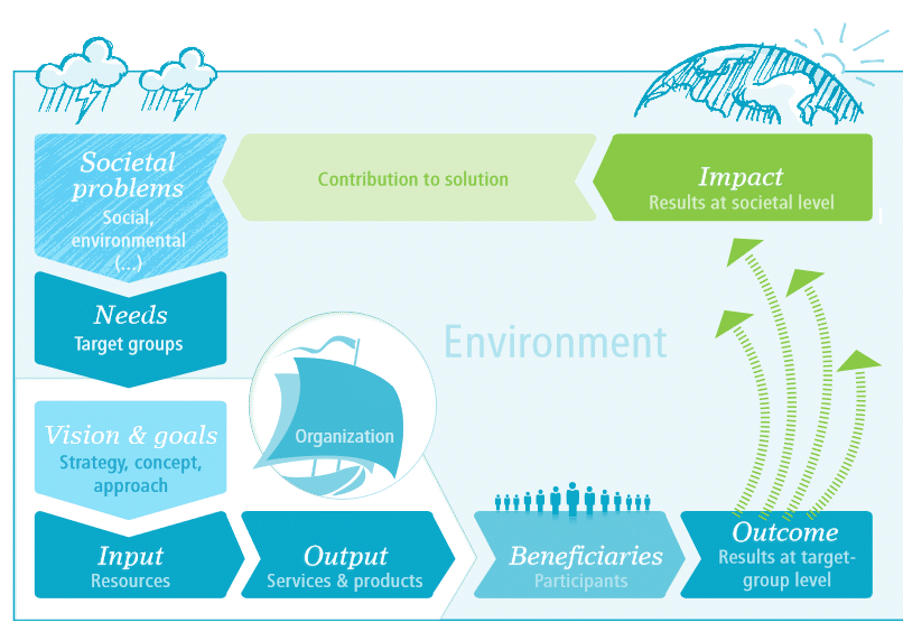
Impact is driven by a need. Mission events focus on the need of worldwide evangelisation and want to mobilise young people to participate in the Great Commission according to their needs and callings. That leads to developing a vision and strategies that touch similar points as seen in figure 8.1. Input needs to lead to impact. Once a solution is found, another need will arise and it starts anew.
When is Impact Measurable?
Mission event organisers need to know if they have actually reached their goals. Random anecdotal evidence does not provide an adequate means to measure results, but well-crafted outputs and outcomes can.
Phineo developed the results staircase as a multi-level guide to increase impact. It includes levels for outputs, outcomes, and finally impact. Interestingly, Phineo talks about impact only starting on level 4 in the outcome levels. This helps make clear the reality that simply doing activities does not achieve desired impact.
Figure 8.3 – The Results Staircase[6]
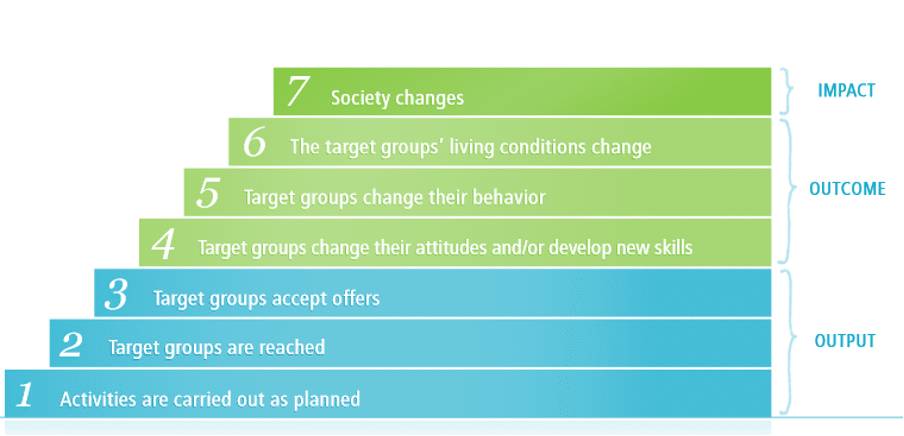
The same is true for mission events. Having 5,000 people at a missions event only brings us to level 3. We need to work through all seven steps. Level 7 surely is a God thing, but our efforts should produce outcomes that support and lead to the impacts that God does.
What Kind of Impact Do Events Have?
Since 2010, research has been conducted on all types of gatherings, fairs, and exhibitions, but it mostly focused on financial returns. However, recently, more non-financial impacts have been explored.
Carmel Foley, Deborah Edwards, and Katie Schlenker in Australia were among the first to analyse the non-economic impacts of conferences. In their “Business Events and Friendship: Leveraging the Sociable Legacies” study, they developed the measurement of Business Value of Meetings (BVOM).[7] They describe three characteristics that measure BVOM:
- Clearly defined event objectives and expectations
- Data collection methods that measure these objectives
- Result evaluation that leads to improvement[8]
BVOM varies greatly depending to the meeting type, budget, geographic region, and other variables. In my research, I discovered even more event impact categories which can also fit under the label of Business Value of Meetings.
- Socio-cultural impact
- Psychological impact
- Cognitive or educational impact
- Emotional impact
- Awareness impact
- Ecological impact
- Spiritual impact
This list is not complete, but represents what I have found so far.[9] I would love to learn what others would add.
Most mission event organisers I talked with had never really thought about impact categories. They might say that they want to see “God turn up,” “God calling people into missions,” or “People giving more for missions.” But these impacts are not clearly defined or measurable.
I wanted to see how BVOM could apply to missions conferences. Would these conferences have clearly defined and written event objectives and goals? Did they have ideas on how to measure these, and a method of collecting data? Do they do a result or impact evaluation which could lead to improving their next missions conference? Is there ever any follow up with people who attended these mission events?
Research on 16 Global Missions Conferences
I created a list of 57 global missions conferences. I looked particularly for missions mobilisation events beyond a singular denomination and beyond their own city. I also looked for events that were national or regional and targeted young people. From there, I contacted 27 events to request an interview. Organizers connected to sixteen events participated.
I conducted interviews in English or German. In three cases, I conducted interviews with the help of an interpreter. The event coordinators I interviewed in 2021 were associated with following events: CIMA (Latin America), CFM (Kenya), EAMC (Ethiopia), Enviados (Argentina), Jumiko (Germany), MissionNow (Switzerland), NAAMC (US), Revive (Europe), Satellites (UK), Sparc (South Pacific), Teenstreet (Europe and Africa), The Send (Brazil), Urbana (US), Vocare (Brazil), Zoom (Poland).[10]
Initial Findings
Reach and Focus
Figure 8.4 – Reach of the Interviewed Missions Conferences
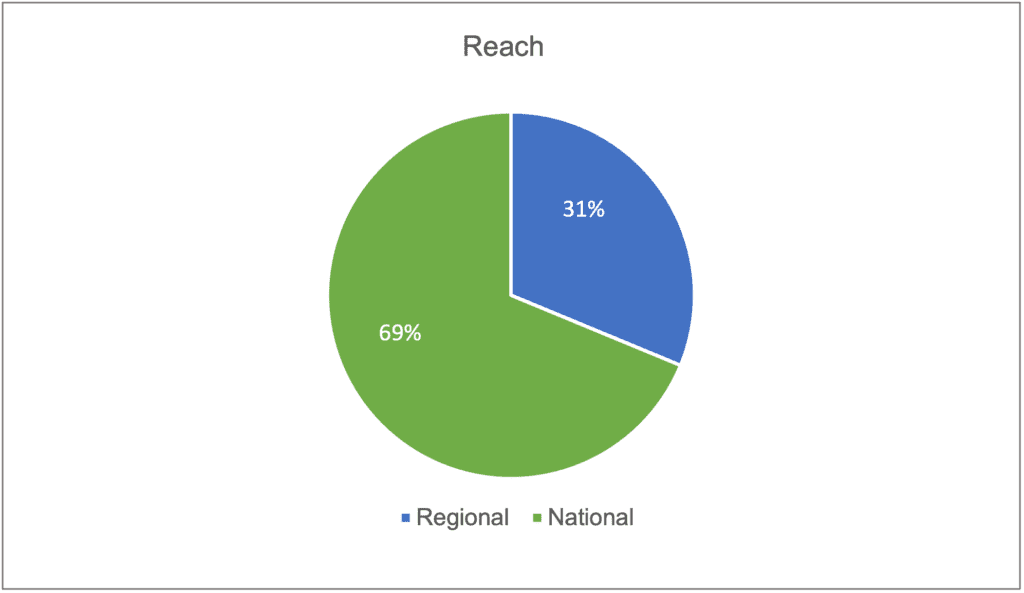
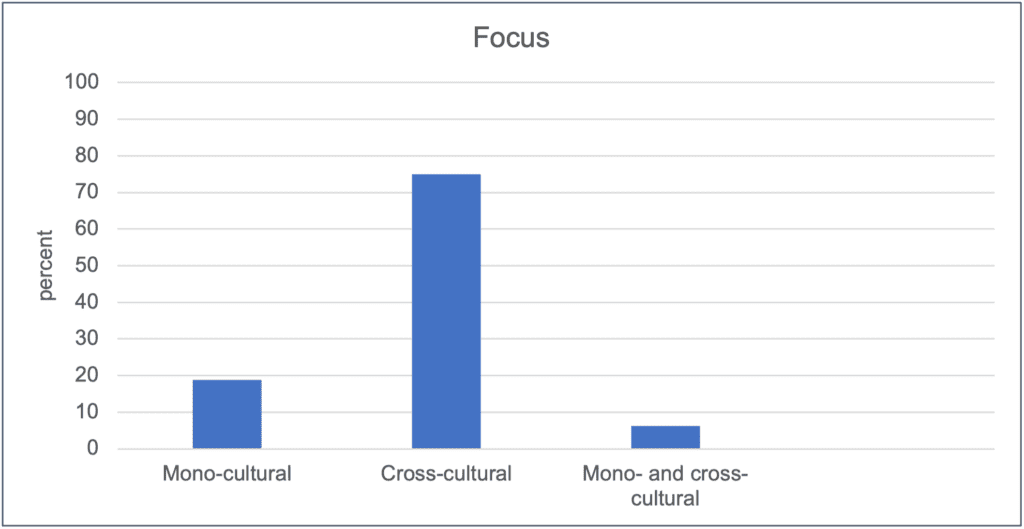
Most of these events have a national focus (69%). For the most part, they are missions conferences, but a few are church events with a focus on missions and evangelism. The majority have an integrated cross-cultural focus (75%).
Figure 8.5 – Focus of the Interviewed Missions Conferences
Target Group
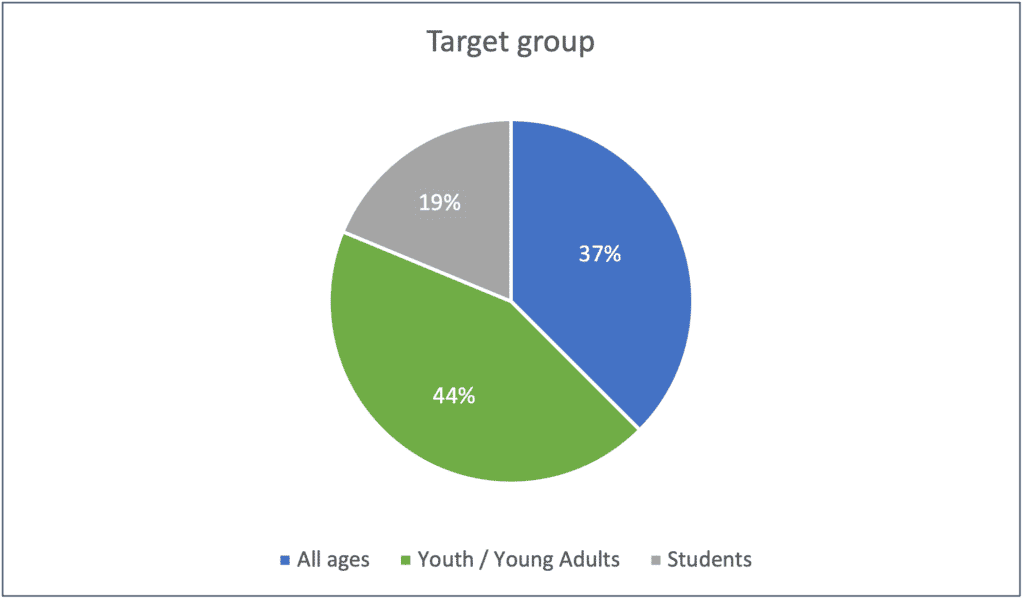
Most either target youth and young adults (44%) or only students (19%), while others mobilise everyone for missions (37%). Only a few are national conferences aiming at youth with a more evangelistic outlook like Satellites.
Figure 8.6 – Target Group of the Interviewed Missions Conferences
Length of the Missions Conferences
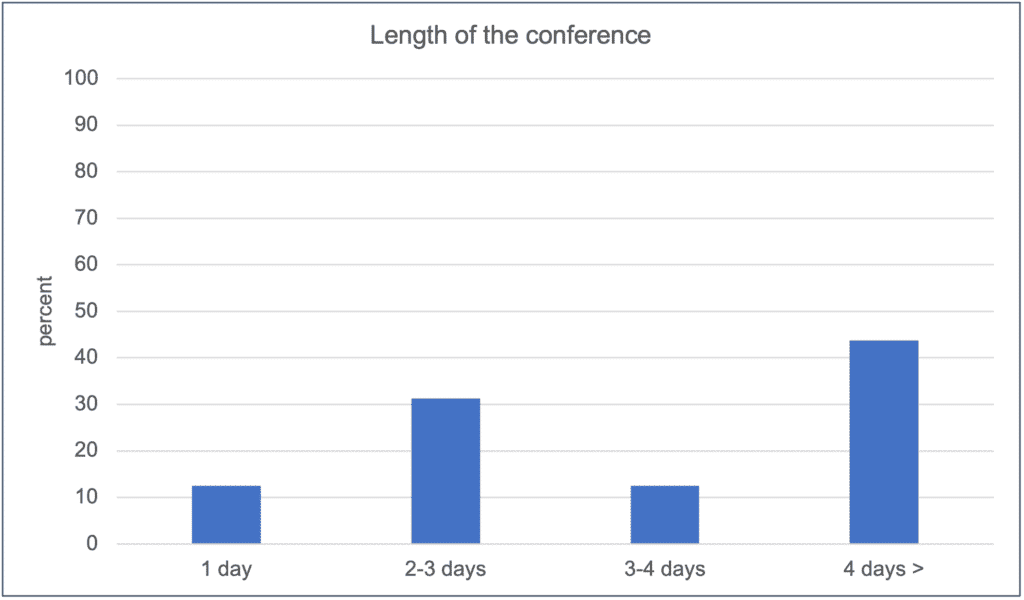
The length of events helps us better understand participants experiences. Nearly 44% of the events are longer than four days. Because people travel to these events, often having to fly, several solid days together makes sense. But again, the length of an event depends on what kind of impact the event aims to achieve. Quite a few set aside time for an exhibition or other means of informal learning. One event – The Send in Brazil –lasted only for one day. It was also the largest participating in my interviews with 120,000 people in attendance.
Figure 8.7 – Length of the Interviewed Missions Conferences
Occurrence
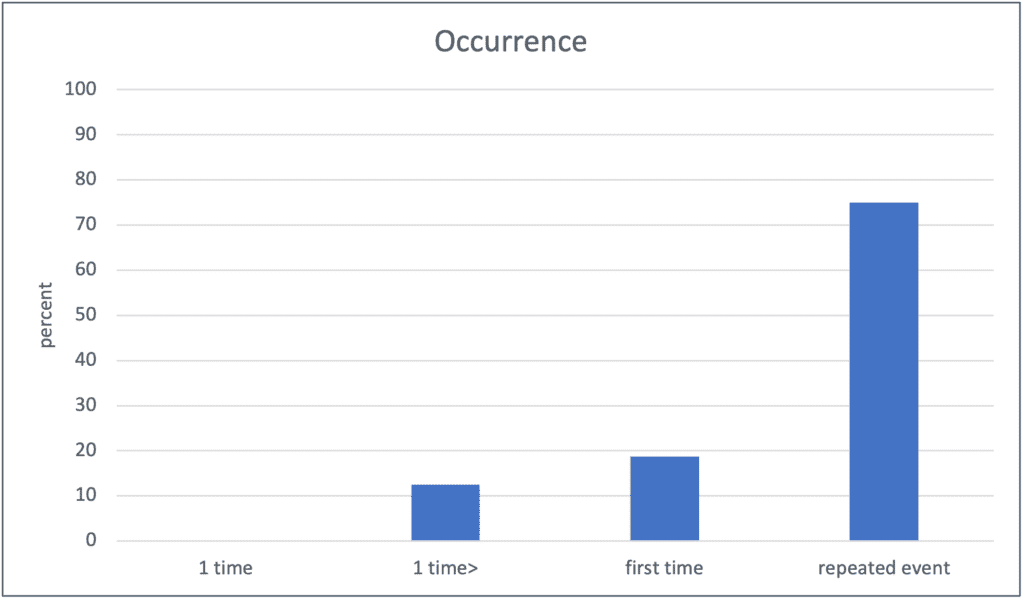
Seventy-five percent of all mission events occurred repeatedly. Satellites in the UK is the only event which has not yet occurred due to the pandemic but will finally happen in the summer of 2022. With 76 years, Urbana in the US has the longest history and is still going strong.
Figure 8.8 – Occurrence of the 16 Interviewed Missions Conferences
Did these events (unknowingly for most) put the principles of BVOM into practice? Let’s look at their non-financial impact.
Written Mission and Vision Statements
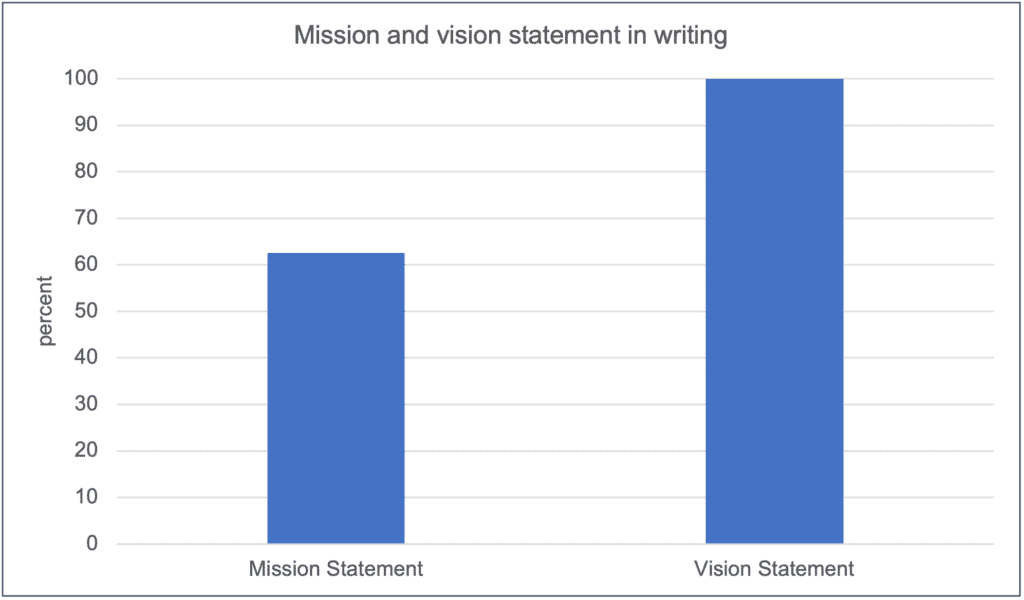
As part of the interviews, I asked event organisers if they have a vision and mission statement for their events, and secondly, if they do, if it is in writing. Everyone shared their event vision, but fewer (63%) had mission statements (more concrete goals). One conference leader said they were not an event. When I requested more explanation, the response was, “We think an event is consumer driven, but we want to make God great.”
Figure 8.9 – Interviewed Missions Conferences with Mission and Vision Statements in Writing
Specific Outcomes Described
Another question I raised in my interviews was “What kind of fruit (results) do you want to see through your event?” Direct answers I received included the following:
- That young people commit their lives to missions service
- Offering programmes around missions training
- Making God great
- Raising awareness and fire for his worldwide missions
- Recruiting young people for ministry in short and long-term assignments
- We set a percentage goal not just a numerical goal due to numbers constantly changing
- We want people to commit two-years of their time serving in missions
- We want the whole church to be mobilised
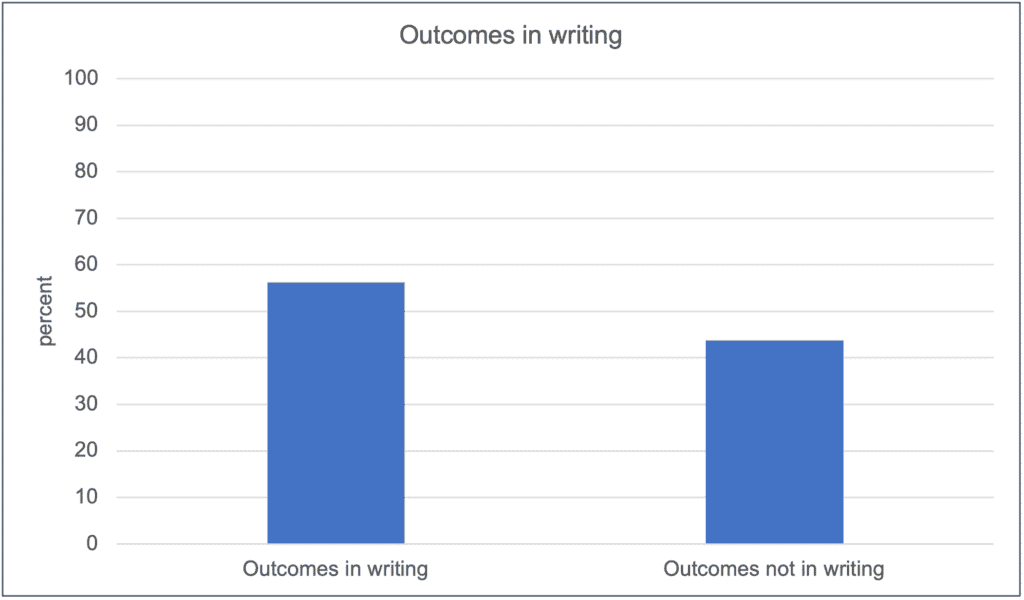
When I solicited information about if they had their goals and desired outcomes in writing, 44% admitted that they did not. This presents a significant challenge to measuring impact.
Figure 8.10 – Interviewed Missions Conferences with Written Outcomes
Then, I asked, “How do you define a successful event?” Here are some of their answers:
- The conference has a biblical foundation that is clear and direct
- The focus of the conference is primarily about God´s mission
- Interaction with participants
- Set goals are achieved
- Satisfaction of visitors and exhibitors
- See churches involved in missions
- Get more pastors onto mission trips
- Impact on universities and schools
- Unity in the body of Christ
Means of Impact Measurement Used
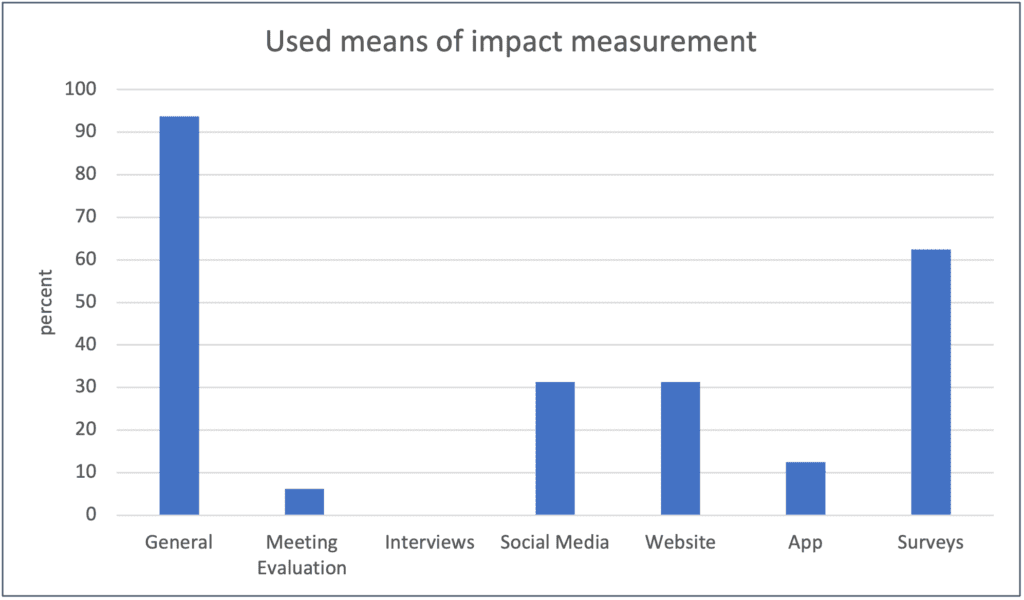
After defining what a successful event would look like, I invited event organisers to share about how they measured impact. Ninety-three percent had some form of measuring. They specifically mentioned meeting evaluations (6%), social media (31%), analysing website content usage (31%), and analysing app usage (12%).
Among specific means for gathering data, surveys, with 63%, were used the most. These surveys, though, were only done afterwards and primarily right after the event finished. In most cases, no one conducted follow-up surveys after time elapsed after the event, so long-lasting impact could not be measured.
Figure 8.11 – Means of Measurements Used by Interviewed Missions Conferences to Evaluate Impact
Post-Event Follow-Up with Attendees
What about advanced preparation for event attendees – like inviting them to read a certain portion of the Bible beforehand, or raising prayer or financial support. When I inquired about this, most event organizations revealed they did not do this.
Even more important than that was the next question: “Have you done any follow-up with the attendees?”
Figure 8.12 – Post-Event Follow-Up Reported by Missions Conferences Interviewed
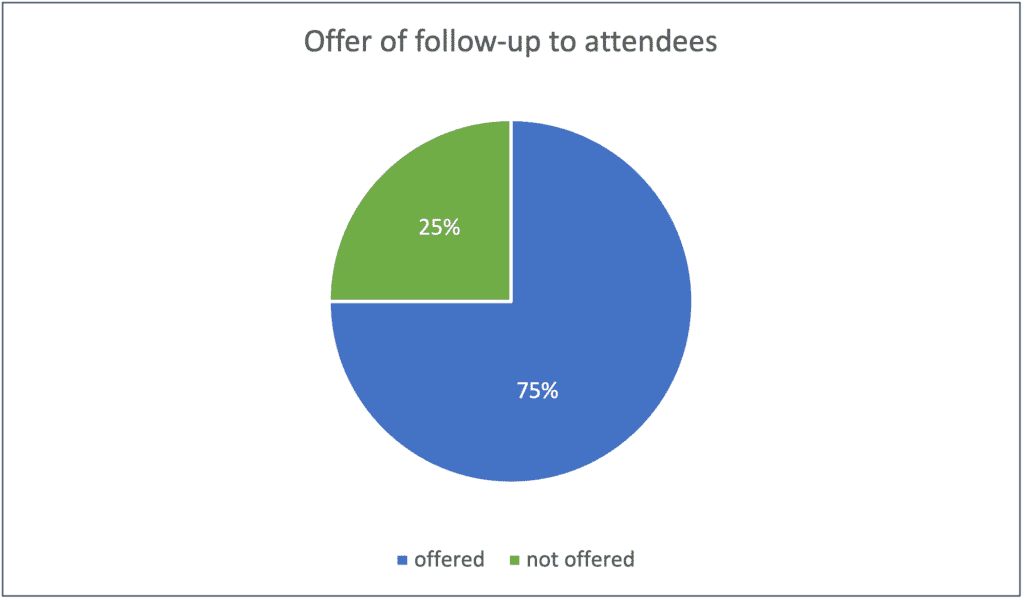
When I inquired with event organisers about post-event follow-up with attendees, 75% reported doing it. They shared the following examples:
- An official partnership with a mobilisation ministry
- A study course like Perspectives
- Newsletters reminding them of content they had listened to
- Encourage them to find prayer partners
- WhatsApp updates
- Bible reading plan with YouVersion
- Adoption programme for children
Event Embedment in Wider Strategies
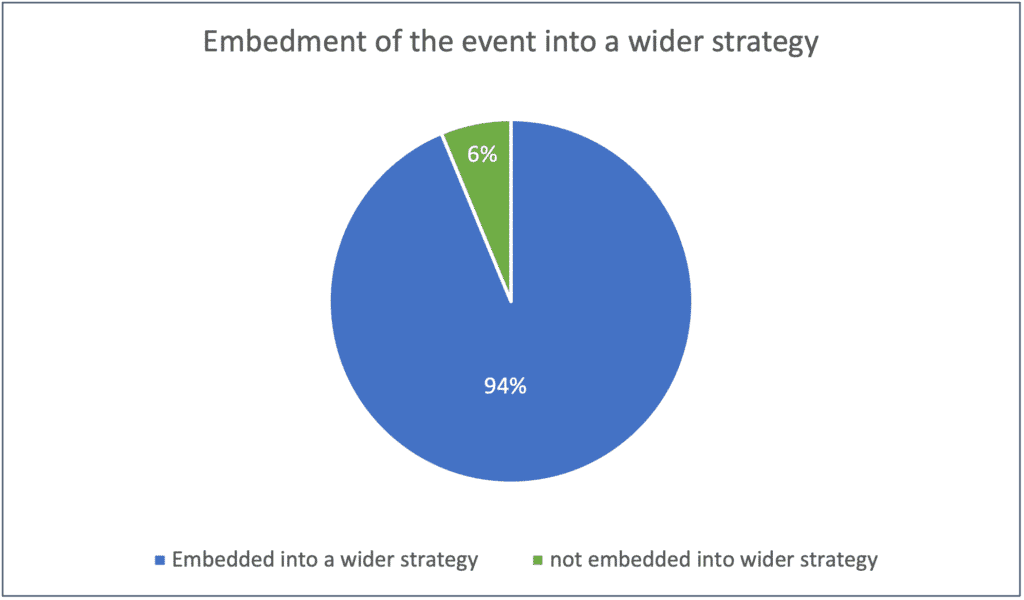
I inquired about how their event embedded into wider strategies, for example as part of a movement, connected to further training, or was it a stand-alone event. Ninety-five percent responded with that their event was implemented into a larger strategy. Two events – Revive and Sparc – are run by Intervarsity/IFES. The Teenstreet event is a branch of Operation Mobilisation (OM) and integrated into OM’s global strategy for recruitment.
Figure 8.13 – Embedment of the Missions Conferences Interviewed in Wider Strategies
A final question focused on if the event organisers saw a correlation between participants attending a missions conference and joining missions short or long-term.
Some responses were:
- At each of our conferences 70% of all attendees are new.
- Half the participants indicated they wanted to go onto a mission trip.
- We offer an official partnership with a sending organisation. When you join them, your student loan is partly paid-off.
- We started a round table for pastors and take them on a mission trip together.
One event reported that every time a mission candidate applied to a mission agency and mentioned they were recruited at their event, the event organisers would receive about US$50.
Gained Insights
Even though not everyone had their goals and outcomes in writing, all were driven by their vision to see the world reached by Jesus. Events such as EAMC or CFM in Africa had 200–300 participants in attendance, and a clearly laid out strategy on how to reach their goals.
I was pleased to see the incredible reach of these conferences plus how many had put solid work into their strategy. On the other hand, I was surprised that some larger events lack a written vision nor any defined outcomes. More work needs to be done to ensure lasting impact.
Lessoned Learned for the Future
Missions event organisers positively received my research on event impact and possible measurements. Several I interviewed came back to me after a few months to ask about how others do their events. This created a wonderful informal learning opportunity. I was also allowed to share some of the written event strategies with other event organisers so they could profit from each other´s work.
In general, I believe we can improve our mission mobilisation events. Clear outcomes that are communicated to everyone on the team, produce greater clarity and unity. We need the Holy Spirit to guide us in this process, and we need to remain flexible to not hold our plans too rigidly. But this does not negate the importance and diligence of launching our endeavours with a quality plan. Donors and foundations want to know what the desired outcome and impact of our events will be, and the event industry now has more tools to measure this.
Urbana is the only conference I researched that completed a longitudal study on attendees. Other conferences that have been held more than five times could follow suit. And all event organisers can do more follow-up related to their desired outcomes. A survey six months or a year after an event to hear how people have implemented their commitments and if there are ways you can support them better, could provide tremendous benefits. As Christians, we leave it up to God to call people into his work but let´s not forget to do our part in planning long-term to strengthen our partnership with him in his mission.

Evi Rodemann (evi.rodemann@leadnow.center) loves to engage and mobilise young people for missions. She founded her own organization, LeadNow, in 2021. She did her MA in European Missions (Redcliffe College, UK) with a focus on evaluating the impact of European mission conferences. She is now pursuing her PhD (UNISA) researching global mission events and tools for measuring impact. She lives in Hamburg, Germany.
[1] Urbana Conference, “Past Urbanas,” Urbana, accessed June 28, 2022, https://urbana.org/about-urbana.
[2] “Impact,” Oxford Learner’s Dictionaries, accessed June 28, 2022, https://www.oxfordlearnersdictionaries.com/us/definition/english/impact_1.
[3] Evi Rodemann, “An exploration of the impact of the Mission-Net Congress” (unpublished master’s thesis, University of Gloucestershire, 2016).
[4] Fabian Walter, “Welche Wirkungen hat dein Projekt,” Erfolgreich Projekte leiten (2016), accessed June 29, 2022, https://erfolgreich-projekte-leiten.de/output-outcome-impact/.
[5] Doreen Kubek and Bettina Kurz, “The Social Impact Navigator,” Phineo gAG (2021), accessed June 29, 2022, https://www.phineo.org/uploads/Downloads/PHINEO_Social_Impact_Navigator.pdf.
[6] Kubek and Kurz, “The Social Impact Navigator.”
[7] Carmel Foley, Deborah Edwards, and Katie Schlenker, “Business Events and Friendship: Leveraging the Social Legacies,” Event Management 18 (2014):53–64, accessed June 29, 2022,https://opus.lib.uts.edu.au/bitstream/10453/31801/1/Foley_Edwards_Schlenker%20EMgt%202014%2018,1,%2053-64.pdf.
[8] “Business Value of Meetings,” Meeting Professionals International, MPI Foundation and AIBTM (2011).
[9] Evi Rodemann, “Do Mission Events Really Have a Long-Lasting Impact on the Younger Generation?” Global Missiology 3, no. 17 (April 2020), accessed June 29, 2022, http://ojs.globalmissiology.org/index.php/english/article/view/2328.
[10] These events are under data protection, so references to specific events are withheld in the chart and graph figures and presented in a neutral form.
EMQ, Volume 58, Issue 2. Copyright © 2022 by Missio Nexus. All rights reserved. Not to be reproduced or copied in any form without written permission from Missio Nexus. Email: EMQ@MissioNexus.org.