
EMQ » October–December 2022 » Volume 58 Issue 4

Innovation
Many missions organizations face two significant problems: limited capacity and ineffective stewardship. Embracing a digital transformation is a key to overcoming these challenges. The first digital native generation – Generation Z – can play an essential part in helping organizations enter the digital world.
By Andrew Feng and Nick Wu
Success and failures are often measured during a post-mortem, a retrospective after a project or initiative has been done. This is used in businesses to examine what went well or didn’t go well. The objective of this process is to identify valuable data points for what to continue or avoid.
Another model to examine a project is a pre-mortem. In this model, a person investigates potential pathways to failure to assess risks and avoid pitfalls before going forward with a project. This is especially helpful when projects cannot be redone.
The Great Commission is the most important project for Christians. This lifelong calling and mandate to go and make disciples in all nations and baptize them in the name of Christ has no post-mortem retrospective. No one can live and die, look back, and start again. This makes pre-mortem the best model for global missions.
Two of the biggest problems confronting many missions organizations are capacity and poor stewardship. Simply put, not enough people are becoming long-term missionaries, especially among the next generation – Gen Z. At the same time, resources are not being appropriately and effectively allocated. Without digital and financial resources more effectively stewarded, Islam’s growth is set to outpace the growth of Christianity in the next 30 years.[1]
Following a pre-mortem, we can properly address the issues of capacity and stewardship. Welcoming innovative new approaches that significantly change current ways of working can move the missions world toward surviving and thriving. Participating in the digital transformation already taking place across all sectors of global society, is a key part of that and an important way the missions world overcome its challenges. Embracing digital transformation can maximize resources, pave the way for greater involvement from Gen Z, and facilitate more authentic collaboration.
Gen Z Lives in a Digital World
Gen Z is the first digital native generation. Born between the late 1990s up to just after the first decade of the 2000s, Gen Z has had access to smartphone technology since their formative years. This sets them apart from previous generations. Gen Z is also on track to be the most educated generation,[2] and all college degrees and majors now require basic digital literacy. As the digital landscape grows and shifts, Gen Z instinctively learns to operate and adapt with it. Organizations and ministries which embrace digital transformation will best facilitate Gen Z’s engagement in the Great Commission.
However, for many Gen Z Christians, global missions is the last thing on their mind. Perhaps one of the most concerning statistics from Barna’s Future of Missions report was that 51% of practicing Christians, including Gen Z, do not even know the meaning of the Great Commission.[3] Even for the few Gen Z Christians who know about and are interested in missions, even fewer know ways to utilize their digital skills to spread the gospel to unreached peoples.
Let’s consider how a typical church might utilize young software engineers. If they utilize their skills at all, it will most likely be to ask them for help with audio and visual needs or to rebuild their church’s website. Then outside of the church, these young people quickly discover that their digital skills are highly sought after and valued by tech companies and multi-million dollar projects. The message the Church unknowingly communicates is that digital skills are not useful in God’s kingdom. The result for these highly educated and digitally savvy young people is that focusing on their career and life success makes more sense.
The oldest Gen Z-ers are 25 years old. As recent college graduates, they are now entering a workforce that is increasingly more competitive. Societal pressures and increased living costs now demand that young adults seek financial security as a top priority. And this is the message they hear from their families and in their churches, too. Yes, this is a life given to Jesus, but they almost never hear, “Quit your job and move overseas to be a missionary.” Many see their faith only as a vertical relationship between themselves and God, not one that involves participating with God and other believers to reach unreached peoples.
Many young adults remain ignorant of the needs in global missions, especially the opportunities involving their digital talents. In fact, many mission agencies and churches see no connection between the digital world and global missions. The global COVID-19 pandemic coupled with limited physical interaction exposed the folly of this way of thinking.
As social norms were upset, many churches responded with self-preservation strategies to maintain in-person congregational gatherings. However, these intense social disruptions revealed a glaring weakness in the church. While churches resisted change, they lacked the discernment to see that the previous norm had already long since passed.
The reality is that church congregations, especially their young people, already live in an entirely different world. New technologies and social media compete for the attention of young people. The average user spends nearly 5 hours a day on their mobile devices.[4] Young people are left digitally navigating today’s turbulence with a largely digitally absent Church. This has undoubtedly exacerbated anxiety and mental health crises. Churches and ministries are far too behind in the digital transformation happening all around them.
Untapped Potential in the Next Generation
Understanding that the current digital landscape can be a tool and resource for global missions is a first step in engaging the next generation. Rather than resist it, Christians need to accept and embrace digital transformation, which will, in turn, enable the next generation to effectively serve.
Engaging the next generation means reconsidering traditional pathways of mobilizing them into global missions. The COVID-19 pandemic accelerated digital transformation changing outlooks on using digital resources and strategies to engage people despite the lack of physical presence. Gen Z grew fully accustomed with online education, much of which took place using now ubiquitous video conferencing. And as Gen Z begins their careers, they can choose from an abundance of remote job opportunities that do not require relocation.
Alex Shih, who serves on the board of Interserve USA (interserveusa.org), and his wife, Naomi, highlight three key impacts and opportunities that remote work has had on missions:[5]
- Enabling Geographic Mobility. Workers can practice their craft anywhere, thus creating a greater disbursement of marketplace believers. Marketplace ministries with increasing specialization[6] have grown over 50% in the last decade.[7]
- Democratizing Access to Opportunity. Organizations can now shift to more equitable hiring for remote-first roles.
- Incorporating More Global Perspectives into Products. Multiple viewpoints increase insights and provide stronger cultural relevance and innovative decision making.
They summarize their essay, stating, “A global marketplace for talent and opportunity leads to a more equitable world. Remote work is a necessary first step, and it is the future of work. May this crisis cause us to engage and embrace remote work as a strategic catalyst for marketplace ministry among the nations, for working and hiring.”[8]
Remote work opens many new opportunities for Christians to use technology to engage with any person in the world with internet access, including those who reside in the 10/40 Window. This is not to replace in-person incarnational ministry, but rather to support frontline missionaries with digital tools and resources that will greatly advance their ministry. This also opens a way for young adults from all over the world to partake in supporting global missions from right where they are. It can be a way they continue in the mobilization funnel while actively serving missions endeavors. And this can be an important pathway that leads toward going directly to the missions field.
Compare these opportunities to the current user-journey for mobilization. For many Christians, their exploration of global missions begins briefly at a church equipped to send missionaries. Typically, they will learn more through missions conferences and courses and gain exposure through short-term missions trips. However, this is where the journey for many stops. Given current barriers to further engagement for many in Gen Z, even considering going overseas for missions may take many more years or even decades.
At this time, evangelical Christians total to 400 million worldwide. Around 435,000 (or about 1%) are missionaries. Among these missionaries, approximately 1 out of 30 are going to countries with the least reached peoples, those who have little to no access to the gospel.[9] These countries require pioneering work, and most missionaries are not going to them. For some of the largest and most strategic of these people groups in the Middle East and South Asia,[10] remote work and digital opportunities may provide a way to overcome the geographic hurdle.
The accessibility of remote work has also enabled greater flexibility. Workers have found more productivity being able to manage their own home life while working remotely. In the same way, Christians have greater freedom and time that they could invest serving in global missions. For young adults, this lowers entry barriers. Digital missions work becomes realistically and reasonably doable. Plus, it gives them a way to use their valuable marketplace skills for global missions advancement.
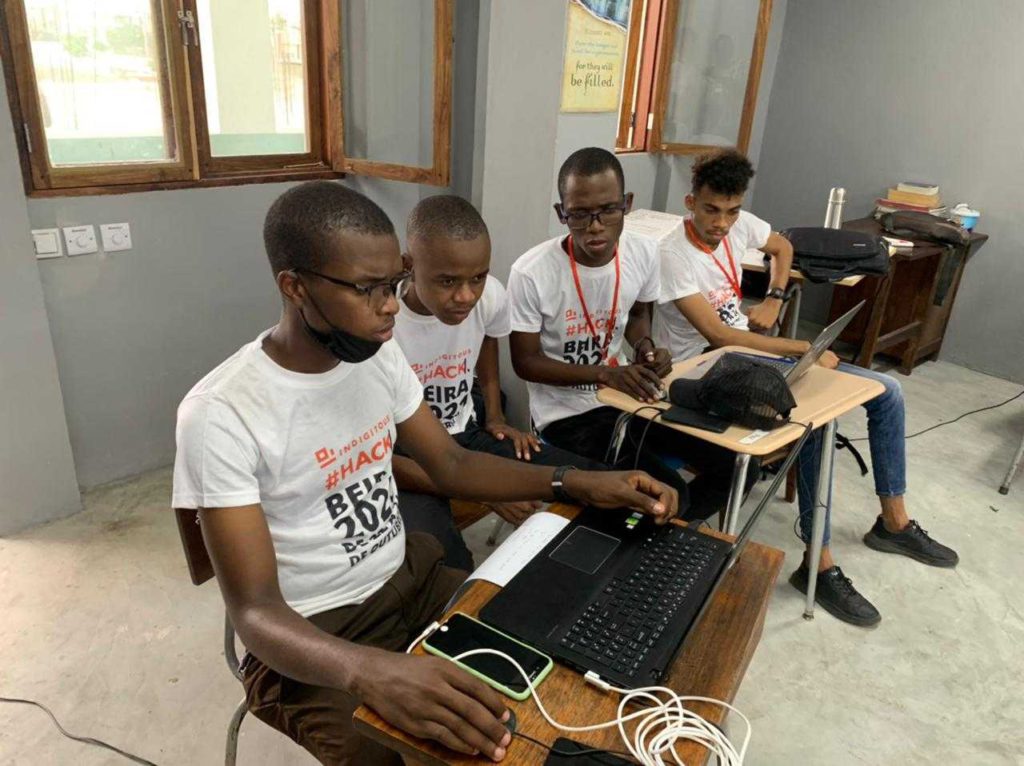
Indigitous (indigitous.org) is testing this strategy for mobilization and digital resourcing for missionaries and ministries in indigenous communities. In the US, Indigitous started a cohort program (idserve.us) to enable the next generation to use their skills for the kingdom. To mobilize Gen Z where they are, Indigitous empowered students and young adults to do what they already want to do, but do it for global missions. The appeal of missions involvement increases when the next generation is invited to use their digital skills and work experience in meaningful missions projects.
Indigitous cohorts have mobilized student designers and developers in several micro-projects that include creating a digitally illustrated prayer guide for frontier people groups (ndgt.us/frontier-peoples) as well as a Bible story app with audio stories in the heart language of an unreached people group. At about 5–10 hours a week for 8+ weeks, Gen Z students committed to learn about the needs of global missions while producing a product that had a direct impact on a community in need of the gospel.
Through remote work as well as connecting Gen’s Z affinities and abilities with real projects, Indigitous is testing crowdsourcing missions work. When fewer than 1% of evangelical Christians are not yet physically going as pioneer missionaries to the least-reached people groups, the opportunity for crowdsourcing and micro-projects leverages what the other 99% of evangelical Christians can do to support taking the gospel to new peoples and new places. This increases the capacity of frontline missionaries by unleashing untapped, latent potential among the next generation.
Innovation and Collaboration
Digital transformation is just the first step to help transform how we think about global missions and implementing new strategies. And empowering Gen Z through creative micro-projects is only one of many innovative strategies that global missions needs. At the same time, the next generation needs modeling and guidance from innovative leaders in missions organizations.
Ted Esler writes in his book, The Innovation Crisis, that leaders in churches and in missions organizations garner the influence to change a culture and way of doing things.[11] Innovators initiate in the adoption curve and eventually a majority joins them. Innovative leaders bring in the next generation as early adopters.
Andy Crouch provides insight into why leaders need to be innovators:
“As leaders we must react swiftly to the blizzard that is already upon us, and pivot to survive the inevitable winter under severe conditions, and reimagine our organizations to outlast the rigors of a possible little ice age…. But here is the thing: if we are wrong, and the blizzard passes, the winter is mild, and the little ice age never arrives, our organizations already know what to do. In any case, responsible leaders have no choice, today, but to assume that the winter is upon us, and an ice age of unknown duration is before us. We are playing a game no one now living has ever played before. We are, for reasons only God knows, on the front line, on the starting team. Let us act boldly, today, to build as best we can, for the love of our neighbor and the glory of God.”[12]
Crouch stresses the importance of leaders preparing for any situation. Unprepared leaders in an ice age can be compared to a boiling frog. When they become numb or immobile to the changing times, their inaction becomes their doom.
Figure 9.1 – The Innovation Adoption Curve. Illustration by Jurgen Appelo.[13]
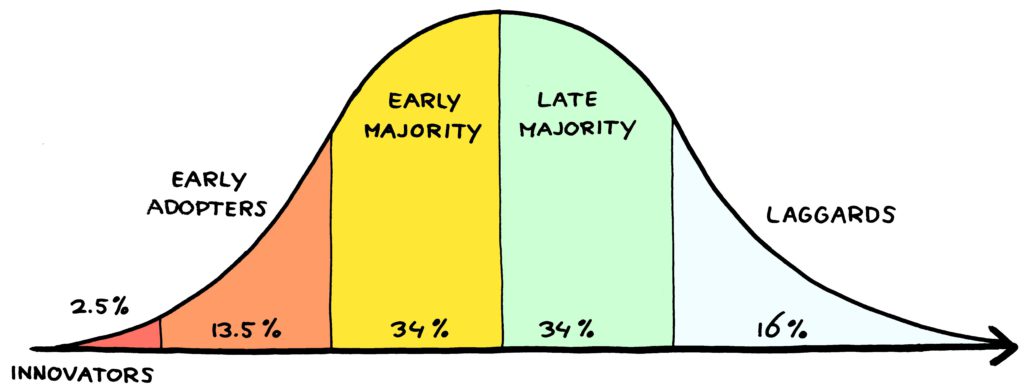
Innovative leaders cannot be laggards if they truly hope to see change, especially in adapting to a turbulent environment on top of the missional calling. Rather, leaders need to come out of this metaphorical blizzard with a bolder appetite for risk before it is too late.
Consider SpaceX rockets as they compare with rockets from United Launch Alliance (ULA) – a long-term NASA partner. As of July 2022, SpaceX launched more than 2,400 Starlink spacecrafts[14] in comparison to ULA’s approximately145 launches.[15] Additionally, SpaceX did it at two-thirds of ULA’s cost.[16] By launching lower-fidelity rockets, SpaceX innovated upon space research at a lower-cost business model.[17]
Similarly, innovation for higher-risk and more iterative strategies has major potential in transforming the landscape for global missions. For example, micro-projects done remotely may yield a low-cost method to contribute to global missions while testing out new strategies.
For ministries, innovation may look like partnership and collaboration. Many organizations function siloed – alone in their work and often in competition with other organizations they could partner with. Collaboration means sharing resources and best practices so that everyone builds capacity to advance the mission together. Gen Z can especially help to break silos that impede ministries in maximizing their digital resources. Capacity-building that takes place through collaboration increases activation energy among leaders, and helps young adults take on the harder challenges with increased resistance to failure.
Conclusion
Before Gen Z becomes fully disengaged, digital transformation, innovation, and collaboration must be implemented to address the pre-mortem challenges of global missions. The current pathway for global missions empowered 1% of evangelical Christians to serve as missionaries. However, digital routes which appeal to the next generation can provide many in the remaining 99% opportunities to have a greater role in supporting and supplementing missions work. Their digital skills may just be a key to taking the gospel message to the hardest-to-reach places.
Going digital is paramount for engaging and mobilizing the younger generation for the remaining task of making disciples of all nations. Inviting young adults to work on missional projects can start their missions journey. Crowdsourcing missions support through digital strategies and remote work is one way we may engage the digital natives which comprise Gen Z.
To keep the next generation, we must continue towards an innovative digital transformation. The new opportunities that will result will not replace incarnational ministry and disciple-making. However, for young adults and teenagers, this may prove to be a critical onramp for continued and sustained global missions involvement.
The end result is an activated generation empowered to take the mantle of the current forerunners for global missions work. They are equipped to break silos that impede digital innovation, and this will increase capacity by unleashing everyone God has called into missions. It’s time to go digital so that Christians will never be late in taking the good news of Christ to all who have yet to hear.

Andrew Feng (andrew@indigitous.org) serves as the US director for Indigitous which engages young leaders to use their giftedness beyond the four church walls. Andrew and his wife served abroad for five years where they adopted their special needs son. Andrew has a heart for the younger generation and continues to mentor them under Indigitous. Andrew holds a ThM and is a Fellow at Dallas Seminary. Prior to ministry, Andrew graduated from USC, interned at Yahoo, and consulted for KPMG.

Nick Wu (nick@indigitous.org) serves as the cohort lead and content producer for Indigitous in the US. He helps engage young adults to use their digital talents and skills in kingdom-minded projects. He also helps produce content and videos for Indigitous and like-minded non-profit organizations, including producing short documentaries in East Asia and the Middle East. He graduated from UC San Diego and is currently an MA student at Dallas Seminary.
[1] Michael Lipka and Conrad Hackett, “Why Muslims are the World’s Fastest Growing Religious Group,” Pew Research Center, April 6, 2017, “https://www.pewresearch.org/fact-tank/2017/04/06/why-muslims-are-the-worlds-fastest-growing-religious-group/.
[2] Kim Parket and Ruth Igielnik, “On the Cusp of Adulthood and Facing an Uncertain Future: What We Know About Gen Z So Far,” Pew Research Center, May 14, 2020, https://www.pewresearch.org/social-trends/2020/05/14/on-the-cusp-of-adulthood-and-facing-an-uncertain-future-what-we-know-about-gen-z-so-far-2/.
[3] Barna, The Future of Missions – 10 Questions About Global Ministry the Church Must Answer with the Next Generation, (USA: Barna Group, 2020), 39.
[4] Simon Kemp, “Digital 2022: Global Overview Report,” Datareportal, January 26, 2022, accessed June 1, 2022, https://datareportal.com/reports/digital-2022-global-overview-report.
[5] Alex, “Advancing Mission in the Digital Frontier,” Vision New Normal: Your Work as Globalocal Mission, November 23, 2020, accessed June 1, 2022, https://youtu.be/xYqNylEdhgM.
[6] Darren Shearer, “3 Trends in the Marketplace Christianity Movement,” Theology of Business Institute, December 15, 2015, accessed June, 1, 2022, https://www.theologyofbusiness.com/trends-in-the-marketplace-christianity-movement/.
[7] “Lausanne Occasional Paper 40 – Marketplace Ministry,” Lausanne Movement (2004), accessed June 1, 2022, https://www.lausanne.org/content/lop/marketplace-ministry-lop-40.
[8] Alex Shih and Naomi Shih, “Spreading the Word and the Work: Remote Work as a Strategic Lever to Advance Global Missions and Economic Opportunity” (2020), accessed June 1, 2022, https://bit.ly/futureofworkshih.
[9] “Missions Stats: The Current State of the World,” The Traveling Team, accessed June 1, 2022, http://www.thetravelingteam.org/stats.
[10] “Frontier Unreached People Groups,” Joshua Project, accessed June 1, 2022, https://joshuaproject.net/frontier.
[11] “Innovate or Stagnate,” The Innovation Crisis, accessed June 1, 2022, https://theinnovationcrisis.com/.
[12] Andy Crouch, Kurt Keilhacker, and Dave Blanchard, “Leading Beyond the Blizzard: Why Every Organization Is Now a Startup,” Praxis, March 20, 2020, https://journal.praxislabs.org/leading-beyond-the-blizzard-why-every-organization-is-now-a-startup-b7f32fb278ff.
[13] Jurgen Appelo, “Figure 15.5 Innovation Adoption Curve” (CC BY 2.0), accessed June 1, 2022, https://www.flickr.com/photos/jurgenappelo/5201275209.
[14] “SpaceX launches another batch of Starlink satellites from Florida’s Space Coast,” Fox 35 Orlando, accessed June 1, 2022, https://www.wogx.com/news/spacex-launch-from-florida.
[15] “Unlocking Space – Missions,” United Launch Alliance, accessed June 1, 2022, https://www.ulalaunch.com/missions.
[16] Adam Mann, “SpaceX now dominates rocket flight, bringing big benefits – and risks – to NASA,” Science, May 20, 2022, https://www.science.org/content/article/spacex-now-dominates-rocket-flight-bringing-big-benefits-and-risks-nasa.
[17] Tom Agan, “What SpaceX Can Teach Us About Cost Innovation,” Harvard Business Review, April 25, 2013, https://hbr.org/2013/04/what-spacex-can-teach-us-about.
EMQ, Volume 58, Issue 2. Copyright © 2022 by Missio Nexus. All rights reserved. Not to be reproduced or copied in any form without written permission from Missio Nexus. Email: EMQ@MissioNexus.org.




