EMQ » October–December 2022 » Volume 58 Issue 4
Expanding Youth Ministry
Ministry to teenagers in continental Europe is less developed than in other parts of the world. While Western and Northern Europe report robust youth participation, youth ministry seems underdeveloped in Central and Eastern Europe. Noting that there are global commonalities to youth ministry and how innovation is diffused, a diffusion model of youth ministry could help global workers and local churches to develop and strengthen ministry to teens in continental Europe.
By Anthony J. Gryskiewicz
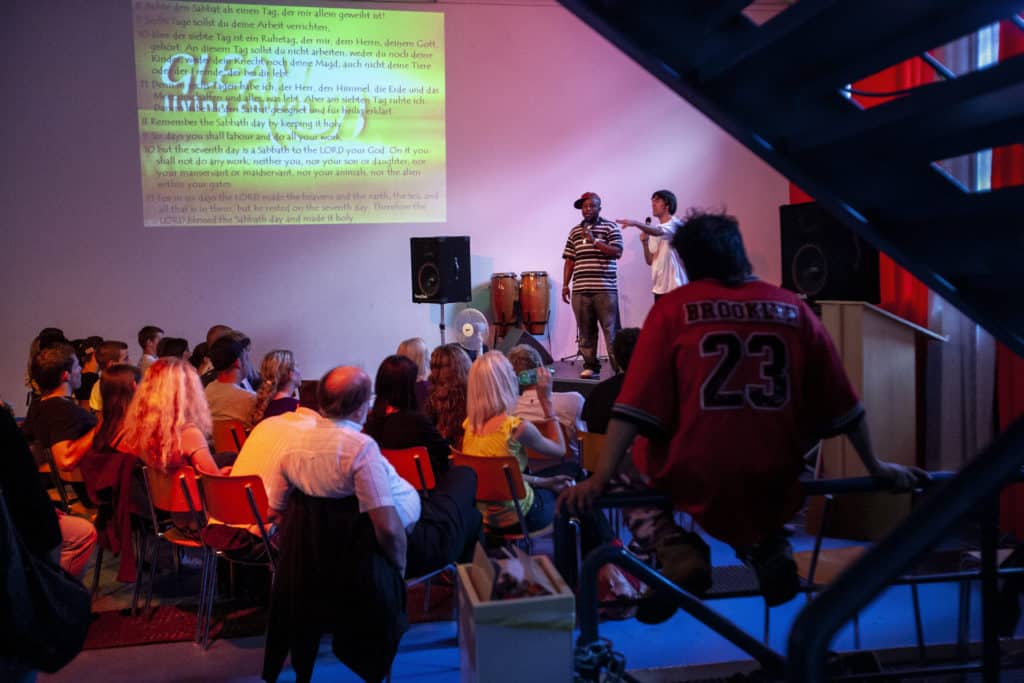
Several years ago, I attended a youth leaders conference in Central Europe. novice youth leaders eager to learn how to reach more teens with the gospel surrounded me. The keynote speaker, a young man in skinny jeans and a T-shirt, walked onto the stage and began to share how he grew his youth group to a massive 60 teenagers by dressing like teens, talking like teens, and playing popular secular music during the youth service.
As I shook my head, I thought, “I’m a fifty-year-old man. No teenager wants to see me in ripped skinny jeans and talking in the groovy, hip lingo of my peeps while Lady Gaga plays in the background.” Then I wondered, “Why are 60 teens considered a massive youth group?”
As an American involved in youth ministry for over 30 years, I have visited youth groups in the US with several hundred teenagers in attendance. Furthermore, the average youth group size in the US is approximately 80–150 teens.[1] Perhaps the difference in youth group sizes between the US and countries in Europe could be attributed to this fact: “97% of the world’s formally trained youth workers live and work in the United States ministering to less than 3% of the world’s youth population.”[2] Or maybe churches in many parts of Europe just lack an emphasis on youth ministry or youth development.
As I examined academic research on church-based youth ministry in Europe, I found a considerable gap. One of the most helpful studies was by Len Kageler. Kageler indicated that continental Europe lags behind many parts of the world in youth ministry development.[3] He found that the average size of a youth group in continental Europe was 10–20 students. Curious to learn more, a colleague and I conducted a preliminary study on Pentecostal youth ministry in continental Europe. Our findings suggest that youth ministry is more robust in Western Europe but less developed in Eastern Europe. In some eastern European countries, youth ministry participation was below the European average found by Kageler. In fact, some national youth leaders had no information on how many youth ministries existed in their country or the average attendance in them.[4]
It appeared that a framework that shared healthy, culturally appropriate youth ministry models could help. Here I offer a broad framework in which youth ministry in Europe could be strengthened and developed. Understanding there are cultural differences within continental Europe, this framework is broad allowing necessary cultural adjustments to make it sustainable in various locations.
This framework is not a one-size-fits-all model to develop youth ministry. However, it does work on the assumption that since there are commonalities in youth ministry globally[5] and there are similarities in how innovation spreads or is diffused[6], a framework can be constructed that would remain useful across the European context.
Developing a Framework
This framework is based on the perspective of the Global Worker (GW) entering a culture to assist in developing ministry to adolescents. It is important to keep in mind the differences and similarities of youth ministry globally and recognize that change agents from within a society can vary from culture to culture. It is also helpful for GWs to identify early adopters.
Recognizing Differences
A common refrain is, “all teenagers are the same.” There are more differences in youth ministry than commonalities when we compare youth ministry in the US to the rest of the world. Terry Linhart and David Livermore explain, “the biggest danger is people from the ‘outside’ who think all youth ministry, all culture is the same.”[7]
Among the Pentecostal churches in Europe, many churches do not have a youth pastor or youth leader. For example, one person I interviewed in Romania stated that there is no such thing as a youth pastor. A pastor, in his context, is someone who has Bible school training, is ordained, and leads two or three different churches totaling 200 to 300 people. He said that it would be “beneath” a pastor to only focus on teenagers. Other Pentecostal movements in Europe reported they did not know how many youth leaders or youth groups existed in their fellowship.[8]
GWs need to understand cultural and leadership differences and other critical cultural values before embarking on youth ministry in another country. For example, in some European Pentecostal churches, men and women sit on opposite sides of the church during the service. How would the church react if someone came and tried to initiate an American-style youth ministry with lights, fog machines, contemporary music, and teenage boys and girls sitting together?
It is also vital to recognize that different cultures define youth differently. In Spain, youth or jóvenes often includes people in their 30s. Student ministry in Europe can be just as problematic. While used in the US to refer to ministry to teenagers, in Europe, the phrase is synonymous with university ministry.[9]
Building Upon Commonalities
The phrase “all teenagers are the same” does bear an element of truth. All teenagers are experiencing puberty and changes in their bodies and minds. Due to their psychological development, teens tend to be driven by their emotions. Adolescence is also the time when teens develop their ethnic-racial identity (ERI).[10]
Global youth ministries also have much in common.[11] In his study, Kageler found that youth leaders worldwide share many of the same frustrations and joys, and most had common ministry modalities such as camps, retreats, and outreaches to minister to youth.[12]
Identifying Opinion Leaders and Change Agents
One goal for GWs seeking to develop youth ministry is to identify the opinion leaders and act as a change agent advocating for healthy ministry to teens within the established social norms. Following Everett Rogers’s diffusion model,[13] it is prudent to identify the opinion leaders and potential change agents in the country and the culture where GWs serve.
Opinion leaders influence the behavior and attitudes of others in the desired direction, while change agents use the influence and social networks of opinion leaders to diffuse or resist change.[14] A GW advocating for youth ministry will often take on the role of change agent. Identifying, recruiting, and learning from nationals as change agents and opinion leaders can help youth workers understand and stay within established church and social norms.
Opinion leaders may vary from culture to culture. In Romania, for example, the opinion leaders of the Pentecostal church are members of the national presbytery. This fellowship seems to make “authority innovation-decisions.”[15] That is to say that decisions are made at the top by a select few. In the case of the Romanian Pentecostal churches, the opinion leaders have not officially offered an opinion on youth ministry, thus leaving the decision undecided. This indecision has resulted in the decision being made among individual churches. Some Pentecostal churches have a youth ministry; most do not.
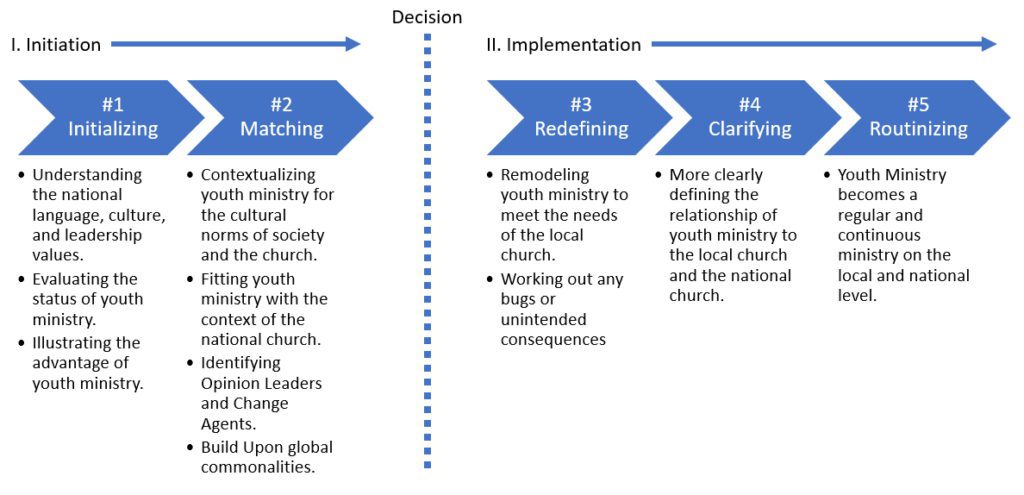
Figure 5.1 –Youth Ministry Innovation Process. This image illustrates the innovation process of youth ministry. Adapted from E. M. Rogers, Diffusion of Innovations, 5th ed. (New York, NY: Free Press, 2003).
Innovators, Early Adopters, and Momentum
To make a change in an institution, a change agent must create momentum.[16] Youth ministry thrives on momentum and experiences explosive growth with continued momentum. One way of generating momentum in youth ministry is by creating a series of small successes or wins. Change can be facilitated by focusing on innovators and early adopters and helping them generate momentum.
In Romania, the early adopters of youth ministry tended to be pastors who were the parents or grandparents of teenagers. They saw that their children or grandchildren were not connecting to the church and would wander from the faith during their teenage years. To meet the felt needs of their teenagers and ground them in the faith, individual pastors decided to institute youth ministry at their local church.
One of the characteristics of an innovator is “the ability to understand and apply complex technical knowledge.”[17] Arguably in this sense, youth pastors are innovators. Religious youth workers are multidisciplinary specialists with an understanding of “theology, psychology, anthropology, and history.”[18] In addition, youth leaders are competent in using social media, pop culture, and meme creation. However, youth ministry innovators often lack the cultural capital and respect of local networks because they work with teenagers.
Geert Hofstede in his country report on Romania rated the country high on power distance (90) and low on individualism (30).[19] These cultural values are evident in the Romanian Pentecostal churches. This may be why innovators in youth ministry in Romania tend to be young seminary graduates and GWs.
Young graduates tend to have little social capital in Romania. While their degree confers some credibility, they, in the words of an interviewee, “haven’t paid their dues.” These young innovators are often not respected by the group’s older members who can make the “authority innovation-decisions.”[20]
GWs are innovators in youth ministry in Romania, and the people I interviewed in my research remarked that they “fall into a weird gray area.” GWs gain social capital by being an expert in their field (youth ministry), being ordained, and having a theology degree. The higher level the academic degree, the higher the social capital. The academic degree, however, can be a double-edged sword. Having a master’s degree or higher and being involved in youth ministry in some countries could counter social norms. Some would not understand why someone with an advanced degree would work with teens when they should be pastoring a church or teaching at a seminary.
In Austria, innovators tend to be GWs and the few youth pastors in the country. As in the Romanian churches, expertise in the field, ordination, and academic degrees can gain the youth ministry innovator social capital. One difference between Romania and Austria is the tremendous amount of social capital advanced academic degrees confer in Austria. Austria is low (11) on the cultural value of power distance.[21] It is common to refer to pastors by their first name without the use of the honorific “pastor.” However, academic titles, including bachelor’s degrees, are regularly used on business cards, letterheads, and mailbox signs.
Advantage
One of the questions opinion leaders ask is, “Why youth ministry?” What value will youth ministry add to our church, our movement, and the kingdom of God? Or what is the “relative advantage”[22] of youth ministry? These are questions that the GW as a change agent must be prepared to answer. Several factors can help shape the response to these and similar questions. First, half of the world’s population is under twenty-five years old.[23] Second, most people (64%) accept Christ before age 18.[24]
It is worth noting how other cultures respond to this question. For the Romanian Pentecostal churches that initiated youth ministry, the relative advantage was retaining their teens and creating Christian peer groups that would counterbalance the negative peer pressure on Christian teens at school. In some European churches, this meant going against social church norms. In several Romanian and Italian Pentecostal churches, teen males and females are allowed to sit with each other during youth service. In some Spanish Pentecostal churches, the jóvenes (youth) have been divided into adolescentes (adolescents/teenagers) and joven adultos (young adults), contrary to traditional norms.
Finally, the Joys of Youth Ministry uncovered by Kageler offers strong evidence of youth ministry’s advantage to the local church.[25] These joys or advantages were found globally. That is to say, the joy of “seeing youth on fire for God” was evident not only in South Africa but in every other region of the world. Combining this with the scriptural admonition of “let the little children come to me, and do not hinder them” (Matthew 19:14 NIV) creates a powerful advantage that few would refute.
A European Youth Ministry Innovation and Diffusion Model
Using the preceding factors, it is possible to construct an innovation and diffusion model. The model is based on Rogers’s five stages in the innovation process.[26] The processes have been adjusted and redefined as necessary to fit within the paradigm of missions. The Youth Ministry Innovation Process takes place in two phases: initiation and implementation. Initiation comprises to steps: initializing and matching. Implementation has three steps: redefining, clarifying, and establishing routines (routinizing).
Step 1: Initializing
In the initializing step, a GW seeks to understand the national culture, language, and leadership values of the country they will serve. They can gain insight from local people in these areas, as well as scholarly sources.
An assessment of youth ministry can be made on the national and local levels during this step. Many national Pentecostal movements in Europe do not have data on their youth ministries, so evaluations can be challenging. During the initializing process, a GW can begin to inquire about the advantage of youth ministry from the culture’s perspective and illustrate where youth ministry has been fruitful.
Step 2: Matching
In the matching stage, a GW begins to contextualize youth ministry for the target culture. It will be necessary to be mindful of the national culture and the church culture, which can be at odds with the attitudes of the national church. Several questions can be helpful during the matching stage. Where does youth ministry fit in the national church? Where does it fit in the local church? Who are considered youth? What should youth ministry look like in this culture?
During the matching stage, opinion leaders and potential change agents are identified. A GW should continue to build a solid network with opinion leaders, even those who may be hesitant to embrace youth ministry. Meanwhile, the GW matches global commonalities in youth ministry with cultural and church values.
Step 3: Redefining
Now the implementation phase can begin with redefining. German military strategist Helmuth von Moltke reportedly said, “No plan survives first contact with the enemy.”[27] The same is often true for ministry plans, especially ministry to teenagers.
Youth ministry may need to be reshaped during this step to fit a congregation’s needs and address any issues. If, for example, the church has many young adolescents (13–14 years old) or is exceptionally multicultural, the youth ministry would need to be redefined to meet the needs of the teens, the parents, and the church.
As with any innovation, there are frequently unintended consequences. These are often difficult, if not impossible, to predict. If the church has made a concerted effort to evangelize teenagers, one of the unintended consequences could be that many teenagers hang out at the church. In Europe, it is likely that many of these teens have never been in church and do not understand how to behave at church. This may result in teens smoking in the bathroom, using profane language, or talking during a service. Any issues need to be addressed, and steps should be taken to mitigate any loss of momentum or hindrance to the church’s ministries.
Step 4: Clarifying
As the youth ministry continues to develop, it will be necessary to clarify the relationship of the youth ministry to the national and local church. In Romania and Austria, youth ministry laggards tended to express suspicion of youth ministry by asking questions such as: Are youth leaders attempting to start their own church or are they trying to marginalize the older people? Clarifying the relationship of the youth ministry to the church helps alleviate these tensions. Similarly, working within the framework of the national church may help national opinion leaders see the advantage of youth ministry on a national level.
It may also be prudent to clarify the purpose of the youth ministry. This could mean redefining the age groups included in youth or if the ministry will be event or relationship oriented. Church leaders may need to clarify the youth ministry’s mission: to win teens to the Lord, build them into disciples, and send them out as witnesses to their peers.
Step 5: Establishing Routines (Routinizing)
Establishing routines can build momentum or kill a youth ministry. Certain routines can bore teenagers and drive them away. However, establishing a youth ministry as a regular church ministry can demonstrate the church’s commitment to reaching teenagers with the gospel. Youth services should be held weekly, on the same day of the week, and at the same time. This will help teens and their parents understand the time and place the service will take place, and it will enable teens to invite their friends and help build momentum.
As a youth ministry builds momentum and the lives of teens are transformed, this can also help spread or diffuse youth ministry. Borrowing terminology from Aaron Lynch, change agents should strive not only for “quantity paternal transmission”[28] but also for “proselytic transmission.”[29]
Teens who grow up in a youth ministry are likely to want their children to experience it. This illustrates quantity paternal transmission. At the same time, proselytic transmission takes place when parents, pastors, and the teens themselves praise the virtues of youth ministry to their friends, extended families, and acquaintances. As new groups of people see the advantage of youth ministry, the potential for youth ministry to expand in new places increases dramatically.
On a national level, creating scheduled events such as youth camps, youth conventions, helps build momentum for youth ministry on a national level, and this can benefit local youth ministries. Many times, local churches lack the resources to do large events. However, a national office can draw many churches together to share financial responsibility and workload. In addition, this gives the national church the platform to help shape and direct youth ministry consistent with the national church’s cultural values.
Conclusion
To effectively develop and strengthen youth ministry in Europe, there must be an intentional effort and a plan to reach teens with the gospel. While the presented framework is broad and may be imperfect, it offers a starting point, a place to start the conversation about reaching teenagers with the gospel. No one-size-fits-all model will develop youth ministry in every context. However, by understanding cultural differences and global commonalities in youth ministry, developing expansive networks with opinion leaders and change agents, and building momentum with early adopters, it may be possible to reach the most unpredictable and amazing creature on the planet – the adolescent human.

Anthony J. Gryskiewicz (tony.gryskiewicz@eu.agwm.org)has been involved in youth ministry for over 30 years, first in the United States and then Europe. Tony is a PhD candidate at the Cook School of Intercultural Studies at Biola University. His research interests include multicultural youth ministry, faith and the development of teen ethnic racial identity, and international churches. Tony and his wife, Anna, live in Vienna, Austria.
[1] Len Kageler, “A Cross National Analysis of Church Based Youth Ministries,” The Journal of Youth Ministry 8, no. 2 (Spring 2010): 54.
[2] Terry Linhart and David A. Livermore, eds., Global Youth Ministry: Reaching Adolescents around the World. (Grand Rapids, MI: Zondervan, 2011), 113.
[3] Kageler, “A Cross National Analysis,” 54.
[4] Anthony J. Gryskiewicz and Garland Owensby, “Youth Ministry & the Missio Dei in Europe (Part 1),” Southwestern University, Thought Hub, February 12, 2020, https://www.sagu.edu/thoughthub/youth-ministry-the-missio-dei-in-europe-part-i; Anthony J. Gryskiewicz and Garland Owensby, “Youth Ministry & the Missio Dei in Europe (Part 2),” Southwestern University, Thought Hub, February 26, 2020, https://www.sagu.edu/thoughthub/youth-ministry-the-missio-dei-in-europe-part-2.
[5] Kageler, “A Cross National Analysis,” 54.
[6] Aaron Lynch, Thought Contagion: How Belief Spreads through Society (New York, NY: Basic Books, 1996); Everett M Rogers, Diffusion of Innovations, 5th ed. (New York, NY: Free Press, 2003).
[7] Terry Linhart and David A. Livermore, eds., Global Youth Ministry: Reaching Adolescents around the World. (Grand Rapids, MI: Zondervan, 2011), Loc. 253.
[8] Gryskiewicz and Owensby, “Youth Ministry (Part 1)”; Gryskiewicz and Owensby, “Youth Ministry (Part 2).”
[9] This is likely due to the German word studen (student) that is used exclusively to refer to university students, while the word schüler is used for high school and below.
[10] Lauren L. Mitchell et al., “Ethnic-Racial Typicality and Its Relation to Ethnic Identity and Psychological Functioning,” Cultural Diversity and Ethnic Minority Psychology 24, no. 3 (July 2018): 400–413, https://doi.org/10.1037/cdp0000193; Pasquale Musso, Cristiano Inguglia, and Alida Lo Coco, “Relationships between Ethnic Identity, Ethnic Attitudes, and Acculturative Stress in Tunisian Individuals in Early and Middle Adolescence,” Journal of Early Adolescence 37, no. 9 (November 1, 2017): 1309–40, https://doi.org/10.1177/0272431616659557.
[11] Kageler, “A Cross National Analysis.”
[12] Kageler, “A Cross National Analysis.”
[13] Rogers, Diffusion of Innovations.
[14] Rogers, Diffusion of Innovations.
[15] Rogers, Diffusion of Innovations, 28.
[16] John C. Maxwell, The 21 Irrefutable Laws of Leadership (Nashville, TN: Thomas Nelson, 2007).
[17] Rogers, Diffusion of Innovations, 282.
[18] Kageler, “A Cross National Analysis of Church Based Youth Ministries,” 49.
[19] Geert Hofstede, “Country Comparison,” Hofstede Insights (blog), accessed December 13, 2018, https://www.hofstede-insights.com/country-comparison/.
[20] Rogers, Diffusion of Innovations, 28.
[21] Hofstede, “Country Comparison.”
[22] Rogers, Diffusion of Innovations, 229.
[23] Linhart and Livermore, Global Youth Ministry.
[24] Barna Group, “Evangelism Is Most Effective among Kids,” Barna Group, October 11, 2004, https://www.barna.com/research/evangelism-is-most-effective-among-kids/.
[25] Kageler, “A Cross National Analysis.”
[26] Rogers, Diffusion of Innovations.
[27] Susan Ratcliffe, ed., Oxford Essential Quotations, 6th ed. (Oxford University Press, 2016), 10.1093/acref/9780191866692.001.0001.
[28] Lynch, Thought Contagion, 3.
[29] Lynch, Thought Contagion, 5.
EMQ, Volume 58, Issue 2. Copyright © 2022 by Missio Nexus. All rights reserved. Not to be reproduced or copied in any form without written permission from Missio Nexus. Email: EMQ@MissioNexus.org.