EMQ » October–December 2022 » Volume 58 Issue 4
Global Youth Culture
As we at OneHope researched characteristics of Gen Z youth across the world, we discovered they have much in common. While nominal faith made little difference to their shared struggles, a commitment to Christ did. Our research indicates key ways we can close the gap to help more young people experience vitality in their faith that positively changes their everyday life.
By Patricia Savage
“I had religion but not relationship,” an 18-year-old young woman told us on the Zoom call. In their separate squares of the computer screen, several other teens nodded in agreement. “I knew of God, of Jesus, that He died and came again. I didn’t believe that with my heart, my mind believed it. [I had] one toe in the Bible and the rest of my body was in the world still.”
This statement accurately describes many Generation Z (Gen Z) Christians, today. They struggle in a world that sucks them in and tells them not to force their beliefs on others because everyone has their own truth. In a world of tremendous diversity – of race, religion, gender identity, sexual orientation, and more – respect and acceptance are banner issues.
Researching Gen Z
OneHope’s mission is to reach every child and youth with God’s Word, so we know it is critically important to understand each generation and what makes them unique. In 35 years of ministry, we reached more than 1.8 billion children and youth through our diverse partnerships with the global Church.
Throughout our journey, research has led the way in shining a light on today’s young people so we can minister to them well. Our Global Youth Culture study connected us to 8,394 youth ages 13–19 in more than 20 countries and fourteen languages.[1] The research represented every major region of the world and fell squarely in the middle of what is generally considered the Gen Z age range (born between 1997–2012).
The online survey revealed what teens believe, how they are struggling, and what influences guide them. Since completing this global study we have continued to expand our understanding by talking to teens directly in focus groups[2] as well as adding new countries to the initiative.
Gen Z’s Religious Identity
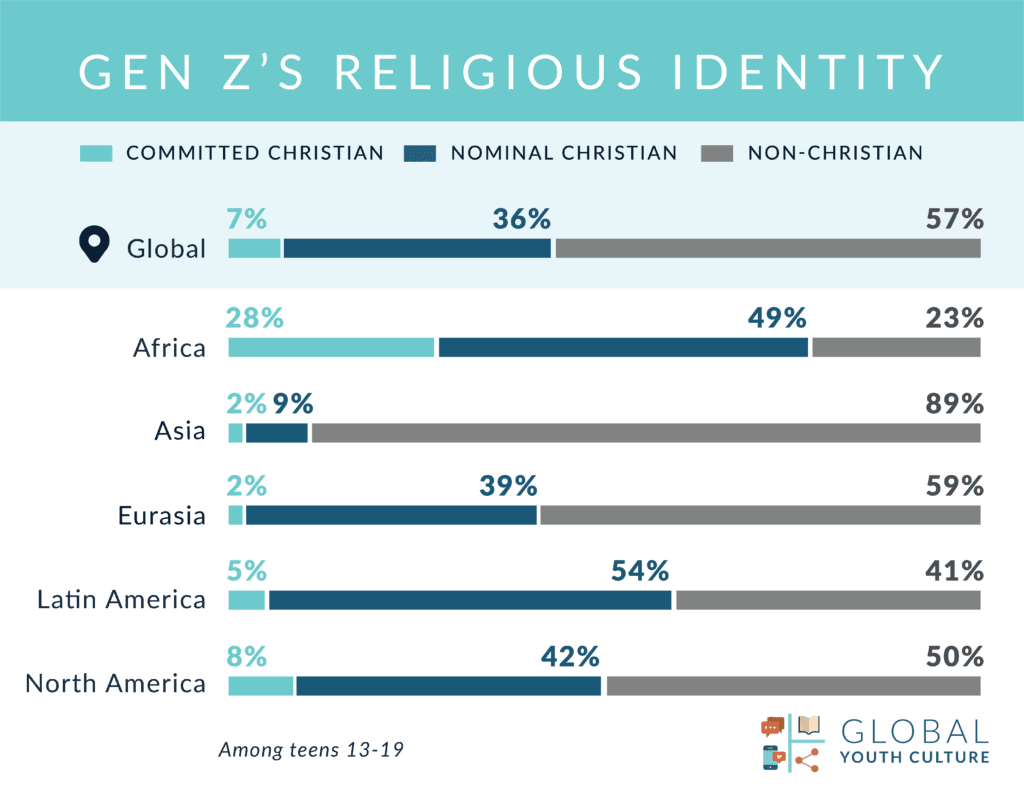
We wanted to understand Gen Z’s religious beliefs and what faith looks like in their everyday lives. Globally 43% of teens in our study reported being Christian, 23% as another religion, and 34% said they had no religion. It was encouraging to see that nearly half of teens globally identified as Christian. However, we quickly realized we needed to take a deeper look at faith.
Christianity can be an identification without being an identity. It can be a young person’s answer to the question “what religion are you?” but not a daily practice of following Christ and being transformed by the Bible’s truth.
To help us better understand this gap, our Research Team created a definition for a committed Christian. To be considered committed, a teen had to be a Christian[3] and embrace the following beliefs and behaviors:
- Believe God exists and they can have a personal relationship with him.
- Believe Jesus is the Son of God.
- Believe that forgiveness of sins is only possible through faith in Jesus Christ.
- Believe the Bible is the Word of God.
- Read Scripture on their own at least weekly.
- Pray at least weekly.
When we filtered Gen Z according to this definition a huge gap emerged. While 43% of teens in our study said they were Christian, only 7% could be called committed Christians. This gap appeared in every country we surveyed.
Christian teens who did not meet our definition of committed-ness, we termed nominal Christians. Our researchers were surprised by the low numbers of committed Christians in every region we surveyed. The four beliefs and two spiritual disciplines we identified as qualifications seemed foundational.
Why is it that so many identify as Christian, but so few commit to their faith?
The Discipleship Gap
Research reveals, but sometimes the revelation is in what you don’t find. In our case, the research pointed toward a discipleship gap in several key areas. The first is in the area of truth. According to our data, over half (52%) of teens surveyed globally believe all religions teach equally valid truths. Notably, Christian teens are just as likely to say this (53%).
In follow-up conversations with teens in the United States, we observed a lot of confusion on this topic. Some young people were quite vocal that all religions are equally valid and need to be respected. Many Nominal Christians echoed this thinking and seemed hesitant to offend by standing on the gospel’s exclusive truth claims. With the exception of committed Christians, Gen Z generally believes truth is unknowable or at least relative. Practically speaking, everyone should choose the truth that seems best to them.
“As long as you’re happy is what matters,” said a 19-year-old nominal Christian young man. But this belief runs contrary to a committed Christian faith which sees Christ alone as the way, the truth, and the life. The road is narrow even for many who call themselves Christian.
Scripture engagement was another observed gap. This was the single biggest break-off point for teens when it came to being committed Christians. Forty percent of Christian teens say they never read the Bible. Just 25% read it at least weekly.
Teens who don’t read the Bible mentioned a variety of reasons ranging from it being boring to outdated to untrustworthy. But how will young people get to know Christ deeply if they are not in his Word? How will they navigate the shifting tides of culture without the solid foundation of Scripture to ground them?
The Benefits of Being Committed
Closing the gap by discipling nominal Christians into committed Christians would be a worthy goal in and of itself. We want Gen Z to have a biblical worldview. But beyond simply having these beliefs, the research made a compelling case that there are other tangible benefits to being a committed Christian.
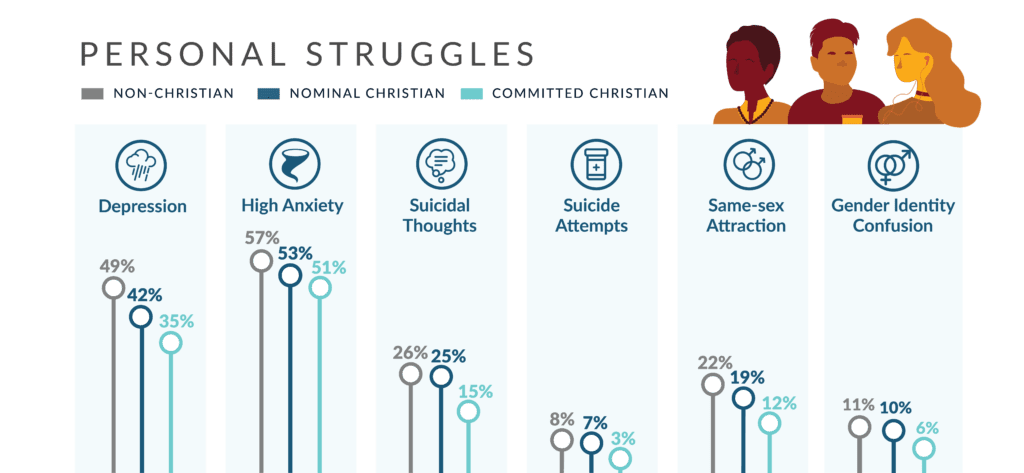
Global Youth Culture revealed a concerning picture of this generation’s mental health. Most teens told us they are experiencing loneliness (63%), high anxiety (55%), and depression (45%). Even more alarming, 25% of teens reported recent suicidal ideation.[4]
Against this bleak backdrop, the lives of committed Christians were a bright spot. Committed Christian teens struggle less than their peers in every one of our mental health indicators. They are also less likely to experience same-sex attraction or gender identity confusion.
These struggles do not disappear entirely, but a committed faith appears to buffer some of these negative personal experiences. As they delve deep into Scripture, teens gain a resilience that many in their generation lack. In our conversations with committed Christians in the US, some teens even spoke of crisis as the catalyst that awakened their faith.
“I became really depressed, and I was to the point where I was about to take my life,” shared an 18-year-old girl. “Then I had this feeling to grab my Bible for the last time…. [Reading it] has brought me out of my depression.”
Committed Christians also appear to have different priorities than their peers. They are more than three times as likely to attend church at least weekly as compared to nominal Christians (85% vs 26%). In addition, they have a strong conviction of the importance of evangelism. Nine in ten committed Christians believe they have a responsibility to share their faith with others, as compared to half of nominal Christians.
It was a tremendous encouragement to see how faith is making a practical difference for young people who are committing themselves to their daily walk with Christ. Cultivating personal spiritual disciplines in the context of community seems to be drawing Gen Z Christians closer to Jesus and to the fruit he promises.
The Identity Gap
The world around Gen Z is changing rapidly and nowhere is this clearer than around the topic of identity. On average, more teens believe that gender is primarily based on a person’s feelings or desires than the sex they were born as (50% vs 45%).[5]
This is not just a belief, but a felt experience. Teens told us that they are personally having gender identity questions and struggles. Ten percent of young people globally say they have experienced gender identity confusion within the past three months, and 15% say they would feel most themselves as a different gender.
Notably, 1 in 5 teens report having felt sexually attracted to someone of the same gender within the past three months. Our researchers were surprised to see that the rates of same-sex attraction among nominal Christians were the same as the global average. We also saw that girls were twice as likely as boys to have felt same-sex attraction (28% vs 13%). While these issues are not being felt to the same degree in all countries we surveyed, the global trend is clear. Identity is a critical battleground for Gen Z.
The research also showed concerning links between these issues and a variety of other personal struggles. For example, of teens who report a recent suicide attempt, nearly half (46%) also report same-sex attraction. Those that are same-sex attracted are also twice as likely to be reporting recreational drug use, depression, high anxiety, or viewing pornography.
There is no one reason a teen might be same-sex attracted or confused about their gender. People are complex and causes are complex. There may be a clustering effect of identity questions, negative experiences, and harmful behaviors. What is clear is that many young people are struggling deeply in multiple areas of their lives.
The first step is moving toward them with the good news and hope found in the gospel.
The Influences that Matter
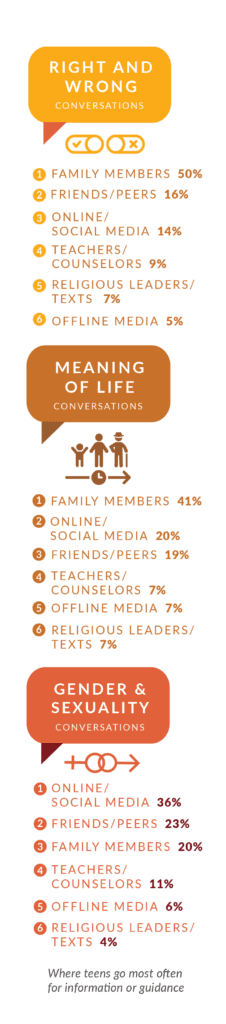
Viewpoints and beliefs are rarely formed in isolation. We were curious to find out who or what influences this generation. We asked teens about two major areas of their lives – where they go for answers about right and wrong and who they talk to most often about the meaning of life. Teens told us the answer was family.
Half of Gen Z surveyed globally said family is their primary guide about right and wrong and 41% said they consult family about the meaning of life. Online sources as well as friends rounded out this generation’s top three influences – but these didn’t come close to the impact of family.
Our conversations with teens in the US strongly confirmed this. Being raised by parents who are committed to their Christian faith can be a primary factor in teens having a faith of their own. And the opposite can also be true. Teens raised in non-religious homes or by parents who were overly strict about religion may reject Christ in their lives.
There are exceptions, of course, but this was a reminder that family really does matter. Parents tremendously influence their children.
The one area where family influence was noticeably less was on the topic of gender and sexuality. This conversation looked very different, with just 20% of teens saying they turn to family most often. Instead, the internet and social media are their go-to guides (36%) followed by friends (23%).
Even among Christians, digital sources are displacing family as teens’ top influence on these important topics. Concerning too is that the voice of Scripture and the church community seem to be lacking. Almost no teens said they turn to religious leaders or texts most often for advice about gender and sexuality (4%), right and wrong (7%), or the meaning of life (7%).
This was a wake-up call for OneHope to recommit ourselves to strengthening families by equipping parents to lead these conversations in love and truth. Parents are uniquely positioned to be lifelong disciplemakers of their children and the research revealed how much their voice matters.
Influence also goes both directions.
“My faith brought my parents back to church,” said a 15-year-old boy in one of our committed Christian focus groups. “I really wanted them to be part of that. We’ve grown together spiritually as a family since then.”
Remember the girl who said her toe was in the Bible and her body in the world? Her story is far from over. Today, she is firmly planted in God’s Word and is planning to go to college to study theology in preparation for a life calling in ministry. She said her faith brought her parents out of a surface-level Christianity and into a deeper faith they are walking together as a family.
Committing your life and daily actions to Christ is a journey that takes time. But vibrant Christ followers in Gen Z give us tremendous hope. They are a light among a dark and confused generation (Philippians 2:15) and will tell the next generation the wonders of the LORD (Psalm 78:4).
Conclusions
The newfound understanding of Gen Z we gained from our research can direct practical strategies to more effectively minister to and mobilize this generation as they mature.
Here are some key action points from our Global Youth Culture study that may help any ministry:
- Engage in Scripture: Scripture engagement is a pace setter that consistently produced multiple positive effects in a young person’s life. When we start in Scripture and let it transform our own lives, we see the biggest change in the lives of those we are trying to reach.
- Equip Families: The influence of parents shows the importance of the Church intentionally equipping families for life’s critical conversations.
- Close the Gap: The gap between those who identify as Christian and those who hold committed beliefs and behaviors is vast. In many ways, discipleship is the new evangelism. Gen Z Christians need vibrant Christ-followers in their lives and practical invitations to deepen their faith.
- Strengthen Committeds: The lives of committed Christians are a bright spot, but they need encouragement as they live out God’s standards in a world that tells them they are intolerant and outdated. Continued discipleship strengthens them to reach their peers for Christ.
Visit globalyouthculture.net to access this research and accompanying resources.

Patricia Savage (research@onehope.net) is the creative editor for OneHope’s research team and has been helping research Gen Z for the past five years. The Global Youth Culture research project has helped OneHope continue to strategically design programs to reach the next generation with God’s Word. OneHope has worked in every country of the world and reached more than 1.8 billion children and youth since 1987.
[1] Data was collected in February–March 2020, which was before national lockdowns in response to COVID-19. As a result, we believe these research findings are an accurate baseline of this generation prior to the widespread impact of the pandemic.
[2] Ninety-four US teens participated across 15 focus groups between April–October 2021.
[3] Note that Jehovah’s Witnesses and Mormons were excluded from our Christian definition.
[4] Teens self-reported on their experiences within the past three months. To see specific rates by country, visit globalyouthculture.net.
[5] Note that opinions varied widely based on region, with Africa most strongly showing the reverse of this trend.
EMQ, Volume 58, Issue 2. Copyright © 2022 by Missio Nexus. All rights reserved. Not to be reproduced or copied in any form without written permission from Missio Nexus. Email: EMQ@MissioNexus.org.