EMQ » July–September 2022 » Volume 58 Issue 3
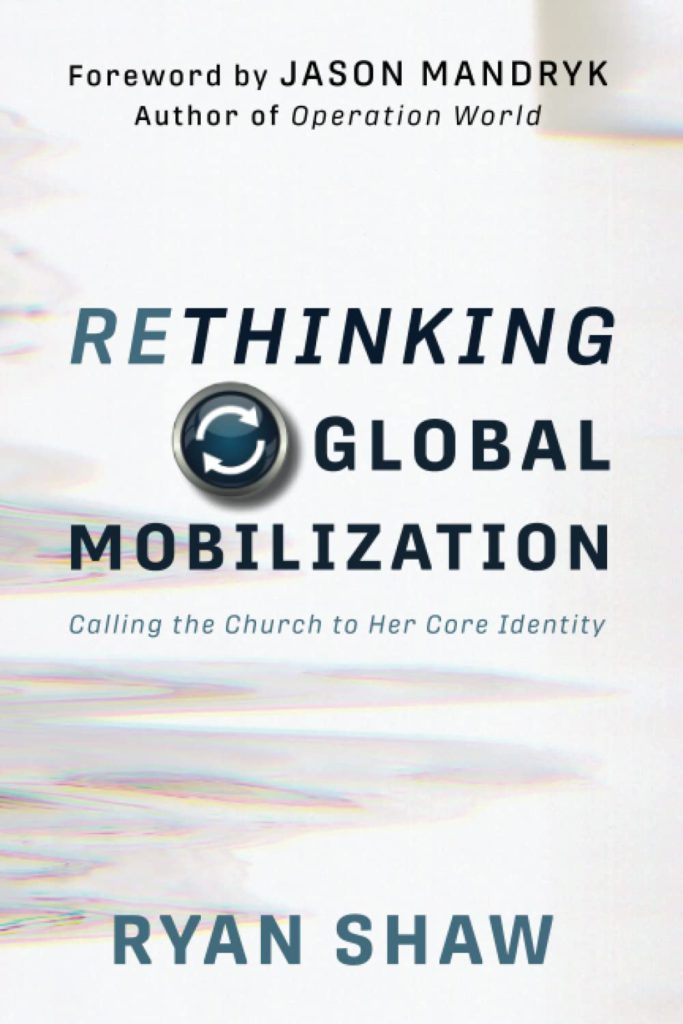
Rethinking Global Mobilization: Calling the Church to Her Core Identity
By Ryan Shaw
Ignite Media, 2022
311 pages
USD $12.99
Reviewed by Cameron D. Armstrong, Asia Graduate School of Theology, Philippines.
Mission leaders the world over expend a great deal of energy on mobilization efforts. However, such agendas often lead to frustration and a lack of response. In Rethinking Global Mobilization, veteran mission mobilizer Ryan Shaw seeks to remedy the situation by asking the whole Church to pray, send, and go on a global scale.
The book is divided into four parts. Part one considers mobilization foundations. Instead of leaving mobilization in the hands of a few specialists, local ministries must begin thinking outwardly and globally. Since God is a mobilizing God, all believers and especially church leaders are called to mobilize message bearers. The term message bearer is Shaw’s preferred expression since missionary carries cultural and professional baggage.
In part two, Shaw develops the Great Commission’s biblical background, analyzing each Great Commission text from the four gospels to show that message bearers are meant to be Spirit-dependent witnesses who both speak and embody the Kingdom. Expansion and outward growth through mission, Shaw maintains, is integral to the Church’s core DNA.
In the book’s third part, Shaw engages mission history using Ralph Winter’s model of three eras. While mobilization started out beautifully, Shaw claims that after the institutionalization of Christianity, mission became less Spirit-dependent and relegated itself to simply “a few monks attracting followers to their ascetic lifestyle” (168). In contrast, Shaw devotes far greater detail to the last 500 years (1500–2000), maintaining this period was “alive with the activity of God” (175). Shaw then adds a fourth era to Winter’s three, convincingly calling ours the era of globalization.
Finally, in part four, he develops a strategy for global mobilization movements. Ministries everywhere ought to engage in three levels of mobilization: local subculture, near culture, and distant culture. To achieve mission mobilization saturation, Shaw advances that roughly 20 percent of believers in local ministries must be sent out to near and distant cultures.
Two noteworthy strengths of Shaw’s work include his passion and purpose. Readers can almost feel Shaw’s excitement building as he discusses the growth of God’s Kingdom around the world. As such, Shaw achieves his overall purpose of showing how all believers are called to mobilize others to join in the missio Dei.
Besides the oversimplification of mission history in part three, another potential weakness is how Shaw relies heavily on Ralph Winter’s unreached people groups model. This model is currently experiencing pushback from missiologists. Although Shaw acknowledges global realities like migration, urbanization, and refugee movements make identifying ethnolinguistic groups messy, the book could be strengthened by further addressing such trends and demonstrating how effective mobilization can still happen with a more nuanced rallying cry.
Still, Shaw’s thesis is solid and his conclusions biblical. God is preparing his Global Church to engage world lostness on an entirely new level. The way forward is calling Christ’s Body to our missional identity, a mobilization task to which Shaw has few parallels.
For Further Reading
Ralph D. Winter: Early Life and Core Missiology by Greg H. Parsons (William Carey International University, 2012)
Pipeline: Engaging the Church in Missionary Mobilization by David & Loren Wilson (William Carey, 2018)
EMQ, Volume 58, Issue 3. Copyright © 2022 by Missio Nexus. All rights reserved. Not to be reproduced or copied in any form without written permission from Missio Nexus. Email: EMQ@MissioNexus.org.