EMQ » July–September 2022 » Volume 58 Issue 3
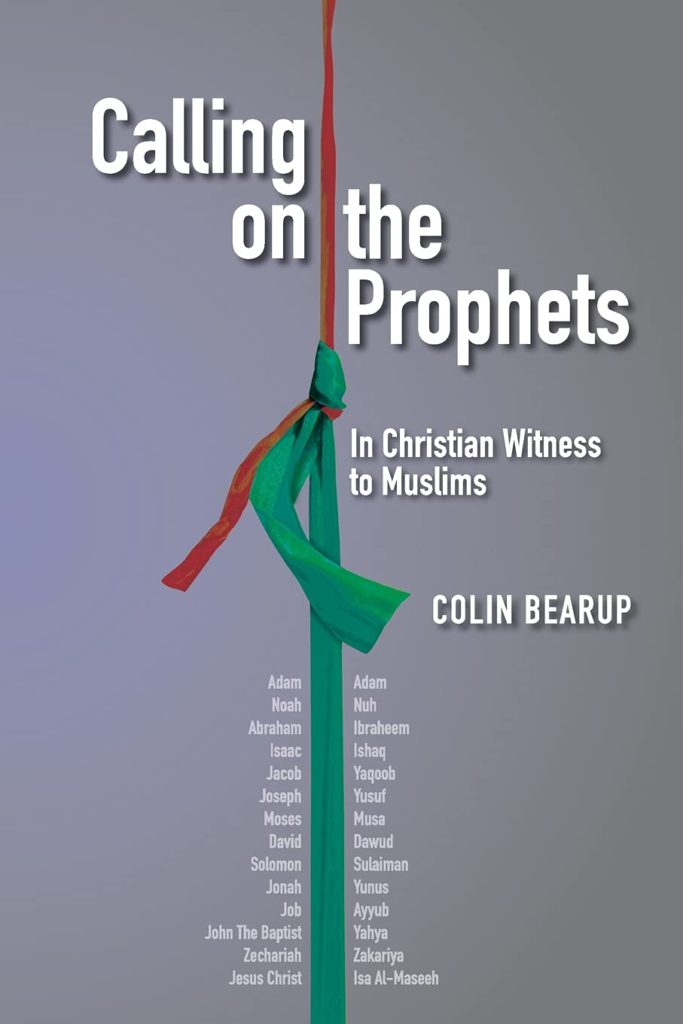
Calling on the Prophets: In Christian Witness to Muslims
By Colin Bearup
William Carey Publishing, 2021
98 Pages
$9.99
Reviewed by Dr. David Cashin who served with SIM for nine years in Bangladesh and is currently professor of intercultural and Islamic studies at Columbia International University, Columbia, South Carolina.
Colin Bearup’s short volume walks us chronologically through the Prophets found both in the Bible and the Qur’an. He compares what the Bible and the Qur’an say about these scriptural figures, from Adam to Jesus. He draws opportunities to share aspects of the gospel from each of these individuals. Though brief, the book presents many ideas that will be helpful to practitioners. There is a wealth of Qur’anic material that may be new to many. I found some insights that were helpful for my own work. He also teaches some anthropologically solid principles of cross-cultural communication.
The book’s strong points include its many citations from the Qur’an as well as some brief material from the Hadith. The author draws on a wealth of personal experience to illustrate how these materials may be used. There are also helpful charts contrasting Biblical and Qur’anic affirmations concerning each of the Prophets. The author provides many practical suggestions for studying the Word of God with Muslims.
By way of weakness, I would call this a volume for those who are already practitioners. Indeed, this seems to be his focus (xi). It may well be that he has covered novice-type materials in earlier works (98). The approach of going chronologically through the Prophets leads to a tendency to hop around and lose track of key themes. Starting each chapter with some brief material on basic themes that speak to the heart of Muslims would provide approaches useful for a novice. For instance, if we take the theme of law and grace, Adam illustrates the inability of even a “Prophet” to keep one single law of God. Abraham illustrates in Genesis 12 that one may be blessed and have a relationship with God when there is no law at all. This would then fit in better with the general approach of Chronological Bible Storying.
There are a few inaccuracies. Bukhari does mention humankind being made in the image of God although this is not understood in Islam (24). The statement “baptism is usually unfamiliar to our Muslim friends” (70) may be true where the author has worked, but in many parts of the Muslim world, it is recognized as the key act of apostasy from Islam which in many contexts brings on immediate persecution. A few apologetic points, such as Qur’an 10:64 stating that God’s Word cannot be changed (a useful passage when encountering Muslims who claim the Bible is corrupted), would also be helpful (90).
Overall, this volume is well worth the read with many pointers for those with experience witnessing to Muslims.
EMQ, Volume 58, Issue 3. Copyright © 2022 by Missio Nexus. All rights reserved. Not to be reproduced or copied in any form without written permission from Missio Nexus. Email: EMQ@MissioNexus.org.