
EMQ » July–September 2022 » Volume 58 Issue 3
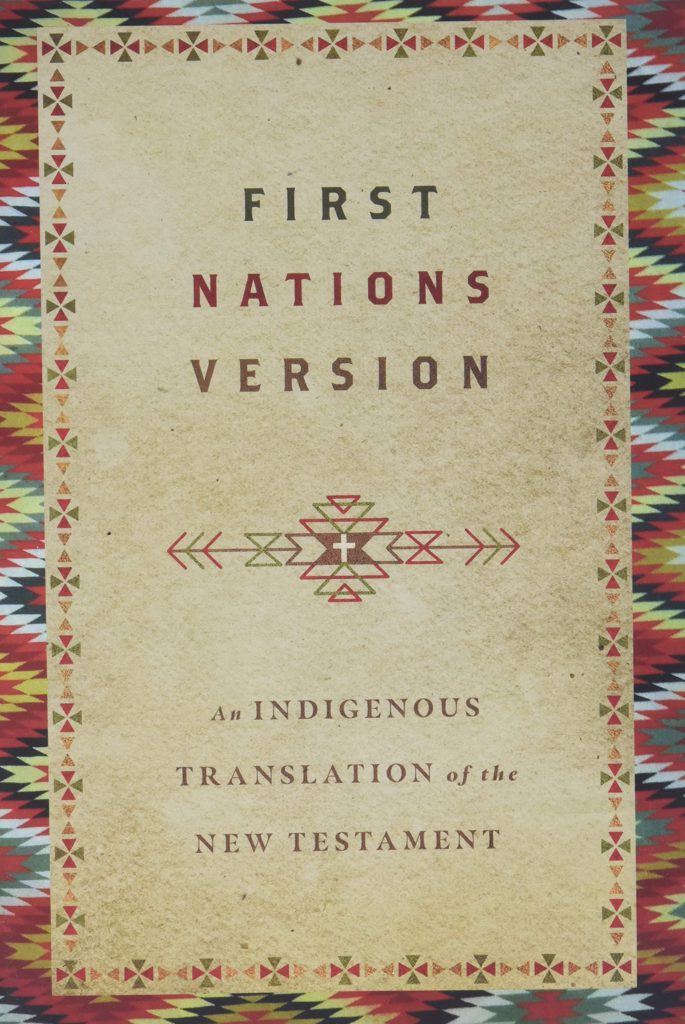
First Nations Version: An Indigenous Translation of the New Testament
By Terry M. Wildman and the First Nations Version Translation Council
InterVarsity Press, 2021
481 pages
US$35.00
Reviewed by Cameron Smith, local church pastor and doctoral candidate in contextual theology, Evangelical Seminary, Myerstown, Pennsylvania.
With contextual sensitivities in mind, I would like to identify myself as a Caucasian male who serves at a small evangelical church and does not have regular interaction with the First Nations community. Also, setting aside my academic and professional qualifications, this review mostly stems from simply being a humble reader of the Bible.
The First Nations Version (FNV) of the New Testament introduces itself as a translation specifically for both English-speaking First Nations people and for the global church. Theologians typically recognize that God wants to be known in the heart language of every people. The FNV is the English attempt to come close to that, as many First Nation people “still resonate with the cultural and linguistic thought patterns found in their original tongue” (ix).
This means the translators took special care with certain words and idiomatic expressions both to stay true to Scripture and to communicate meaningfully in a First Nation context. This non-tribal-specific translation was led by Terry M. Wildman and a nine-person translation council, and the involvement of many other reviewers, commentators, and consultants.
In the four-page prologue (which succinctly recounts the Old Testament), one first encounters storytelling in an indigenous manner. This is the Creator’s story; the theocentric prologue situates the main plot and foundation for the New Testament. Readers will also notice this dynamic translation’s use of names.
For example, the names in Jesus’ tribal ancestry (genealogy) are given in the traditional way, such as: “Father of Many Nations, He Made Us Laugh, Heel Grabber, Give Him Praise” (i.e., Abraham, Isaac, Jacob, Judah). Places and other entities are also told in the same way: “Village of Iron,” “Sacred Family,” “Good Road” (i.e., Rome, the church, Kingdom of God).
The translation features verse numbers and headings, but sparsely utilizes footnotes. Additionally, the reader will delightfully notice supplementary phrases in italics inserted throughout the text. These additions add background information and a small amount of artistic license to aid the story-formed nature of the translation. A basic glossary of biblical terms is found in the back with helpful descriptions and definitions.
As one who has spent considerable time with numerous English translations of the Bible, the FNV was a fresh read. I have been a Bible reader for most of my life. If there was ever a moment I could re-experience reading the Bible for the first time, this was it. This translation will feel similar to other translations, but the indigenous storytelling nature is certain to keep you enthused.
The familiar Western voice of modern English translations is scrubbed out enough to entice the reader to take in afresh the Creator’s story. Not only can over six million First Nation people in North America have a translation in their hands that will resonate with them, but I believe the FNV will be a vital resource to help Bible readers intake the Creator’s story through a different, yet faithful, lens. The FNV is recommended for every English reader everywhere.
EMQ, Volume 58, Issue 3. Copyright © 2022 by Missio Nexus. All rights reserved. Not to be reproduced or copied in any form without written permission from Missio Nexus. Email: EMQ@MissioNexus.org.




