EMQ » July–September 2022 » Volume 58 Issue 3
Orality
Oral strategies represented a breakthrough in mission work. However, if orality is to continue to make a meaningful contribution to global mission advance, we must remain abreast of the latest scholarship and reflect this awareness in our mission strategies.
By Trevor Yoakum
Everyone who is faithful to the Great Commission should be grateful to Avery Willis, Jim Slack, and many other early pioneers of orality as a mission strategy.[1] Their labors exposed how easily Western mission efforts marginalized non-literate peoples or missed them altogether. Today, many theological schools feature orality in their missions curriculum, and rightly so. Across the globe, people use orality-based methods in their gospel proclamation.[2]
Yet as we laud the contributions of the past, we must be aware of present realities if we are to remain relevant in our future mission endeavors. This maxim holds true to our implementation of orality in ministry. As the field of orality undergoes a constant process of testing, evaluation, revision, and reconceptualization, researchers and practitioners slowly realize that some old assumptions fail to explain what they witness on the field and propose alternative ideas.
Failure to acknowledge this in our application of orality may make us susceptible to canonizing certain texts on the subject. None may dare second-guess them. The celebrated authors of these near-sacred texts enjoy a status closely akin to the human authors of Holy Writ. If orality is to continue to make a meaningful contribution to global mission advance, however, we must remain abreast of the latest scholarship and reflect this awareness in our mission strategies.
Early Orality Research
Research in orality began in the 1920s from the contributions of Milman Parry and Albert Lord.[3] Both sought to explain a literary problem in Homer’s Iliad and the Odyssey. Their effort to solve a literary question helped to create a new field of research. Eric Havelock continued the work of Parry and Lord to explain how the development of the alphabet in ancient Greek culture encouraged the rapid advancement of their civilization.[4] Jack Goody proposed that we could mark the successive stages in a society’s development with its growth in literacy.[5] Yet it was the writing of Walter J. Ong, a Jesuit priest and professor of humanities in psychiatry, that helped the field of orality gain greater prominence.[6]
Ong wrote that writing is a technology that alters the consciousness of human beings because it changes the dominant sense used in communication.[7] Before the development of writing, most human discourse was spoken. Thus, the sense of hearing was the dominant sense used in communication. As societies developed writing, however, the more literate these societies became the more they relied upon the written word. And writing is dependent upon the sense of sight.
Ong concluded that as a society switches the dominant sense used to communicate, the transition would alter the psychological makeup of its members. In fact, Ong compared ten different psychodynamics between oral vis-à-vis literate societies.[8] While Ong distinguished oral cultures from literate, he did note that there was a continuum between these poles. Primary oral cultures, or those groups who had never read a word, could eventually become manuscript cultures, in which writing is preserved by handwritten copies. The sequence continues from manuscript cultures to typographic cultures, which use printing technologies, and extends to hypertext cultures, or societies that use electronic media for information exchange.[9]
Oral vs. Literate Peoples
Not everyone embraced Ong’s conclusions. Some have argued that Ong presents an overly simplistic explanation for the theory of communication. Others have challenged the notion that writing alone, without consideration of sociological factors, has such an influence on the psychology of a culture.[10] These critics charge Ong and his followers with what they call a “Great Divide” hypothesis between literate and non-literate societies, Ong’s oral-literate continuum notwithstanding. And many of those criticisms seem valid.
Ong’s binary distinction between oral and literate people is the result of his reliance on the fieldwork of anthropologist Claude Lévi-Strauss.[11] Lévi-Strauss was the founder of structuralist anthropology, which used the linguistic theory of language likewise known as structuralism in its interpretation. This school of Continental philosophy conceived of language as operating in pairs or binaries of signs.
Lévi-Strauss followed this philosophy of language and applied it to his anthropological research. The result was a binary understanding of cultures. According to Lévi-Strauss, one is either a fellow member of the “savage mind,” or the bricoleur as Lévi-Strauss called it, or one is a member of modern industrialized society, or is an engineer. Ong relied on Lévi-Strauss to such an extent that Ong’s descriptions of “oral” and “literate” peoples follow Lévi-Strauss’s comparisons of the bricoleur and the engineer in his book, The Savage Mind.[12]
Considering Multiple Oralities Across Cultures
The critics of Ong eventually developed a different school of orality.[13] They reject Ong’s proposal that orality manifests in all cultures along the same continuum from “primary oral culture” to “hypertext culture.” They counter Ong’s “unilinear-evolutionary” understanding of orality with their own “contextual-ideological” perspective. Proponents like Brian V. Street prefer a post-structuralist philosophy of language, a later development of Continental thought, over Ong’s reliance on structuralist philosophy.[14]
This difference in philosophy of language means they believe that the relationship between orality and literacy is dynamic and complex.[15] The two are interdependent rather than opposite poles. Moreover, how orality and literacy interact in any given society differs from others. Rather than considering orality as a monolithic linguistic phenomenon, proponents of the contextual-ideological school of orality believe that it is preferable to think of multiple oralities across cultures.[16]
Rather than considering orality as a monolithic linguistic phenomenon, proponents of the contextual-ideological school of orality believe that it is preferable to think of multiple oralities across cultures.
Drawing Conclusions from Orality Research
We can make several conclusions about the study of orality from this brief history. First, many orality researchers have, knowingly or unknowingly, relied upon continental philosophy and linguistics in their conclusions about orality. Many linguists and scholars consider structuralism, as used by Ong, as passé. Post-structuralism, including deconstruction, is highly subjectivist in its understanding of language and the reading of texts.[17] The meaning of texts, so post-structuralists say, is determined not by the author but the reader.
This understanding of language is incompatible with the evangelical doctrine of the clarity of Scripture, also called perspicuity. We believe that we can discern the original intent of the divinely inspired authors of Scripture. As an alternative, the analytic school offers a competing philosophy of language, speech-act theory, that evangelicals may more confidently rely on in their study and use of Scripture as it pertains to orality.[18]
We also cannot envision oral strategies as a one-size-fits-all endeavor. We must recognize that all cultures will demonstrate a dynamic between orality and literacy that is unique to them. To insist that the members of an ethnic group follow our prescription for how they transfer information could become egregiously paternalistic.
To insist that the members of an ethnic group follow our prescription for how they transfer information could become egregiously paternalistic.
Rather, we should come alongside them, learn how they interact with one another, and adopt strategies that reflect their own use of language. Many non-literate cultures will be completely oral, to be sure. However, not all will. In fact, some whom we may be inclined to label oral will prefer written forms of communication.
Evidence of Anomalies
My reasons for making these conclusions are not based on an abstract philosophy but by empirical evidence. For example, in the Oral Tradition Journal, Moradewun Adejunmobi speaks of the intriguing dynamics at play among rural, uneducated populations in Ghana.[19] While these populations exhibit low literacy and the presence of orality as it has been traditionally understood, contemporary verbal artists still refer to themselves as writers. Such is the case even though they perform their contemporary stories orally.
Moreover, even though they perform their compositions orally, most write their stories in advance. This reality may call into question some of the presumptions of oral preference people that proponents of the unilinear-evolutionary perspective promote. Clearly, the lines between oral and literate are blurred.
As another example, the linguistic phenomenon known as diglossia poses a challenge to Ong’s writings as well as the unilinear-evolutionary perspective of orality. Diglossia, literally two tongues, refers to the sociological dynamics in which a society speaks two different forms of the same language.[20]
Anthropological research among the Vai people of Liberia has yielded some interesting insights on this subject. For the Vai, spoken language is reserved exclusively for mundane matters or matters not held in high esteem. In contrast, the written form of the same language is generally much more formalized and is given much higher status.[21] The presence of diglossia in societies with a high residual orality makes it difficult to know where exactly to locate those cultural communities along an oral-literate continuum that the unilinear-evolutionary perspective proposes.
Further complicating matters is the fact that various segments of the community may be in different places along the supposed oral-literate spectrum, depending upon their socio-economic status and level of education. Even more difficult is the fact that a member of the community could speak at one level with a high level of oral residue, only to speak at a much lower level of residual orality when employing the prestige dialect in a different setting within the same community. Diglossia, it is shown, demonstrates how difficult it is to classify a complex linguistic community in its use of orality and literacy.
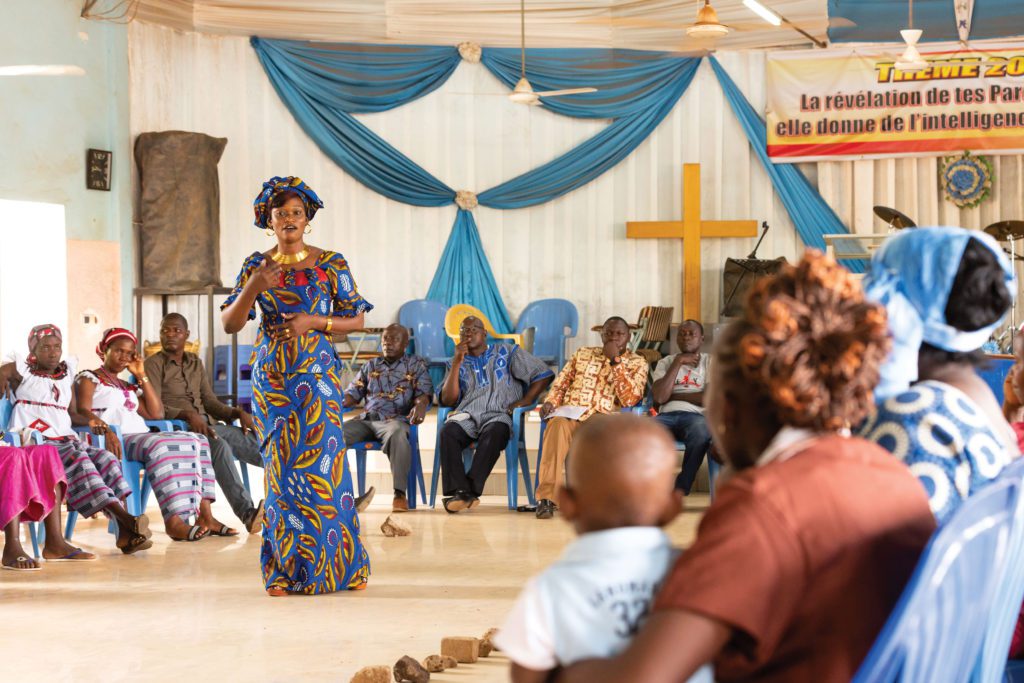
Master orality trainer and evangelist Seni Zougrana tells the story of the crossing of the Red Sea to pastors and students during a StoryTogether workshop. PHOTO COURTESY OF IMB
Implications for Mission Strategies
The insights gained from the latest research on orality have deep implications for how we use orality in our mission strategies. As I have demonstrated, the contextual-ideological perspective of orality should not be accepted wholesale by evangelical missionaries for their work. An uncritical acceptance of everything that the proponents of the contextual-ideological perspective say could cause harm in how we regard the authority and clarity of Scripture. Yet, as I also demonstrated, empirical research does seem to support many of the criticisms leveled against the positions held by the supporters of the unilinear-evolutionary view of orality.
First, since the manifestation of orality across cultures is not monolithic, we should be reluctant to promote a strategy for orality that is all-encompassing. Rather, oral strategies should look different not only in every continent, but also within the same country. In some places, oral methods may use narrative more than other expressions of orality. In other locales, oral methods may use proverbs or parables more than other expressions of orality. But this diversity of manifestations extends beyond which genre of oral expression that ministry practitioners may employ.
Oral strategies should look different not only in every continent, but also within the same country.
Since orality is not monolithic across all cultures, the dynamic interplay between oral and literate will differ from place to place across cultures and among various segments of the same culture. Some population segments will have a high level of oral expression with little to no use of literate methods. Others will use printed materials but engage those texts in a manner that reflects but one manifestation of orality. Still others may exhibit a high level of literacy with only a faint echo of residual orality in their linguistic expression. It is the task of mission strategists to examine critically the social and linguistic elements at work among the people that they wish to engage.
Finally, a more dynamic understanding of orality will mean reconsidering how we may approach pastoral training and leadership development. In some cases, groups meeting in homes or hotel conference rooms and sharing narrative portions of Scripture may be the only viable means of training. Others may develop orality schools in which the learners memorize dozens of Scripture narratives that cover the big story of the Bible.
A more dynamic understanding of orality will mean reconsidering how we may approach pastoral training and leadership development.
But orality can also be useful for those who teach in a more traditional educational setting, such as in a university or a theological seminary. While the students enrolled in these institutions would read assigned books and perform written work, the pedagogy used in the classroom would differ markedly from that of a Western classroom. The difference in teaching methods exists because the instructor would use the insights gained from how that given culture manifests orality.
Conclusion
Studies in orality have provided some of the best insights in mission strategy over the last twenty years. But we would be remiss to uphold and defend the outdated conclusions many have debunked thirty years ago in a discipline that continues to grow and develop over time. We should be students of the disciplines that we engage in formulating our mission strategies. As they change, so we should adapt and adjust while remaining faithful to the deposit of faith that never changes. To do so is to be wise and faithful stewards of that which God has granted in the time that he has allotted to each of us.

S. Trevor Yoakum, DMin, PhD (trevorkimberlyyoakum@yahoo.com), is a career missionary and serves as the theological education consultant for West Africa with the International Mission Board of the Southern Baptist Convention. He is also a member of the faculty at the Ecole Supérieure Baptiste de Théologie de l’Afrique de l’Ouest (ESBTAO). Trevor has lived in Lomé, Togo with his wife and four children since 2009.
Bibliography
Books
Austin, J. L., J. O. Urmson, and Marina Sbisà. How to Do Things with Words.
Cambridge, MA: Harvard University Press, 1975.
Foley, John Miles. Oral Tradition in Literature: Interpretation in Context. Columbia:
University of Missouri Press, 1986.
Goody, Jack. The Domestication of the Savage Mind. Cambridge: Cambridge University
Press, 1977.
________. The Interface Between the Written and the Oral. Cambridge: Cambridge
University Press, 1987.
________. The Logic of Writing and the Organization of Society. Cambridge:
Cambridge University Press, 1986.
________. The Power of Written Tradition. Washington, DC: Smithsonian Institution,
2000.
Havelock, Eric. Origins of Western Literacy. Monograph Series 14. Toronto: Ontario
Institute for Studies in Education, 1976.
________. The Greek Concept of Justice from Its Shadow in Homer to Its Substance in
Plato. Cambridge, MA: Harvard University Press, 1978.
________. The Liberal Temper in Greek Politics. New Haven, CT: Yale University
Press, 1957.
________. The Muse Learns to Write: Reflections on Orality and Literacy from Antiquity
to the Present. New Haven, CT: Yale University Press, 1986.
________. Preface to Plato. Cambridge, MA: The Belknap Press of Harvard University
Press, 1982.
Ong, Walter J. Faith and Contexts. 4 vols. Edited by Thomas J. Farrell and Paul A.
Soukup. Atlanta: Scholars, 1992.
________. Interfaces of the Word: Studies in the Evolution of Consciousness and
Culture. Ithaca, NY: Cornell University Press, 1977.
________. Orality and Literacy: The Technologizing of the World. New Accents.
Edited by Terence Hawkes. Padstow, UK: T. J., 1991.
________. Presence of the Word: Some Prolegomena for Cultural and Religious
History. New Accents. Edited by Terence Hawkes. New York: Simon and
Schuster, 1967.
________. Rhetoric, Romance, and Technology: Studies in the Interaction of Expression
and Culture. Ithaca, NY: Cornell University Press, 1971.
Parry, Milman. The Making of Homeric Verse: The Collected Papers of Milman Parry.
Editedby Adam Parry. Oxford: Oxford University Press, 1987.
Scribner, Sylvia, and Michael Cole. The Psychology of Literacy. Cambridge, MA:
Harvard University Press, 1981.
Searle, John. Expression and Meaning: Studies in the Theory of Speech Acts.Cambridge: Cambridge University Press, 1979.
________. Speech Acts. Cambridge: Cambridge University Press, 1969.
Vanhoozer, Kevin. Is There a Meaning in This Text? The Bible, the Reader, and the
Morality of Literary Knowledge. Grand Rapids: Zondervan, 1998.
Articles
Briggs, Richard S. “Speech-Act Theory,” Dictionary for the Theological Interpretation of the Bible, ed. Kevin J. Vanhoozer. Grand Rapids: Baker Academic, 2005.
Cole, Michael and Ageliki Nicolopoulou. “Literacy: Intellectual Consequences.” In
International Encyclopedia of Linguistics. Oxford: Oxford University Press, 1992.
Internet
Adejunmobi, Moradewun. “Revenge of the Spoken Word? Writing, Performance, and
New Media in Urban West Africa.” Oral Tradition Journal 26 (2011): 3-26.
http://journal.oraltradition.org/issues/26i/adejunmobi (accessed September 27, 2018).
Finnegan, Ruth. “Orality Today: Response from an Africanist Scholar.” Oral Tradition
Journal 25 (2010): 7-16. http://journal.oraltradition.org/issues/25i/Finnegan.
(accessed September 27, 2018).
Steffan, Tom. “Tracking the Orality Movement: Chronological Communication of the Gospel Goes from Country to City,” Lausanne Global Analysis, March, 2015, vol. 3, no. 2, found at https://www.lausanne.org/content/lga/2014-03/tracking-the-orality-movement-some-implications-for-21st-century-missions (accessed September 27, 2018).
Wiles, Jerry. “Orality in the Academy and Beyond: Practical Resources for Advancing the Great Commission,” Lausanne Global Analysis, May, 2018, vol. 7, no. 3, found at https://www.lausanne.org/content/lga/2018-05/orality-in-the-academy-and-beyond (accessed September 27, 2018).
NOTES
[1] Tom Steffan, “Tracking the Orality Movement: Chronological Communication of the Gospel Goes from Country to City,” Lausanne Global Analysis 3, no. 2 (March 2015), accessed September 27, 2018, https://www.lausanne.org/content/lga/2014-03/tracking-the-orality-movement-some-implications-for-21st-century-missions. Steffan chronicles the contributions of Willis, Slack, and many others in the history of the orality movement.
[2] Jerry Wiles, “Orality in the Academy and Beyond: Practical Resources for Advancing the Great Commission,” Lausanne Global Analysis 7, no. 3 (May 2018), accessed September 27, 2018, https://www.lausanne.org/content/lga/2018-05/orality-in-the-academy-and-beyond. Wiles writes,“Institutions such as the Asia Graduate School of Theology and South Africa Theological Seminary are able to connect with North American-based institutions like Biola University, Fuller Theological Seminary, Wheaton College, University of Toronto, and others. Oklahoma Baptist University now offers a Minor in Orality Studies. Other institutions will have an emphasis on or concentration in Orality as part of their Intercultural and/or Cross-Cultural Study programs.”
[3] John Miles Foley, Oral Tradition in Literature: Interpretation in Context (Columbia: University of Missouri Press, 1986), 3; Milman Parry, The Making of Homeric Verse: The Collected Papers of Milman Parry, ed. Adam Parry (Oxford: Clarendon, 1971).
[4] Eric Havelock, Preface to Plato (1963; repr., Cambridge, MA: The Belknap Press of Harvard University Press, 1982); Eric Havelock, Origins of Western Literacy, Monograph Series 14 (Toronto: Ontario Institute for Studies in Education, 1976); Eric Havelock, The Greek Concept of Justice: From Its Shadow in Homer to Its Substance in Plato (Cambridge, MA: Harvard University Press, 1978); Eric Havelock, The Liberal Temper in Greek Politics (New Haven, CT: Yale University Press, 1957); Eric Havelock, The Muse Learns to Write: Reflections on Orality and Literacy from Antiquity to the Present (New Haven, CT: Yale University Press, 1986). A reprint of much of Havelock’s writings can be found in The Literate Revolution in Greece and Its Cultural Consequences (Princeton, NJ: Princeton University Press, 1982).
[5] Jack Goody, The Domestication of the Savage Mind (Cambridge: Cambridge University Press, 1977); Jack Goody, The Logic of Writing and the Organization of Society (Cambridge: Cambridge University Press, 1986); Jack Goody, The Interface Between the Written and the Oral (Cambridge: Cambridge University Press, 1987); Jack Goody, The Power of Written Tradition (Washington, DC: Smithsonian Institution, 2000).
[6] Walter Ong, Faith and Contexts, ed. Thomas J. Farrell and Paul A. Soukup, vols. 1–4 (Atlanta: Scholars, 1992); Walter Ong, Interfaces of the Word: Studies in the Evolution of Consciousness and Culture (Ithaca, NY: Cornell University Press, 1977); Walter Ong, Orality and Literacy: The Technologizing of the Word, New Accents, ed. Terence Hawkes (Padstow, UK: T. J., 1991); Walter Ong, Rhetoric, Romance, and Technology: Studies in the Interaction of Expression and Culture (Ithaca, NY: Cornell University Press, 1971); Walter Ong, Presence of the Word.
[7] Ong, Orality and Literacy, 38–56. These nine psychodynamics include: (1) Additive rather than subordinate; (2) Aggregative rather than analytic; (3) Redundant or copious; (4) Conservative or traditionalist; (5) Close to the human lifeworld; (6) Agonistically toned; (7) Empathetic and participatory rather than objectively distanced; (8) Homeostatic; and (9) Situational rather than abstract.
[8] Ong, Orality and Literacy, 11, 117–138.
[9] Ong, Orality and Literacy, 11, 117–138.
[10]Ruth Finnegan, “Orality Today: Response from an Africanist Scholar,” Oral Tradition Journal 25 (2010): 7–16, accessed September 27, 2018, http://journal.oraltradition.org/issues/25i/finnegan.
[11] Ong, Orality and Literacy, 29, 39, 48, 104, 164–5, 174–5. Ong’s estimation of Lévi-Strauss’s contributions to orality from Structuralist Anthropology are complex. In one instance, Ong refers to Lévi-Strauss’s The Savage Mind as “[o]ne of the pivotal anthropological works of recent decades” and acknowledges the frequent citations to Lévi-Strauss in his own work (174). Yet in another section, Ong critiques Structuralism: “Studies of orality as such have brought out that oral narrative is not always put together in terms which admit of ready structuralist binary analysis” (164). Such a quote would seem to refute the claim made above. However, at least two of the nine psychodynamics between oral-literate people that Ong identifies relies on Lévi-Strauss’s binary distinction between the civilized and the savage mind, namely the homeostatic (46–48) and aggregative rather than analytic (38–39). Moreover, Ong’s entire premise of the two broad distinctions between oral and literate rely upon Lévi-Strauss’s binary distinction between the civilized and the savage mind, clarifying that the “shifts . . . from Lévi-Strauss’s ‘savage’ mind to domesticated thought . . . can be more economically and cogently explained as shifts from orality to various stages of literacy” (29). Despite his efforts to distance himself from some of the excesses of Structuralist semiotics, Ong nevertheless reveals the influence of Lévi-Strauss’s Structuralist thought.
[12] Ong, Orality and Literacy, 29.
[13] Michael Cole and Ageliki Nicolopoulou, “Literacy: Intellectual Consequences,” in International Encyclopedia of Linguistics (Oxford: Oxford University Press, 1992).
[14] Brian V. Street, Literacy in Theory and Practice, Cambridge Studies in Oral and Literate
Culture 9 (Cambridge: Cambridge University Press, 1984), 4.
[15] Street, Literacy in Theory and Practice, 95–125. Street calls the contextual approach ideological because ideology within particular socio-cultural contexts is, he believes, a major influence in the development of human cognition.
[16]Ruth Finnegan, “Orality Today,” 7–16.
[17] Street, Literacy in Theory and Practice, 4. Cole and Nicolopoulou summarize this approach as including “the diversity of literate traditions, the multiplicity of goals that are served by multiple writing systems . . . the mulitiple potentials of different technologies of representation, the socially defined nature of reading and writing
practices . . . and the heterogeneity of mental activity” in Literacy.
[18] John Searle, Speech Acts (Cambridge: Cambridge University Press, 1969); Searle, Expression and Meaning: Studies in the Theory of Speech Acts (Cambridge: Cambridge University Press, 1979), 1–29. Austin, Urmson, Sbisà, How to Do Things with Words. An evangelical treatment of speech-act theory is found in the writings of Kevin Vanhoozer. For a comprehensive treatment of speech-act theory in Vanhoozer’s theological development, see Kevin J. Vanhoozer, Is There a Meaning in This Text? The Bible, the Reader,and the Morality of Literary Knowledge (Grand Rapids: Zondervan, 1998). See also, Richard S. Briggs, “Speech-Act Theory,” Dictionary for the Theological Interpretation of the Bible, ed. Kevin J. Vanhoozer (Grand Rapids: Baker Academic, 2005).
[19] Moradewun Adejunmobi, “Revenge of the Spoken Word?: Writing, Performance, and New Media in Urban West Africa,” OTJ 26 (2011): 3–26, accessed September 27, 2018, http://journal.oraltradition.org/issues/26i/ adejunmobi. Adejunmobi chronicles how verbal artists, in local contexts with low literacy rates and the presence of traditional orality, nevertheless refer to themselves as writers even though their works are received solely via oral performance. Moreover, most of these artists first compose their art as a written text before the process of memorization and oral performance. Furthermore, such artists are quick to use smart phones and YouTube in proliferating their art. The creative process – from composition to performance to recording – intermingles oral, typographic, and hypertext media.
[20] Sylvia Scribner and Michael Cole, The Psychology of Literacy (Cambridge, MA: Harvard University Press, 1981), 31–34.
[21] Scribner and Cole, Psychology, 258–60. Scribner and Cole conclude, “Vai culture is in Vai literacy practices: in properties of the writing system, the means used to transmit it, the functions it serves and contexts of use and the ideologies which confer significance on these functions. But literacy activities are carried out by individuals and our research has shown that psychological skills are also in Vai literacy practices . . . We can . . . continue to ask questions about cause and effect, but we do not need to conceive these as requiring us to shift from one level of analysis to another” (59).
EMQ, Volume 58, Issue 3. Copyright © 2022 by Missio Nexus. All rights reserved. Not to be reproduced or copied in any form without written permission from Missio Nexus. Email: EMQ@MissioNexus.org.