EMQ » July–September 2022 » Volume 58 Issue 3
Scripture for Deaf Children
The current Bible translation available in Tanzanian Sign Language is too difficult for some children to understand because of their limited language ability and life experiences. But sign translations of Bible stories are making a difference.
By Sensor Joseph Msimbete
Tanzania is a large country in East Africa. At 947,303 square kilometres,[1] it is about 1.3 times the size of the state of Texas in the United States. And with about 60 million people,[2] it has almost twice its population. More than half of the people in Tanzania are under the age of 18.[3]
There is no good census data on the number of Deaf in Tanzania. BILAT, the organisation to which I belong, estimates that there are 890,000 Deaf in the country, half of which are children under the age of 18. Some children are born deaf; others become deaf due to sickness or injury.
The majority sign language in use is Tanzanian Sign Language [tza]. Another sign language is used in the Moshi and Arusha areas in northeastern Tanzania. And another is used in the Njombe area in the southwest. Though both of those minority sign languages have been influenced by Finnish Sign Language, it is not known whether they are mutually intelligible. The first Deaf school in Tanzania is in the northwest in the city of Tabora. There are reports that yet another sign language may be used there.[4]
Challenges for Deaf Children
In Tanzania, the vast majority of families with Deaf children do not know a sign language, so most Deaf children do not learn a language at home. As a result, Deaf children often spend their early childhood years deprived of meaningful, relational communication.
Deaf children often spend their early childhood years deprived of meaningful, relational communication.
Those who are able to attend a Deaf school[5] learn a sign language as their first language mainly from the other students. Those who do not attend a Deaf school learn a first language much later in life. Since Deaf children start learning their first language later than other children, their language ability lags behind their chronological age. Additionally, because of the language challenges at home, Deaf children have less experience with social situations, understanding how life works, and why people behave the way they do. Essentially Deaf children in Tanzania lack the opportunity to develop theory of mind.
Deaf children usually have no religious training. If a Deaf child’s family attends religious services, the services are conducted in a spoken language with no interpretation. Often Deaf children will go through the motions of worship during a service, mimicking the actions of the people around them, but they do not understand the content of the service.
The current Bible translation available in Tanzanian Sign Language is too difficult for some of the children to understand. Bible translation that they can understand needs to make allowances for their limited language ability and life experiences.
BILAT (Tanzania Sign Language Development Organisation) is a Deaf-led national NGO whose purpose is language and community development among the Deaf, including the translation and promotion of the Bible and other Christian materials in Tanzanian Sign Language. I, and most of the other founding members, had been involved with DOOR International, translating 110 Bible passages into Tanzanian Sign Languages while we lived at the DOOR Centre in Kenya.[6] After we met that goal, we formed BILAT as an independent organisation and have continued working on Bible translation.
Our heart’s desire is to reach Deaf children all over Tanzania with the good news of Jesus Christ, to disciple them as children of God, and to help them reach their potential as members of their communities. We consulted with international Deaf organisations and with organisations that work with children in general, but no one had a programme designed specifically for Deaf children.
Our heart’s desire is to reach Deaf children all over Tanzania with the good news of Jesus Christ.
So, in cooperation with SIL’s Global Sign Language Team (GSLT), we designed a programme ourselves. There are two parts to this programme:
- Bible translation that Deaf children can easily understand.
- Scripture engagement and mentoring by Deaf adult volunteers.
Scripture Engagement for Tanzania’s Deaf Children
Sign language translation teams in Asia used the Hong Kong Bible Society’s Words of Wisdom (WoW) Bible story books for children as the source for videos in their signed languages. Rather than translating the text of those 15 Bible story books, we decided to use the WoW illustrations and then translate as Scripture the Bible passages on which these stories were based. An SIL GSLT consultant checked the passages for exegetical accuracy and tested the Scripture portions with Deaf children to be sure they could understand the message.
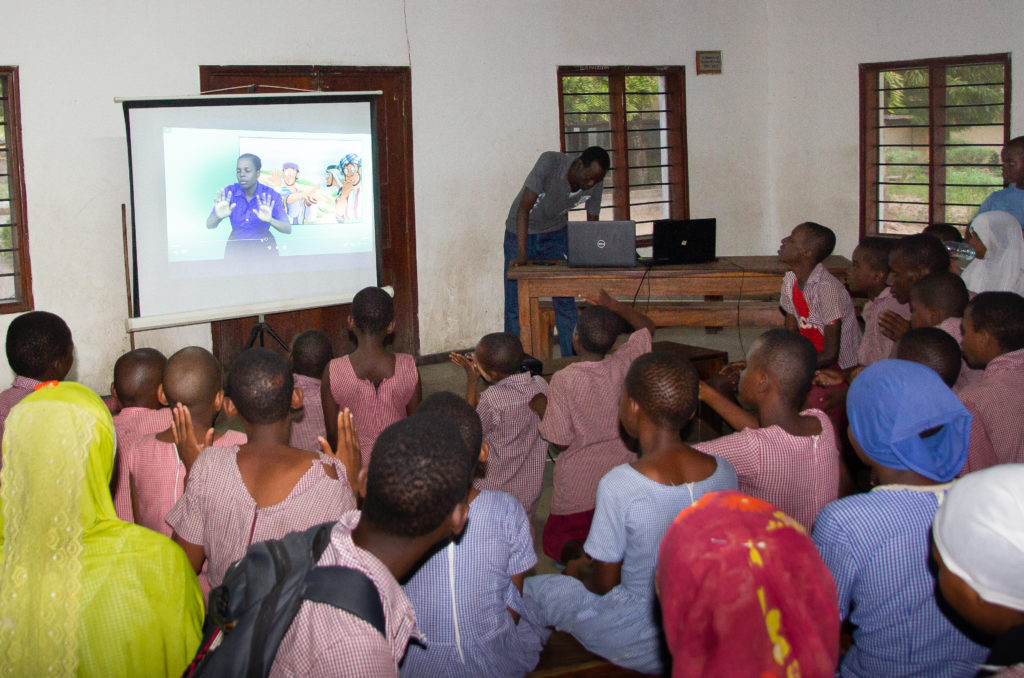
Though these Scripture passages are available on YouTube[7], many Tanzanian Deaf children will not see them because they do not have access to the internet. We determined that the best way to share the Bible with Deaf children was face-to-face. But we needed more people to be able to do that – people who could specialize in Scripture engagement (SE) for Deaf children.
Deaf people do not have a geographically defined area like other linguistic groups. They are dispersed throughout the country. The only places where there are concentrations of Deaf children are in the Deaf schools.
So, working with Deaf churches in five regions we recruited from each region two Deaf adult volunteers who were willing to come to Tanzania’s capital city, Dar es Salaam, to be trained. After their training, the adults returned to their home areas to work with Deaf children. We were inspired by the work of YWAM, so we followed their example and used storying, drama, and Scripture songs to convey the message of the Bible to the children.
Besides the obvious ministry of sharing Scripture with Deaf children, another important component of this programme was bringing Deaf children in contact with Deaf adults. Most Deaf children have very limited or no contact with Deaf adults, and, therefore, have no Deaf role models. Deaf children need to be connected with successful Deaf adults whose lives can serve as an inspiration for them.
Deaf children need to be connected with successful Deaf adults whose lives can serve as an inspiration for them.
In March 2020 the first Deaf volunteers came to the BILAT Centre for three months of training. They learned the 15 Bible passages, then composed songs in Tanzanian Sign Language and created dramas based on the stories. BILAT also provided training in leadership, Christian doctrine, Deaf culture, Tanzanian Sign Language, information about the sexual abuse of Deaf children (how to spot it, what to do about it, and how to prevent it), and instructed them in how to report on the work they were doing. Each team received a smart phone with the Scripture videos pre-installed. Besides giving the Deaf children access to these Scripture videos, the phones would also facilitate communication with and reporting to BILAT.
All of the Scripture engagement workers are volunteers. Besides the training, the main costs of the programme are small amounts given to each team for travel and to pay for time on their phones so they can communicate with BILAT staff and with local people using messaging and video chat.
A second group of SE workers were trained in 2021. These workers came from five other regions. Some of the SE volunteers from the first group served as trainers.
One of the new areas, Moshi (Kilimanjaro Region), uses a different sign language than Tanzanian Sign Language [tza]. To ensure the Moshi SE workers had Scripture the children could easily understand, BILAT met with church leaders in Moshi, and together we selected two people who could translate from Tanzanian Sign Language into their own sign language.
They arrived at the BILAT centre in May 2021 to begin the extra work of translation. They used the already published Tanzanian Sign Language WoW videos as their source text. BILAT translators served as a resource and an SIL GLST consultant was available to answer any questions they might have had. The two volunteer SE workers from Moshi, who arrived one month later, provided native signers to help check the translation. The translators, SE workers, some BILAT staff, and I travelled to the Deaf schools where this language is used to make sure the children would be able to understand the translation.
After introducing this material in the Moshi area, Deaf church leaders began asking for more materials in their sign language. They are very pleased with the WoW videos and want materials for adults, as well, and more materials they can use in church.
Children in Deaf Schools Respond to God’s Word
The reception of the translated Scriptures in the Moshi area and in other places that use Tanzanian Sign Language has been resoundingly positive. The SE volunteers have all been allowed access to the children at the Deaf schools. The children have been very happy to have Deaf adults teach them about Jesus and about God’s Word. They have memorised the Bible passages and songs. They have taken turns playing different characters in the dramas. Lives have been affected positively and changed by the advent of Scripture in a language and form they can understand.
For example, K. was the biggest and oldest student in his school. He often hit students he did not like. He was known for his disruptive behaviour. After studying the Unforgiving Servant story, he realised that he needed to change. He stood in front of the other students, his teachers, and the SE workers and asked people to forgive him. He also forgave anyone who had offended him.
A. was estranged from his parents. His parents had divorced, remarried, and moved on. He was in the care of his mother’s parents, but they were poor and in bad health. He became bitter and violent. Here is his testimony.
“I have learned to forgive. I have forgiven my father for deserting us for another woman, the same to my mother for leaving me in the hands of her parents who are ailing. I was bitter and my schoolwork suffered, too, because I hated most people. I just felt life was unfair. Through the Unforgiving Servant story which I was able to imitate, to sing, to act out and pray through, I now have peace. I give all my worries to God and it works. I have learned to study Scripture engagement every day. I know God has forgiven me for hurting many people with my bitterness.”
M. and Z. were good friends. M. was from a very poor family but Z.’s family was relatively wealthy. After attending the SE programme M. shared the following with Z.
“Do you remember when you lost your expensive school bag earlier this year? It was I who stole it and then sold it in the market. I am sorry for this, I did it because of my need for money due to the fact that I am coming from a very poor family which relies on one meal a day. Sometimes I go to bed without eating. But I have learned that poverty doesn’t justify doing such evil, I am so sorry. Will you please forgive me?”
Both boys were crying as Z. forgave M.
Two students at one Deaf school caught the attention of the teachers. They had not been good students. But after they attended the SE classes, they learned to be more responsible, and their grades improved. Their teachers were very pleased with the changes.
When the SE team leader asked the students about the changes in their lives, they said, “God changed us. We prayed and asked God to help us. He answered our prayers. We are pleased that God cares for us, and we want to know him more and more.”
Parents have also seen the positive changes in their children. A single parent who was a farmer said, “My son learned to be responsible and his grades went up, and the teachers love him. Then I asked him what made him different, and he said God changed his life.”
“My son learned to be responsible and his grades went up, and the teachers love him. Then I asked him what made him different, and he said God changed his life.”
The teachers and leaders of the schools have been impressed by the positive changes coming from the SE programme. Some of the SE workers were given seats of honour at graduation ceremonies. The Deaf volunteers were asked to counsel troubled students.
In fact, the changes observed in students caught the attention of others in the community. Parents whose children did not attend the classes asked the Deaf volunteers to talk with their children as well.
Connecting with Rural Deaf Children
In one region the SE workers did not limit their activities just to the children in school. They also visited rural areas looking for Deaf children who were not attending a school. Some parents in these rural areas did not know that there were special schools for Deaf children.
Ten-year-old S. lived 120 kilometres from the nearest Deaf school. The SE workers visited her and shared the WoW stories with her. S. prayed that she would get to go to school someday. Later she was invited to attend the closest Deaf school. Because it was not a boarding school the government arranged for her to stay at a home for street children. Here is what she said:
“I was so happy and grateful to God that he answered my prayer. I thank God for not abandoning me. I was living in agony, in a world of my own, lonely, no school. So meeting the SE team and learning spiritual and social lessons had a big impact on my life. I was eager to learn more about the miracles Jesus had performed and about his holy life. I want to follow him and his commandments so that one day I will meet him.
Learning the stories of the biblical characters indeed boosted my brain development and so I had no difficulty in school despite my late entry into standard class. I am now confident to face the way forward. Praise the Lord!”
In a recent article published in the Journal of Deaf Studies and Deaf Education, authors Brittany A. Blose and Lindsay S. Schenkel indicate that Deaf children need a social network which “facilitate[s] the development of more proficient perspective-taking, emotional competence, and psychosocial functioning.” We in BILAT intuitively knew Deaf children needed all that. It’s encouraging now to see research that supports our intuition.[8]
Deaf children are not the only ones who are benefitting from this programme, however. The SE workers themselves also have been greatly affected by the work. The training programme, their experiences in working with the children and the apparent spiritual, social and educational results have served to improve their reputation in their Deaf communities as well as in the non-Deaf communities. Some have been selected to be leaders in their churches and communities.
Expanding the SE Programme
In 2022 we hope to expand the SE programme to more regions in Tanzania. We plan to have an SIL GSLT consultant finish the checking of the Moshi WoW passages and then we will test the translation to see whether it can be understood in the Njombe region. If the Moshi materials cannot serve the people of Njombe, we hope to translate a unique set of WoW stories for the children there.
We are interested in seeing this programme expand to other countries as well. One organisation has recently expressed interest in testing it in two West African countries.
We in BILAT are grateful to God for giving us the idea for this programme with Deaf children. Looking back, it is clear that God has guided us. We consider it a miracle that all of this happened during a pandemic. We are also grateful to SIL, Pioneer Bible Translators, and others for providing training and for those who provided funding.
* My special thanks to Harry Harm and Dawn Kruger for their help editing the English version of this article.
Sensor Joseph Msimbete (bilatteam@gmail.com)is a Deaf Tanzanian. He trained as a translator at DOOR International in Kenya for 10 years before returning to Tanzania to help found BILAT, a Deaf run NGO. As president of BILAT, he is engaged with Bible translation, Scripture engagement, and language and community development. He is also the president of ADMA (Africa Deaf Mission Alliance) which supports Bible translation in Africa. In addition, he pastors a Deaf church.
NOTES
[1] “Basic Facts and Figures on Human Settlements,” National Bureau of Statistics, Tanzania Ministry of Finance(2013), 1.
[2] “Population, total – Tanzania,” World Bank, accessed February 15, 2022, https://data.worldbank.org/indicator/SP.POP.TOTL?locations=TZ.
[3] The median age in Tanzania is 17.7, https://worldpopulationreview.com/country-rankings/median-age.
[4] “Documentation and description of the Tabora variety of Tanzanian Sign Language,” Projects, Universiteit Leiden, accessed February 15, 2022, http://www.africansignlanguages.org/researchrecherche/projects/.
[5] In Tanzania there are Deaf schools which are special schools for deaf students and there are Deaf units which are located in non-specialised schools. In this article we will be using Deaf school to refer to both types of schools. Deaf spelled with a capital first letter indicates a sociolinguistic group which uses a sign language as a preferred language. With a lower case first letter, deaf refers to audiological deafness.
[6] See the article in this issue about the work of D.O.O.R. International.
[7] “WoW – Words of Wisdom,” YouTube, https://www.youtube.com/playlist?list=PLcX5nvnAiyGHorIlLugarsCoPrV-CXo5n.
[8] Brittany A. Blose and Lindsay S. Schenkel, “Theory of Mind and Alexithymia in Deaf and Hard-of-Hearing Young Adults,” in The Journal of Deaf Studies and Deaf Education 27, no. 2(April 2022): 10, https://doi.org/10.1093/deafed/enac001.
EMQ, Volume 58, Issue 3. Copyright © 2022 by Missio Nexus. All rights reserved. Not to be reproduced or copied in any form without written permission from Missio Nexus. Email: EMQ@MissioNexus.org.