
EMQ » July–September 2022 » Volume 58 Issue 3
Translation Consultancy
Bible translation consultants’ expertise and skills are pivotal in ensuring quality translations. The current shortage of consultants slows Bible translation progress. To overcome this problem, we must evaluate the root causes.
By Brigitte Rabarijaona
Making the Word of God accessible to people through translation is a mission shared by many Bible translation agencies.[1] It involves different stakeholders and actors at different levels, depending on the context. The main stakeholder initiating a project is the community or church that has expressed their desire to have the Bible in their language.
This is often motivated on the one hand by the need to have a comprehensible Bible in their heart language, to be able to reach the maximum number of people and impact on their lives. On the other hand, this desire may also be motivated by a concern to preserve the language. Then come the organizations such as Bible agencies, Church or Christian associations who help communities implement the project.
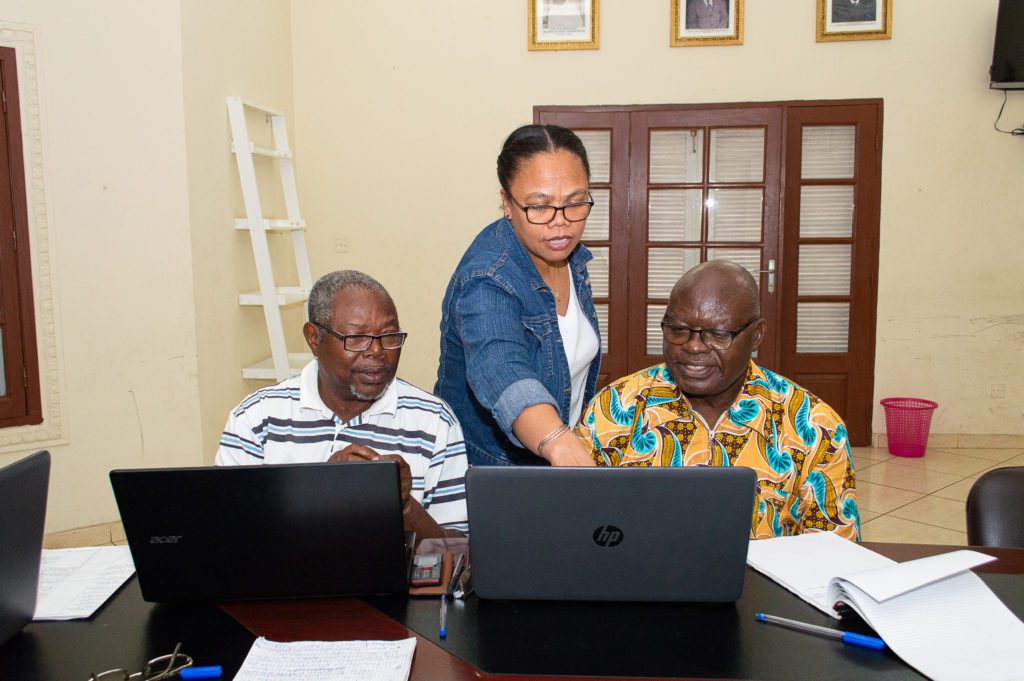
Between the implementing organization and the end-users, for a Bible translation to be successful, there are other important categories of actors that cannot be ignored, namely translators and translation consultants. Their roles are crucial because they are the ones who actually do the work. Their tasks are complementary. Translators are native speakers of the language they translate into. They know their culture well. Whereas translation consultants are experts in source languages and in Bible translation techniques.
Translation consultants are experts in source languages and in Bible translation techniques.
Their respective roles are well defined. Both contribute towards guaranteeing a quality translation. However, the translation consultant has a broader responsibility. He or she must accompany all the stakeholders and member of a Bible translation project team from the project’s beginning until it reaches the hands of the target audience in one form or another, be it printed, electronic, or oral.[2]
Ideally, each project should have one translation consultant in charge of the scholarly expertise and technical input needed for translation work, but unfortunately, in reality, the number of translation consultants is much less than the number of active translation projects. Due to that, many serve several projects, and some even in several countries. Why is there such a shortage, and how can we overcome it without compromising the quality of the translation?
Education and Training
The United Bible Societies meets the need for professional translation services through a team of international, interconfessional specialists serving the Bible Societies’ translation program as translation consultants. Currently, UBS translations consultants work for several translation projects in various countries and have other academic duties to perform both globally and regionally. The most important aspects of their work are training and coaching Bible translators and quality control of publications of Biblical texts, they also provide the staff of the implementing organization with translation project management training.
The translation consultant’s expertise and skills are pivotal in ensuring a quality translation – one that communicates the meaning of the source texts faithfully, clearly, naturally, and acceptably in the receptor languages. These skills are also necessary to ensure that publications of biblical text materials in different formats preserve the integrity of the source text message. Providing this level of quality assurance requires consultants achieve a minimum academic qualification.
A fully qualified UBS translation consultant must hold a PhD degree in biblical studies, linguistics, translation studies or anthropology. Additional academic training, dependent on a consultant candidate’s PhD field of study, is also required. Then anyone desiring to be a translation consultant must complete all the courses in UBS’s two-year consultant training programme.
The training tracks and reading materials fill academic gaps for candidates. For example, biblical scholars complete courses in linguistics, while linguists do additional study in biblical languages and exegesis. Coursework also gives a thorough overview of UBS’s standards and policies.
Few people have these academic qualifications or desire to invest their time to meet these rigorous educational requirements. While these are essential for quality assurance, they may contribute to the translation consultant shortage.
Economic Pressures and Compensation
When people do have these skills and qualifications, it is rare for them to also be willing to work on translation projects. Often, they already have other responsibilities in their churches and academic institutions. Participating in Bible translation may only seem attractive if the working and financial conditions are more attractive than where they already are.
In some countries, opportunities to acquire advanced degrees and extra studies in fields related to Bible translation is limited. Institutions in their country may lack the right programs or may not offer graduate degrees. This means that candidates may have to go to another region or even another country to acquire needed academic credentials. The financial burden, especially for studies abroad, may create another significant barrier.
To compensate for this, USB allows some candidates to start their training without a PhD, but they are encouraged to pursue doctoral studies later. UBS also has a mentorship track for translation consultants-in-training to guide them in their career path and growth. This has helped several Bible Societies to have their own translation officers/consultants.
Still, the salary of a translation consultant can also make this job less attractive, especially over the long term. Organizations implementing translation projects often cannot pay a salary that suits the education level and training required. This is especially true if the translation consultant has a permanent and full-time role for a Bible Society. As a result, potential candidates either lose interest and move on to other, more financially rewarding jobs, or they accept the job but on a part-time basis. Being a translation consultant is not an easy task, and expertise is required. It is hard to maintain quality when a translation consultant is not fully available for a project.
It is hard to maintain quality when a translation consultant is not fully available for a project.
The Impact of the Shortage
The shortage of translations consultants can affect the translation project in many ways. It can slow down the progress of a project. Sometimes when a translation project takes too long, the Bible has to be revised before it is even launched. This discourages both the donors and the target audience.
The lack of translation consultants also affects the quality of the translation, especially when translators have neither a good background in biblical source languages, nor a good biblical exegete working with them. Despite these challenges, we cannot neglect the integrity of any translation. Solutions to the shortage must necessarily maintain the reliability of translations, and at the same time, ensure that they remain available, accessible, and credible products.
Increasing the Capacity of Translation Teams
While translation consultants play an essential role in ensuring quality translations, they are not the only ones involved. Translators play an equally critical part. When translators have a good understanding of both their language and culture as well as the source biblical languages and cultures, translation consultant have less work to do. Therefore, hiring translators with a good knowledge of biblical Greek and Hebrew, and a good capacity for exegesis, would significantly reduce the amount of work and quality assurance burden carried by translation consultants.
When this is not possible, collaboration with a biblical exegete can provide significant help. An exegete assigned to a translation project does not have to be full-time. He or she could work part-time or as a contractor. To effectively work with the translation team and potentially help with pre-consultant checking, he or she needs prior training in the policies and principles of Bible translation. A translation consultant’s expert input is still necessary. However, a consultant’s work on a pre-checked translation project goes faster, and this avoids project slowdowns.
Another way to increase the capacity of translation teams is to provide them with additional training. UBS set up a 2-year training course for translators for this purpose. Such a training helps to consolidate foundation learning.It equips translations to produce improved translations that will then require less hands-on engagement from translation consultants. This enables translation consultants, whether local or international, to help the team in more efficient ways.
Developing Translators into Translation Consultants
UBS tries, as much as possible, to organize training for translators in cooperation with a university or academic institution. This allows training to be accredited towards a diploma or even a master’s or a PhD degree. Translators who choose this option have potential to begin a path towards becoming translation consultant candidates. Over the long-term, this may help fill consultant gaps.
It is important to remember that in addition to attaining a high level of academic credentials, field experience is also crucial for translation consultants. The cultural factor remains a vital element in maintaining a good quality of translation. Existing translators gain valuable field experience during their work for translation projects, which makes it even more strategic to invest in training them to become translation consultants.
But as mentioned previously, the minimum academic level required to be a translation consultant can be an obstacle in some regions because of costs and/or the lack of available local institutions with the right study programs. An implementing organization, in collaboration with the church, or the Bible agency, and other donors, could help remove this barrier by investing in the financial support of one or several people who are able to pursue further academic credentials.
This would put translators on the path to becoming full-fledged translation consultants. One or more neighboring implementing organizations could also join together to share the cost of supporting a candidate’s training and studies. Then later on, they could also share this translation consultant’s salary expenses so that one organization does not have to take on the entire compensation responsibility alone. This only works if there is a clear agreement among the candidate and the translation project implementing organization.
I benefited from an approach like this. I initially joined the Bible Society in my country (Madagascar) to serve as an exegete with a translation team. At that time, I only had a master’s degree. Later, through the collaboration of my church, the Bible Society in Madagascar, and a Christian organization in Switzerland, I was able to complete my PhD studies.
When I came back to Madagascar after studying abroad, I was immediately hired by the Bible Society to be the local translation consultant while helping neighboring Bible Societies in countries such as Mauritius and Seychelles. At the same time, I undertook the UBS training course, which subsequently led me to become a UBS translation consultant.
Sharing Translation Consultants Across Agencies
Agencies in the Forum of Bible Agencies International (FOBAI) have expressed their desire to share translation consultants. Their agreement recognizes that each organization maintains its own internal standards for consultant recognition, and thus various levels of application is needed between organizations to accommodate policy differences.
The practical parts of the FOBAI agreement need to be thoroughly discussed in order to be implemented well. Some organizations may wish to define specific requirements more explicitly in their own bilateral agreements. [3] Translation consultants from other agencies must be aware of the inevitability of respecting the standards of the implementing organization.
This is not easy particularly when an organization is a publishing partner in a joint project. In these cases, the publishing organization may require that final checking and sign-off on publication be restricted to only those who meet their standard.
More translation consultants are needed to ensure that the quality of Bible translation is maintained.
Conclusion
More translation consultants are needed to ensure that the quality of Bible translation is maintained. The shortage of consultants strains the capacity of existing consultants and causes delays on Bible translation projects. Overcoming this issue requires considering the root causes of the problem and then creatively thinking about ways to overcome barriers, redistribute tasks, and increase the capacity of current translation team members. Potential solutions offer promise for both the short-term and long-term. Choosing what will work best depends on each country and region considering the human and financial resources and limitations in their context. But the translation consultant shortage is not without potentials solutions, and I remain hopeful that God will direct us towards a way forward.

Brigitte Rabarijaona, PhD (brabarijaona@biblesocieties.org), is a United Bible Societies’ global translation advisor (GTA) and coordinator for Africa for The Bible Translation Roadmap. She works directly with several translation teams in Africa and oversees the training and mentoring of translators and future translation consultants worldwide. Brigitte completed her doctoral studies in Old Testament Studies at the University of Geneva in Switzerland in 2014. She is from Madagascar.
NOTES
[1] Most of these agencies are members of the Forum for Bible Agencies International (FOBAI). FOBAI is a network of 40 international Bible agencies and other mission organizations with a shared vision: “working together to maximize the worldwide access and impact of God’s Word,” https://forum-intl.org/about/mission-and-vision/.
[2] I am a UBS translation consultant, so I mostly refer to the UBS translation process and principles. I am also mindful of the fact that Bible translation is part of the Bible life cycle which includes: Bible translation, production, distribution, Scripture engagement, advocacy, and holistic ministry.
[3] FOBAI Board Resolution/Standards: III. G, 2006, Statement on qualifications for translation consultant.
EMQ, Volume 58, Issue 3. Copyright © 2022 by Missio Nexus. All rights reserved. Not to be reproduced or copied in any form without written permission from Missio Nexus. Email: EMQ@MissioNexus.org.




