EMQ » April–June 2022 » Volume 58 Issue 2
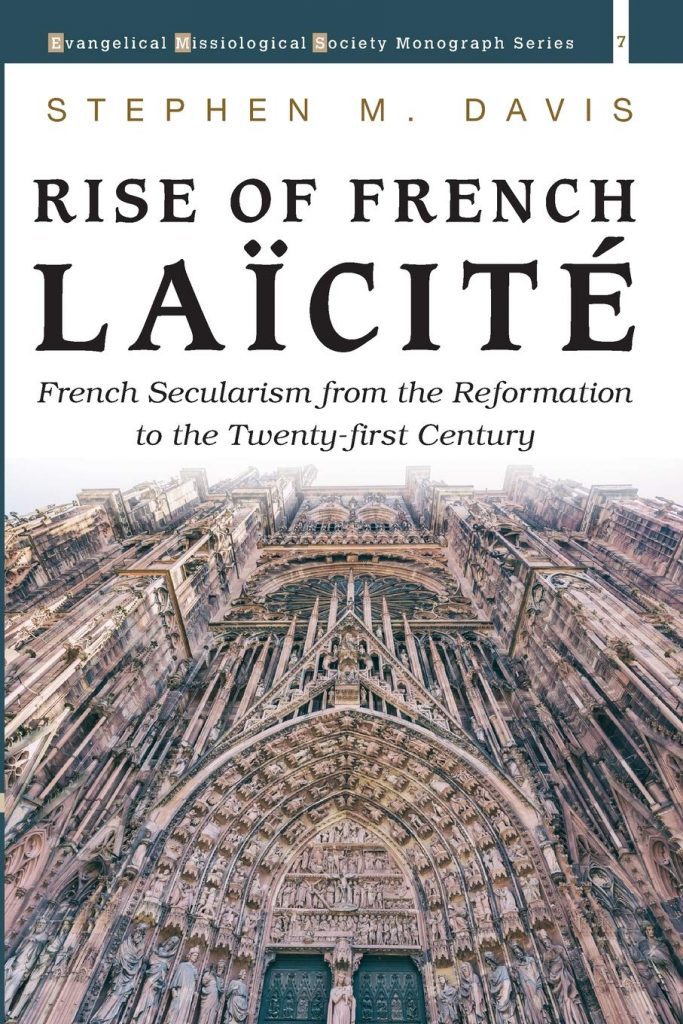
Rise of French Laïcité: French Secularism from the Reformation to the Twenty-first Century
By Stephen M. Davis
Pickwick, 2020
250 pages
US$30.00
Reviewed by Jonathan P. Case, professor of theology, Houghton College.
Stephen Davis has written a detailed analysis of the rise of the phenomenon known as laïcité in France. Almost impossible to translate, laïcité includes the idea of secularization as a gradual change in society that doesn’t require any political implementation – a phenomenon observable in many western countries – but also the idea of “a political choice which defines the place of religion in society in an authoritative manner” (119). The latter idea is, unsurprisingly, the controversial part: What exactly is the State doing (or what should it be doing) concerning the place of religion?
Davis carries out careful historical work in tracing out the rise of a sovereign French state to the exclusion of the Church from the realm of politics. In terms of broad historical brushstrokes, one might naturally think of the reformation movements in the sixteenth century, political revolutions in the seventeenth and eighteenth centuries, and the scientific revolution as factors contributing to the rise of laïcité in France, but Davis takes the reader deep into the details of important controversies and documents in this story, from the Edict of Nantes (1598) through the Law of Separation (1905).
Davis does a fine job of bringing the discussion into the twenty-first century. Of special interest is his treatment of how Islam and Muslims are viewed within a laïque Republic, especially since several highly publicized Islamic headscarf incidents. Davis also introduces us to the tricky relationship between France’s policy of laïcité and the Charter of Fundamental Rights of the European Union, which rightly recognizes that churches play an important ongoing role in civil society and do not simply operate in the private sphere.
A concluding chapter includes implications for gospel ministry, and Davis effectively throws cold water on unrealistic expectations held by anyone who seeks to minister in secular France with all its cultural particularities and its view of religion. This is not an easy field. Church planting and Muslim evangelization remain top priorities. As an evangelical, in this area, I wish the author had carried out more sustained theological reflection: What might God be up to in a public space putatively scrubbed clean of religious and theological vestiges? The reader is tantalized by the French Catholic historian Delumeau’s comment that “the God of Christians was in times past much less alive than one might have believed and today much less dead than one might think” (131). Davis is not writing principally as a theologian, but I had hoped there would be a bit more follow-up to this insight in his treatment.
Davis’ command of French sources is impressive, and this book will deepen the reader’s grasp of French laïcité, even though the ongoing controversy around the very meaning of the word remains bewildering. On account of its specialized and detailed character, I suspect this book would not work well in lower-division undergraduate courses, but it could be used profitably in a more advanced study of the rise of modern secularism in the West, and (of course) in a missiology class on ministry in western Europe.
For Further Reading
Kuru, Ahmet T. Secularism and State Policies Towards Religion: The United States, France, and Turkey. Cambridge; New York: Cambridge University Press, 2009.
Laxer, Emily. Unveiling the Nation: The Politics of Secularism in France and Quebec. Montreal; Kingston: McGill-Queen’s University Press, 2019.
EMQ, Volume 58, Issue 2. Copyright © 2022 by Missio Nexus. All rights reserved. Not to be reproduced or copied in any form without written permission from Missio Nexus. Email: EMQ@MissioNexus.org.