EMQ » April–June 2022 » Volume 58 Issue 2
By Harry Hoffman

Member care is a vast topic with many aspects. I fit all of these into four different member care roles: the member care beginner, member care provider, member care facilitator, and member care trainer. These roles provide a continuum for involvement that is almost like a career path towards becoming professionally involved in member care internationally.
[memberonly folder=”Members, EMQ2YearFolder, EMQ1YearFolder, EMQLibraryInstitution”]Member Care Beginner
People in this beginner category are just dipping their toes into the world of member care. They typically come from one of two backgrounds. The first group are people with a professional care background such as pastoral care providers, social workers, counselors, psychologists, psychiatrists, or educators who felt God’s urge and encouragement to use their skills to serve missionaries.
The second and larger group are missionaries who have experienced struggles while serving overseas. It was either the lack of care or a positive experience from member care providers that caused their interest and motivation to learn more about member care.
In my early days in the ’90s, I was involved in an orphanage ministry in Asia. The high stress environment really hit us hard as a family with two young children. We had cross-cultural training and anticipated stress. However, we expected and counted on a higher personal resilience than we actually had.
High stress in a cross-cultural context over long period of time required an extra level of care, support, and cross-cultural understanding that we only found years later while talking to member care providers. What a positive difference this made! This experience started my journey as a member care beginner. Thankfully, many more member care resources are available, today, than existed in the ’90s.
The Pyramid of Care
Figure 20.1 – Pyramid of Care
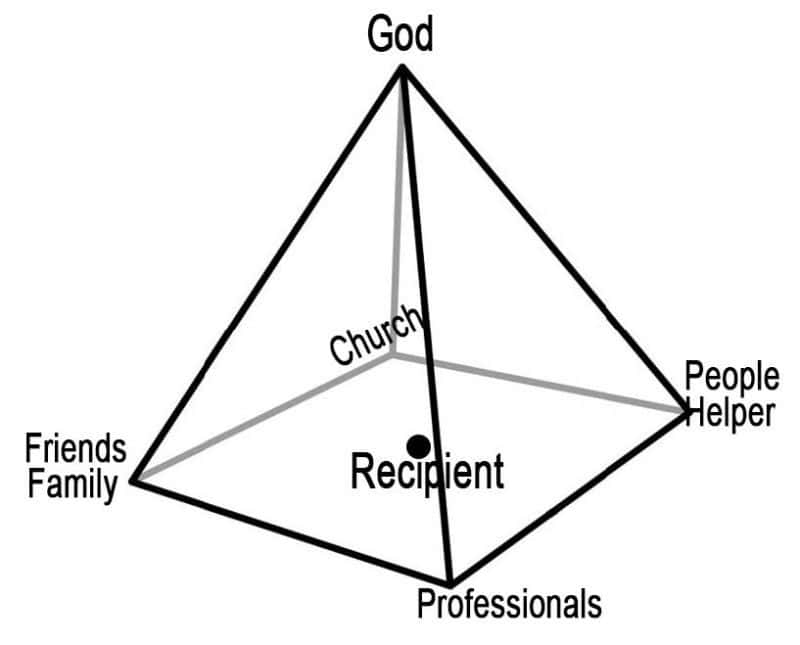
I use the pyramid of care (see figure 20.1) as a model to describe member care especially for beginners who want to grow to become providers. Located at the base of the pyramid is the recipient of care. God is at the top of the pyramid, connected to each of the corners and directly covering the recipient of care. The corners represent various types of member care providers:
- The friends and family corner is immensely vital for missionaries, easily accessible, and free of charge. Relationships with friends and family, where love, trust, and vulnerability are already established, can be greatly valuable for personal wellbeing and spiritual health.
- The church corner is just as critical. Included here is the sending church back home as well as possibly the receiving church where a missionary serves. Church members can pray, write, care, visit, and serve in many capacities to support missionaries.
- The people helper corner represents lay counselors, mentors, peer support groups, seminars, workshops, and other training. Included here are also spiritual mothers and fathers who offer spiritual care in a familial way. People helpers can be found in most churches and often in the mission community worldwide as well. They are often not considered member care providers.
- The final corner is the professional corner. Compared to the other corners, member care professionals are fewer in numbers but are usually explicitly and formally recognized as care providers. Located in this corner are trained and licensed professionals such as mental health providers, coaches, educators, and others.
The Global Member Care Network (GMCN) website and Facebook group offer a variety of resources to help member care beginners to explore the world of member care and discover how they can best contribute. Find information about training opportunities, conferences, member care vacancies, specialized topics, editorials, new books and more from around the world on one of these sites.
Member Care Provider
Many member care beginners look for a specialization or niche from which they can offer care to missionaries as providers. Providers can fit into the people helper, church, or the professional corner.
Providers operating from the people helper corner offer a variety of formal and informal services. They may join the teaching team of an established training course, such as the popular Sharpening Your Interpersonal Skills Workshop (SYIS). This is taught worldwide in several languages (itpartners.org). Others offer self-created training such as conflict mediation workshops, spiritual formation retreats, or transition or stress management seminars.
Routine and crisis debriefing for individuals and families is a growing field in member care, too. This is offered by mental health professionals as well as by people helpers. Le Rucher in France (lerucher.org) offers training for people who want to become certified debriefers.
Informal member care can be provided through pastoral care visits. This can be done by elders, mentors, and spiritual mothers and fathers. Many of these are connected to sending churches or mission agencies. Pastoral carers have good listening skills, loving attitudes, and big hearts. Their visits may incorporate pastoral care, spiritual encouragement, prayer, or marriage or parenting advice. They may even baby-sit or connect missionaries to more resources.
Member care providers operating out of the church corner are summarized well by Neal Pirolo. In his book Serving as Senders (eri.org), he points out different support roles a sending church can offer. Those can include moral, logistical, financial, prayer, communication, and reentry support. Members of a sending church can share these responsibilities to provide essential member care to their missionaries.
Finally, some member care providers decide to pursue further education or accreditation to become a part of the professional corner of the pyramid of care. Among many options for careers are accredited coaches and licensed counselors. Being in a professional network, like the missions coaching network (coachingmission.com) or the third culture kid (TCK) counseling network (tckcounseling.com), enhances credibility. Some offer services online, while others travel to visit missionaries in-person on the field. A few relocate to be available full-time on-site to workers.
Member Care Facilitator
This role is increasingly important within mission agencies. Member care facilitators are often not member care providers, but they make sure that sufficient providers and resources are available to the agencies’ staff.
Member care needs look different for each agency depending on the number of single people, couples, and families as well as the age and schooling needs of missionary children, field locations, and on-field risk levels. Member care facilitators assess needs and then locate member care resources and providers to meet those needs.
Member care networks play an important part in this category because quite unique needs can emerge. Facilitators may need help to find the right resources to help meet that need. The Global Member Care Network (GMCN) offers this kind of help. Through its Facebook community (facebook.com/groups/globalmembercare) thousands of member care people share resources and support each other.
Interagency member care centers are another form of facilitated member care. Member care centers are usually geographically located at missionary hubs and have providers on staff from various missionary agencies, nationalities, and backgrounds. Member care providers at these centers can work as a team. They benefit from mutual support, case consultation, and referrals.
The advantage for the mission community is the accessibility of a variety of specialized services in one location, available to missionaries from all nations, agencies, and denominations. I started several member care centers, including THE WELL in Chiang Mai, Thailand (thewellintl.org), and I continue to consult with similar startups.
Member Care Trainer
Academic degrees taught by member care trainers are currently available in at least three locations. Columbia International University in South Carolina, USA (ciu.edu), and All Nations Christian College in England (allnations.ac.uk) both offer master’s degrees in member care. Fundación Universitaria Seminario Bíblico de Colombia (unisbc.edu.co) together with Fundación Vinculo (fundacionvinculo.org) – a member care center in Medellín, Colombia – offers a diploma in member care called Diplomado de Cuidado Integral.
I predict more and more such member care training programs emerge all around the world, with and without academic degrees or diplomas, because of the considerable need for contextualized member care. Mission movements on all continents have benefitted from North American and European member care resources, but usefulness is limited because some western concepts of member care are not applicable to other cultural contexts. Even the term member care is considered difficult to translate into other languages, which caused Latin America for example to use “Cuidado Integral del Misionero” (comprehensive missionary care) instead.
The need for contextualized and culturally appropriate expressions of care is evident. Member care trainers from various nations are stepping into this gap to write and teach about additional and alternative forms of care. A current example would be a Chinese member care book that will be published in 2022 which was authored solely by ethnic Chinese member care colleagues.
Generally, in contextualized training, we see little emphasis on the professional corner. Most of the focus is on the friends and family, people helper, and church corners.The roles of leaders, elders and communities are particularly important aspects in these corners of member care in the mission movements from the Global South.
Conclusion
Whether you are already involved in member care or not, everyone wanting to learn more is welcome to view resources on the GMCN website (globalmembercare.com). It includes links to the GMCN monthly newsletter, YouTube channel, and online training. Or join the GMCN Facebook group (facebook.com/groups/globalmembercare). Email me with specific questions.
Harry Hoffmann (harry@globalmembercare.com) is the founder of several counseling and member care centers in Asia and is the current coordinator of the Global Member Care Network. He has degrees in Chinese studies, theology and leadership and is a licensed mediator. His life’s passion is investing in member care and business as mission start-up ministries.
EMQ, Volume 58, Issue 2. Copyright © 2022 by Missio Nexus. All rights reserved. Not to be reproduced or copied in any form without written permission from Missio Nexus. Email: EMQ@MissioNexus.org.