EMQ » April–June 2022 » Volume 58 Issue 2
By David R. Dunaetz

Andrew and Brandon recently started a pioneer church planting work in a new field with their mission. Andrew thinks a coffee shop would be the most effective way to meet new people and develop relationships, while also providing a place for future meetings. Brandon believes a focus on hospitality and visiting people in their homes is more culturally appropriate because sharing meals is the normal context for developing relationships; such an approach also involves less financial risk. Their disagreement begins to intensify. Will this become a destructive conflict that will hinder their ministries, or could it be constructive and enable greater effectiveness?
[memberonly folder=”Members, EMQ2YearFolder, EMQ1YearFolder, EMQLibraryInstitution”]Such a situation is very common in missionary contexts where missionaries work closely with each other and are highly dependent on one another. It is especially common if they expect their team to be an important source of emotional support and encouragement. The initial tension can escalate and become destructive and may eventually contribute to one or both missionaries leaving the field.[1]
However, if managed correctly, their conflict can be constructive, leading to a solution that is better than either Andrew or Brandon’s original ideas. If missionaries are aware of each other’s concerns, their differences of perspective, and any power imbalances that exist within their team, a constructive conflict becomes much more likely. That will enable them to work better as a team making continued ministry more fruitful.
Missionary conflict is inevitable and potentially dangerous if mismanaged. However, when missionaries in conflict seek to cooperate by understanding each other’s perspectives and interests, creative solutions can be found. This requires time and effort, and sometimes outside help. However, cooperation with a desire to love and serve the other is a Christ-like response that is well worth the cost.
The Dual Concern Model of Interpersonal Relationships
To understand a conflict, it is useful to understand the concerns and interests of each. The dual concern model of conflict management (model simply means a simplification of a complex reality focusing on only a few key aspects) describes four different ways people respond in conflicts based on the focus of their interests.[2]
When Andrew and Brandon have a conflict, their interests can be divided into two sets: the interests of Andrew and the interests of Brandon. Andrew has four ways to approach the conflict (see figure 18.1). First, he can be concerned about his interests, but not those of Brandon (high concern for self, low concern for other). In this case, his approach might be characterized by forcing, using his power to get Andrew to accept what he wants. A second option is accommodation (low concern for self, high concern for other), deciding to only be concerned about Andrew’s interests and denying his own.
A third approach is to simply decide that the disagreement is not worth discussing, which leads to avoidance (low concern for self, low concern for other). A fourth approach, cooperation, describes a situation with both high concern for one’s own interests and high concerns for the other’s interests. If Andrew and Brandon want to cooperate, they will first strive to understand what each other is concerned about and then will consider various solutions that will maximize addressing all these concerns.
Figure 18.1 – The Dual Concern Model of Conflict.[3]
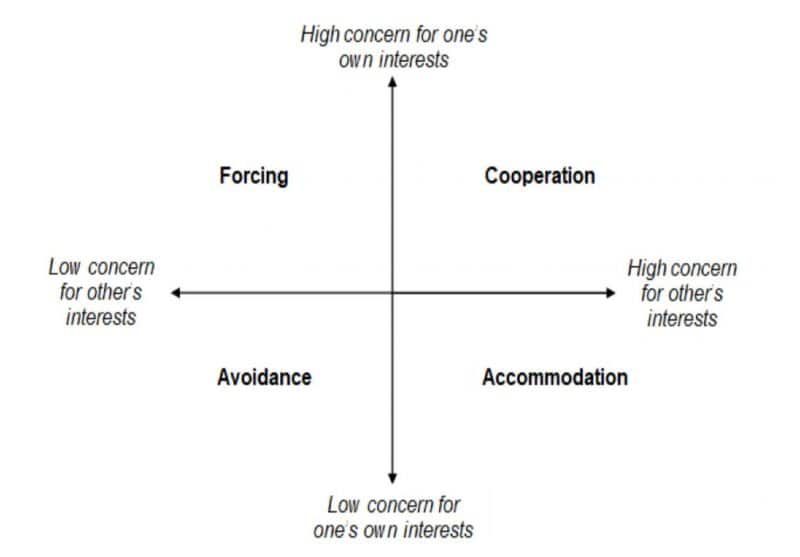
This fourth approach (cooperation) has been empirically demonstrated to lead to the best outcomes in organizations,[4] including mission organizations.[5]
Not surprisingly, this is the exact approach that Paul recommended to the church in Philippi, “Let each of you look not only to his own interests, but also the interest of others” (Philippians 2:4, ESV). When missionaries disagree with each other, often both have legitimate concerns. Solutions that address all of these concerns are the best, but finding them often demands time, effort, and creativity.
Missionary Conflict Should Be Expected
Although mission organizations each have their own clear purpose, how this plays out in a specific context is less precise. Missionaries working in teams must coordinate their efforts to accomplish anything. They need to share a common vision, a common set of values, and a common strategy. However, missionaries often come from vastly different backgrounds.
Andrew and Brandon may both love God and his Word, but they also have distinct personalities, perspectives, and knowledge. Andrew is more extroverted and previously worked in the restaurant industry. He can’t imagine a better form of outreach than a coffee shop. Brandon is quieter and has led several of his close, long-term friends to Christ in their homes. He can’t picture himself in a coffee shop ministry. Because their different backgrounds prevent them from understanding each other, the tension in their relationship escalates.
Our different backgrounds shape the lenses through which we view the world. Andrew and Brandon both see opportunities for ministry through their own uniquely shaped lens. This creates the foundation for conflicts. To cooperate, Andrew and Brandon need to understand one another’s lens so that they see the situation from the other’s point of view. This enables them to consider each other’s interests and concerns. However, understanding another’s perspective requires hard work.
Cooperation is Difficult
From a scriptural point of view, cooperation seems like a natural first choice since this approach aligns nicely with the concepts of love, service, and humility. But it can take significant time and effort which may be more than what Andrew or Brandon are ready to give. This is especially true when there is a power imbalance – one missionary has more power than the other.
For example, if Brandon is Andrew’s supervisor, he would have the authority to tell Andrew what they are going to do. This requires far less effort than coming up with a solution that addresses both his and Andrew’s concerns. Such an approach is an example of forcing, or “lording it over” (Matthew 20:25–26), which is the opposite of serving the other.
Forcing one’s will on the other is fast, efficient, and, perhaps in some rare cases, could be considered an appropriate last resort. However, it will damage the relationship, maybe permanently, and prevent a potentially better solution from emerging.[6] Ministry leaders who use such tactics are not likely to be very fruitful, at least from God’s perspective (1 Peter 5:2–3; cf. Demetrius in 3 John 9–11).
An imbalance of power may also occur if one missionary is more verbally fluent and can process information more quickly than the other. If Andrew presents many reasons for his ideas faster than Brandon can understand them, Andrew may come across as trying to deceive or trick Brandon. In this case, Andrew needs to be careful not to force more information on Brandon quicker than Brandon can handle it. This makes cooperation even more difficult and time demanding.
If Brandon has positional power but Andrew has fluency power, it is quite possible that Brandon will use his power to avoid addressing the issues that concern Andrew or, in the worst-case scenario, use his power to remove Andrew from ministry. Andrew needs to learn how to slow down and work on persuading Brandon of the validity of his concerns in a way that does not threaten Brandon. Nevertheless, in some cases, an outside mediator will be necessary. Wise mission organization leaders will provide such a structure and encourage missionaries to use it.[7]
Conclusion
Although cooperation ought to be the default approach to managing conflict on a missionary team, finding possible solutions that take into consideration each missionary’s perspective, values, interests, and concerns is time-consuming, hard work. Philippians 2:4 describes cooperation perfectly, “Let each of you look not only to his own interests, but also to the interests of others” (ESV). The preceding verse explains how we can do it: “Do nothing from selfish ambition or conceit, but in humility count others more significant than yourselves” (Philippians 2:3, ESV). The verses which follow underscore that such cooperation is a manifestation of the Christlikeness to which we as Christians and as missionaries are called, “Have this mind among yourselves, which is yours in Christ Jesus, who . . . emptied himself, by taking the form of a servant” (Philippians 2:5–7a, ESV).

David R. Dunaetz (ddunaetz@apu.edu) is an associate professor of leadership and organizational psychology at Azusa Pacific University, California. He previously served in church planting missionary for 17 years with WorldVenture in France.
[1]. Rob Hay et al., Worth Keeping: Global Perspectives on Best Practice in Missionary Retention (Pasadena, CA: William Carey Library, 2007).
[2]. Ralph H. Kilmann and Kenneth W. Thomas, “Developing a Forced-Choice Measure of Conflict-Handling Behavior: the ‘Mode’ Instrument,” Educational and Psychological Measurement 37, no. 2 (1977); David R. Dunaetz, “Submission or Cooperation? Two Competing Approaches to Conflict Management in Mission Organizations,” in Controversies in Mission: Theology, People, and Practice in the 21st Century, ed. R. Cathcart Scheuermann and E. L. Smither (Pasadena, CA: William Carey Library, 2016); Jeffery Z. Rubin, Dean G. Pruitt, and Sung H. Kim, Social Conflict: Escalation, Stalemate, and Settlement, ed. Philip G. Zimbardo, 2nd ed., McGraw-Hill Series in Social Psychology, (New York: McGraw-Hill, 1994).
[3]. Rubin, Pruitt, and Kim, Social Conflict; Dunaetz, “Submission or Cooperation?”
[4]. Jonathan A. Rhoades and Peter J. Carnevale, “The Behavioral Context of Strategic Choice in Negotiation: A Test of the Dual Concern Model,” Journal of Applied Social Psychology 29, no. 9 (1999); M. Afzalur Rahim, Managing Conflict in Organizations, 3rd ed. (Westport, CT: Quorum Books, 2001).
[5]. David R. Dunaetz and Ant Greenham, “Power or Concerns: Contrasting Perspectives on Missionary Conflict,” Missiology: An International Review 46, no. 1 (2018).
[6]. Dunaetz and Greenham, “Power or Concerns”; Dunaetz, “Submission or Cooperation?”
[7]. David R. Dunaetz, “Long Distance Managerial Intervention in Overseas Conflicts: Helping Missionaries Reframe Conflict Along Multiple Dimensions,” Missiology: An International Review 38, no. 3 (2010).
EMQ, Volume 58, Issue 2. Copyright © 2022 by Missio Nexus. All rights reserved. Not to be reproduced or copied in any form without written permission from Missio Nexus. Email: EMQ@MissioNexus.org.