EMQ » April–June 2020 » Volume 56 Issue 2
By Greg Carter
“Should I Stay or Should I Go?” is more than a well-known song by the British punk rock band Clash.[1] At a critical point in Jesse de Pugh’s[2] ministry at Redeemer Church, he reviewed with the congregation his personal introspection on this question.
In his role as senior pastor at Redeemer, through its multisite approach, the church had made strategic moves, into several neighborhoods in Baltimore. In an era when gray-hairs populated most church pews, Redeemer’s various sites were overwhelmingly twenty- and thirty-year-olds.
Even as Jesse led the church’s expansion, there were other sheep in the periphery of his vision; he wanted Redeemer to see them as well. The goal was to be a strong missions church, but not necessarily in the traditional sense. Given the complexity of leading an eight-location multisite church, he needed a missions pastor who could lead the way on a less-traveled road in missions.
Already a member of the congregation, Teddy had been in Jesse’s sights for several years. Unfortunately, Teddy was happily employed at another ministry. Undeterred, Jesse pursued him, and a second request elicited a yes to a staff role.
Understanding that sending workers to the nations was a priority, one of the first questions Teddy asked his new boss was, “Can you tell me about this two-year missionary training process?” Well, ummmm. There was a lot of desire, but little substance and practice.
To get things moving, Teddy “threw some stuff together” by starting monthly meetings and finding mentors for those in training. Not many months into it, he recognized the program wasn’t all that good; it needed to be more challenging to be accepted. The result of the rework was a 15-page application, essentially the kind that a missions agency would use. This was something Teddy was familiar with from his most recent ministry.
Making it harder wasn’t necessarily the silver bullet. Within a few months twenty-five people had completed the application. And the mentor part? These wannabe missionaries couldn’t find mentors. Teddy winced when the only mentors who could be found were twenty-five-year-olds; thus revealing a hidden weakness of the church’s strategic tilt toward Millennials.
Teddy proposed to the staff and elders what he thought was a God-honoring goal: sending fifty workers into the harvest over the next seven years. The elders asked, “Where did you come up with fifty?” In his mind Teddy knew that he already had twenty-five in the pipeline; he had seven years to come up with twenty-five more. Convicted that he was doing what he felt he could accomplish, he asked God, “What would honor You?” “Trust Me for one hundred,” was the answer: an audacious goal, something that is impossible, that is, unless God does it.
Teddy was familiar with Training Ordinary Apprentices to Go (TOAG).[3] The approach utilizes a missional community format in its disciple-making structure. He was also aware of the incredible missionary sending history of The Austin Stone Community Church.[4] Understanding that they had sent one hundred workers in a seven-year period only added to his desire to learn more.
An on-site visit and lengthy conversations with staff of The Austin Stone enlarged Teddy’s vision and also revealed his negotiating skills. Through a partnership with Launch Global,[5] the church had ten supported staff who served as missions mobilizers. They were the foundational element to the breadth of missions interest and action. Would the church be willing to let him recruit four of their staff to move to Baltimore and work as mobilizers at Redeemer? Within six months Teddy had his own support-raised staff members helping him transform the church into a bastion of missions activity. Today those four staff members number six. Each is a full-time staff member, with support raised through Launch Global.
Joshua Rolf, church relations coordinator with Launch Global, describes their unique role in the kingdom as helping churches send healthy workers to the harvest, particularly world areas that have limited access to the gospel. They especially desire to serve churches that have a deep commitment to church-planting movements/unreached people groups. Recognizing that many first-term missionaries struggle with conflict resolution skills, this is addressed in an intentional approach to character development.
In the fall of 2016 Redeemer launched its first missional community. Leading up to this, Teddy challenged his core group of potential missionaries to commit to a nine-month training process that would include intentional discipleship in a supportive environment, with a significant cross-cultural element. Knowing that proximity to one another is a huge factor (“optimal proximity” being defined as how far you would walk in your socks—two blocks became the standard), some members sold their condos and others ended their apartment leases. The Redeemer missional community group moved into the Little Pakistan neighborhood on Sheridan Road.
Having completed two iterations of the missional community, the process has evolved into the foundational sending process of Redeemer’ Kingdom workers. Each member raises some level of support to pay for materials, retreats, and assessments. Completion of Perspectives on the World Christian Movement[6] is one of the required elements.
Phase One is ten weeks long and precedes the on-site missional community experience. Spiritual development receives the most attention. Each week members are expected to “spend three hours with Jesus” developing intimacy. With a partner they spend two hours sharing their faith, preferably in a cross-cultural setting. Missional community members schedule an hour in corporate prayer. A weekly group meal, with time for training and accountability, rounds out the elements.
Phase Two is the defining component of the global missional community experience: living in proximity in a neighborhood, members are still working or in school full-time. Beyond the assigned reading[7] a lot of time is invested with people. Believing that prayer is vital, the frequency is ramped up. One of the groups meets five times a week for prayer, scheduling it at 5:00 a.m. before members start their school or workday.
This phase includes two retreats: one focusing on multiplication evangelism; the second utilizing the peacemaker training on conflict[8] material. Launch Global conducts its own renewal conference, and most of Redeemer’s community members have attended.
Matt is one of Redeemer’s mobilizers; he and his wife, Marty, were two of the four original mobilizers who moved to Chicago at Teddy’s invitation. While living in Dallas, he took the Perspectives course and became aware of missional communities at Prestonwood Baptist Church. He participated in several sets, becoming a leader for the first phase. As his passion for global missions grew, he eventually left his career in real estate to become a staff member with Launch Global.
Matt describes his mobilization role with the discover, develop, deploy alliteration—part of the Launch Global training he brought to Redeemer. In Discover he helps believers discover God’s heart for the nations[9], teaching the biblical basis of missions. He recruits for Perspectives, taking people through the Xplore study[10], and hosting various events to capture the attention of missions-interested church attendees. All this falls within the structure of Phase One.
Develop continues into Phase Two: practicing disciple-making, becoming familiar with life on the field, understanding how to prepare for transition overseas, dealing with critical cross-cultural issues, basics of evangelism, sharing your story, helping people to follow Jesus. An invitation to the missional community is limited to those who are strongly considering moving overseas in the next twelve to twenty-four months. Additional elements of the curriculum/equipping process include conflict resolution, a theology of suffering, understanding rhythms of life, how to establish leaders, sabbath rest, dynamic discovery of personality, spiritual gifts, personal assessment, enduring through tough seasons.
In Deploy, community members explore different opportunities for global service, narrowing options down to one or two. Matt facilitates the numerous calls to leaders and organizations, arranging for attendance at missions agency candidate schools, planning vision/confirmation trips to the selected field, coaching through support raising, overcoming roadblocks, and building resilience.
Commending the modeling aspect of Redeemer’s mentoring approach, Matt agrees strongly with the truism that more is caught than taught. The church has learned that if they are overly formal or systematic, and in the process become less relational, then zeal starts to flag. He also emphasizes the critical role of intercessory prayer. The intentional proximity of the missional community allows leaders to see red flags that need to be addressed: evidence of spiritual pride, general poor health, compulsive behaviors.
Matt acknowledges that receptivity and teachableness among team members has varied: some recognize how much they don’t know, some don’t see their arrogance and that they have a lot to learn. Seeing a teachable spirit is on the mentors’ radar.
Now parents of two preschoolers, Marty and Matt have a long-term goal to do church planting overseas, location TBD. For Matt geography is less important than team composition. While Southeast Asia (one of the focus areas for Redeemer) holds a lot of intrigue, they are maintaining an open-heart attitude. Departure is likely still three years off and they are committed to stay until Redeemer sees its one hundred workers raised up by the target date of September 2022.
Becka, another of Teddy’s mobilizers, is well-educated with a master’s in intercultural studies. She initially felt ready to go until learning that her rural California home church didn’t have a sending process in place. Through some self-assessment, and likely wisdom, she started looking for a church that could provide that. A friend at her home church recommended Redeemer. Though piqued by what she learned on Redeemer’s website, she wasn’t too sure about relocating to inner-city Baltimore. Her degree from the University of California, Davis, in sociology gave her a theoretical understanding of the refugee crisis, but she had no practical experience. Redeemer was actively serving their needs. Anticipating joining that effort was enough to overcome her misgivings about living in the heart of the city.
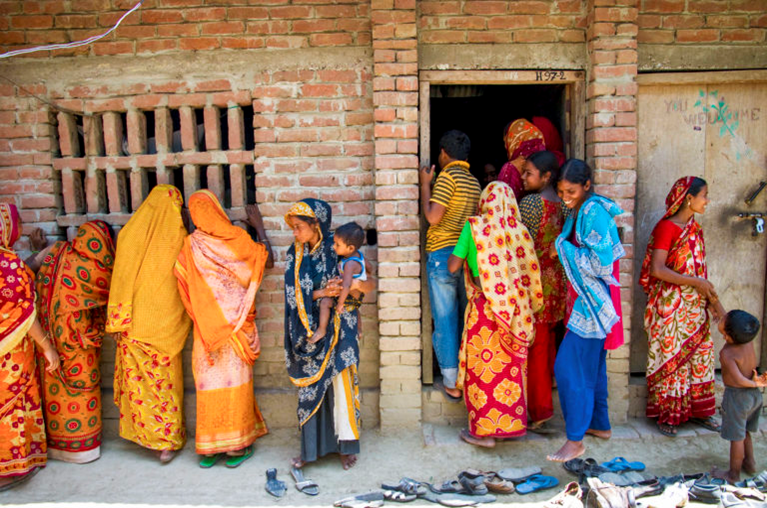
She arrived in 2014 just as the elders had rolled out an informal preparation process, becoming a participant in the first missional community. That was such a positive learning experience that she readily agreed to lead one the following year. She describes the Little Pakistan neighborhood as a community where you can walk the streets and not hear English.
During this nine-month period, time is spent in personal discipleship, helping members address character issues, learning how to read stress, and healing of family of origin scars. One of Becka’s critical functions is modeling, showing that the real work is prayer, going out and meeting neighbors, how to respect culture, and still show boldness in conversation.
A practical role she plays is helping team members get matched with an agency, to secure a good fit. She describes one of her community members as a female doctor who wants to use her medical training living among Muslims.
Nate Carlson is a former missional community member who now has benefited from seeing his local church training implemented on the field. Tracing his conversion experience to a short-term missions trip, he had always imaged that missions would be part of his life; he couldn’t conceive of doing anything else. Attending Bible school was a natural decision as he followed Jesus.
His required internship was in the Philippines with missionaries doing Bible translation. Naively he thought he and his wife, Sonja, would be overseas within six months of his graduation from Moody Bible Institute. But while in the Philippines, they were encouraged to postpone departure until they found a strong sending church. They moved to Baltimore and began attending Redeemer.
Jumping immediately into church life, he contacted the missions pastor and was invited to join the global team. While part of Redeemer’s first missional community, he and Sonja completed support raising, but delayed their departure wanting to complete the training, both for their own benefit as well as serving the church through mobilizing.
Reflecting on his mentoring experience, Nate especially valued being taken out to meet with people two-by-two, learning to share Jesus stories. He loved watching his mentor initiate contact, bringing the conversation around to spiritual topics, offering up prayer for people. Sometimes their trips into neighborhoods were just knocking on doors. Being an introvert, he would never have done that by himself, but that was one of his mentor’s strengths. He talked with them naturally; he could just walk up to someone on the street and start talking.
The result was that he discovered more courage in sharing Jesus stories. Hearing exhortation from the pulpit, feeling the nudge from Holy Spirit, being nervous and afraid was all part of the learning. Nate found living and working with a group of people who modeled how a team works overseas—what they would be doing on that team—was excellent.
Once on the field Nate realized how much he had valued the missional community experience. Meetings with his on-field team had a different, though probably more typical, dynamic. They met as a team once a week for two hours; the leader would share a brief devotional thought, likely a reflection on what he had read in his personal “devos.” It was always done by the team leader (whereas in his missional community, the participants shared the leading). Nate adds that, to be fair, the team’s focus was primarily Bible translation and, since their visas were not for religious workers, their work needed to fly under the radar. Thus, the team members exhibited a much more cautious approach to outreach, resulting in not a lot of focus on outreach.
Sonja especially chaffed under their new setting. Naturally a people person, she had loved the missional community experience, seeing people coming to Christ, but now they were hearing far fewer stories of what God was doing. Having valued the bonding that was part of the missional community, she knew what she wanted/needed from their field team, but now she was feeling far less connected. This translated directly into team conflict becoming harder to resolve. If you felt close, then you knew they loved you; but relationships were not as deep and thus differences were harder to work through.
One of the saving graces to this normal tension was the foundation in linguistics that Nate received in Bible school; he understood the team’s approach to ministry. It tempered his behavior from becoming judgmental. He balanced his accommodation to structure with gently bringing in practices from their missional community experience, such as inviting others to come with him on his two-by-two visits. Nate intentionally modeled humility, trying to encourage and work toward a stronger team cohesion.
Back at Redeemer the global missions staff unquestionably dwarfs the size of other church ministries. Because each mobilizer raises his/her support, this influence comes without a financial cost to the church. While this unbalanced emphasis could potentially cause envy on the part of other staff, the opposite has been true.
Early on, Teddy admonished his mobilizers with several of his “rules.” They needed to be at every staff meeting; spread out; don’t sit together. When the opportunity was given, “Do you have anything to share?”don’t pass. Never, or you’ll be in trouble with me. You must have a story to tell that occurred in the past week and the name of the person with whom you shared the gospel.
After two weeks of these stories, staff members started making their way to Teddy’s office, asking, “Who are these people?” And, “Can they do a seminar?” Nope, these people are super busy, can’t do a seminar. But they will probably be willing to take you out to share Christ with someone. The whole staff of the church has been impacted by the mobilizers. The overall response from other staff has been genuinely positive; there is lots of excitement about what God is doing globally with Redeemer.
Teddy quickly acknowledges the critical importance of having a senior pastor who affirms and supports the church’s overall emphasis in missions. Part of that is confirmed by regularly talking about the “Redeemer 100,” the goal of one hundred global workers in seven years. The church schedules global weekend emphases several times a year. With nine campuses, each with live teaching, making this happen is a juggling act. Occasionally, Teddy will give the campus pastors a suggested outline for the global weekend message.
At the central campus site, Teddy had typically engaged a guest missions speaker once a year. Several years ago, he took a different tact; he asked Jesse to give the missions sermon. “No, people hear me a lot. They don’t want to hear me again.” A week later Teddy asked again. No. He approached his boss a third time, no. Perhaps remembering his own reluctance to say yes, Teddy steadied himself and pressed a fourth time. “Okay, I’ll pray about it.” Long story, short, was the “Should I stay, or should I go?” sermon.
The longer version is that as Jesse was preparing the sermon, God clearly said he should go. Fast-forward to September 2018 when Jesse announced that he would be stepping down from the role as senior pastor. He and his wife, Tris, would be moving to Turkey. In the past he felt he was called to stay; now he felt called to go. With emotion deep in his voice, he told the congregation that he wanted to be number 101.
Jesse and Tris, will soon be living in the Middle East, doing coaching and coordinating pastoral care for Redeemer’s workers in the entire region. Their home will become a hospitality house and a welcome destination for field workers needing listening ears and understanding hearts.
Have you asked yourself, “Should I stay, or should I go?”
Greg Carter has served over thirty years in two churches
(EFCA) directing global outreach. He leads Future Missionaries, an organization
that trains local church missions leadership in equipping the next generation
of global Kingdom workers.
[1] “The RS 500 Greatest Songs of All Time (1-500)”. Archived from the original on 25 October 2006. Rolling Stone. 29 December 2004.
[2] Locations and names have been changed for security purposes.
[3] Training Ordinary Apprentices to Go, https://toag.org.
[5] https://www.launchglobal.org.
[6] https://www.perspectives.org.
[7] Participants read Spiritual Multiplication in the Real World: Why some disciple-makers reproduce when others fail, Bob McNabb, Dallas, TX: Multiplication Press, 2014).
[8] https://peacemaker.training.
[9] The curriculum they use is God’s Heart for the Nations, Jeff Lewis (Colorado Springs: BottomLine Media,2015).
[10] https://www.mobilization.org/resources/live-missionally/xplore/.