EMQ » October–December 2019 » Volume 55 Issue 4
By Elliot D. Stephens
Has anyone noticed recently if we are improving in our retention of workers overseas? Are the attrition numbers still staggeringly high? Can we turn this ship around and keep our people on the field longer today?
Attrition and Retention of Workers
Ever since the ReMAP I research done 20 years ago, mission leaders have been quoting the discouraging attrition rates of workers leaving the field prematurely: 47% of career missionaries leaving by year five, with 71% leaving over preventable character issues.1 ReMAP II gave some encouraging signs of improvement in retention, while also indicating that low retention agencies were still witnessing higher attrition over preventable reasons.2 Taylor concluded from the ReMAP I research that “This attrition topic is a massive and dangerous iceberg that has to be dealt with in the right way and with the right tools.”3
Are we making any progress in this fight for retention?
I always thought my agency was marked by excellent retention. When I joined 37 years ago, we were a young agency of about 25 adults. Today we number around 3,500. Surely that must mean we are experiencing high retention.
I decided to find out. I conducted an in-depth qualitative PhD research dissertation project, guided by Dr. Duane Elmer as my first reader and mentor, focused on discovering the factors for retention. I interviewed workers and leaders who had passed the 9-year mark on the field, since over 70% of our field workers who had resigned were leaving before reaching the 8-year mark. I also kept in mind Patrick Johnstone’s research, indicating that most church planters are more effective starting in year eight.4
I also consulted with our US team to dig deep into our attrition statistics to discover the facts. I quickly learned that we were on par with the ReMAP research projects. Our annual attrition was around 6%, which means we were losing personnel at the same rate as many other agencies.5 Some years we would average a bit better than the ReMAP stats, but overall, we were not looking as good as I expected.
Retention and Onboarding
Our average number of years of service was 7.99 years for field personnel. Low retention agencies average below 8 years, while high retention agencies average 17 years.6 ReMAP II discovered that the average length of service on the field was 12 years. Though our overall retention was 7.99 years on the field, the median was 5.0 years. That’s when I realized that if our median was 5.0 years, 50% of all our US personnel were in their first five years on the field. I also discovered that our highest years for attrition were during the first five years on the field. Nearly 60% of our attrition was happening in those first five years. We were facing a significant challenge of high attrition for many of our new arrivals.
This was a massive wake-up call to the challenge and stewardship of both the new workers joining our teams and the funds invested by the church to send them. People had given up so much to come to the field as career workers. GMI’s research suggested that it cost $500,000 to mobilize, select, train, send, and keep a worker on the field for four years of service. Stewardship of lives and funds seemed paramount. Patrick Johnstone’s words hit home afresh: “Anything that local churches and mission agencies can do to keep missionaries in the field and lengthen their useful ministry is a good investment.”7 How could we retain our workers past the 5-year mark?
While the research revealed these insights, interviews with field leaders and church planters yielded some startling realities clearly indicating that the early years on the field were the make-it-or-break-it years. At the time of the interviews, we were not yet aware of the data coming from our US office, which underlined the penetrating and insightful nature of these comments from the interviews.
One Area Leader shared his thoughts about new arrivals: “It’s their most vulnerable time … and probably the biggest thing that would help is giving more attention during those first few years. Getting people solid, off the ground.”8
The interview with the International Director echoed the same conviction: “As it stands now there is a giant … gap … There’s this one to three-year window that I think we could do much more … I wonder if we could … celebrate the reallocation of some leadership energy toward formation of new arrivals. The development, mentoring and life, spiritual ministry, personal and emotional life formation.”9
GMI’s research on retention, the Engage studies published in 2016, also confirmed what we were learning. “Only 50.6% of the respondents agreed that their organization has an on-the-field orientation/onboarding process that helps new staff thrive in their new setting.”10 That is not a passing grade! So 50% of agencies are not receiving their new arrivals in a way that helps them stay and thrive. And agencies are losing 50% of their workers by year five. Engage research also discovered that only 38% of missionaries felt their agency was able to equip those struggling for effectiveness in ministry. Some, if not most, of those struggling were probably among the first termers since attrition rates were highest during the first five years on the field. The issue was becoming clear.
So what should shape those first years on the field to help new arrivals thrive and last the long haul? What should characterize the onboarding process for new workers?
Onboarding for New Arrivals
We asked our field leaders and workers what they would include in an onboarding experience that would help new people thrive on the field and stay the long haul. Here are the components they described.
Foundational to the onboarding process would be selecting a leader with the right kind of posture. Leaders were not meant to be “holding hands” or getting in the place of God as the rescuer to help new arrivals have an easier landing. Instead, leaders were meant to be “unhurried” as they walked the journey with new people, building trust with them by shepherding, modeling, equipping, and praying with them.
The second foundational element that would mark the entire onboarding process was a life-on-life mentoring experience, focused on both spiritual formation and development of ministry skills. The mentoring would last for at least two years, as the new arrival was equipped for stepping into a church planting focus.
Thirdly, existing church planting teams would designate a member of their team, or their team leader, to receive and onboard new members. Or the field would establish new teams fully dedicated to receiving new arrivals, mentoring and equipping them for a two-year period before they would be launched onto long term church planting teams.
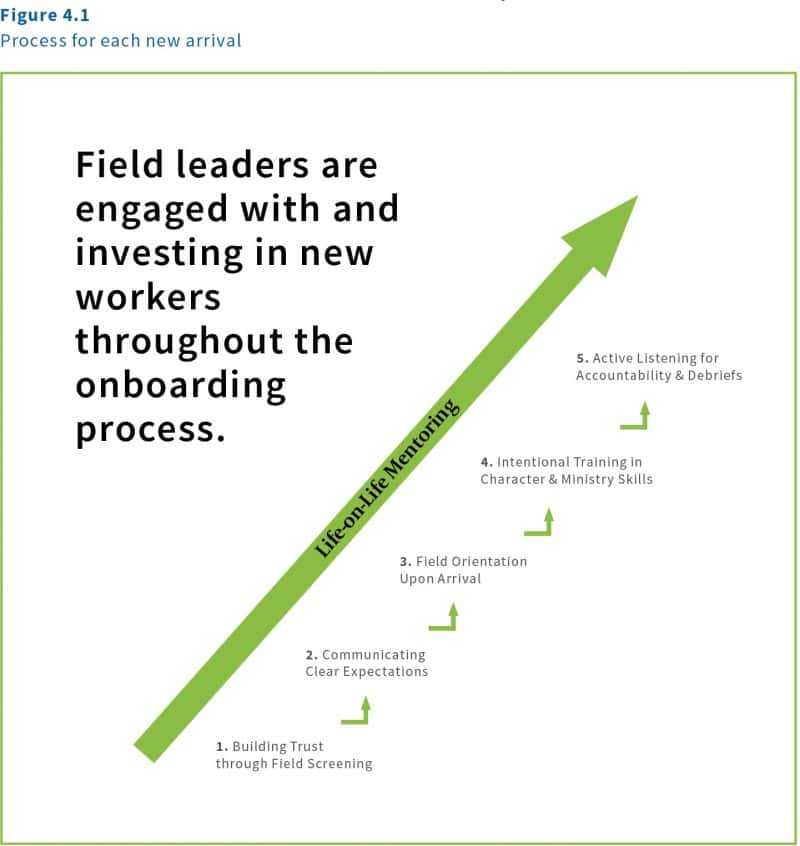
Finally, a clear process would be mapped out for each new arrival. That process would include these steps:
- Building trust through initial screening or evaluation to determine “fit” between the candidate and the onboarding field leadership or team.
- Communicating clear and realistic expectations through initial Skype calls, email communication, a survey trip, and a team covenant.
- Field Orientation for the new arrivals’ first week in country to learn survival information and to help them settle into life on the field.
- Intentional equipping in both spiritual formation and ministry skills. Three key areas of content would make up this equipping stage: spiritual vitality, relational maturity, and ministry effectivity.11 We will discuss these three areas later.
- Active listening for encouragement and accountability through periodical debriefs would help to evaluate the progress of the new arrival through the process of being equipped and prepared for launching into their church planting ministry.
Figure 4.1 helps to see the onboarding process in a glance.
Does Pre-field Training Help New Arrivals?
The immediate pushback from some is: “Should not workers come with these areas already covered?” Yes and no! Ideally, yes, workers should come as well prepared as possible. ReMAP confirmed the high correlation between pre-field training and retention.
But in reality, field leaders are seeing something different today. Field leaders agreed that new workers come to the field today less and less discipled. The exception is normally seen in those who have completed a non-formal program of training, similar to the program with International Project in New York City. “Non-formal, pre-candidate training that looks at character, interpersonal skills and initial cross-cultural entry attitudes and skills is the single most effective way to minimize attrition potential.”12
This phenomenon is being felt across the Global North and the Global South. A respected leader from Africa shared his feeling that new workers are coming today with no understanding of discipleship. When I asked him to clarify, his heartfelt response was: “You are asking a difficult question. Yes, I feel that the responsibility should be laid at the door of the local church … I believe it’s not being fair. Before people arrive on the field, the local church, the theological institutions, and, if possible, the mission organizations ought to have done that homework of discipling, disciple-making, so when they get to the field they will be able to perform.”13 Growing weary of this evolving trend, this leader started his own discipleship initiative for new workers.
One Bible college dean, from a well-known school for training missionaries, told us they ceased being a spiritual boot camp years ago and are today a spiritual hospital.14 A Bible college president commented that they do not prepare people for ministry; rather, their focus is to teach knowledge. The ReMAP II research brought bold clarity to the need for change in how Bible colleges and seminaries are preparing workers. Rob Hay concluded that formal training “is certainly not an adequate training for someone about to embark on cross-cultural mission.”15
Though there is still validity in preparing workers with theory and a foundation in theology and missiology, it appears that Bible colleges and seminaries are not using reflective and experiential training necessary for effectively preparing future missionaries. Only 62% of those interviewed in our research gave credit to their formal training for retention on the field, while 90% cited their non-formal training events as critical, and 100% of interviews referred to mentoring in informal training as a factor for longevity on the field.16 Even those who gave some credit to their formal training qualified their comments by saying it was the life-on-life time spent with professors outside of the classroom that really made the difference.
Are Bible colleges and seminaries hearing these concerns? They can still play a vital role in preparing future workers, but they will need to change their approach if they want to stay on the cutting edge of mission training for the future. “Many of us have become convinced that training new workers in their home land is the most effective way to alleviate these problems. However, this requires a significant shift in attitude by all parties.”17 As an adjunct professor at a Bible college, I’m taking these challenges to heart and I am making the necessary changes. I hope others will also.
Content for the Onboarding Process
Our research suggested three areas of equipping necessary for shaping content for the onboarding process. First, clinging fiercely to God because of His pursuit of us, which I’ll call spiritual vitality. Second, learning how to build healthy relationships in all directions, which is relational maturity. Third, learning how to do effective ministry in context among the unreached, or ministry effectivity.
The research pointed to a new dynamic that mission leaders are realizing today. We can no longer assume that new arrivals will come to the field equipped in these three areas of content. Since character issues are causing people to leave the field prematurely, then we must focus on spiritual vitality and relational maturity while training new workers in ministry skills.
Spiritual Vitality: Cling Fiercely to God
Many people come to the field with their own definition or understanding of God and when their experiences don’t line up as expected, they leave. Death to self is a new topic for many.
The highest factor discovered in our research for retention was a deep pursuit of God with a rich understanding of His character. Spiritual disciplines are critical, but even more critical are the motives behind those disciplines and the goal for the time spent with God. Many of those who have lasted the long haul mentioned “clinging fiercely to God” because of his pursuit of us. There is no place for coasting. This was evidenced by a healthy desperation for the grace of God, and fluency and delight in his Word. Also, workers referred to a rich theology of suffering and a solid understanding of his goodness in the face of impossible trials and setbacks. Finally, they also shared about a true expression of prayer as a mark of integrity of the soul that longs for God, and an obedience to the call of God, no matter where that may lead.
This awareness of the character of God produces the highest character trait for retention in the lives of missionaries, which is a posture of heart in humility and teachability. Some teams and bases look for teachability as the most important character quality when screening for new workers. Field leaders have rejected well-trained candidates because of their lack of teachability. One African base sends candidates to the field for six months and will only accept them if the field leadership sees teachability.
Clinging fiercely to God with a heart of humility way outnumbered every other factor for retention on the field.
Mission leaders have been stressing for years that we must stop assuming that missionaries are doing okay spiritually.18 The Engage research discovered that 58% of missionaries are not asked on a regular basis about “the condition of their soul.”19 The ReMAP II research found that workers find it difficult to maintain a strong spiritual life.20 The first term pushes workers past their normal levels of stress, causing the baggage or personal issues in their lives to surface and send some of them home.
The reality of the challenge began to sink in as my interviews continued. All of the interviews showed that the leaders were in full agreement that the most important factor for retention was a vibrant and robust encounter with God. But the startling realization emerged that field leaders must embrace their role in discipleship with new arrivals. They must teach many new arrivals to read and study the Word, and they must help them to learn to pray again in complete dependence on God.
Relational Maturity: Love One Another
The second area of equipping during the onboarding stage is relational maturity: learning to love one another in every relationship. The challenge of healthy relationships on the field remains extremely important. One agency reported that their top reason for attrition was broken marriages. Parenting challenges have also led to early departures from the field. Others have reported the breakdown of relationships on missionary teams or with national workers.
Building healthy team dynamics while also learning how to build close friendships within the new community is only possible when workers understand and practice relational maturity. Learning how to handle conflict on the field with others is critical. Multiple tools are available to help with this area of equipping.
This whole arena of relationships becomes even more complicated when we bring in the challenge of internationalization. When more than one culture is represented on a team, cultural intelligence becomes vital. There must be a significant measure of grace to receive and love one another, especially when communication is difficult and worldviews clash.
Ministry Effectivity: Making Disciples and Planting Churches
A third and vital part of equipping is ministry effectivity. This involves both character and skills formation. For example, language learning requires self-discipline and deep humility, as a foreigner spends sometimes years to gain a level of fluency that opens the door for ministry. Bonding and becoming embedded in a new culture and community also requires humility and patience. Exchanging one’s former community for a new one and developing deep friendships in a new context can take years. The goal is to understand a new worldview through ethnographic studies. And for new arrivals to realize that culture shock is more rightly described as “self” shock as they come to see their own pride in the face of new cultural values that they must embrace if they are going to ever call their new location “home.”21
When does equipping in ministry begin? Some workers have been blessed to see a church planted during their initial two years on the field—during the onboarding process. Church planting principles should begin to be taught in the first week of orientation, helping missionaries to learn how to live their faith out loud. This “DNA” will mark their entire time on the field for seeing churches planted. As the missionary gains fluency in the language and becomes embedded in the culture and community, more church planting training will equip them for the long term vision of ministry on the field.
Conclusion
The high correlation between retention and onboarding became clear in both the general research and in my interviews with leaders and field workers. God has given us, the mission community, the responsibility to be good stewards of both the lives and finances invested to our care for the worthy cause of equipping new arrivals for seeing the Gospel reach all nations.
As an agency, we are committed to turning this ship around. Team leaders of our church planting teams are being resourced and equipped for receiving new workers. Also, nearly thirty teams are positioned around the world exclusively focused on onboarding new arrivals. A global summit, with representatives from fifteen nations, met together this year to tackle the challenge of receiving, mentoring, and equipping new arrivals to the field. Our agency is starting to see improvement in retention.
The driving motivation behind our commitment to helping new arrivals thrive is the Great Commission. To see new workers lasting the long haul, experiencing retention, and joining the ranks of those who have had the honor of watching God reach a people for his glory.
Are you ready to take another look at how you are receiving new arrivals on the field? Are you ready to mentor and equip them towards thriving overseas? Are you ready to ask the hard questions about how your agency is really doing with onboarding your new arrivals?
It might be hard, but it’s worth it.
Dr. Elliot D. Stephens (pseudonym) has served in Oceania and South/SE Asia in church planting, leadership, and training since 1982. He has recently completed his PhD research on factors for retention in missions today.
Notes:
1 Rob Hay, Worth Keeping: Global Perspectives on Best Practice in Missionary Retention (Pasadena, CA: William Carey Library, 2007), 12.
2 Jim Van Meter, US Report of Findings on Missionary Retention, 2003. Retrieved from http://www.worldevangelicals.org/resources/source.htm?id=95, 3.
3 William Taylor, Too Valuable to Lose (Pasadena, CA: William Carey Library, 1997), 358.
4 Patrick Johnstone, The Future of the Global Church: History, Trends, and Possibilities (Milton Keynes, United Kingdom: Authentic Media Limited, 2011), 227.
5 Elliot Stephens, Factors Contributing to Missionary Longevity (Doctoral Dissertation, Retrieved from ProQuest: https://secure.etdadmin.com/etdadmin/files/863/631141_pdf_A0B90150-FE57-11E8-A62E-E84959571AF4.pdf), 2018, 3.
6 Rob Hay, 3.
7 Patrick Johnstone, 227.
8 Elliot Stephens, 217.
9 Elliot Stephens, 218.
10 Ken Harder & Carla Foote, Help Your Missionaries Thrive: Leadership Practices that make a Difference (Colorado Springs, CO: GMI, 2016), 74.
11 Effectivity is a word! I chose to use “effectivity” over “effectiveness” because it flows better with spiritual vitality, relational maturity, and ministry effectivity! Also, there is a slight difference in the nuance of meaning. Effectivity focuses more on the ability to be effective (https://wikidiff.com/effectiveness/effectivity).
12 Jonathan Lewis as quoted by William Taylor, Revisiting a Provocative Theme: The Attrition of Longer-term Missionaries (Missiology, 30(1), 2002, Retrieved from: https://doi.org/10.1177/009182960203000105), 79.
13 Elliot Stephens, 208.
14 Elliot Stephens, 34-35.
15 Rob Hay, 108.
16 Elliot Stephens, 214-215.
17 Roger Dixon, Framing a New Model for Training Cross-cultural Church Planters. (Mission Frontiers, May 2013, Retrieved from: http://www.missionfrontiers.org/issue/article/framing-a-new-model-of-training-cross-cultural-church-planters).
18 Elliot Stephens, 34-35.
19 Ken Harder & Carla Foote, 10.
20 Rob Hay, 133.
21 Roland Muller, Tools for Muslim Evangelism (CanBooks: 2016, Retrieved from: https://www.smashwords.com/books/view/619104), 19.