
EMQ » April–June 2019 » Volume 55 Issue 3
By Alrena V. Lightbourn and Richard K. Kronk
Equipping and training young leaders who are sensitive to missions to the unreached must be a deliberate exercise in their Christian development. Through teaching, preaching and practical demonstrations, Jesus Christ equipped his disciples for missions, a focus that must become a priority for modern churches. Hence, the purpose of this article is to suggest a basic conceptual approach for engaging in missions to an unreached people group.
Establish Goals of Christian Missions
In the ‘Great Commission’ found in New Testament scriptures, Jesus Christ sends His disciples to all nations[i] throughout the world[ii]. Their biblical mandate specifically required that they: use the very example of discipleship that Christ modeled before them[iii]; baptize converts in the Name of the Father, Son and Holy Spirit; teach them to obey all of Christ’s commands[iv]; preach the good news to all creation[v]; and, preach repentance and forgiveness of sins first to Jerusalem, then to all nations, having witnessed Christ’s crucifixion and the resurrection.[vi]
In executing the mandate, the first apostles exemplified several leadership qualities deemed essential for alignment with the biblical model of Christian missionary etiquette.[vii] Right up front, Christian missionaries must assume a subservient role amongst those served, exuding a pleasant, humble, honest but purposeful disposition. A concerted effort should be made to learn and understand both the language and the culture of the community, making it easier to adapt to the new environment. While not losing sight of one’s own spiritual identity in Christ, the missionary should try to identify with the ethnicity of people, adopting them and their nation as your own. Always keeping the vision of the mission in focus, the missionary should affirm his call to serve as often as necessary, while remaining accountable and responsible for any decisions or measures undertaken.[viii]
Identify and Characterize Your Target Population
A ‘people group’ (“panta ta ethne”) is evangelically defined as “the largest group within which the gospel can spread as a church planting movement without encountering barriers of understanding or acceptance.”[ix] An ‘unreached people group’ within this subpopulation is specifically characterized by the absence of an indigenous community of Christian believers to evangelize the community.
Such is the case with the ‘Chala peoples’, who number 4,400 persons and were identified as one of 111 people groups in the African state of Ghana.[x] Among the Chala, there are only 5% (220) Christians, among whom are at least three of the world’s major Christian groups. Independent (20%, 44), Protestant (20%, 44) and Roman Catholic (60%, 132) denominations make up Christian segments of this community. Only 1% (44) of this indigenous, Sub-Saharan subpopulation is represented by evangelical Christians. The vast majority of the Chala people follow ethnic religions as their primary source of inspiration (93%, 4092), and non-religious practices (2%, 88) persist. Interestingly, there are no Muslims among the Chala.[xi] This unique unreached people group is further classified under the ‘Sub-Saharan peoples’ affinity bloc.[xii]
Survey the Religious and Cultural Diversity within the Geographical Region
The Sub-Saharan region is home to more than 500 million Christians, the third largest in the world, and Ghana contributes 0.8% of this Christian population.[xiii] In contrast, it is estimated that 24 million lost people of Sub-Saharan Africa are without access to the Gospel of Christ via Bibles, radio stations, or even access to Christians[xiv]. Resident within this region, the unreached Chala people group is only found in the Volta Region of Ghana.[xv] Roughly seventy-five percent (75%) of Sub-Saharan people are under 29 years of age and tend to migrate from animistic practices of their villages to a hedonistic lifestyle in the large cities.[xvi] The Chala, however, have not migrated cross-continentally or internationally.[xvii] Based on a relief map, obstacles to travel may include hills, elevations up to 100m, dense national forests, and difficulty crossing the headwaters of the Volta River. The north central location of two Chala communities is within the Volta region (Figure 1), on either side (west and east) of this major waterway.
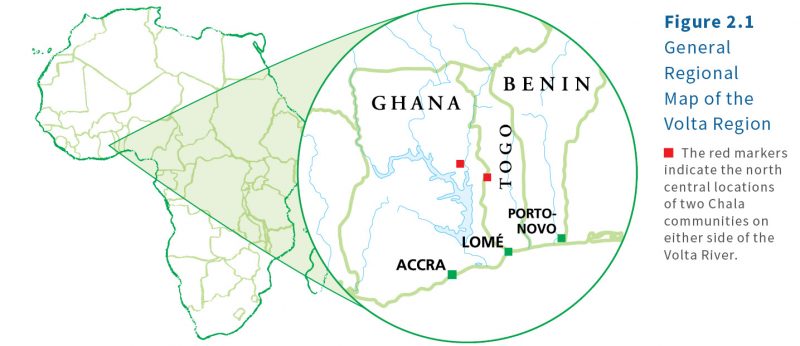
The Middle Volta was not without its challenges, given its longterm preference to exercise religious freedoms. In areas where Islam successfully gained converts, Christianity was weak. However, Muslim clerics who were by practice given to experimentation with spiritual powers failed to convince local cults to join their faith. Instead, they cast aside their Islamic beliefs to become employed as diviners among the local cults.[xviii] In 1995, prospects for evangelism of the Chala became a concern for the Joshua Project, a church planting agency that identified and enumerated the Chala peoples, recording their great need for evangelization and a Bible in their language.
Consider Language Barriers and Discover Ways to Overcome Them
A review of language notes (Ethnologue.com/country/GH) revealed at least two dialects for Chala peoples: Cala and Tshala.[xix] These findings were limited but consistent with the Open Language Archives Community[xx] Resources archives and Max Planck Institute.[xxi] Also identified as the ‘Bagon’, ‘Bogon’, ‘Bokkos’, or ‘Ron-Bokkos’ people (ID#19022), ‘the Chala’ people cluster belongs to a larger grouping of closely related ethnolinguistic peoples, coded ‘NAB56a’, whose principal language is ‘Gur’. The historical, social, religious, political, traditions, beliefs, ethnic practices, and cultural profiles of the Chala tribes are poorly documented.[xxii] The dominant language, Chala, is consistent in both of the two locations (Figure 2) of this people group. Bogon, a Gur language, (Cala) is also referenced by the Mainz University as the corresponding language of record for the Chala.
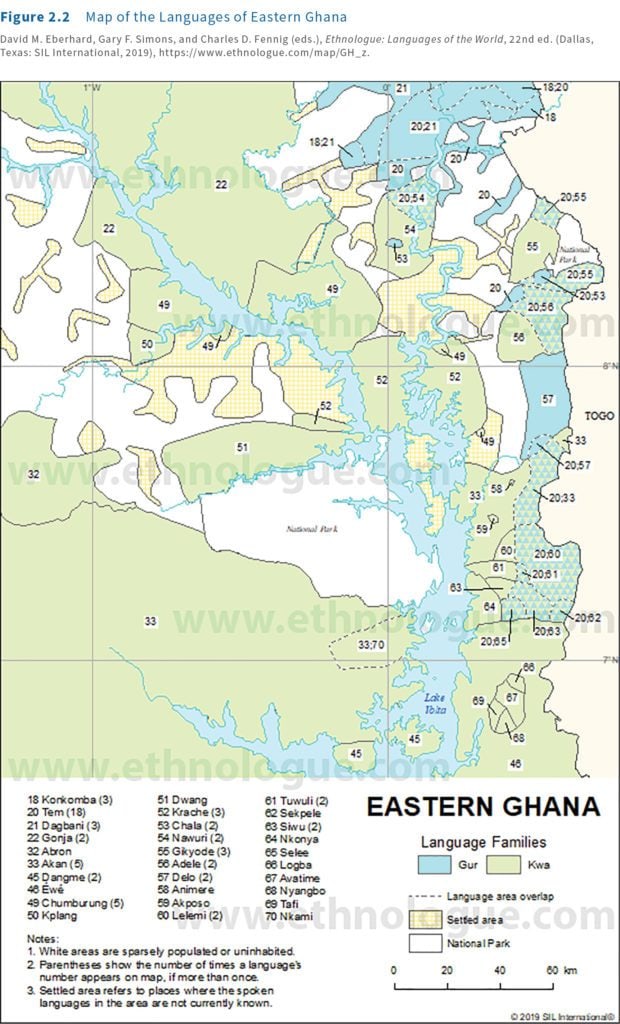
In order to establish a significant Christian community among the Chala, several needs have been identified. There is presently strong emphasis on the acquisition of a missionary worker, skilled in linguistics, to assist with the translation of the English Bible into the mother tongue of the Chala peoples. No count of available English Bibles was found. The Ghana Institute on Linguistics, Literacy and Bible Translation (GILLBT) has listed a need for envisaged Bible translation in the Chala language from scratch.[xxiii] Christian resources available to the Chala included audio recordings of the Bible teaching numerous printed stories, and God’s Story Video.[xxiv] Global Recordings Network is noted as the only organization that has produced media in the Chala language. Efforts to preserve the dominant Chala mother tongue through Bible translation will also impact education and literacy while teaching Biblical principles and building community relations.
Study the Lifestyle, Governance and Ethnic Heritage of the People
Not much is published about the basic culture, society, norms, education, literacy, lifestyle, worldview and values of the Chala peoples. Besides emerging religious efforts to access this people group, much work is needed to document and memorialize their culture, customs, language, internal governance, rules, actual religious practices, and much more. Although a need for Bibles in the Chala language has been expressed,[xxv] local collaborations and access to the community are needed for full characterization. Translating the Bible into the Chala language would improve communication with this community by increasing the level of effectiveness of the ministry of the gospel, and by helping to improve Chala’s understanding of Christ’s mission to share the gospel and bring the blessing of Abraham to all nations.
Explore the Socioeconomic, Education and Health of the Peoples
Regional socioeconomic, education and health trends,[xxvi] were examined in the absence of data specific to the Chala. Poverty is widespread in the northern region of Ghana, and access to transportation, healthcare, and industrial centers is limited. Literacy statistics are not available for the Chala, but at least 76.6% of the national population is considered literate. A greater percentage of persons over 60 years reside in the Sub-Saharan region where life expectancy is generally 67 years old. Healthcare, nutrition, fertility, and infant mortality statistics are not available for the Chala. However, data suggests that a decline in population health may have been precipitated by relocation to coastal areas which are more demanding but better resourced.[xxvii] National public health and environmental information are also not specifically sourced to the Chala. However, within the Ghanaian population, public health concerns include: HIV (1.6% prevalent); food or waterborne disease (e.g., hepatitis A); vectorborne disease (e.g., malaria); respiratory disease (e.g., meningitis); and animal disease carriers (e.g., rabies).[xxviii]
Identify Historic Missions and Previous Attempts at Evangelism
Accounts of Christian missions and previous evangelistic efforts to the Chala deserve careful documentation. Based on denominational distributions above, the Chala have tolerated Christianity only to a small extent.[xxix] It is known that the Chala peoples have already begun to be sensitized to the gospel of Christ through audio recordings of the Bible and video footage about the nature of God. It is likely that translation of the Bible into the Chala language will enhance the missionary work possible in their communities. Support for this effort is building but much of the work is incomplete.
Existing media resources in the Chala language include ‘The God Film’ and recorded stories of the Bible, as well as small segments of the Bible in the Chala tongue.[xxx] Once the language is properly documented, cultural storybooks, leaflets for evangelization, skits/plays, culturally- sensitive religious art, etc. can be designed in conjunction with local artists to reinforce key lessons from the Bible and to demonstrate Chala art and culture. It may also be feasible to incorporate proverbs of Chala origin into these activities.[xxxi]
Propose Initial Evangelism and Church Planting Strategies
Within the first six months of arrival, a missionary should become immersed in observing the language and culture of the Chala people. Through direct interface with existing missionaries, the newcomer can build a network within the community without imposing the values and behaviors from the home country on the peoples served. Prospects for a gospel mission to the Chala peoples is promising, especially since it might involve engaging both communities on either side of the Volta.
As a navigable alphabet and vocabulary are being established, missionaries can work with Chala families to enhance language skills and cognitive abilities within communities by teaching them how to read the Bible. Working with local artists to develop culturally-relevant visual aids would increase participation and perception of biblical stories, making it easier for the group to relate to the gospel and to decide to accept Jesus Christ as Lord. Evangelism targeting individuals (children, adults), small groups, and larger groups can serve as stepping stones to evangelizing the entire community. When tribal leaders recognize a correlation between Chala beliefs and what the Bible teaches, their intervention to help motivate the masses may trigger lasting change (e.g., commitment to Christian faith, church growth and multiplication) that would persist beyond the missionary’s involvement in the community. For a sustainable church presence, however, embarking on structured theological training of candidates within the community would produce church leaders with a solid foundation, thus ensuring impartation of the Truth and accurate interpretation of the Scriptures23.
According to the Lausanne Covenant[xxxii], “to evangelize is to spread the good news that Jesus Christ died for our sins and was raised from the dead according to the Scriptures, and that as the reigning Lord He now offers the forgiveness of sins and the liberating gift of the Spirit to all who repent and believe.” Application of the ‘Unique Solution Strategy’ would allow missionaries to tailor the evangelization experience to the peoples and their culture. With planning and the leading of the Holy Spirit, the missionary team can learn from the mistakes and accomplishments of the past and move progressively forward to achieve set goals.
On hearing and receiving the gospel message, a spiritually convicted Chala assembly is expected to gravitate toward the drawing of the Holy Spirit. Their decision to accept that God wants them to follow Him wholly, abandoning all allegiances to traditional religious and ethnic practices, would then make way for the Chala to participate in God’s mission to share the gospel to all peoples. On embracing the greater spiritual redemption Jesus Christ affords those who receive Him as Lord, the Chala necessarily accept the blessings of good news for the poor, release for captives, sight for the blind, and freedom for the downtrodden[xxxiii] should trigger repentance. Solid teaching of the Word in simplified, native language, and using cultural art forms to illustrate Biblical themes, will help to paint a clearer picture of what the missionary is sharing. Those who come to Christ must continue to be taught and nurtured, and their ability to read and interpret the Bible accurately is a hallmark of evangelistic efforts. Through prayer and fasting, the missionary can be available to facilitate these and other transformational changes in the lives of the Chala peoples, recognizing that it is the Holy Spirit (and not self-effort) that is guiding the process and finishing the work in the individual and in community. This is one approach that could result in an initial evangelism effort being effective.
Identify Opportunities to Partner with Global Christian Organizations
Organizations with access to the Chala peoples include: GILLBT, GRN, the Joshua Project, and SIL. Bible translation may be accessed through partnership with Wycliffe Translators. Support from international funding agencies and mission societies is available to either initiate or advance missions. Collaboration with the business community in the missionary’s home country could be one mechanism of promoting entrepreneurship, economic self-sufficiency, and sustainability as community infrastructure expands according to mission. Peculiar among the Chala is the notion that converting to a major world religion like Islam or Christianity is like joining another tribe.[xxxiv] They expect strict adherence to their sayings within the culture[xxxv], which suggests the existence of strong leadership and perhaps a severe punitive system for keeping order in their communities. Hence, strategic collaborations with local government and churches within Ghana will reinforce the overall effort and create an opportunity for community and government leaders to participate as stakeholders in matters of national concern (i.e., preserving the legacy of the Chala peoples).
Conclusion
Missionaries are often encouraged to carefully examine their call to serve an unreached community through persistent prayer, fasting and steadfastly seeking God’s guidance for a clear and specific vision for a Christian mission. Without doubt, an exciting opportunity exists for evangelistic outreach to the Chala peoples of Sub-Saharan Africa, bringing transformation and lasting change through the Gospel of Christ.
Dr. Alrena V. Lightbourn studies Bible and missions at Tallahassee Christian College & Training Center. Dr. Richard K. Kronk serves on the Cross-Cultural Studies academic team at Toccoa Falls College.
[i] Matthew 28:18-19
[ii] Mark 16:15
[iii] John 20:12
[iv] Matt 28:18-19
[v] Mark 16:15
[vi] Luke 24:46-48
[vii] Roosevelt Rogers, J.R. (2015). My Role as a Christian Missionary: Engaging in Christian Work. Accessed online in 24 April, 2019 at: https://books.google.com
[viii] Todd, C. (2013). Project Manager Reveals ‘Whole Life’ Approach (Richard Zanner). NT News, p. 404. Accessed online on 24 April, 2019 at: http://careerone.com.au
[ix] Winter, R.D., and Koch, B.A. (2009). Finishing the Task: The Unreached People Challenge. In: R. Winter and S. Hawthorne (Editors), Perspectives on the World Christian Movement, 4th Edition, William Carey Library, p. 536.
[x] The Joshua Project (2018). Chala: Unreached People Group. Accessed online on 29 March, 2018 at: https://Joshuaproject.net/people_groups/19022
[xi] Global Prayer Digest (GPD) (2017). The Chala People of Ghana. Accessed online on 27 March, 2018. http://www.globalprayerdigest.org/issue/day/chala-people-of-ghana/
[xii] The Joshua Project. Chala: Unreached.
[xiii] Kabutz, R. (2011). Engaging the Church in Africa in its Key Mission Issues to 2050: The impact of Cape Town 2010. Lausanne Global Analysis. Accessed online on April 20, 2019 at: https://www.lausanne.org/content/lga/2015-11/engaging-thechurch-in-africa-in-its-key-mission-issues-to-2050. United States Government, Department of Defense, Central Intelligence Agency (CIA) (2018). World Fact Book Online. Accessed online on 27 March, 2018 at: https://www.cia.gov/library/publications/the-world-factbook/.
[xiv] International Mission Board (2017). Sub-Saharan Africa Peoples: Prayer. Richmond, VA.
[xv] The Joshua Project. Chala: Unreached.
[xvi] International Mission Board. Sub-Saharan Africa Peoples
[xvii] The Joshua Project. Chala: Unreached.
[xviii] British Broadcasting Corporation (BBC) World Service (2018). The Story of Africa: Christianity. Accessed online on 6 May, 2018 at: http://www.bbc.co.uk/worldservice/africa/features/storyofafrica/index_section8.shtml
[xix] Simons, G.F. and Fennigs, C.D. (Editors) (2018). Chala. In: SIL International, Ethnologue: Languages of the World, 21st Edition. Accessed online on 27 Mar. 2018 at: http://www.ethnologue.com
[xx] Open Language Archives Community (OLAC) Resources archives (2018). Accessed online on 27 March, 2018 at http://language-archives.org
[xxi] Max Planck Institute for the Science of Human History (MPI) (2018). The Chala People: Glottolog 3.2 – Resources for Chala. Accessed online on 27 March, 2018 at: oai:glottolog.org:chal1269
[xxii] McDonnell, J. (2012). Re-Theorizing the Integral Link Between Culture and Development: Exploring Ghanaian Proverbs as Theoretical and Practical Knowledges for Development (Thesis). Ontario Institute for Studies in Education, University of Toronto.
[xxiii] Ghana Institute of Linguistics, Literacy and Bible Translation (GILLBT) (2017). Chala. Accessed online on 27 March, 2018.
[xxiv] Global Recordings Network (GRN) (2018). Audio Bible Teachings. Accessed online on 27 March at: http://globalrecordings.net/langcode/cll
[xxv] The Joshua Project. Chala: Unreached.
[xxvi] The World Bank (2018). Ghana: Country Profile. In: World Fact Book. Accessed online on 27 March, 2018 at: http://Worldbank.org. International Mission Board (2017). Sub-Saharan African Peoples: Prayer Needs Accessed online on 23 April, 2019 at: http://www.imb.org .
[xxvii] Global Recordings Network. Audio Bible Teachings.
[xxviii] International Mission Board (2017). Sub-Saharan Africa Peoples. Global Recordings Network. Audio Bible Teachings.
[xxix] The Joshua Project. Chala: Unreached.
[xxx] The God Story Project (GSP) (2018). Orality. Accessed online on 27 March, 2018 at: http://Oralbibleresources.com/shopcart/productTeachingEvangelismMaterials.asp
[xxxi] Kleinewillinghöfer, U. (2006). Chala: A Language of Ghana. SIL International. Endangered Languages Documentation Programme, Endangered Languages Archive. Accessed online on 23 April, 2018 at: http://www.language-archives.org/item/oai:ethnologue.com:cll. Kleinwillinghofer, U. (2007). Bogon aduuna na bind atawisa: A collection of proverbs and wise sayings of the Chala people. University of Ghana, Accra.
[xxxii] Winter, R. and Hawthorne, S. (1974). Congress on World Evangelization: The Lausanne Covenant. Perspectives on the World Christian Movement, edited by, 4th edition, 1974, Switzerland, p.765
[xxxiii] Isaiah 61:1–2
[xxxiv] Global Prayer Digest. Chala People of Ghana.
[xxxv] Ullrich, K. (2007). Bogon Aduuna na Binde Atawisa: A Collection of Proverbs and Wise Sayings of the Chala People. Institute of African Studies, University of Ghana.




