
EMQ » April–June 2018 » Volume 54 Issue 2
[memberonly folder=”Members, EMQ2YearFolder, EMQ1YearFolder”]Ambassadors for the King to the Muslim world must be equipped to give an answer for the hope that lies within (1 Peter 3:15). We are taught that we must contend for the faith (Jude 3), and that we must take every thought against the knowledge of God captive under Christ’s authority (2 Corinthians 10:5). Every missionary to the Muslim world wrestles with how to approach their Muslim friend when confronted with objections that strike at the very authority and core message of Christianity.
Over the years I have identified five major Muslim objections to Christianity as follows: (1) The allegation that the Bible has been changed or corrupted (Tahrif il Lafzi). (2) The doctrine of the Trinity is really tri-theism. (3) The claim that Christ’s deity is committing shirk or attributing deity to something that is not. (4) The doctrine of the crucifixion or suffering of Christ is impossible because God would not allow his prophets to suffer. (5) The doctrine of the atonement is unjust because one must pay for one’s own sins.
Since 1998 I have been engaging with these Muslim objections: first with my Turkish brother-in-law, and then later with my Pakistani brother-in-law. My engagement deepened even more with my move to Turkey in 2002, and became more refined later with a completion of a MA in Muslim studies from Columbia International University. However, it was not until I was introduced to Reformed Presuppositional Apologetics (hereafter, RPA) at Reformed Theological Seminary that I began to see that many of my methods were neither faithful to Scripture nor historical Christian apologetic models that were employed with Muslims.
I remember answering Muslim objections that the Bible has been changed or corrupted using the methods suggested to me in the past. I would spend hours with my Muslim friends explaining the manuscript evidences for the Bible, and I would draw out charts that would explain the canon of the NT. I would have them look at their own Qur’an and show them that the Qur’an said our books were valid, and challenge them to search out all we discussed. Although everything I said to my Muslim friends was true and might sound compelling, it rarely ever led them to further study or a true desire to search out the Scripture.
It was later, after being immersed in the language and culture, that I learned the Muslim culture does not generally emphasize critical thinking, rarely scrutinizes evidences, and generally does not question authorities. If I quoted a verse from the Qur’an concerning an objection they believed it was a “Christian missionary version” of the Qur’an that I was using and they would ignore what was said. Even if they would ask their Imam about the verse, they were told not to question the Qur’an. They also would not ask me a clarifying question if they did not understand (as one should not interrupt a teacher), and would sit patiently until I was finished.
When I was introduced to RPA I began to realize that I had previously failed in my apologetics fundamentally in two respects: I did not honor the Bible’s view of itself, the biblical God, and I did not get at the heart of the issue, being ultimate authority.
I also realized that missionaries are generally not using a Presuppositional Approach with Muslims (hereafter, PAM) in their apologetics, precisely because this approach has not been written about, articulated, or been made readily accessible to them. Generally syncretistic, historical, and archaeological evidences are often employed to persuade the Muslim.
When I began to understand Reformed Presuppositional Apologetics, I began to apply the principles with Muslims. It was then that, instead of spending literally hours with a Muslim answering the objection to the corruption of the Bible or others, I would spend five to ten minutes and see an immediate connection with the Muslim and understanding of the issues at hand. I also found that this model had a strong biblical framework, was easy to teach, and I was able to better fulfill my task of equipping the saints. After my students learned this model, they would not feel overwhelmed, but rather equipped and encouraged to engage with Muslims.
The most complicated component to this model that I have found is its own name—“Reformed Presuppositional Apologetics.” This in itself may be a reason it is generally not known or used as it sounds highly academic and intimidating.
What is Presuppositionalism?
The force behind this method is that one must presuppose the existence of the Christian God and the authority of Scripture in order for any fact of human experience to be intelligible.1
I believe there are two premises that RPA is based upon: (1) A high view of God and Scripture, which is a commitment of the heart to the Lordship of Christ and his word. and (2) A low view of man and his inability, which recognizes man’s total depravity and spiritual inability.
There are four major features that undergird RPA: (1) There is no neutral ground with a Muslim and all facts must be filtered through the lens of Scriptures. (2) Making use of the sense of the divine that is inherent in the Muslim, yet at the same time recognizing their suppression of truth. (3) Muslim objections are answered in light of the ontological Trinity, and (4) Christianity as defended as a unit based upon the authority of the Scripture.
When applied to Muslim objections I refer to this model as a Presuppositional Approach with Muslims (PAM). The same principles of argumentation from Reformed presuppositionalism are applied to Muslim objections. Presuppositionalism has traditionally been used in the context of atheism, and the first step is to move away from disbelief in God and move towards Christian theism. The first step of the PAM approach is to move away from doubting the infallibility and authority of the Bible.
The Two-Step Approach of PAM
There is a two-step approach to Reformed Presuppositional Apologetics when used with Muslims. Greg Bahnsen summarizes the presuppositionalist approach in his book Van Til’s Apologetic, “apologetics is to move beyond the recognition of the presuppositional nature of the disagreement between the believer and the unbeliever and shows whose presuppositions are correct.”2 This first aspect of presuppositionalism, negative apologetics, Bahnsen describes as requiring the apologist to take the offense.3 The offensive is described by both Van Til and Bahnsen as “removing the foundation of the unbeliever’s argument.”4 Thus in presuppositional apologetics there is a strong focus to reduce the unbeliever’s worldview to absurdity.5
The second aspect to PAM is the positive apologetic and that is presenting the faith of Christianity as the only viable option to the Muslim worldview and authority. Bahnsen explains that it is presenting “the Christian worldview to be true from the impossibility of the contrary.”6
Step One: PAM Positive Apologetic
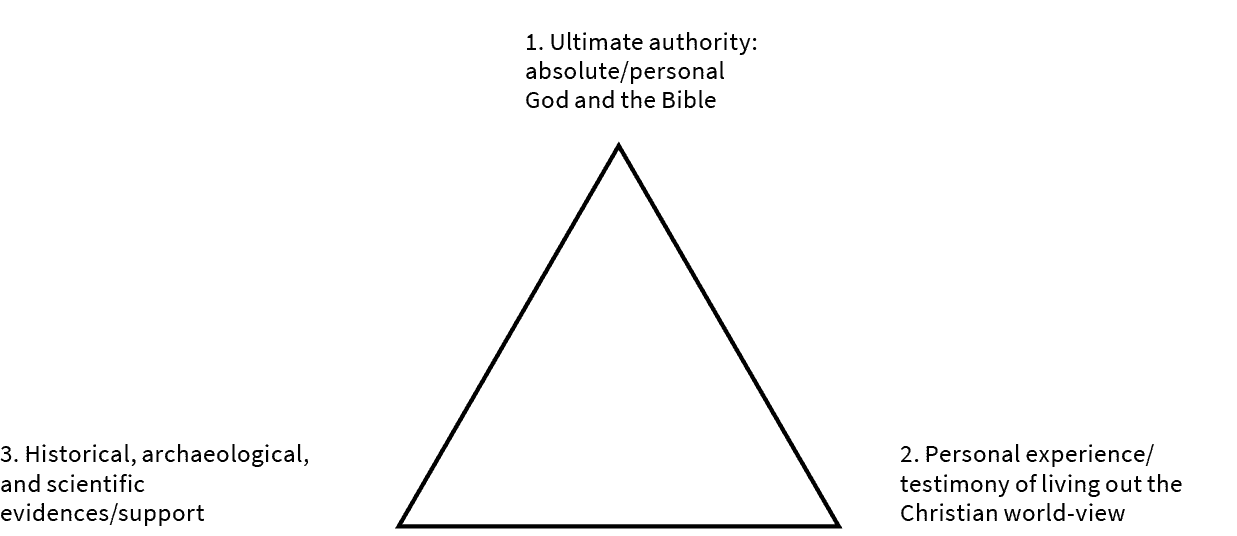
The positive apologetic aspect of PAM has three features. PAM primarily focuses its defense by (1) appealing to Christianity’s absolute authority; the biblical God and His revealed word, (2) using the Christian’s testimony and life experience to demonstrate they are living with no contradiction to their authority, and (3) examining historical, archeological, and scientific evidences that also attest to the truths found in the authority.
The three features of PAM are to be used to show the consistency, rationality, and superiority of the Christian worldview. This is to be done after the Muslim’s foundation has been shown wanting and that in fact, Muslims in many areas have been living according to the Christian worldview. The apologetic or positive side to PAM is to give them the only replacement they can have to their faulty system and present a clear gospel message.
Step Two: PAM Negative Apologetic
The PAM negative apologetic challenges three areas of the Muslim faith. (1) The Muslim’s ultimate authorities that shape Islam’s worldview and religion are critically examined.7 (2) PAM assesses the testimony that should be experienced out of strictly adhering to Islam’s ultimate authorities, and points out any contradiction that may lie within. (3) PAM examines historical, archeological, and scientific issues inherent in Islam. These three areas are to be examined and attacked for their inherent inconsistencies.
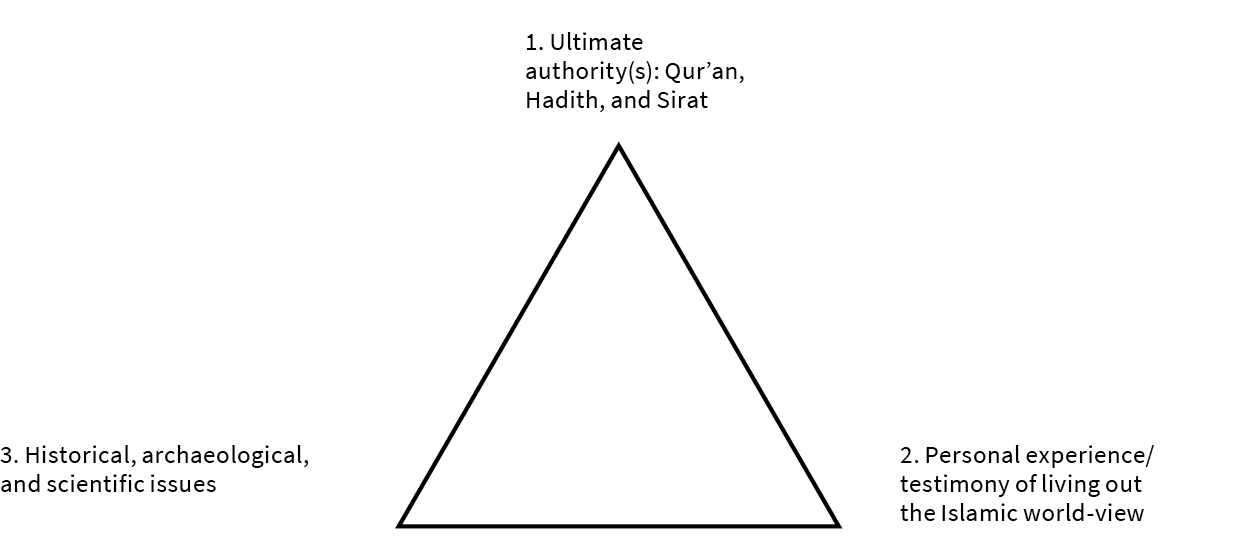
There are three features of the PAM negative apologetic and each point is to be examined and attacked for its inherent inconsistencies. The focus for PAM in both aspects of negative and positive apologetics however is aimed at the ultimate authority.
The negative aspect of the PAM argument is to evaluate where a Muslim’s worldview collapses on itself. The method seeks to do an internal critique of all three areas mentioned in the negative apologetic. This challenges the Muslim according to their absolute authority, and can be used to demonstrate that their worldview is irrational and incoherent. PAM shows the negative aspects of Islamic teaching and presents to the Muslim the logical conclusions, which must follow if lived out strictly according to their sources.
PAM can appeal to the laws of logic and moral absolutes when speaking to the Muslim especially in regards to their notion of a tawhidic God. For example the Unitarian concept of God cannot give account for an eternal, loving, personal, communicating, and relational God. When challenged that God is eternal, loving, personal, and communicating, Muslims would affirm this. However, the question is for God to be personal, communicating, and loving, in eternity past with whom did God love, communicate with and relate to personally? Only plurality in the Godhead adequately answers this question.
PAM posits to Muslims that they are living inconsistently with their primary sources, and in fact, whether they are aware of this or not, they are borrowing from the Christian worldview. After presenting the negative aspects to the Muslim, PAM presents the antithesis to their worldview and explains how for the Muslim to live and think rationally he must adopt the Christian worldview. The reductio ad absurdum (reducing their view to absurdity) is to be used in all three areas of the PAM negative apologetic.
Example of the PAM Negative Apologetic8
When answering the objection that God’s word has been changed or corrupted I suggest the apologist begin quite forcefully and passionately, for example:9
I cannot believe that you would insult God by suggesting that finite, mortal men could change an infinite all-powerful eternal God’s word. You are diminishing the true God’s power, authority, and sovereignty. I cannot believe you would have such a low view of God and high view of man. This is absurd at best and blasphemous at worst. If God has allowed his word to be changed in the past, how do you know with certainty the Qur’an you possess today is trustworthy? How can one know with certainty that God will not allow this again in the future?
A few simple questions can be asked by follow up, concerning the nature of God:
(1) Do you believe that God is eternal? (2) Do you believe that God changes? (3) Do you believe that God’s word is separate from himself or a part God’s being? If it is a part of who God is, then it necessarily means that God’s word is eternal. (4) Do you believe that God is all-powerful and infinite? (5) Do you believe that God is all good and wise?
These questions appeal to the sense of the divine in the Muslim (Rom. 1:18–23).
On the mission field the apologist sometimes has only a few precious minutes with a Muslim. In the city of Istanbul with a population of around twenty million a missionary could encounter several Muslims a day: on the boat, on a bus, on a train, in a taxi, or sitting in a tea garden. Since this objection is the most common and most fundamental, and the window of opportunity may be very short, it is imperative that the apologist/missionary be equipped to speak truth to the Muslim and challenge him.
The above argument of the PAM method is very practical and challenging for the Muslim. Of course, time permitting, one could go into the other aspects of the PAM method, which would be extremely helpful. I would suggest that after challenging the Muslim in the areas of their ultimate authorities (the Qur’an and Allah), the missionary then give their Muslim friend a copy of the Bible and encourage him or her to read it.10
Example of the PAM Positive Apologetic
The PAM apologetic approach forces the Muslim to either accept the Bible as authoritative, in which case they must submit to its teachings, or reject the authority of the Bible. This makes Reformed Presuppositional Apologetics (RPA), as Van Til said, a defense of Christianity as a unit. The Muslim challenge of biblical authority is the most important objection to answer when speaking to a Muslim. If the Bible is authoritative that necessarily means that the Qur’an is a lie and Islam is a false religion, since their message and morals are antithetical to each other. The Muslim’s system therefore would need to be discarded and replaced so as to come under the authority of Jesus Christ.
If the Muslim decides that he will reject the authority of the Bible, he is faced with the following dilemmas: (1) He must come to terms with rejecting the verses of the Qur’an that assume the opposite. (2) He must deny that God’s words are eternal. (3) He must live in doubt concerning the validity of his own book. (4) He must recognize that the Islamic God can change, is not good, is not wise, is not sovereign, is not all-powerful, is not absolute, deceives people, and is not trustworthy. (5) If he is intellectually honest he will be forced to search out when the so-called corruption took place and present the evidence.
If the Muslim understands and submits to the authoritative nature of the Bible he will not utterly dismiss the Trinity, the deity of Jesus, and the crucifixion as an atoning sacrifice. The Christian apologist then will take the time to go through Scripture and explain these doctrines and show their centrality to the Bible (Tawrat, Zabur, and Injil) and that this was how God chose to reveal himself and his plan. The fulfilled prophesies concerning Jesus are also compelling and may be used to attest to the reliability and authority of the Bible.
Conclusion
The PAM model is also practical in the sense that it can be explained in two simple steps, that is the negative and positive apologetic, each with three areas. The negative apologetic includes an internal critique of authority, an experiential challenge, and an evidential challenge. The negative arguments presented against the Qur’an, hadith, sirat, Muslim experience, and evidences, reduces the worldview of the Muslim to absurdity. The positive apologetic includes the claim that only the Christian worldview offers a coherent system of faith and practice and is the only alternative to the Muslim worldview. The biblical God and his word are authoritative and harmonize with human experience, laws of logic, morals, and can evidentially be verified.
The Muslim objection that the Bible has been changed or corrupted, is foundational for the Muslim because it is from this false doctrine that all other objections to Christianity stem. Once the authority of the Bible is established, the Trinity, lordship of Christ, the atonement, and other disputed doctrines can be easily explained to the Muslim upon the authority of God’s unchanging word, thereby defending Christianity as a unit.
The Muslim, challenged by the presuppositional method, will be presented with a faith that does not rest in the wisdom of men or plausible arguments. The faith imparted will present the biblical God and his word for what they are, the ultimate authority and foundation of the Christian faith. The BMB’s discipleship and theology will also be founded on the premise that Jesus Christ is Lord and his word is authoritative and should be obeyed.
Yakup Korkmaz (pseudonym) has been a church planter in Turkey since 2002. BS Pastoral Studies, Clarks Summit University, MAR, Reformed Theological Seminary, MA Muslim Studies, and PhD student at Columbia International University.
Notes
1. Cornelius Van Til, The Defense of the Faith (Philadelphia, PA: The Presbyterian and Reformed Publishing Company, 1955), 48–49.
2. Greg L. Bahnsen, Van Til’s Apologetic: Readings and Analysis (Phillipsburg, PA: P & R, 1998), 108.
3. Bahnsen, 108.
4. Bahnsen, Van Til’s Apologetic, 108; Cornelius Van Til, An Introduction to Systematic Theology (Phillipsburg, NJ: P & R, 1979), 7.
5. Bahnsen, Van Til’s Apologetic, 111.
6. Bahnsen, 113.
7. The primary source for authority for all Muslims in the world is the Qur’an. For Sunni Muslims the second source of authority would be the six accepted Hadith. The third category of literature utilized is the Sirat or the biographical stories of the life of Muhammad. More importantly Muslims tend make up their own version of Islam via folk stories or convenience to fit their life-style and beliefs. The majority of Muslims I have encountered make up their own version of Islam according to what they think Islam should be or their version is a mix and match of philosophies, folk religion, Christianity, and is highly syncretistic. Their version generally resembles nothing of what their primary sources actually teach.
8. This is not an exhaustive illustration of how PAM is used and only presents a small aspect of the method.
9. This direct approach may seem offensive to Westerners, however Muslims will only respect people who are passionate about what they believe, and passion in Muslim culture often comes out in “heated” debate. I have been in many conversations with Muslims while my Western friends listen in horror (not understanding Turkish) and thinking a fight could break out at any minute, only to see us (the Muslim and I) embrace each other later.
10. I suggest that the apologist should bring up the Muslim claim that the Bible has been changed and corrupted first. This breaks the ice and gives you an opportunity to speak the truth about this and give them further resources about the subject. Nearly every Muslim I have ever met with has never even seen a Bible, much less read it. This will be the first time the Muslim will have ever seen a Bible and now they have been presented with valid arguments concerning why they must read it.
Article




