
EMQ » April–June 2018 » Volume 54 Issue 2
[memberonly folder=”Members, EMQ2YearFolder, EMQ1YearFolder”]The Holistic Worldview Analysis (HWVA) strategy is a holistic development strategy that engages closely with a community to understand its survival strategy and then works towards strengthening it so that the community is able to solve most of its own problems. While this concept should excite most people by the way in which it engages with the community, building on the ownership and capability they already have; it often doesn’t find common ground with those that believe development is a top down process.
HWVA Explained
The use of the HWVA strategy is part of a larger overarching strategy called the W3P7 strategy which is a holistic and integrated development program developed by the author for Integral mission. The core principle in implementing the HWVA strategy is to work with an identified community and find out what their ‘survival strategy’ is. This is done using the HWVA tool. The
HWVA tool consists of first identifying and tracking the community’s revenue stream and secondly looking at the range of problems they encounter. Both the revenue stream and the problems that a community faces fluctuate with the future uncertainties they encounter, so this becomes the third dimension that is explored and understood.
All three of these dimensions go towards developing the HWVA of the community. The HWVA tool was developed by the author in the early 2000s after field testing it in multiple countries and contexts. Once the HWVA of the community has been determined, it forms the core of the development program, because the HWVA is a visual snapshot of the ‘survival strategy ‘of the community.
Table 10.1 What W3P7 stands for
|
W3 |
P7 |
|
|
Works Word Wonders |
Strategic prayer for the community (4 level) God’s people on the ground Prayer for healing of the land Plan of action implemented |
Powers of darkness confronted Partnership with the local church Partnering with God in what He is doing |
The work of engaging with the community in a new area, involves first identifying the community’s own resource persons. These are essentially members of the community that have a special concern for their community. They are ordinary citizens from that community and may or may not have an official position in it, but they are definitely people whom the community values and respects. The process is initially facilitated by an outsider who is well versed with development strategy and participatory development. Ultimately, the community takes over the process. The external facilitator enables the following through active community engagement:
- Identify priorities for development through the HWVA and number them for future tracking. The priority ranking once established at the beginning of the project (baseline), becomes the final code for the rest of the project.
- Help analyze each of the development priorities to see if they are ‘capacities’ or ‘vulnerabilities’ and coding them green (capacity) or red (vulnerability).
- Establishing a development response plan for each development priority and based on the impact it will have on completion, slot it under one of the three impact objectives as appropriate: Promote holistic well-being, prevent disease and mitigate disasters, and provide an appropriate intervention to alleviate an immediate problem.
- Enable the development of a Gantt chart to plan the activities through the calendar year and from which it is very easy to calculate costs and develop a budget.
- Help the community identify and mobilize resources to support the development plan.
Once this core information has been developed, the information is displayed at a prominent place in the community (clinic/office/meeting space) and all members of the community are encouraged to study and understand it. Sometimes the community uses a big banner to display the HWVA, while others have it on a poster, or painted on the wall of their meeting room. Development activities then start off in the community with the core group leading the process and the external facilitator acting as a catalyst and technical support, encouraging the process, and helping solve problems when they arise. Even if the leadership group changes over a period of time (1–3 years), care has to be taken to ensure that the leadership core is populated by active members.
New members are trained by former ones or by the external facilitator on how to carry out the following:
- Livelihood or revenue analysis
- Problem or challenge analysis
- Uncertainty analysis
- Holistic Worldview Analysis (HWVA)
- SSEI (Survival Strategy Empowerment Index)
- CCEI (Corporate Community Empowerment Index)
- VCI (Values Change Index)
- Documentation of progress against plan of action
Philosophy and Development Framework
The core philosophy of the program is the recognition that every community has its own development priorities and that good development practice must recognize this and engage with the community to enable it to carry out its own development priorities. When this is done correctly, there is ownership of the goal and process remains sustainable. When the goals are achieved, and even when the community is moving toward achieving them, the community gets empowered. An important principle in the process of engagement with the community is to always be conscious that the external person facilitating the development ‘is participating with the community in its development priorities’ and not vice-versa. Interventions therefore are only in the areas where there are shortcomings of technology, or resources or skills.
For the first phase of the project, if a program is not a part of the community’s survival strategy (as portrayed by the HWVA) it is not taken up for development. These resources in a rural project are usually land for agriculture and households, water, forests, livestock, grazing fields, etcetera. The community then identifies skills that they have to interact with the stock of resources to produce livelihood in alignment to the stakeholders’ (the original residents of the community) interests. When skills from within the community itself (innermost circle of the HWVA—showing what the community controls) are inadequate to effectively utilize community resources, they enter into informal partnerships with “outsiders” to make up for the inadequacies. This is seen very clearly in the second circle of the HWVA, related to the areas controlled by outsiders.
This process is referred to as an emergent survival strategy, with additions continuing to take place progressively. As this survival strategy emerges, areas develop that the community is unable to find ‘outsiders’ to help. It then adds the ‘supernatural’ to the mix of partnerships to ‘take care of the gaps in the survival strategy’. (The ‘supernatural’ dimension consists of the ‘local gods, spirits and the community’s ancestors.’) Since they have no other options, this becomes the survival strategy of the community and is reflected in its worldview. While this emergent survival strategy may seem ‘strange’ to outsiders, it is a very real thing to the community—a combination of relationships, permutations, and combinations of the empirical and supernatural world to make up their survival strategy. The 4 ‘S’s (Stock of resources, Skill base, Stakeholders interests, and the engagement with the Supernatural in the community) thus complete the integrated and holistic survival strategy of the community that can be seen reflected at a given point of time in the HWVA of the community. Development agencies must recognize and understand this reality of the community to be able to engage with it effectively and address issues of transition.
Core Components and Critical Characteristics
The HWVA is therefore a core component of the process. In launching a program in a new area, the first thing that is carried out is a HWVA. This is done, as mentioned earlier, with the core group who must become very familiar with the technique and share it with the rest of the community. After the HWVA is developed and the development priorities are identified, responses for each of these are identified by the community with support from the agency facilitating the process, and this is then developed into a log frame with activities and outputs.
From the activity list a simple Gantt chart is developed to show when various activities will take place and from this the budget is determined. The impact objectives for the program cover three key areas, namely:
- Holistic well-being and security of livelihood promoted
- Diseases prevented and impact of disasters mitigated
- Appropriate external intervention introduced to solve any immediate problem so that the program gets a boost at the start.
While the three impact objectives generically are the same for every program the development priorities that result in achieving these extremely generic impact objectives will vary a great deal based on the needs and context of each community. From the start, the community is shown how to ‘measure all that matters.’ Like everything else mentioned as being a critical component of the program, tracking progress and the ability to analyze progress or the lack thereof is also critical. Each success brings about greater community engagement and empowerment. The community leaders soon begin to recognize what is important for their progress and even start learning to say “no” to things that don’t help them strengthen their survival strategy. They thus become active engagers and planners rather than passive recipients. The leadership core is also encouraged to be on the look-out for resources to resource the development plan. It is for this reason that care must be taken initially to keep the program budget as small as possible so that it operates on ‘demand pull’ rather than ‘supply push’ as with several top down programs. When all these precautions are taken to ensure that the core components and critical characteristics are addressed, the program grows and blooms to the fullness of its potential.
Strategy for Site Selection Process and Identifying Development Priorities
Site selection is a very important part of the process and this is where alignment takes place with the facilitating organization’s priorities. If an organization is focused on health, it should choose to identify its program in areas where there is high disease incidence. Alternately high poverty, low or sub-standard infrastructure, and places that are generally marginalized and neglected could be other areas of focus. Such places are also areas where there are unreached and underserviced people groups. It’s very important to realize that the context of each community is different hence the response cannot be a cookie cutter program.
Once an area is identified for a potential project, the most strategic community in the area is selected, and an initial reconnaissance visit to meet the people is initiated. The community leaders are met to explain the strategy and concept behind the program. If the village or community is interested in working with the organization initiating the program, they are asked to identify a ‘core group’ of persons from among them who are all residents and key stakeholders in the development of their village or community. This core group becomes the leadership core or the first interface group with whom the initiating organization works. The facilitator should be familiar with the strategy and well versed in participatory development. The first task undertaken as a group (core group and the external facilitator) is a needs assessment. The group is trained on how to perform the assessment and then it is carried out in the village.
The participatory tool that is used is referred to as the HWVA. The precursors to this exercise are:
- Problem analysis of the community as a whole
- Uncertainty analysis, which helps understand fluctuations likely to occur in the community’s revenue, changes in the status of the problems that the community faces, and the risks that the community faces with reference to its survival strategy.
- Revenue stream, which analyzes the livelihoods to determine the sources of revenue in the community
Community development essentially involves engaging with this survival strategy to strengthen it. Since this is what the community has been trying to do as a corporate whole, everything done to strengthen the survival strategy of the community serves to empower it.
Impact and Impact Objectives
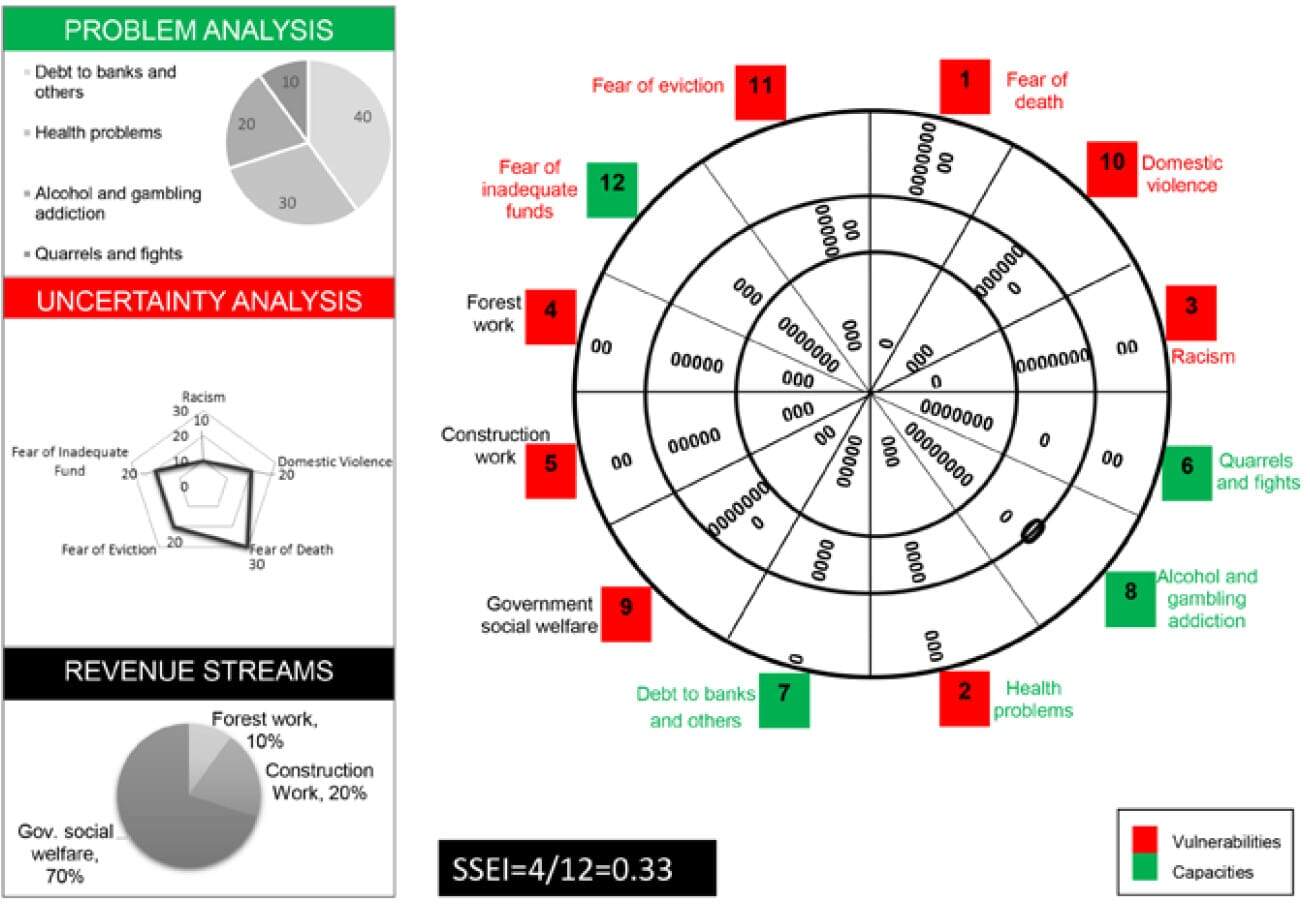
The first and most important impact to measure is the extent to which the Survival Strategy of the community has been strengthened. In this example of the HWVA of a community from Slovakia (see figure 10.1), one can see the development priorities listed from 1–12. (This of course will vary in number from project to project, depending on the local context).
On the right the 12 development priorities are indicated with boxes colored either green (representing capacity) or red (representing vulnerability). These are determined by looking at the number of ‘seeds’ in each pie segment of the three concentric circles on the left. The innermost circle is what the community can do on its own. The second outer circle is what it depends on from outsiders, and the outermost circle represents the ‘gap’ between what needs to be done and what is able to be done by the community with the help and support of outsiders. So, the seeds in the innermost circle represent the community’s current capacity, the seeds in the outermost circle represent the current vulnerability, and the second circle represents future vulnerability.
To determine whether each sector (represented by the development priorities—in this case 12 of them) is currently a capacity or a vulnerability, calculate the total number of seeds in the inner most circle and compare it to the total of the two outer rings for that sector or pie segment. If the total of the inner most segment is more than the total of the two outer segments, then it is marked as a ‘Capacity’ and shaded green (6, 8, 7, 12). If, on the other hand the total of the outer 2 segments is more than the total of the inner most circle, it is considered a ‘vulnerability’ and marked red (1, 11, 10, 3, 2, 9, 5, 4).
The SSEI (Survival Strategy Empowerment Index) is determined by dividing the number of greens (4) by the total number of development priorities (12). Therefore, 4/12=0.33 is the SSEI for this particular community. The date when the exercise was conducted gives the status of the SSEI at that particular time. Hence, the SSEI for the above community is 0.33 in that particular year.
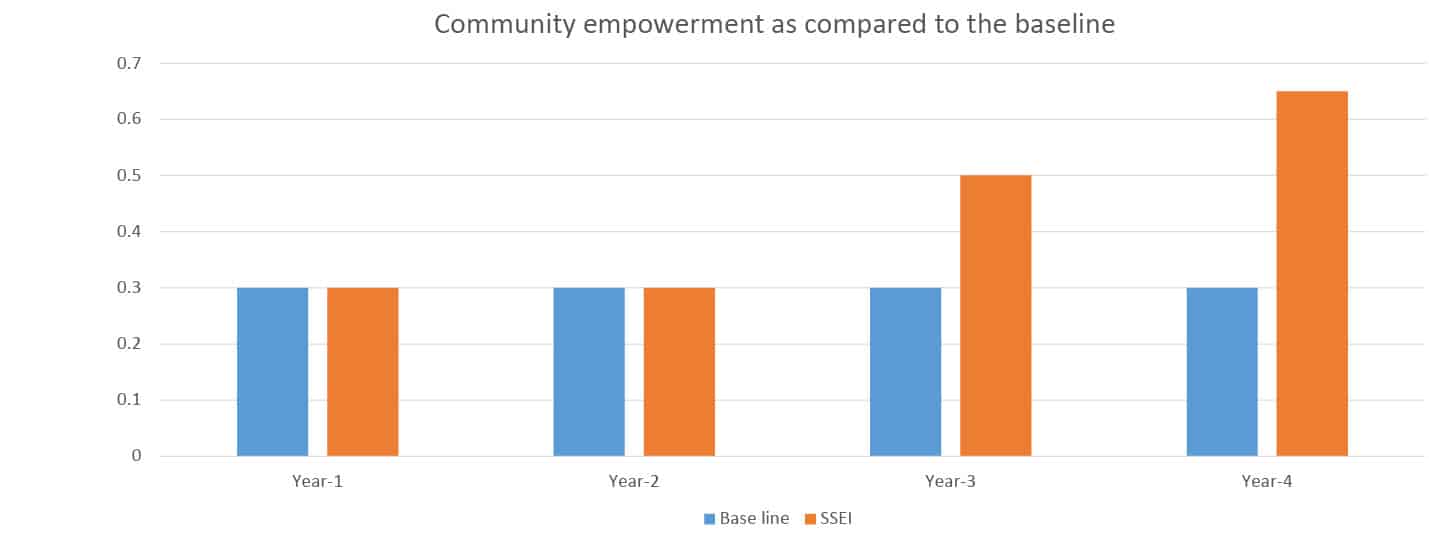
The exercise is conducted on an annual basis to check the progress, to see if the number of sectors where the community has ‘Capacities’ has increased. The SSEI for each year becomes a consolidated figure of progress and can be depicted on a graph as shown in the SSEI diagram (figure 10.2), tracking it over the years, and using the base line as a reference point to measure progress.
The progress for each of the development priorities can also be tracked on an annual basis for the length of time the project has been operational. Positive progress is manifested by an increase in the community’s control on that sector, with progressive reduction of the gap and a progressive reduction in the dependence on external support. Since dependence on outsiders beyond the very initial phase is not very conducive to sustainability, while tracking progress, if one sees a tendency for dependence to continue, corrective action by way of changes or modifications in the program is needed.
- Besides the SSEI, the following additional assessments can also be made to track progress:
- CCEI (Corporate Community Empowerment Index)
- VCI (Values Change Index)
- Improvement in access to primary and secondary education
- General reduction in diseases in the area
- Improved access to safe water
- Improved status of sanitation in the community (freedom from Environmental Enteropathy)
- Accountability standards—such as the Accord network standards of excellence in Integral mission
- For more details see: 2015 IWMC – Measuring What Matters by Dr. Ravi I. Jayakaran at https://youtu.be/46UTLU70KzA
As representatives of the Lord Jesus on this earth we are responsible to do whatever we do ‘as unto Him.’ This brings Him the glory, and also demonstrates to the community that we love them and care for them because God loves them and cares for them. When this is on track we are in alignment to complete all aspects of the W3P7 strategy.
The Larger W3P7 Strategy
Integral mission is about demonstrating and proclaiming the gospel. One without the other makes it incomplete and ineffectual. As evangelicals, proclaiming the gospel comes easy to us. However, especially when we engage with the poor, the marginalized, and the unreached, if what we proclaim is not backed up by how we demonstrate the love of God, all we say sounds like empty words.
As the W3P7 strategy gets into full action, transformational changes will start happening in the community due to Integral mission. More people will come to know the Lord and be added to the local church in the community. The best part of this will be that the new converts will be disciples whose empirical and spiritual lives will be in balance. These balanced and integral disciples will be best suited to bring others like themselves into the body of Christ. As they grow in numbers and multiply in influence, so does the continuous significant impact of the movement.
Dr. Ravi Jayakaran is the President of Medical Ambassadors International and has decades of experience leading international poverty reduction and development programs. He has provided technical support in 23+ countries on issues of transformational development, integral mission, relief and development, public health, and prevention of trafficking. Ravi is a Catalyst for the Lausanne Movement and on the ACCORD Network and the Chalmers Center boards.
Bibliography
Hennink, Monique, Ndunge Kiiti, Mara Pillinger, and Ravi Jayakaran. “Defining Empowerment: perspectives from international development organizations,” Development in Practice 22, no. 2 (March 2012): 202–215.
Hiebert, Paul G. Transforming Worldviews: An Anthropological Understanding of How People Change. Baker Academic, 2008.
Jayakaran, Ravi. “Cross Border Community Interaction and Engagement: The Poverty Impact of Regional Economic Integration in the GMS sub region.” Asian Development Bank, RETA.
———. Facilitating Small Groups. World Vision International, China, 2002.
———. “Participatory Poverty Alleviation & Development.” Mekong Institute, Khon Kaen University, CD Rom, 2005.
———. The Ten Seed Technique. World Vision International, China, 2001.
http://www.ravijayakaran.com/books.htm.
Read more on the Ten Seed Technique: http://www.csd-i.org/lesson-plan-ten-seed/.
Watch a video clip on the Ten Seed Technique: https://youtu.be/-nUnguhTLxI.
———. “Wholistic (Holistic) worldview analysis: Understanding community realities,” IIED 56. International Institute of Environment and Development, UK, 2003.
Myers, Bryant. Walking With The Poor: Principles and Practices of Transformational Development.




