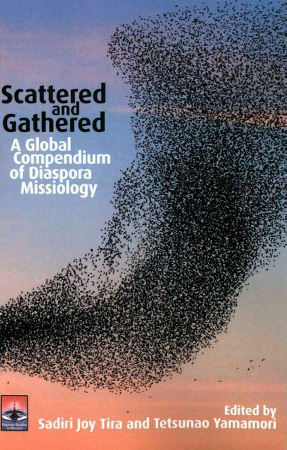
by Sadiri Joy Tira and Tetsunao Yamamori, eds.
—Reviewed by Rajkumar Boaz Johnson, Ph.D., professor of Biblical and Theological Studies, North Park University; visiting professor, SHIATS University, Allahabad, India
Section 1 sets out phenomenological issues with respect to diaspora missiology. Chapter 1 makes clear the need to develop a new phenomenology of the Missio Dei in the context of “push/forced” immigration. Chapter 2 includes a good demographic analysis of this new diaspora. Chapter 3 urges that Christian institutions must get involved in the whole phenomena of life, including legal and social issues, human rights and care of refugees, and issues relating to good immigration policies.
Section 2, “Biblical and Theological Foundation for Diaspora Missiology,” is the strongest part of this compendium. It lays the crucial biblical and theological underpinnings for diaspora missiology. Daniel Carrol makes it clear that the Hebrew Bible is written by immigrants, and focuses on immigrant issues in the laws, prophecies, and wisdom literature.
Similarly, Steven Chang shows that the New Testament was written primarily to diaspora Jews and emerging diaspora Christian communities. Paul Woods focuses on a very critical motif of “otherness”, which, he suggests, is central to both the Old and the New Testament and must become the basis of a good diaspora missiology.
Section 3 explicates various strategies towards diaspora missions. These include helpful insights on (1) the role of local churches to reach out to immigrants; (2) guidance to reach out to refugees, arguing that church planting should be an integral part of refugee work; (3) material for reaching out to international graduate students in Western universities; (4) Business as Mission as a creative and fruitful field of diaspora missions; and (5) a moderate use of social media in diaspora missions.
Section 4 sets out various examples of churches from the Global South that are having a significant impact on the Church in the Global North. Chapter 18 describes this as “cruciformity to address the Babel complex,” which breaks down all barriers, which have shattered global society. The following chapters in this section discuss how diaspora churches can teach several crucial lessons to the churches in the West.
Section 5 contains assorted case studies from different regions: Jewish, Korean, Chinese, Indian, Latino, Brazilian, African, and Iranian peoples. These are very brief chapters, and contain practical information for those interested in reaching out to these diaspora groups.
Section 6 gives case studies of issues which are unique to diaspora such as hospitality to strangers, totalitarianism, sex trafficking, materialism, brain drain, transnationalism, refugee crisis, and human trafficking. These chapters contain very moving and thought-provoking stories of people who are doing diaspora missions.
Section 7 ends with a very helpful glossary, and a series of appendices, which give the context of this compendium. I highly recommend this book. The first two sections alone provide a solid biblical undergirding for diaspora missions.
. . . .
EMQ, Vol. 53, No. 2. Copyright © 2017 Billy Graham Center for Evangelism. All rights reserved. Not to be reproduced or copied in any form without written permission from EMQ editors.