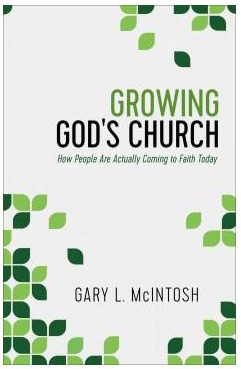
by Gary McIntosh
—Reviewed by John Doss, senior pastor, Discovery Christian Community, Salt Lake City, Utah
Chapters 1–6 are devoted to clarifying the Church’s mission through studying Christ’s ministry in the Gospels. McIntosh emphasizes the priority of proclaiming the gospel over community service, the latter of which is referred to as ‘presence evangelism.’ He uses scripture to show that evangelism means asking people to make a decision and seeking to persuade them to follow Jesus.
McIntosh’s discussion of his research and its implications for the local church in Chapters 7–11 are the real value of Growing God’s Church. Like Arn, McIntosh’s survey reveals the supremacy of family relationships as the primary means by which people come to faith in Christ.
Conversing with family members and friends about Jesus is the most effective means of reaching people for Christ. Relationships with family and friends is also by far the main factor influencing a person’s decision to attend a church. There are various reasons why people stay at a church, chief among them being the church’s friendliness, clarity of mission and vision, style of worship, and simple biblical teaching.
The survey also yielded a surprisingly high influence of a pastoral staff on a person’s faith decision and choice of a church. McIntosh notes the contribution that a pastor’s preaching and example of personal evangelism make toward healthy growth. At the end of each chapter, he offers seven “down-to-earth ideas” (i.e., practical ways for churches to be more effective evangelistically). The final two chapters shift to providing principles of evangelism, placing the greatest emphasis on training people to build relationships with others and share their faith with them.
The relationship between McIntosh’s discussion of the Church’s mission (Chapters 1–6) and his survey (Chapters 7–11) is unclear in the book. Furthermore, it is unnecessary for McIntosh to share his views on controversial, theological issues, such as the relationship between the “church” and the “kingdom”. Why not devote the entire book to the survey and write more extensively on its implications for the local church?
McIntosh’s research is a valuable contribution to the field of church growth and evangelism as he specifically surveyed those who had been members of a church for less than two years. He also distinguishes between new converts and church transfers, generational differences (millennials, boomers, etc.), and gender as well as one’s ministry context (rural, urban, etc.). The results reinforce many widely-known principles of evangelism (such as the importance of friendship evangelism), while challenging other widespread presuppositions about church growth.
Additional Reading:
Rainer, Thom. 2001. Surprising Insights from the Unchurched and Proven Ways to Reach Them. Grand Rapids, Mich.: Zondervan.
Stetzer, Ed and Mike Dobson. 2007. Comeback Churches: How 300 Churches Turned Around and Yours Can, Too. Nashville: B&H Publishing Group.
. . . .
EMQ, Vol. 53, No. 2. Copyright © 2017 Billy Graham Center for Evangelism. All rights reserved. Not to be reproduced or copied in any form without written permission from EMQ editors.