
EMQ » July – Oct 2024 » Volume 60 Issue 3
[mepr-show rules=”100329″ unauth=”message”] This content is shown only to authorized members. It is hidden from everyone else.
Conflict Competence
Summary: As mission organizations, how do we move “from me to we to the world?” The knowledge, skills, and attitudes of conflict competence are the foundation of an authentically inclusive culture in which diversity is welcomed and “all peoples” (panta ta ethne) experience both full belonging and high value on their uniqueness.
By Rocky Tyler
I once worked together with K-12 teachers to create authentically inclusive learning communities in their classrooms. The curriculum that guided us in this challenging task introduced the topic of human development with a novel metaphor, calling it a journey “from me to we to the world.”[i]
The missionary endeavor is a similar journey. As I consider the future of missions, I wonder how we are thinking about the we of our work. Our efforts to fulfill the Great Commission have traditionally focused on preparing me to carry the gospel to the world. Mission agencies have worked diligently to accomplish this with maximum efficiency.
On my second day of employment as the staff development manager at Wycliffe Bible Translators USA in 2016, the President/CEO at that time, Bob Creson, stood in front of his assembled staff and said, with great emphasis, “Work always flows from relationship.”
This brief, powerful, exceptionally wise observation highlights the critical significance of we in the work. And how we do we is becoming ever more significant as the society we seek to mobilize is increasingly composed of the world, or panta ta ethne.[ii]
We must give our full attention to each element of the missionary experience “from me to we to the world.” The success of our attempts to empower me to carry the gospel to the panta ta ethne literally depends on how we do we. And if we’re serious about inviting more of the panta ta ethne to our work, we must reflect deeply on our approach to we.
A Brief Health Check
So how are we? Because work always flows from relationship, it’s possible to think of health in our we as a balance between our tasks and our relationships. If we focus our energies exclusively on either of these elements of the work, we will ultimately fail. Short of these unlikely extremes (i.e., all task or all relationship), we are either balanced or tilting one way or the other.
Most – if not all – mission agencies focus their attention primarily outward (to the field), giving inward attention (to the organization) as necessary to ensure the meeting of the outward needs. While there’s nothing inherently wrong with this approach, it can lead to an emphasis on tasks at the expense of relationships. In other words, a too-narrow focus on meeting the needs of the world can lead to the neglect of me and especially we.
Consider, for example, a 2017 observation by Paul Akin. He said, “The most common reason missionaries go home is not due to lack of money, illness, terrorism, homesickness, or even a lack of fruit or response to the gospel. Regretfully, the number one reason is due to conflict with other missionaries.”[iii]
Recent analysis by researcher Andrea Sears “confirmed other studies that have found interpersonal conflict to be one of the primary reasons for missionary attrition.”[iv] And in the Valeo Research Institute’s 2023 Global Worker Needs Assessment Report, Geoff Whiteman noted that “the inability to deal with or work through conflict in ways that are constructive rather than destructive is highlighted as a major obstacle” to missionary well-being and development.[v]
In his book Cross-Cultural Conflict, Duane Elmer identifies unity as the key to fulfilling the Great Commission. He explained, “Our ability to resolve conflict, thus preserving unity, is directly related to people’s coming to Christ …. A lack of unity in our relationships veils the glory of God. So relationships affect mission.”[vi]
However, the persistent problem of destructive interpersonal conflict seems to have become an accepted feature of missionary organizational culture. Many of us have resigned ourselves to it, writing it off as the cost of doing business and dealing with it on a case-by-case rather than systemic basis.
The Problem is an Opportunity
We are clearly not as balanced and healthy as all of us would like us to be. To their credit, in recent years many missionary organizations have invested more robustly in member care, seeking to rectify resource imbalances in their approach to tasks and individual (me) needs. But what about relationships, the foundation of we? Are we giving our relationships the attention they need, or are we giving up – writing off conflict-related missionary attrition as a cost factor instead of investing in our we?
In simplest terms, the core problem is that we – like all humans who attempt to work together – have difficulty dealing with our differences. This difficulty not only hinders our efforts to carry the gospel to the panta ta ethne, it’s also the main obstacle to the authentic inclusion of the panta ta ethne in our organizations. So in essence, we have a buy one, get one free opportunity. If we solve this core missionary attrition problem, we also open the door to enduring diversity and genuine mutuality.
In other words, learning to welcome difference is the key to a healthy we that invites everyone to the work and supports their long-term retention. So how do we learn to welcome difference? Let’s start by identifying the primary obstacle that keeps us from handling our differences productively. I call this barrier conflict incompetence.
Born and Reborn Incompetent
Competence consists of the knowledge, skills, and attitudes (KSA, in training development lingo) that enable us to do something successfully. At birth, humans are essentially completely incompetent. We don’t possess any knowledge, skills, or attitudes. We have only the most basic of instincts and the potential to acquire KSA.
Interpersonal conflict is a natural feature of the fallen world into which we’re born. Rick Warren observed that “it takes both God’s power and our effort to produce a loving Christian community. Unfortunately, many people grow up in families with unhealthy relationships, so they lack the relational skills needed for real fellowship. They must be taught how to get along with and relate to others in God’s family.”[vii]
This keen observation highlights the fact that our new birth in Christ does not make us immediately competent in handling conflict. We’re naturally conflict incompetent, and at our new birth we are endowed with enhanced potential (via the power of the Holy Spirit) to acquire the KSA that enable us to deal with our differences in ways that emulate and honor our Master.
In our natural state, we can’t consistently engage in the assertive behaviors of constructive conflict. Instead, when confronting difference, we typically resort to one or more of these types of behavior:
- Aggressive (e.g., screaming, insulting, physical violence)
- Passive (e.g., avoiding, resignation, silence)
- Passive-aggressive (e.g., procrastination, sabotage, gossip)
We engage in aggressive behaviors during destructive conflict, while passive and passive-aggressive behaviors are employed for conflict avoidance. It’s important to acknowledge that passive-aggressive behaviors can be extremely destructive. However, since the primary motivation behind them is avoidance of direct interpersonal interaction, they’re most accurately characterized as conflict avoidance behaviors.
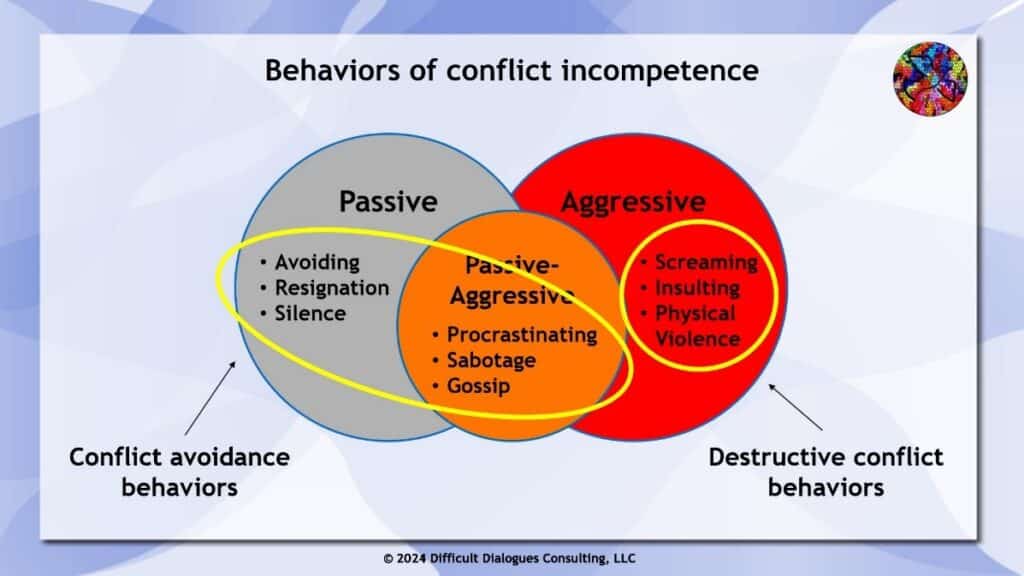
Figure 8.1: Behaviors of conflict incompetence.
I draw attention to conflict avoidance behaviors because I believe they’re a primary source of dysfunction in the we of Christian organizations. I’m apparently not alone in this belief. Christian leader Nancy Ortberg was asked in an interview “Do you find that in Christian workplaces there is a tendency to be too nice or too afraid of conflict?”
In response, she said, “Oh yes. There is a tendency to be conflict avoidant, to be superficial, to be frustrated with a person and then talk about that frustration with everyone but the person. I don’t know how conflict avoidance and Christianity came to be so linked, but it has been to the detriment of our leadership.”[viii]
The hard-hitting proposition here is that when you say “Christian,” you’re essentially saying “conflict avoider.” This makes it difficult for us to earn respect as leaders in our society.
Conflict incompetence (especially conflict avoidance) has deeply disturbing costs in our organizations. I implore my brothers and sisters in Christ to begin discussing this problem openly. You see, conflict isn’t the problem; conflict incompetence is the problem that’s been ejecting missionaries from the field (and sadly, sometimes from ministry altogether) in alarming numbers for far too long. It’s the most formidable barrier to creating a missionary we of enduring inclusion and authentic mutuality into which panta ta ethne may be safely and joyously invited.
Incompetent No Longer
The key to overcoming this obstacle is, of course, the acquisition of the knowledge, skills, and attitudes that empower us to consistently engage in constructive conflict. Let’s begin by considering the perspective of Mary Parker Follett, an early twentieth-century social analyst sometimes referred to as the Mother of Modern Management. Follett said,
We must face life as it is and understand that diversity is its most essential feature. I know a man whose fear of difference is so great that he looks alarmed if the most friendly argument appears at his dinner table; he always changes the subject immediately. But fear of difference is dread of life itself. It is possible to conceive conflict as not necessarily a wasteful outbreak of incompatibilities, but a normal process by which socially valuable differences register themselves for the enrichment of all concerned.[ix]
Pay particular attention to the profound phrase “enrichment of all concerned.” This underappreciated genius challenges us to no longer fear difference but instead seek to engage in conflict that harnesses the power of difference and uses it to create value in human relationships and activities.
God gave us a solid foundation for this type of conflict via his servant James, who wrote “let every person be quick to hear, slow to speak, slow to anger” (James 1:19, ESV). Over the years, my colleagues and I at Difficult Dialogues Consulting have attempted to identify the core KSA that empower us to obey this command. Our model of conflict competence is shown in figure 8.2.
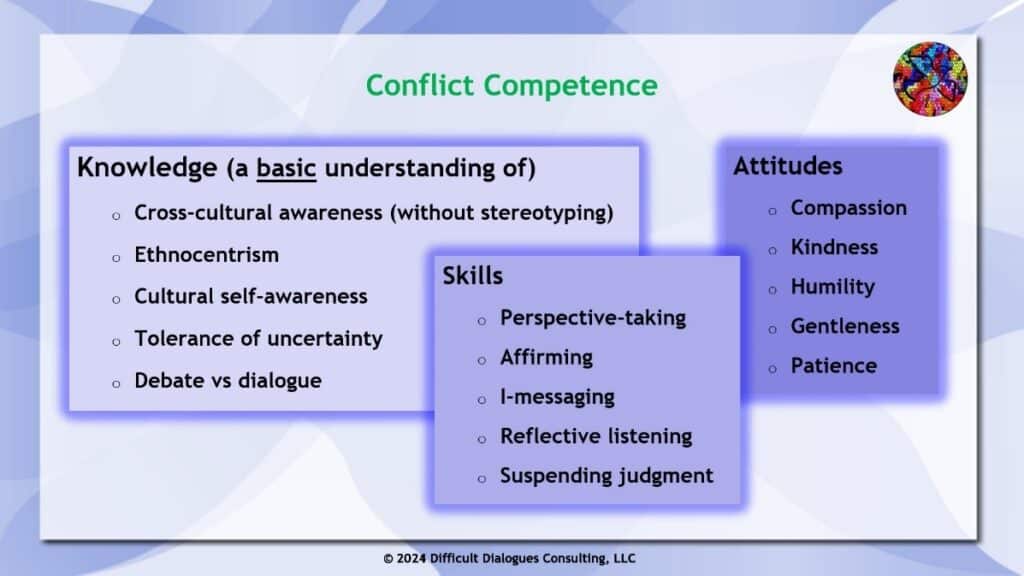
Figure 8.2: The Difficult Dialogues Consulting model of conflict competence.
This is certainly not an exhaustive list of the KSA that may be possessed by a conflict-competent individual. Our model aims to capture what we believe are the minimum essential elements of conflict competence. We’ve limited ourselves to five items in each of the components for a practical, old-school reason: it can be useful to count off each set of five items on the digits of the hand to help memorize information.
The first three topics listed under the knowledge component of the model should be familiar to missionaries. Tolerance of uncertainty and the difference between debate and dialogue may be less familiar, depending on individual education and training experiences. The attitudes required for authentic conflict competence are found in the Apostle Paul’s directive to “clothe ourselves” in compassion, kindness, humility, gentleness, and patience (Colossians 3:12).
An additional memory aid can be found in the listing order of the skills from top to bottom, which yields the acronym PAIRS. The skills occupy the foreground of the model image because they’re observable behaviors; the knowledge and attitudes in the background support them. These assertive behaviors empower us to be authentically quick to listen, slow to speak, and slow to become angry when encountering difference.
Perspective-taking is the mental positioning of myself to see things through the eyes of others. Affirming is the deliberate and generous use of positive you-messages, which draw appreciative attention to another individual’s strengths. I-messaging is communication deliberately designed to protect the listener from negative you-messages.
And I-message always focuses on the facts of a situation, never on the character or identity of the individuals involved. It is delivered from a position of just enough emotional vulnerability to offer to the listener a “heart-to-heart connecting point.” This is perhaps the most difficult skill to master, and poorly-crafted I-messages can alienate their recipients and make even the most well-meaning speaker appear extraordinarily arrogant.
Reflective listening is, in its simplest form, listening with the intent to paraphrase rather than respond. And suspending judgment is the deliberate refusal to evaluate another person’s perspective. This is arguably the most important skill, because in order to engage productively with difference, we must suspend judgment long enough to fully explore the essence of the difference via perspective-taking, affirming, I-messaging, and reflective listening.
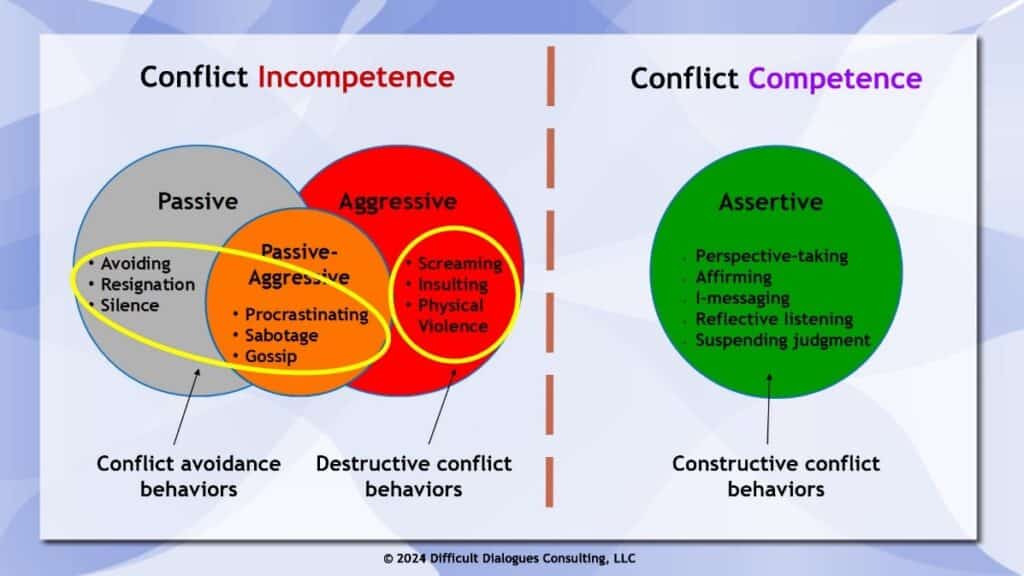
Figure 8.3: This diagram highlights the contrast between the behaviors of conflict incompetence and conflict competence.
The key takeaway from the diagram in figure 8.3 is the fact that all of the behaviors on the left side are natural. We’re born into a fallen world where these behaviors dominate our interactions. Those on the right side of the diagram are unnatural. We must be intentional and disciplined in learning and employing them.
The Authentically Inclusive “We”
Missionary researcher David Dunaetz said, “As the demographics of sending countries evolve, a healthy mission that maintains its ranks (or even grows) will most likely be composed of a more racially diverse missionary force … Although increased diversity may require many changes in some mission organizations, these organizations can adapt to and profit from diversity. These organizations will likely be the most effective ones in reaching a diverse world as they reflect the incarnational adaptation that Jesus Christ himself modeled.”[x]
As Duane Elmer noted, our unity – as demonstrated in how we handle our differences – is critically important to the fulfillment of the Great Commission. This focus on unity requires that we address the profound difference between unity and uniformity. Uniformity is the degree to which parts of a whole are similar to one another, while unity describes the strength of the connections between parts of a whole.
Sadly, we often mistake uniformity for unity. We also often mistake belonging for inclusion. Organizational effectiveness research reveals that individuals experience genuine inclusion when a group provides both a high level of belonging and a high value on their uniqueness.[xi] In too many organizations (both secular and sacred), dominant group members enforce uniformity by applying covert and/or overt pressure on minority group members to minimize their uniqueness in order to be granted full belonging. The process of forfeiting one’s uniqueness in order to gain belonging is called assimilation. Assimilation yields uniformity, while authentic inclusion yields unity.
When these mistakes permeate an organization’s culture, the we becomes assimilative rather than inclusive. One of the driving forces behind the perpetuation of an assimilative culture is the organization’s success. If you’ve ever heard yourself or a colleague talking about “The ___________ Way” (insert your organization’s name in the blank), there’s a possibility that your we is an assimilative culture rather than an authentically inclusive one.
Returning to Dunaetz’s comments, it should be obvious that “adapting to and profiting from” the increasing presence of panta ta ethne in our we requires structures and processes of authentic inclusion. Such incarnational adaptation replaces assimilative organizational cultures with cultures of conflict competence, where difference is welcomed and put to work creating value in relationships and endeavors.
Where to Begin?
Start in the mirror. A healthy we begins with me – how do I deal with difference? Do I try to avoid it, or do I welcome it as an opportunity for enrichment? What kind of knowledge, skills, and attitudes do I bring to my encounters with difference?
Start a discussion. Engage your we in an honest dialogue about dealing with difference. Is conflict incompetence a problem in your organization? Is your we an authentically inclusive culture, or does it try to enforce uniformity by minimizing difference in order to avoid conflict? Are new ideas or behaviors welcomed, or immediately dismissed because they’re not an established part of “The ___________ Way”? Perhaps most revealing, when we look at each other, how much of the panta ta ethne is visible?
Start advocating. If we have room for improvement, ask your leaders to resource the development of an organization-wide culture of conflict competence. The KSA we need can and should be learned and employed. This is especially important if we wish to welcome more of the panta ta ethne to the work.
Finally, consider this important advice from an expert in diversity training: “Stop training people to be more accepting of diversity. It’s too conceptual, and it doesn’t work. Instead, train them to do their work with a diverse set of individuals. Not categories of people. People. Teach them how to have difficult conversations with a range of individuals.”[xii]
This is what conflict competence is all about and developing it as your culture requires time and money. If you worry that your donors will complain about “too much spending on overhead,” educating your donors will be a priority task. If you’ve identified conflict incompetence as a problem in your organization, be honest, explain the problem to your donors, and trust God to help them understand it and be willing to be part of the solution.
The Bottom Line
Work always flows from relationship. The quality of our work can be no higher than the quality of our relationships. Missionary attrition due to conflict incompetence is an avoidable cost. As we look at the missionary endeavor from me to we to the world, are we truly ready to welcome the panta ta ethne to a culture of authentic inclusion, where each individual experiences full belonging and high value on uniqueness? If we aren’t ready, a commitment to developing a culture of conflict competence is a good first step in an incarnational adaptation that will reduce missionary attrition and welcome more of the panta ta ethne to our work.

Rocky Tyler (rtyler@difficultdialogues.net) is the managing director of Difficult Dialogues Consulting, LLC. He has studied and practiced the principles of constructive dialogue for nearly 40 years in contexts ranging from educational leadership to international political-military negotiations to missionary organization staff development. Rocky holds a BS in general engineering from the United States Military Academy at West Point and an MA in international relations from Yale University.
[i] Jeanne Gibbs, TRIBES TLC: A New Way of Learning and Being Together (Windsor, CA: CenterSource Systems, 2001), 40, TRIBES Basic Course facilitator notes, slide 9.
[ii] “The most accurate definition of the term ethnē used in Matthew 28:19 is based on the decision of the Content Information Team at Logos Bible Software with access to 20,000 Bible related resources electronically in an integrated system. Their conclusion is that ethnē in Matthew 28:19 means a large group of people based on various cultural, physical, or geographical ties!” Luis Bush, “The Meaning of Ethne in Matthew 28:19,” Mission Frontiers, 35, no. 9 (September1, 2013), https://www.missionfrontiers.org/issue/article/the-meaning-of-ethne-in-matthew-2819.
[iii] Paul Akin, “The Number One Reason Missionaries Go Home,” IMB (blog), May 25, 2017, https://www.imb.org/2017/05/25/number-one-reason-missionaries-go-home.
[iv] Andrea Sears, “The Missions Experience,” The Mission Experience (blog), February 1, 2023, https://themissionsexperience.weebly.com/blog.
[v] Geoff Whiteman, “How Are We Doing at Supporting the Well-being and Development of God’s Beloved Global Workers? 2023 Needs Assessment Report” (Valeo Gloal: 2023), 25, https://www.valeo.global/research.
[vi] Duane Elmer, Cross-cultural Conflict: Building Relationships for Effective Ministry (Downers Grove, IL: InterVarsity Press, 1993), 27.
[vii] Rick Warren, The Purpose Driven Life: What on Earth am I Here For? (Grand Rapids, MI: Zondervan, 2012), 145–146.
[viii] Nancy Ortberg, “What Can Christians Learn from Jesus’ Leadership Style?,” interview by Biola Magazine Staff, Biola Magazine, May 29, 2014, https://www.biola.edu/blogs/biola-magazine/2014/what-can-christians-learn-from-jesus-leadership-st.
[ix] Mary Parker Follett, Creative Experience (New York: Longmans, Green and Company, 1924), 301, emphasis added.
[x] David Dunaetz, “Understanding the Effects of Diversity in Missionary Teams: Insights from the Social Sciences,” in Reflecting God’s Glory Together: Diversity in Evangelical Mission, eds. A. Scott Moreau and Beth Snodderly (Pasadena, CA: William Carey Library, 2011), 1–18, https://scholarship.claremont.edu/cgu_fac_pub/1013.
[xi] See, for example, Lynn Shore, et al, “Inclusion and Diversity in Work Groups: A Review and Model for Future Research,” Journal of Management 37, no. 4 (2011): 1262–1289.
[xii] Peter Bregman, “Diversity Training Doesn’t Work,” Harvard Business Review, March 12, 2012, https://hbr.org/2012/03/diversity-training-doesnt-work.
EMQ, Volume 60, Issue 3. Copyright © 2024 by Missio Nexus. All rights reserved. Not to be reproduced or copied in any form without written permission from Missio Nexus. Email: EMQ@MissioNexus.org.




